Weekly Digest Number 21 - May 24th, 2022 |
|
Welcome to the RWU Rail & Labor News! This news bulletin is produced and emailed out each Tuesday morning. We hope you find each week's news and information useful. If so, please share with co-workers, friends, and colleagues. If you like, you can sign them up to get all the news from RWU HERE. Or forward them the link. Note: If you read over this news bulletin each week, you will be sure to never miss the important news of what is going on in the railroad world from a worker's perspective!
|
|
(Editor's Note: Railroad workers across the country are continuing to mobilize against the tyrannical power of the Class One railroads. From Stevens Point, WI (CN) to Fort Madison, Iowa (BNSF) workers are rallying to draw attention to their plight. Eight years ago, BNSF workers engaged in similar activities around a tentative contract would would have mandated single person train operations. The result: we sent BNSF packing with its tail between its legs, resoundingly voting down that back room deal 5-to-1 across the former BN system. Not one craft or terminal voted in favor of the contract. Today, BNSF is running point once again for both draconian attendance policies AND single person crews. in 2014, with determination, solidarity and rank & file action we won. And we can win again in 2022! Solidarity Forever!! ) |
|
Rank and File Workers Continue to Mobilize Against Exploitation by the Rail Industry |
|
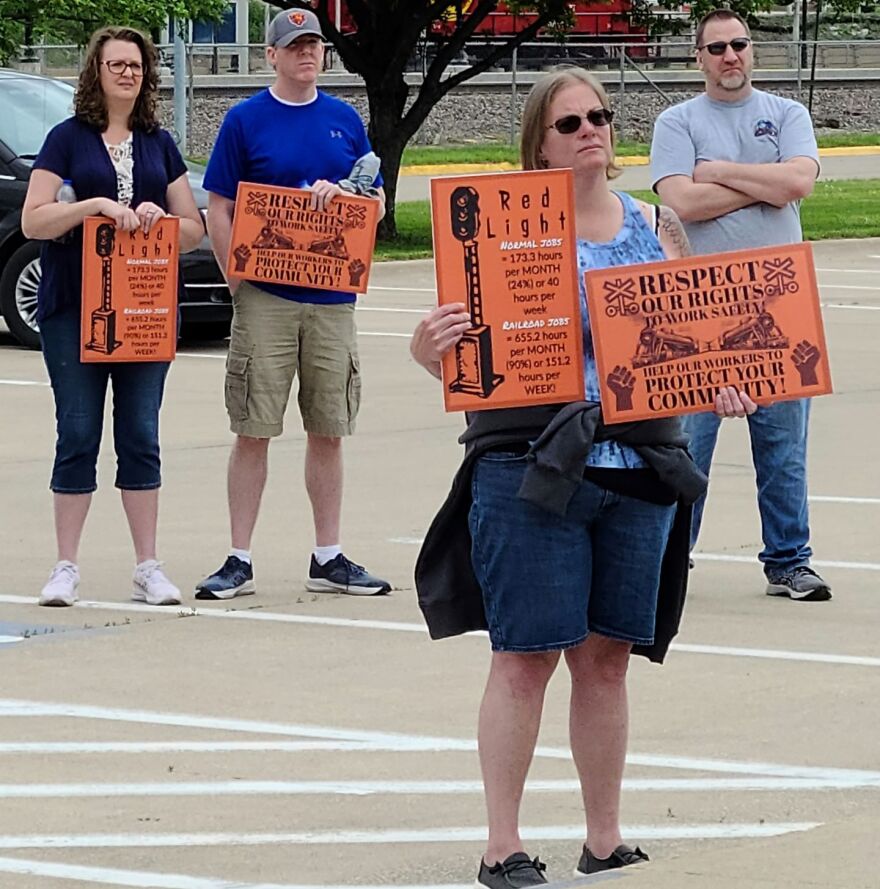
Labor Holds Rally in Fort Madison to Oppose ‘Draconian’ Attendance Policy
Representatives from organized labor in southeast Iowa are standing in solidarity to oppose what they call a draconian attendance policy at BNSF Railway. They rallied in the shadow of Fort Madison’s historic, newly restored train depot to raise awareness about the railway’s policy known as Hi-Viz.
“This rally is not about money. This rally is about the fact that they’re trying to steal the lives of the people that are running these trains and making their money for them,” said Jeff Kurtz, a retired locomotive engineer and a former state representative in Iowa.
“The people that are controlling the wealth – they’re trying to steal their lives because they think they can squeeze another dollar out of them. And it’s not right.”
|
|
(Editor's Note: Curiously, neither BNSF nor the unions have made clear exactly what "changes" the railroad is making to the Policy. Whatever the case, one can imagine that the amendments were meaningless fluff designed to fool people that the carrier was listening and taking workers' concerns into account. Typical Class One BS.) |
|
Unions Critical of BNSF’s New Adjustments to Attendance Policy |
|
Two unions are still critical of BNSF’s controversial attendance policy, saying recent adjustments aren’t enough to overcome its shortcomings.
“BNSF’s proposed changes to its HiViz attendance policy are unimpressive. These changes do nothing to address the policy’s fundamental flaws,” said Greg Regan, president of the Transportation Trades Department, which is affiliated with the AFL-CIO.
BNSF implemented the “HiViz” policy, which stands for high visibility, on Feb. 1. The railroad has said the policy aims to provide more transparency on absences as well as more predictability for crews around when they will go to work. But union members contend that the policy shortchanges rest time and penalizes employees for time off.
In response to feedback, BNSF has adjusted the policy several times since February, but the unions argue the most recent tweaks still don’t address worker fatigue sufficiently.
Regan said the changes in point collection that are part of the policy incentivizes “fatigued workers to double down. This will not stand.”
The Brotherhood of Locomotive Engineers and Trainmen (BLET) also criticized recent changes, with BLET President Dennis Pierce calling the changes a “little more than fluff.” He charged that the policy keeps locomotive engineers and other railroaders on call day after day and around the clock.
“The changes in policy show that BNSF’s CEO Katie Farmer and other executives of the railroad know that they have a problem. The railroad’s action also demonstrates that our union’s national campaign to expose its abuses is having an effect,” Pierce said.
He also contended that BNSF made these changes on Friday without input from the rail unions.
Pierce argued that the staffing issues facing BNSF and other Class I railroads are due to the railroads’ efforts to cut headcount by 29% collectively over the past six years. As the railroads and the unions hash out a new labor agreement, attendance policies must be at the discussion table, he said.
“Enough with the fluff. It’s time for BNSF as well as other railroads with similar attendance policies to sit down with their unions and negotiate staffing policies that work for the railroads, their customers and their employees,” Pierce said. The railroads and the unions have been in talks for a new labor agreement since January 2020.
“The HiViz attendance policy exacerbates the breakdown in the supply chain and drives more railroaders away at a time of critical need,” Pierce said. “Not only is the supply chain failing, but this abusive and punitive attendance policy is breaking apart families and causing locomotive engineers and other railroaders to come to work dangerously fatigued.”
BLET and the International Union of Sheet Metal, Air, Rail and Transportation Workers – Transportation Division (SMART-TD) sought to take action against BNSF’s attendance policy earlier this year by going on strike. But the federal courts sided with BNSF’s argument that a strike would be too disruptive to the supply chain. The unions have since said they will seek arbitration to address their issues over the attendance policy.
|
|
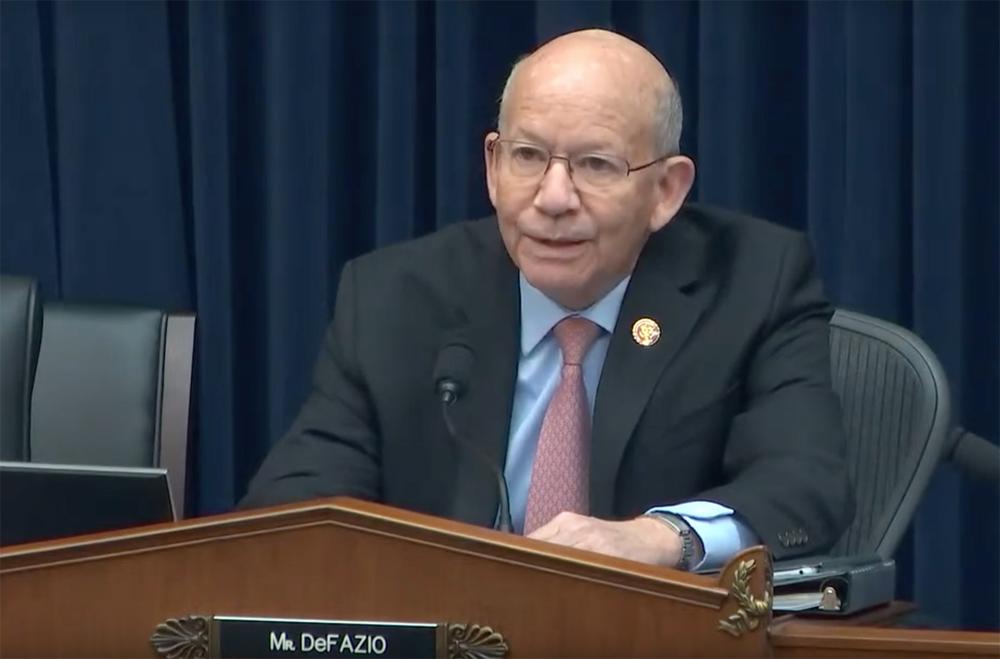
(Editor's Note: Representative DeFazio - head of the House Transportation and Infrastructure Committee - has long been a champion of rail labor. Watch him here tell it like it is in his opening statement before the Committee at a hearing in mid May.) |
|
Chair DeFazio's Opening Statement for Hearing on "Board Member Views on Surface Transportation.." |
|
The House Committee on Infrastructure and Development recently held hearings before the Surface Transportation Board where the railroads' failures to perform adequately came under attack. The STB was urged by the Committee to act, and to put an end to the Wall Street shenanigans that is destroying the North American rail industry at a time when we desperately need expansion - not contraction - of that industry. |
|
(Editor's Note: The fact that the Class One carriers have pissed off virtually every shippers association in North America, means the STB simply has to act. The fact that the carriers have screwed workers, made their lives miserable and their jobs unsafe apparently does not count for much. Likewise, the fact that the Class Ones are providing terrible service and are hostile to Amtrak and passenger trains probably is little incentive for STB to take action. But when wealthy shippers are enraged, perhaps we will finally see some action by STB. What exactly that will look like remains to be seen. We all need to keep up the pressure.) |
|
Surface Transportation Board Poised to Enact Shipper-Friendly Regulations |
|
The Surface Transportation Board could be poised to mandate shipper-friendly regulations aimed at incentivizing Class I railroads to improve rail service, which has deteriorated in recent months.
Mandating some form of reciprocal switching, in which shippers are granted access to a nearby competing rail network under certain situations, could be something the board will act upon later this year. Reciprocal switching is one of the more contentious issues facing the board, with shippers largely in favor of the measure and railroads and other logistics stakeholders against it or skeptical of it.
“By making rate relief easier to obtain… [that] will incentivize the railroads and shippers to reach their own [service] agreements,” STB Chairman Marty Oberman told congressional leaders last Thursday. Oberman and the four other board members were testifying at a hearing on STB reauthorization before the congressional subcommittee on railroads, pipelines and hazardous materials. That subcommittee is part of the U.S. House Committee on Transportation & Infrastructure.
While the Staggers Act of 1980 removed many of the government regulations that may have hindered the freight rail industry from growing, the last 40 years have seen a lot of consolidation, Oberman stated.
“In my view, the pendulum has swung too far,” and the Staggers Act has created an environment that has led to regional monopolies as well as duopolities for the eastern and western U.S. and that has incentivized the railroads to cut resources, he said.
“I don’t care what your OR is but you have to have decent service,” Oberman added, referring to a railroad’s operating ratio. The Class I railroads had been seeking to reduce OR in order to demonstrate that the company is showing increasing profitability. The deployment of precision scheduled railroading (PSR), an approach that seeks to streamline operations, has been viewed by some as a key way to reduce OR.
|
|
(Editor's Note: This is a promising development. But the time for action is now. Amtrak has the money, many states are clamoring for more and improved rail service, and passenger demand is dramatically increasing. We have a historic window of opportunity in the coming months and years to transform what passenger train operations look like in North America. Rail workers and their unions must jump into this effort with both feet, joining with enviros, train advocacy organization, and transportation justice groups to build the boots-on-the-ground coalition necessary to make it all happen.) |
|
FRA Unveils Corridor ID and Development Program |
|
WASHINGTON — Last week, the Federal Railroad Administration met the deadline set by lawmakers to establish a $1.8 billion Corridor Identification and Development program, characterized by the agency as “a formal framework to guide the future development of intercity passenger rail throughout the country.”
However, additional application details need to be issued before it is possible to formally seek federal funding support from the Bipartisan Infrastructure Law.
The document posted in the Federal Register, available here, stresses that the program is only meant to identify — not build — routes sponsored by an entity willing to provide not less than a 20% match to secure federal funding.
Abandoned former Seaboard track at Norlina, N.C., seen in 2007, is on the Richmond, Va., to Raleigh, N.C. route North Carolina and Virginia have been attempting to rehabilitate. The route could be a prime candidate for corridor investment. (Bob Johnston)
The process begins with online “expressions of interest” by “eligible entities” to the federal regulations site. Those comments can be publicly viewed. But the agency doesn’t anticipate publishing “detailed procedural and substantive Corridor ID program information” and “a notice requesting proposals to participate” until the last quarter of 2022.
Entities eligible to express interest are wide-ranging and include:
— Amtrak;
— Regional passenger rail authorities;
— States, groups of states, interstate compacts, political subdivisions of a state, and regional planning organizations;
— Federally recognized Indian Tribes;
— Other public entities, as determined by the Secretary of Transportation.
Eligible routes seemingly exclude only those more than 750 miles in length never operated by Amtrak. Included are:
— New or enhanced routes less than 750 miles;
— Any Amtrak route that was ever discontinued;
— Service frequency increase of a long-distance intercity passenger rail route .
|
|
(Editor's Note: Many of you might remember a few years ago when industry pundits were opining that "Precision Scheduled Railroading" would be a boon for Amtrak and passenger operations. After all, they stated, a scheduled and precise railroad would more easily accommodate scheduled passenger runs. And with longer and fewer trains, even better! Well, these folks could have and should have spoken with the workers who inspect, maintain, dispatch, and run the railroad. We knew it was a farce from Day One. There is nothing scheduled about it, nothing precise about it, and it 'aint even railroading, it is a Wall Street scam). |
|
No Long-Distance Routes Meet FRA On-time Standard in Latest Amtrak Stats |
|
WASHINGTON — Sixteen of 43 Amtrak routes — none of them long-distance operations — met the 80% customer on-time performance threshold established by the Federal Railroad Administration in first-quarter 2022 statistics released Tuesday by the FRA.
The latest quarterly stats are the first to use all of the metrics established by the FRA [see “FRA publishes final rule …,” Nov. 16, 2020]. They measure on-time performance and train delays, customer service, financial performance, and public benefits. Most of the stats had been included in the report on the fourth quarter of 2021 [see “FRA report details Amtrak delays …,” News Wire, Feb. 15, 2022].
“Customers deserve high quality, reliable passenger rail service without interference from freight trains that can cause substantial delay,” FRA Administrator Amit Bose said in a press release. “This report provides a meaningful tool for everyone — including customers, communities, and other stakeholders — to review comprehensive data on passenger rail performance.”
The best on-time performance for any Amtrak route during the first quarter belonged to the Chicago-Milwaukee Hiawatha service, which recorded 95.1% customer on-time performance. The worst was Auto Train, with an on-time rate of just 24.2%. Eight long-distance trains recorded on-time performance of less than 50%; closest to the 80% FRA standard among long-distance trains was the City of New Orleans, missing by the narrowest of margins at 79.9%.
The reports also break down delay minutes by responsibility (Amtrak, host railroad, or third party); host-railroad delays by type; customer satisfaction by route; cost recovery by route; and average ridership, among other statistics. The report detailing those numbers is available here; the full set of documents is available here.
|
|
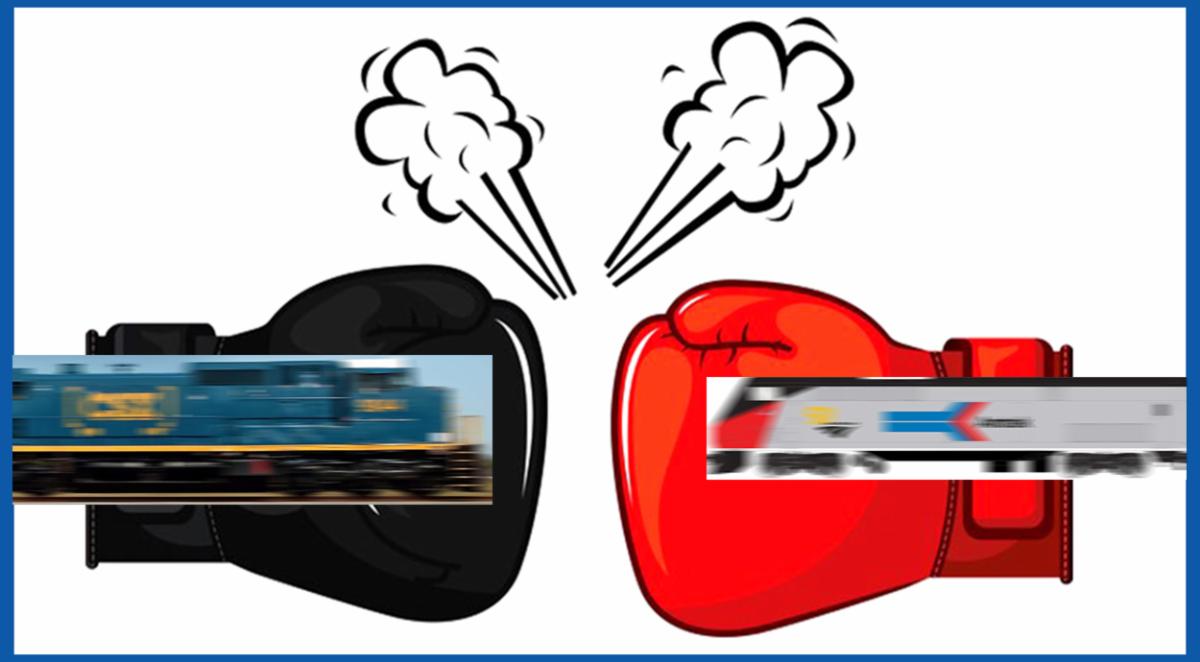
(Editor's Note: CSX and NS have committed vast resources and is going all out to this fight against passenger train operations.) |
|
Gulf Coast Battle: An Interim Report |
|
The witness phase of the slugout between Amtrak on one side and CSX, Norfolk Southern (NS) and the Port of Mobile on the other, ended May 12 as its 11th day concluded. It ended not with T.S. Eliot’s oft-quoted “whimper” but truly with a bang.
It was held before the Surface Transportation Board, and STB Chair Martin J. Oberman characterized it as “an unprecedented hearing” and “maybe the longest ever.” The “bang” was a frank, forthright and apparently frustrated summation by Oberman, who acknowledged that he could not force the parties to provide more evidence, but gave them the opportunity to do so next month. Accordingly, the next session is scheduled for June 13. Oberman’s statement lasted for nearly 35 minutes.
Most of the trial focused on Railroad Traffic Control (RTC) modeling, which simulates real-time conditions on a rail line, and a study that attempted to show that CSX and NS needed a number of infrastructure projects built before Amtrak can begin to operate two daily passenger round-trips on the Gulf Coast Corridor between New Orleans and Mobile, Ala. (For more, see “Round 6: The Port Raises a Statutory Issue.”) One Amtrak witness also described an alternate methodology that indicated that Amtrak could run the trains first without unreasonably impairing freight movement on CSX and NS (the statutory standard), and then build additional needed infrastructure after service begins.
|
|
(Editor's Note: The author interviews the Co-Chairs of the newly formed Nevada Rail Coalition, a group composed of labor, environment, neighborhood organizations, rail advocates, shippers, and supporters of "transportation justice," all of whom have an interest in seeing and expansion of rail service - both freight and passenger - in the Silver State.) |
|
Railroaded: Arguing it is an Economic and Gamechanger, a New Coalition is organizing for More Trains |
|
STUCK IN A TRAFFIC JAM on the stretch of I-15 between Victorville and Cajon Pass — sustained only by visions of the Newport Beach rental, Hollywood Bowl concert, or Disneyland outing that awaits on the other side — who hasn’t fantasized about a high-speed train between Las Vegas and L.A.? The Nevada Rail Coalition sees you. And it’s not stopping with regional passenger rail either. The group, comprising more than a dozen environmental nonprofits, labor organizations, and railroad associations, is advocating for a lower-carbon, more sustainable transportation future that would include both freight and passenger, inter- and intrastate trains spanning Arizona, Nevada, Utah, and even Montana.
“(It) translates into a safer, cleaner, more prosperous, efficient, and less congested Nevada that would greatly benefit all the citizens — both rural and urban — of the state,” says Ron Kaminkow general secretary of Railroad Workers United and vice president of the Division 51 Brotherhood of Locomotive Engineers and Trainmen.
Working together since 2021, the Sierra Club, Progressive Leadership Alliance of Nevada, Nevada State AFL-CIO, and other coalition members hope an organized political initiative can spark the policy and funding needed to increase both passenger and freight train accessibility. Their specific goals include achieving a better trucks-to-train ratio; developing a regional passenger rail transit system in northern Nevada; restoring Amtrak’s Desert Wind service between Salt Lake City, Las Vegas, and Southern California; expanding and upgrading Amtrak station stops in rural Nevada; and completing the much-anticipated high-speed rail service between Los Angeles and Las Vegas.
“Our concern is for the climate emergency, but we also understand that a public transportation-based system is much more equitable,” said Anne Macquarie, co-chair and secretary of the Nevada Rail Coalition’s steering committee. Low-income communities and communities of color are disproportionately impacted by pollution according to the National Institute of Environmental Health Sciences.
|
|
(Editor's Note: After numerous runaway trains in Canada in the last decade - including Lac-Megantic. QB and Field, BC - it appears that some important necessary regulation of the industry may be at hand.) |
|
Transport Canada Updates Rules for Securing Trains |
|
Canadian Minister of Transport Omar Alghabra yesterday announced approval of amended regulations aimed at improving railway safety.
To help ensure trains are properly secured, revisions to the rules will establish:
• performance standards for locomotives equipped with rollaway protection, which is a feature designed to automatically apply brakes when there is an unintended movement of a train;
• safety procedures and requirements that must be met before leaving a locomotive, such as confirming that brakes are effectively set and double-checking with another employee that safeguard measures have been implemented; and
• testing procedures to ensure that a rollaway protection system is operating properly.
"These updates build on the significant work already being undertaken by the railway industry to implement measures to prevent the occurrence of uncontrolled movements. Every additional layer of protection to reduce the risk of the uncontrolled movement of railway equipment helps keep communities and Canadians who live and work along rail lines safer," Alghabra said in a press release.
|
|
NTSB Releases Final Report on KCS Conductor Fatality |
|
On December 23, 2020, about 6:55 a.m. local time, the conductor of Kansas City Southern Railway Company (KCS) train L-CO302-22 was struck and fatally injured by the train in the Tupelo Rail Yard in Tupelo, Mississippi. (1) The accident occurred on main track 1 at milepost 278.0 on KCS’s Artesia Subdivision. (See figure 1.) At the time of the accident, the train consisted of 3 locomotives and 22 railcars. It was dawn, the sky was clear, and the temperature was 44°F with light winds from the south.
The crew, which consisted of an engineer and a conductor, operated their train from yard track 2 to yard track 1 to pick up 22 stored railcars. After picking up the 22 railcars, the conductor climbed onto the northeast corner of the lead railcar to direct the train movement. Using his portable radio, he then directed the engineer to shove the train north along main track 1 the length of 40 railcars to couple with additional railcars.(2) After moving the train about 15 railcar lengths, the locomotive engineer, who had not received additional instructions from the conductor, applied the independent brake to reduce the train’s speed and prepare to stop in accordance with the General Code of Operating Rule (GCOR) on radio contact. (3) Event recorder data showed that the engineer maintained an average speed between 9 and 10 mph before braking. As the train began to slow, the conductor reported that the train was 10 railcar lengths from coupling to the nearest railcar. In his interview with NTSB investigators, the engineer said that the distance reported by the conductor was shorter than the engineer had expected given how far the train had traveled. The engineer said he increased the locomotive independent brake rate, and the train’s speed then decreased from 9 mph to 6 mph in about 3 seconds.
|
|
Railroads Report On-time Performance to Federal Regulators for first time |
|
WASHINGTON – The Class I railroads submitted their first batch of expanded performance metrics to federal regulators this week, including a snapshot of on-time performance data.
The board on May 6 ordered the railroads to report the data beginning this week in response to shipper complaints and testimony delivered during two days of hearings last month on widespread rail-service problems at the big four U.S. Class I systems, BNSF Railway, CSX Transportation, Norfolk Southern, and Union Pacific.
On-time performance is defined as the weekly percentage of carloads and intermodal trains that arrived at their destinations within 24 hours of the railroads’ original arrival estimate for the week ending May 13, 2022. NA means information was not submitted to the Surface Transportation Board. Due to differences in the ways the railroads calculate their data, it may not be possible to directly compare railroads. Source: Class I railroad reports to the STB.
The intermodal on-time performance data showed BNSF and UP struggling in the West, while CSX and NS were both running well in the East. On-time performance for manifest – or carload – traffic at the big four U.S. systems ranged from a low of 48% at NS to a high of 69% at CSX.
|
|
(Editor's Note: Here is the latest in what appears to be an uptick in the number of major derailments of late.) |
|
CP Potash Train Derails in Alberta |
|
FORT MACLEOD, Alberta — Forty-three cars of a Canadian Pacific potash train derailed Sunday morning, CTV News reports.
The Royal Canadian Mounted Police said the incident occurred about 8:15 a.m. east of Fort Macleoad and about 170 kilometers (105 miles) south of Calgary.
No injuries were reported and there was no public safety hazard from the accident. Potash is primarily used in fertilizers.
CP told the broadcaster that it had personnel on the scene working on cleanup and recovery, and that the cause is under investigation.
|
|
(Editor's Note: Hope springs eternal ... but every week the numbers are bad. We cannot help but wonder if and when this is ever going to bottom out.) |
|
U.S. Rail Volumes Fell 5.4% in Week 19 |
|
U.S. freight-rail traffic decreased 5.4% to 505,120 carloads and intermodal units in the week ending May 14 compared with the same week last year, according to Association of American Railroads data.
Railroads logged 230,128 carloads, down 5.2%, and 274,992 containers and trailers, down 5.5%.
Three of the 10 carload commodity groups that the AAR tracks weekly posted increases. They were nonmetallic minerals, up 1,570 carloads to 33,344; farm products excluding grain and food, up 993 carloads to 16,257; and motor vehicles and parts, up 625 carloads to 13,097.
Commodity groups that posted decreases included coal, down 4,317 carloads to 64,015; grain, down 3,561 carloads to 21,910; and metallic ores and metals, down 2,289 carloads to 21,426.
Meanwhile, Canadian railroads reported 74,072 carloads, down 5.1%, and 76,004 intermodal units, down 1.8%. Mexican railroads reported 21,231 carloads, up 12.6%, and 16,157 intermodal units, up 9.5%.
|
|
|
|
|
|
|