News and information to help journalists serve the public and stay safe.
July 31, 2020
TOP STORIES
Government records belong to the public, but journalists often face delays and redactions that make it difficult to get the information they need to inform the public about significant issues. Against the backdrop of the COVID-19 pandemic, it’s more important than ever for journalists to be strategic when they are seeking government records.

Panelists  Miranda Spivack , journalism fellow at the Brechner Center for Freedom of Information at the University of Florida, and  Mark Walker , FOIA coordinator in The New York Times’ Washington Bureau, will cover strategies and approaches to requesting and obtaining public records using the Freedom of Information Act and state open records laws. 

Registration is open for this program, which will be at 11:30 a.m. EDT on Aug. 5.
Three veteran journalists agreed Friday that coverage of law enforcement policy reforms and systemic injustices must outlast the current moment and take precedence over crime blotter news and clickbait misdemeanors that sap newsroom resources and perpetuate stereotypes.

The National Press Club Journalism Institute and News Leaders Association hosted a video program featuring Michael Days of the Philadelphia Inquirer, Libor Jany of the Minneapolis Star Tribune and Jamiles Lartey of the Marshall Project for a conversation on “Covering Justice: Reimagining the cops, crime, courts beats.”

While acknowledging that George Floyd’s killing by police in Minneapolis and the ensuing social justice protests have captured the nation’s attention, the three conceded that that consciousness could be fleeting. 

"The better question to me is, will we remain engaged beyond that sort of flash of interest in the general public and will we continue to highlight these stories when potentially folks' attention span has moved on," Lartey said. “I think the question is, do we have the interest and the mentality to stick with it. I hope so, I don't I don't know if I can answer it in the affirmative.”

Key points from their hour-long conversation:

  • Covering protests is one thing; covering the broader issue of criminal justice requires long-term commitment.
  • Newsrooms need to rethink crime coverage and allow reporters to examine crime and policing through thorough reporting.
  • Journalists should be mindful of language used by police to avoid accountability.
  • Local reporters need to carry out independent reporting that doesn’t rely simply on police as sources and national reporters must resist the temptation to swoop in to a community without regard for local issues and sensibilities.

Sticking with the issue

Lartey : It takes more stick-to-it-iveness to cover your local police department, to cover police reforms, to cover the less public and less performative side of these questions. So, can we? I think, yes, it's certainly something that people in our industry have the skill set to do — to file for public records requests, to analyze statutes that local city governments are writing in response to the public outcry — and say ‘Hey, is this going to work? Or what will be the side effects of passing a city ordinance or a federal law that will do that?” 

Jany : I get the sense through talking with my colleagues that the burden really falls on the reporters to lean on management, lean on the editors months down the road … after the world's gaze has sort of drifted to the next story. So I'm hopeful, but a lot of the burden is going to fall on reporters to sort of push back and ensure that some of these changes do stick. 

As news organizations and the nation have responded to the coronavirus pandemic and the protests following the murder by police of George Floyd, journalists have increasingly confronted the need for newsroom equity and a truer relationship with the communities they serve.

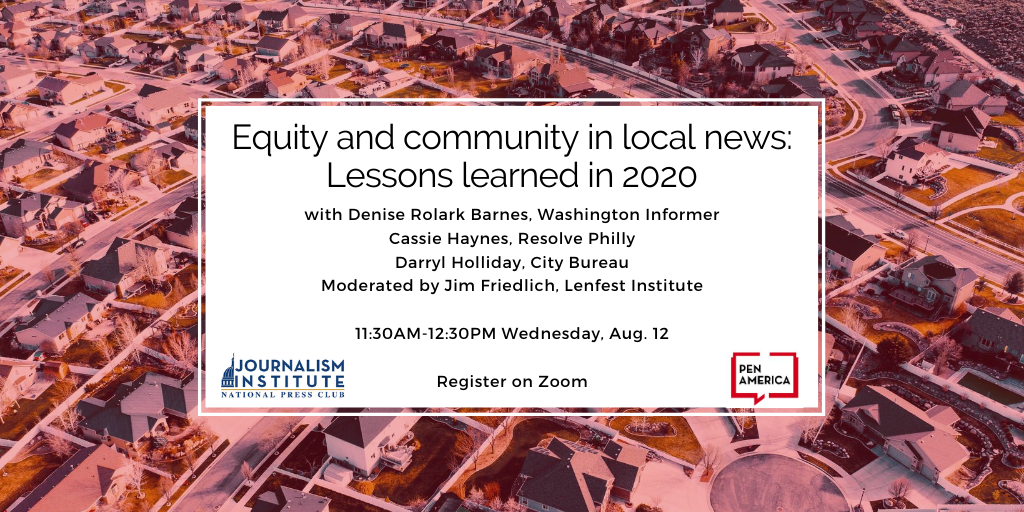
The National Press Club Journalism Institute and  PEN America  will co-host a program on “Equity and community in local news: Lessons learned in 2020” to identify and share takeaways from pandemic and protest coverage and to look ahead toward election coverage. 

Registration is open for the program , which will be moderated by  Jim Friedlich , executive director and CEO of the Lenfest Institute of Journalism, and will feature  Denise Rolark Barnes , publisher of The Washington Informer;  Cassie Haynes , co-executive director at Resolve Philadelphia; and  Darryl Holliday , co-founder and News Lab director at City Bureau in Chicago.
There’s that spinning pinwheel again, right on deadline. And your inbox is piled up with unnecessary mail. And your smart phone just informed you that it has reached its storage limit.

Don’t throw anything. Your devices are simply telling you it’s time for some summer tech cleaning.

Easy steps to declutter your phone:

  • The biggest space eater? Photographs. Those selfies you keep taking, move them to cloud storage. Try this for Android phones and this for iPhones.
  • Delete apps you don’t use or haven’t used in the past year. 
  • Clear up app data. Your music and podcast apps, for example, will save content on your phone for offline listening. But it takes up space, so delete it. You can still access it with wifi.

When your laptop needs the spa treatment, try these various cleanses :

  • First the aesthetics. Clean your mouse, your keyboard, your USB ports and your screen.
  • Get rid of the cord tangle at your feet. Use a good power strip and tuck your wires into a cable sleeve.
  • Don’t keep your equipment constantly plugged in. Charge them to 100%, unplug and don’t begin to charge again until they’re close to 20%. If you are traveling, follow the on-the-road ABC rule: Always Be Charging. You don’t know when you’ll get to another electrical outlet.
  • Shut your computer down every night.
  • Don’t ignore software and/or system updates, or make sure they are installing automatically. They often include protections and added safety features.
  • Clean your email inbox. 

Read on for more self-care tips, or share your own .
This newsletter is written & edited by the National Press Club Journalism Institute staff: Beth Francesco, Holly Butcher Grant, Jim Kuhnhenn, and Julie Moos. Send us your questions and suggestions for topics to cover.

Get this from a friend? Subscribe , and view the archives .