|
“It ultimately comes back to land use planning. If a county is doing a good job of land use planning, then a lot of these issues can be foregone as you move forward.”
- Sen. Russell Ott of Calhoun County on local governments siting data centers and the need for transparency.
“I think the zoning is better because it clearly gives counties and local government the right to site instead of the state, which I prefer.”
- Sen. Michael Johnson of York County on whether the state should prohibit nondisclosure agreements with data center companies or require a separate local zoning designation for data centers for transparency.
| |
Bills of Direct Interest to Counties | Revenue, Finance and Economic Development | | |
S. 866 would enact the “Municipal Tax Relief Act,” authorizing a municipality located wholly or partially in a county that does not impose a 1% sales tax to impose a 1% municipal sales tax, subject to a referendum. At least 20% of the revenue must be used for property tax relief with the remaining revenue available to be used for transportation, infrastructure, parking lots or garages, core local government services, administration buildings, civic centers, police stations, fire stations, or any combination of the above projects. The tax could be imposed for up to eight years and could be reimposed for up to an additional seven years.
Status: SCAC worked with several senators on an amendment to limit the authority to cities within the two counties (Greenville and Oconee) that have never imposed a county-wide sales tax and to allow cities in Beaufort County to hold a sales tax referendum in 2028 if a county-wide referendum fails this year. The authority is not extended to any city in the other 43 counties. The Senate gave S. 866 a second reading, and the bill is pending third reading on the Senate calendar.
South Carolina Department of Transportation (SCDOT) Modernization
Last week, a House Ways and Means subcommittee passed both comprehensive SCDOT modernization bills (S. 831 and H. 5071). These bills include language to:
-
Clarify —at SCAC’s request— that the transfer of roads from SCDOT to counties must be agreed to by mutual consent (an SCAC policy position) and remove the requirement that any roads transferred to counties always be maintained in good condition under SCDOT’s standards;
- Abolish the current county transportation committees (CTCs) and require the legislative delegation to appoint the members. The legislative delegation may devolve the authority to appoint the members of the committees to the governing body of the county, but the devolution may be reversed by resolution at any time;
- Add an ethics requirement and a residency requirement for CTC members;
- Create a pothole remediation program to allow residents to report potholes to SCDOT through a mobile app or website and direct $15 million from the General Fund to pay for this program;
- Exempt certain purchases for road construction projects from the procurement code;
- Provide that if local money is used to fund a project to improve the state highway system that is on the SCDOT priority list, then SCDOT must reprioritize the next project within that county that is also on the priority list;
- Clarify that a county may only accept the non-essential roads from SCDOT that are within the unincorporated areas of the county, and cities may only accept the non-essential roads that are located within the municipality; and
- Clarify that the millage cap exception is only available to counties and cities that accept the nonessential roads and that revenue must be spent on maintaining these roads.
Status: The House Ways and Means Committee met Wednesday to take up both S. 831 and H. 5071. The Committee adopted the subcommittee’s strike and insert amendment to S. 831 and gave both bills favorable reports, as amended. These bills, which are now pending second reading on the House floor, include the following stipulations for counties to consider before accepting roads from SCDOT:
-
57-5-105(C) In counties where all roads identified by SCDOT as nonessential to the State Highway System under this section have been transferred to the county and municipalities within that county, that county’s CTC shall not be required to meet the 33% on state highway system requirements of Section 12-28-2740(C).
-
(D) In counties where all roads identified by SCDOT as nonessential to the State Highway System under this section have been transferred to the county and municipalities within that county, that county may impose a sales tax of two cents in accordance with the requirements of Section 4-37-30(A).
This language clearly requires all municipalities within a county to accept state roads for the county to be exempt from the requirement that 33% of C-Funds be spent on state-owned roads and for the county to be permitted to impose an additional transportation sales tax. If you are concerned about the above provision, please reach out to your House members.
Treasurer Qualifications
S. 97, an SCAC policy position, would require that to be eligible to serve or continue to serve as the county treasurer, a person must:
1) be a citizen of the United States and of South Carolina;
2) be a qualified elector of the applicable county;
3) have:
a) a four-year bachelor's degree in accounting, finance, business administration, or economics from an accredited post-secondary institution; or
b) at least four years' experience:
i) in the field of accounting, financial management, financial reporting, budgeting, or economics;
ii) as an employee in a treasurer office in this state; or
iii) as a treasurer in South Carolina.
Status: The Senate adopted an amendment, requested by SCAC and many county treasurers, to add a grandfather clause and require each treasurer to complete a one-time 40-hour training program or risk forfeiting their salary supplement. The Senate then gave S. 97 second and third readings, sending the bill to the House.
Auditor Qualifications
S. 98, an SCAC policy position, would require that to be eligible to serve or continue to serve as the county auditor, a person must:
1) be a citizen of the United States and of South Carolina;
2) be a qualified elector of the applicable county;
3) have:
a) a four-year bachelor's degree in accounting, finance, or economics from an accredited post-secondary institution; or
b) at least four years' experience:
i) in the field of accounting or auditing;
ii) as an employee in an auditor office in this state; or
iii) as an auditor in South Carolina.
Status: The Senate adopted an amendment, requested by SCAC and many county auditors, to add a grandfather clause and require each auditor to complete a one-time 40-hour training program or risk forfeiting their salary supplement. The Senate then gave S. 98 second and third readings, sending the bill to the House.
| | |
Accommodations Taxes
H. 3876 would update the process of collecting and remitting accommodations taxes, with an emphasis on providing guidance when third-party platforms or other online booking services are involved to ensure that all accommodations taxes are remitted to local governments, an SCAC policy position. Third parties are required to collect and remit state and local accommodations taxes if they facilitate a booking unless a professional property company is involved. Last year, the House amended the bill by striking Section 8, which included a provision requiring the collection and administration of accommodations taxes by the Department of Revenue. The result is that the taxes will be remitted directly to local governments. However, during testimony it became clear that not all booking platforms are currently collecting and remitting local accommodations taxes.
Status: A Senate Finance subcommittee gave H. 3876 a favorable report with the understanding that amendments would be offered during full committee.
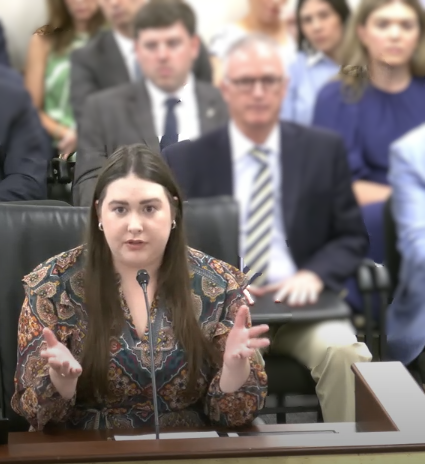
| | | | SCAC Government Affairs Specialist Sallie McLeod testifies on a bill about accommodations taxes at Senate subcommittee hearing. | | Land Use, Natural Resources and Transportation | | |
Data Centers
Two bills would create a regulatory framework under the Department of Environmental Services (DES) (S. 867) and Public Service Commission (S. 902) for permitting and siting requirements that data centers must meet to locate in South Carolina.
Status: A Senate Agriculture and Natural Resources subcommittee discussed several major changes to S. 867 this week but took no formal action. Under the latest proposal, site suitability determinations for data centers would be shifted from DES to local governments, giving counties greater control over where data centers could be located through zoning. As a result, local governments would be required to establish a three-tiered application process based on the connected electrical load to be consumed by the data center along with specific timelines for review. A provision that would have automatically approved project applications when local governments failed to meet review deadlines was removed from the proposal due to the potential administrative constraints that might occur in smaller counties. To balance transparency and confidentiality, nondisclosure agreements between local governments and data centers would continue to be allowed, with the caveat that local governments would generically disclose that the siting of a data center is being considered 15 days prior to the first reading of a zoning or rezoning ordinance.
The subcommittee likely will meet again soon to formally adopt the changes discussed to S. 867. Review the full amendment to see the proposed changes.
In addition, the subcommittee has publicly stated that there will either be a requirement at the county council level about disclosure to the public that a data center is being considered or by creating a zoning category specific for data centers. If you have an opinion on this matter, please contact SCAC staff and let them know.
A Senate Judiciary subcommittee also met this week to discuss S. 902 and continued to hear testimony specifically from technology companies; however, no action was taken on the bill. The subcommittee plans to have future meetings to take further testimony.
If S. 867 or S. 902 advances to the Senate floor for debate, SCAC anticipates that there will be significant efforts to prohibit any financial incentives that a county may offer to data centers looking to locate in the state. Please contact your senator and ask them to oppose any attempts that would be detrimental to economic development in your county.
Coastal Permitting
H. 3931 (R. 124) would set timelines for DES to act on certain permit applications within the coastal zone and critical areas. Under the bill, DES must act on a permit application within 90 days after the request is determined to be administratively and technically complete. Additionally, if DES requests supplemental technical information from the applicant, the request must be made within 15 days after the conclusion of the public notice period. DES also could hire a qualified third-party or independent engineer to assist the department in processing permit applications in coastal zones.
Status: The Senate gave the bill a third reading and sent it back to the House. The House concurred with a technical amendment adopted by the Senate, and the bill was enrolled for ratification.
Public Water Systems
H. 5111 would prohibit counties and municipalities from mandating connection to municipal water systems absent a documented public health threat through fines, fees, assessments, and penalties. The bill also would prohibit a county or municipality from denying building permits, certificates of occupancy, zoning approvals, subdivision approvals, or other land-use or development approvals solely because a property owner elects to use a private water well. Political subdivisions that knowingly violate these provisions would be subject to a civil penalty not to exceed $1,000 per day for each day the violation continues.
Status: The House Agriculture, Natural Resources, and Environmental Affairs Committee adopted the subcommittee’s strike-and-insert amendment that significantly scales back the original bill’s protections for property owners by allowing local governments to still charge fees, require the registration of wells, and mandate continued connection to public water systems. The adopted amendment also removes enforcement mechanisms (like lawsuits and penalties against local governments) and replaces them with more regulatory oversight and conditions favoring local water systems. The Committee gave H. 5111 a favorable report as amended, and the bill is pending second reading on the House calendar.
Foreign Ownership of Land
H. 3408 would prohibit companies from owning, leasing, or controlling real estate in South Carolina if they are owned or controlled, in whole or in part, by entities tied to U.S. designated foreign adversaries such as the People’s Republic of China, the Chinese Communist Party, Russia, Iran, or North Korea. The bill would authorize the South Carolina attorney general, local government attorneys, or certain affected parties to file legal actions to remove the foreign adversary from the property and confirm the invalidity of the transaction and would clarify that the law must not conflict with any applicable international treaties.
Status: A House Judiciary subcommittee adopted a strike-and-insert amendment to limit the application of the bill exclusively to farmland before giving H. 3408 a favorable report, as amended. The bill will be on the next full committee’s agenda.
Utility Relocation During Transportation Projects
H. 3768 would extend the sunset provisions relating to transportation improvement projects in Act 36 of 2019 from July 1, 2026, to July 1, 2031. This act sets forth a system of cost-sharing for relocating utilities during transportation projects.
Status: The Senate amended the bill to extend the sunset to July 1, 2032, before giving H. 3768 a second reading. The bill remains on the Senate calendar pending a third reading.
Protection of Monuments and Memorials
S. 508 would prohibit local governments from relocating, removing, or disturbing certain monuments and memorials. Any county or municipality that violates the prohibition would lose all disbursements from the Local Government Fund (LGF) until the violation is corrected.
Status: The Senate adopted a committee amendment to remove the LGF penalty and narrow where monuments can be put back or transferred before giving the bill a second reading, carrying over all amendments to third reading and reserving the roll call vote until third reading.
Energy Standards for Construction
H. 5216 would limit application of the 2009 edition of the International Energy Conservation Code to construction that falls within the scope of the International Residential Code. For all other types of construction, the edition of the International Energy Conservation Code is subject to adoption by the South Carolina Codes Council as the Energy Standard. It also would allow a local jurisdiction to appeal to the South Carolina Building Codes Council on statewide modifications to the Energy Standard for construction not falling within the scope of the International Residential Code, including emergency modifications, in the same manner as other building codes adopted by the South Carolina Building Codes Council.
Status: The House Labor, Commerce, and Industry Committee adopted a subcommittee amendment to require community review of modifications to the Energy Standard before giving the bill a favorable report, as amended. H. 5216 is pending second reading on the House calendar.
| | Public Safety, Judicial and Corrections | | |
Police Animals
H. 3034 would enact “Fargo's, Hyco's, Rico's, Coba's, Wick's, Mikka's, and Bumi’s Law," relating to harassing, injuring or killing police dogs or horses, by expanding the conduct that violates these provisions, increasing the penalties, and requiring restitution to the law enforcement agency, a past SCAC policy position.
Status: The House adopted the committee amendment to increase the penalty from up to five years in jail to up to 15 years for willfully and maliciously torturing, injuring, poisoning, or shooting into a vehicle while a police dog or horse is inside. The House further amended the bill to require law enforcement officers, including the South Carolina Law Enforcement Division (SLED), to maintain a detailed account of all incidents where police dogs are engaged and a dog bite occurs and to subject these accounts to the Freedom of Information Act. The House then gave H. 3034 second and third readings, sending H. 3034 to the Senate.
Coroner Qualifications
H. 3048/S. 753 would revise coroner qualifications to delete a provision allowing a candidate to simply be enrolled in a recognized forensic science degree or certification program to be completed within one year of being elected to the office of coroner. The bill also would require a candidate to be fingerprinted and have a criminal background check performed by SLED at the candidate’s expense and to, at the time of filing, submit an affidavit along with supporting documents verifying that they meet the qualifications, an SCAC policy position. The House removed the fingerprint requirement in 2025.
Status: After taking testimony from several coroners, a Senate Judiciary subcommittee amended H. 3048 to put the fingerprint requirement back into the bill and amended S. 753 and H. 3048 to delay the effective date to Jan. 1, 2027. The subcommittee gave both bills a favorable report, as amended, and they will be on the next full committee’s agenda.
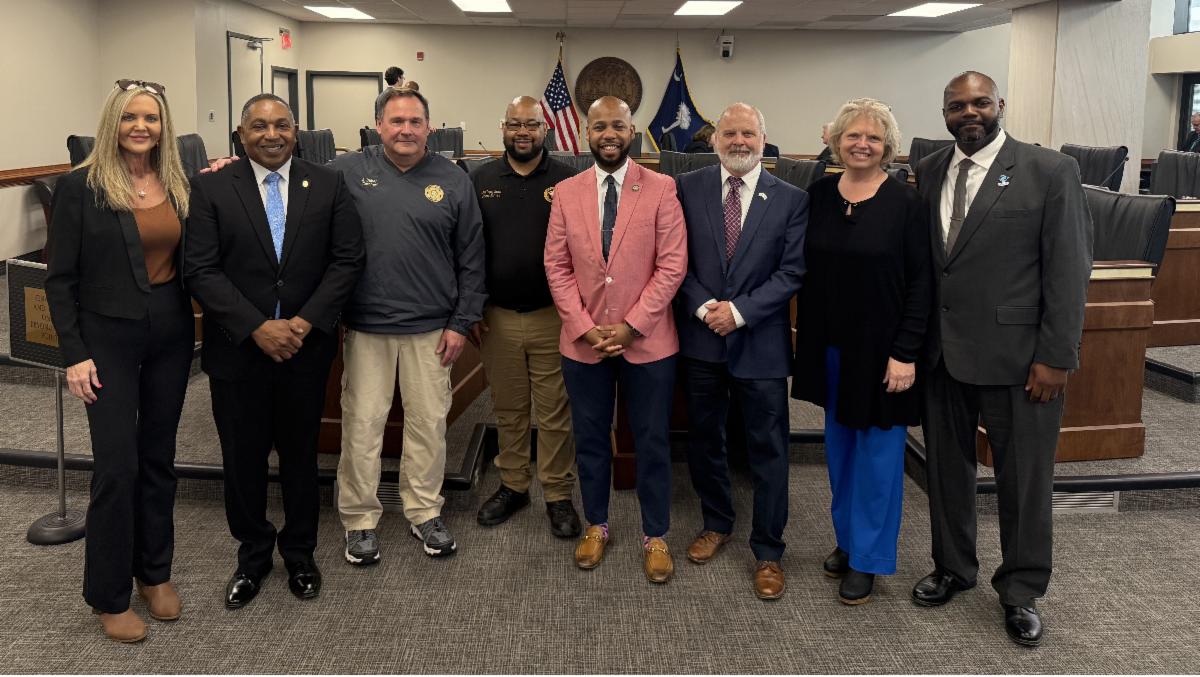
| | Lancaster County Coroner Karla Deese, Aiken County Coroner Darryl Ables, Sumter County Coroner Robbie Baker, Chesterfield County Deputy Coroner John James, Sen. Deon Tedder, Sen. Brian Adams, Charleston County Coroner Bobbi Jo O'Neal, and Berkeley County Coroner Darnell Hartwell following a Senate subcommittee meeting, where several coroners testified on multiple bills. The subcommittee approved a coroner qualifications bill, an SCAC policy position. Richland County Coroner Naida Rutherford (not pictured) also testified on coroner-related bills. | | |
Immigration
H. 4764 would require law enforcement agencies operating correctional facilities to enter into written agreements or memorandums of agreement with federal immigration enforcement agencies to participate in the immigration programs that authorize state and local law enforcement agencies to enforce federal immigration laws within a correctional facility. If the federal government terminates an agreement, a local law enforcement agency would not be found in violation of federal law. The bill also would require SLED to provide a training program for law enforcement agencies that enforce federal immigration laws.
Status: The House adopted a committee amendment to provide safe harbor where hardships exist and to provide certain immunity to law enforcement agencies—including counties and county law enforcement operating jails and detention centers—acting within the scope of the agreement while carrying out the provisions of the bill. The House amended this provision to exclude immunity when the act was done outside the scope of official duties or which constitute actual fraud, actual malice, intent to harm, or a crime involving moral turpitude.
The House further amended the bill to require the Attorney General’s Office to determine whether a law enforcement agency has a qualifying hardship. The attorney general also must publish a quarterly report of the agreements between federal immigration enforcement agencies and correctional facilities listing race and ethnicity data, legal status outcomes, the number of wrongful detentions, and the costs to the state in the previous quarter. The House then gave H. 4764 a third reading, sending the bill to the Senate.
Street Takeovers
H. 4292 would make it unlawful to organize, participate, or be a spectator in a deliberate and coordinated blocking of a public street, highway, or parking lot for racing, burnouts, or any other such reckless behavior with vehicles. It also outlines penalties.
Status: The House adopted a committee amendment to exclude spectators from the penalties and to allow for burnouts if authorized on certain properties. The House further amended the bill to remove the provision requiring the responding law enforcement agency to seize any vehicle used by a spectator during a street takeover. The House then gave the bill second and third readings, sending it to the Senate.
Seizure First Aid Pamphlets
S. 935 would require state agencies, counties, and other political subdivisions to post a pamphlet on rendering seizure first aid to those who have suffered a seizure in the workplace. The Department of Public Health must create this informational pamphlet and post it on its website for use by the above agencies.
Status: The Senate gave S. 935 third reading this week, sending the bill to the House.
Drone Regulations
H. 4679 would enact the “South Carolina Drone Regulation and Public Safety Act” to establish statewide regulation of drone operation, create criminal penalties, and authorize law enforcement to detain individuals, investigate violations, and confiscate violating drones. Operating a drone in restricted areas as outlined in the bill would be a misdemeanor, while more serious offenses such as weaponizing a drone, unlawfully surveilling, or smuggling contraband to correctional facilities would be a felony. Exemptions for law enforcement, emergency medical services, military, and agricultural operations are included.
Status: A House Judiciary subcommittee amended the bill to clarify that the legislation would not apply to employees of any state, county, municipal, or local government agency or department acting withing the scope of their employment or official duties. The full committee removed the weight requirement for a drone and gave H. 4679 a favorable report, as amended. The bill is pending second reading on the House calendar.
Coroners’ Disposition of Remains
H. 4188 would allow coroners to release unclaimed remains to another family member of the deceased when the next of kin of the deceased is charged in connection with the death or is otherwise uncooperative in claiming the remains. It also would allow the coroner to cremate unclaimed remains 30 days after the date of death or date of discovery.
Status: After taking testimony from several coroners, a Senate Judiciary subcommittee amended H. 4188 to allow, instead of require, the coroner to bury or inter unclaimed remains in a cemetery 30 days after the date of death or date of discovery. The bill will be on the next full committee’s agenda.
| | County Government and Intergovernmental Relations | | |
Polling Places / Municipal Elections
S. 694 (R. 121), as introduced, would allow the Aiken County Board of Voter Registration and Elections, with consent of their legislative delegation, to move polling places within the county. Last week, the House inserted Section 2 of H. 4669 into the bill, relating to municipal elections, to require all municipalities that choose to hold partisan elections for municipal offices to pay all costs and expenses associated with conducting a municipal primary election.
Status: This week the Senate concurred with the House amendment to S. 694, and the bill was enrolled for ratification.
Candidate Filing
H. 3557 would shorten the candidate filing period from March 30 to March 25.
Status: The Senate amended the bill to provide several dates for special elections, to change the effective date of various provisions of the bill, and to provide an alternative date if any of the required dates fall on a weekend or holiday. The Senate also amended the bill to provide a procedure to reopen the filing period for additional candidates if there are less than three candidates for any office or one or more of the candidates dies or withdraws. The Senate then gave the bill second and third readings, sending H. 3557 back to the House.
Primary Protests
H. 3556 would authorize the state executive committee to hear protests for partisan county officers, partisan less than county officers (for example, a partisan-elected school board member), and partisan municipal officers. The Senate previously amended the bill to allow a municipal governing body to determine by ordinance when the terms of its newly elected officers begin, provided the terms begin no earlier than 48 hours after the certification of the results and no later than 80 days after the election.
Status: The Senate gave H. 3556 second reading this week, and the bill is pending third reading on the Senate calendar.
Rural Emergency Hospitals
H. 5173 would include within the definition of “hospital” all hospitals that convert to rural emergency hospitals for purposes of the State Health Facility Licensure Act and Medicare reimbursement. These hospitals provide outpatient/emergency services but do not maintain inpatient units.
Status: The House Ways and Means Committee gave H. 5173 a favorable report this week, and the bill is pending second reading on the House calendar.
Hospital Beds
H. 5164 and S. 958 would create building and fire code exceptions for the placement of hospital beds in hallways during emergencies. A member of a hospital’s leadership team must make the decision to authorize hallway beds in justified emergencies.
Status: The House gave H. 5164 a third reading this week, sending the bill to the Senate.
Last week, the Senate amended S. 958 with language mirroring the House amendment described above and gave the bill a second reading. The Senate gave S. 958 a third reading this week, sending it to the House.
| | Other Statewide Bills of Interest | | |
Tax Conformity
H. 3368 would amend Section 12-6-1120, relating to modifications to gross income for individual income tax purposes, to exclude overtime pay and certain bonus pay from gross income. This would conform South Carolina with the current Internal Revenue Code, including the One Big Beautiful Bill Act. After the House passed the bill 121-0 earlier this year, the Senate vote this week failed 16-27, likely ending its chances of passing this year.
Insurance Rate Reduction Act
H. 4817 would enact the “Insurance Rate Reduction and Policyholder Protection Act” to overhaul the insurance business in South Carolina. Section 12 of the bill would charge the director of the South Carolina Department of Insurance or their designee with approving the appropriation of funds for local government loss mitigation projects. The House gave H. 4817 second and third readings this week, sending the bill to the Senate.
Underground Storage Tank Laws/Pipelines
S. 893 would align federal and state standards and provide clear, consistent criteria for identifying and counting the underground storage tanks subject to oversight by DES. The bill also would increase the maximum reimbursement for qualifying cleanup costs resulting from a petroleum release from an underground storage tank from $1 million to $2 million and restore $1 million to the State Underground Petroleum Environmental Response Bank (SUPERB) financial responsibility fund, commonly known as the cleanup fund. In addition, the bill would change the annual renewal fee and add a member to the SUPERB Advisory Committee, requiring that the appointee be an underground storage tank owner. The Senate adopted a technical amendment and gave the bill second and third readings this week, sending S. 893 to the House.
Special Purpose Districts Retirement
H. 4576 would expand the definition of “employer” eligible for participation in the state optional retirement plan to include special purpose districts already participating in the South Carolina Retirement System. A House Ways and Means subcommittee gave H. 4576 a favorable report, and the bill will be on the next full committee’s agenda.
Military Licensure
H. 4607 would enact the “Military Skills to Civilian Licensure Act” to require all licensing boards to grant equivalent credit for military training and experience toward licensure and to mandate expedited application processing for veterans and military spouses. A House Medical, Military, Public and Municipal Affairs subcommittee amended the bill to provide a 12-month grace period upon discharge and gave the bill a favorable report, as amended, and the bill will be on the next full committee’s agenda.
| | Newly Introduced Legislation | | | | |