ADA Highlight:
Glossary of ADA Terms
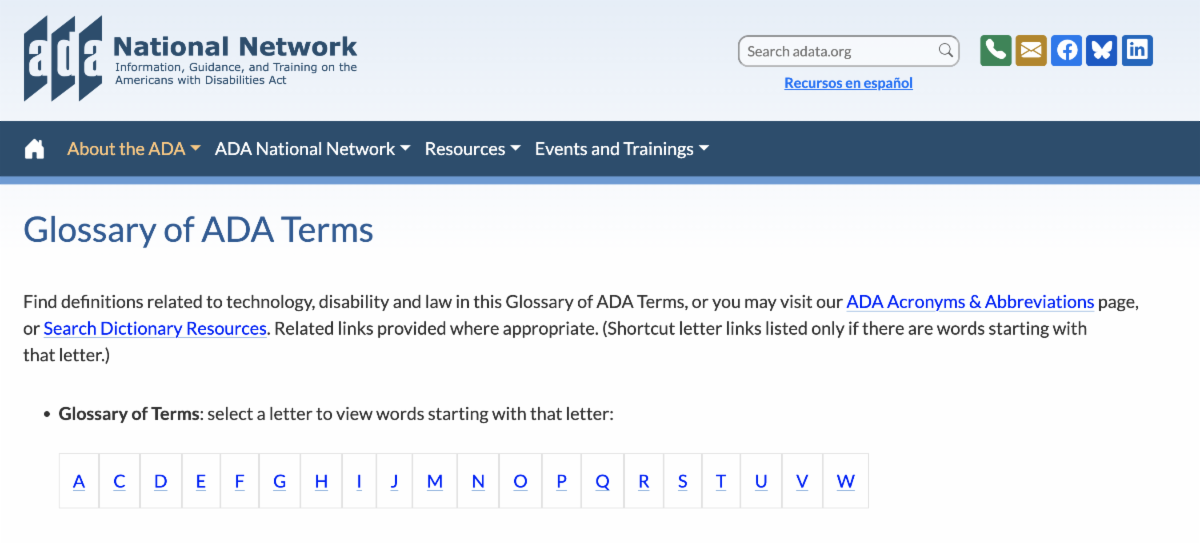
| As you work to ensure accessibility in your organization and community services, it is understandable that some of the terms and requirements are technical and can be confusing. If you need clarification, there are great resources on the ADA website, including the Glossary of ADA Terms! | | |
Here are some examples of how local health departments could utilize this resource.
Responding to a Public Accommodation Complaint
- A resident reports that they were unable to participate in a public health education class because communication accommodations were not provided.
- Investigators consult the glossary to clarify terminology related to effective communication, qualified interpreter, and auxiliary aids and services before evaluating the complaint.
Training New Employees
- A health department is onboarding new staff who will interact with the public.
- During ADA compliance training, employees use the glossary to become familiar with terms such as disability, reasonable accommodation, program accessibility, and service animal, helping ensure consistent understanding across departments.
Conducting Facility Accessibility Assessments
- Environmental health staff evaluate whether a clinic or public health office meets accessibility standards.
- The glossary helps them interpret terms such as accessible entrance, accessible route, and barrier removal while discussing needed improvements with facility personnel.
Handling Requests for Workplace Accommodations
- An employee requests a modified work schedule or adaptive equipment due to a disability.
- Human resources staff use the glossary to better understand terms like reasonable accommodation, essential functions, and undue hardship before working through the accommodation process.
| |
Training Topics?
We are working to provide trainings and learning resources that you will find valuable, but we would love to hear your insights.
Please let us know what you are interested in learning more about!
| | External Trainings & Resources | | | |
Research Brief & Webinar
State Innovations in Improving Access to Care for Adults with Complex Needs in Rural Communities
Wednesday, July 29, 2026
1:00pm
Virtual
This brief highlights Medicaid policy and financing strategies that can help improve access to care for rural older adults, people with disabilities, and others with complex health and social needs.
| | | |
Celebrating 36 Years of the ADA and 35 Years of the ADA National Network
Thursday, July 30, 2026
12:00pm
Virtual
Join our regional ADA Centers and the Knowledge Translation Center as we celebrate two significant milestones: the 36th Anniversary of the Americans with Disabilities Act (ADA) and the 35th Anniversary of the ADA National Network (ADANN). The mission of the ADA National Network is to increase awareness and knowledge of the ADA, with the ultimate goal of promoting voluntary compliance with the law. This mission is achieved through customized training, technical assistance, research, and the development and dissemination of informational resources.
During this two-hour webinar, each of the 10 regional ADA Centers will highlight how they support this mission and the impact their work has had in promoting voluntary compliance and ADA education. Participants will learn more about the resources and initiatives available in their region and how we can continue working together to create a more accessible future.
| | | |
Americans with Disabilities Act: Beyond the Basics
Thursday, August 5, 2026
12:30pm
In-person in Colorado
Join us for a full-day ADA training designed for professionals who are ready to move beyond the basics and dig deeper into practical, real-world application. This session will cover the role of the ADA Coordinator, advanced service animal considerations, sustainable digital accessibility practices, and emerging issues related to aging and the ADA. Attendees will leave with useful strategies, scenario-based insights, and a stronger understanding of how to support effective ADA compliance in their organizations.
| | | |
Disability & Health in Extreme Weather Contexts
Thursday, August 27, 2026
12:30pm
Virtual
Extreme weather events, and the power disruptions that often accompany these crises, present unique health challenges for community members with disabilities. In this webinar, we will explore both the issues disabled people confront in these crises and promising initiatives to strengthen weather resilience.
After providing a short overview of how disability law relates to emergency contexts, we will discuss lessons learned from Winter Storm Uri and the 2021 Texas power crisis, as well as the work of the organization Upstream Access, to provide back-up power to disabled Oregonians.
| | | |
Supporting the Whole Person
Wednesday, Sept. 2 and 9, 2026
10:00 AM MDT
Virtual
Join us for a training designed for professionals who support individuals with intellectual and/or developmental disabilities.
Empower yourself with insight and skills to navigate the complexities of sexuality with confidence and compassion. Prepare to confront social barriers self-advocates face and how you can change the narrative.
| | | | |
Disability & Healthy Relationships ECHO
Consent and Boundaries: Tools for Empowerment
Thursday, Sept. 10, 2026
11:30 AM MDT
Virtual
There is a general lack of awareness and capacity around supporting healthy relationships and sexuality education for individuals with disabilities. This ECHO is primarily for professionals who provide services or support to individuals with disabilities, in any capacity. This ECHO training series will share important information, education, and resources about the intersection of disability and healthy relationships, sexuality, consent, and abuse prevention to increase the knowledge and capacity of professionals who work in various fields. With this information, participants will be better equipped to share accurate information, resources, and support for individuals with disabilities.
| | | |
Healthcare Transition Made Easy: Tools for Youth and Families
Thursday, Sept. 10, 2026
7:00 PM MDT
Virtual
Transitioning from pediatric to adult healthcare can feel overwhelming, but it doesn’t have to be. Join us to learn practical strategies for navigating adult healthcare systems with confidence. Discover tools and resources to help organize important medical information, keep track of documentation, and prepare youth with disabilities to advocate for their healthcare needs.
| | |
| |
Online Learning Resource
10 Lessons We've Learned About Person-Centered Practices
The team at the Center for Advancing Person-Centered Systems at the Human Services Research Institute (CAPS@HSRI) has deep experience providing technical assistance to state and local service agencies to drive systems change. We have supported systems to implement customized strategies to shift services and supports to be more responsive and person-centered while fostering cultures of inclusion and respect. Changing systems is hard work. This resource shares 10 key lessons we’ve learned about person‑centered practices to help support ongoing change across systems.
| | |
Share with your connections!
We encourage you to share these emails and Accessibility & Health content with other in your networks who may be interested to learn more with us!
We are always creating new learning opportunities for people working in public health settings to better serve people with disabilities in their communities.
If you received this email from a friend and would like to sign up to receive them to your own inbox, please use the button below!
| | | | | |