The American Society of Le Souvenir Français Inc.
Monthly Bulletin - Vol. III. No 8 - August 2023
|
|
The exploits of French aviation pioneers
Costes & Bellonte
|
|
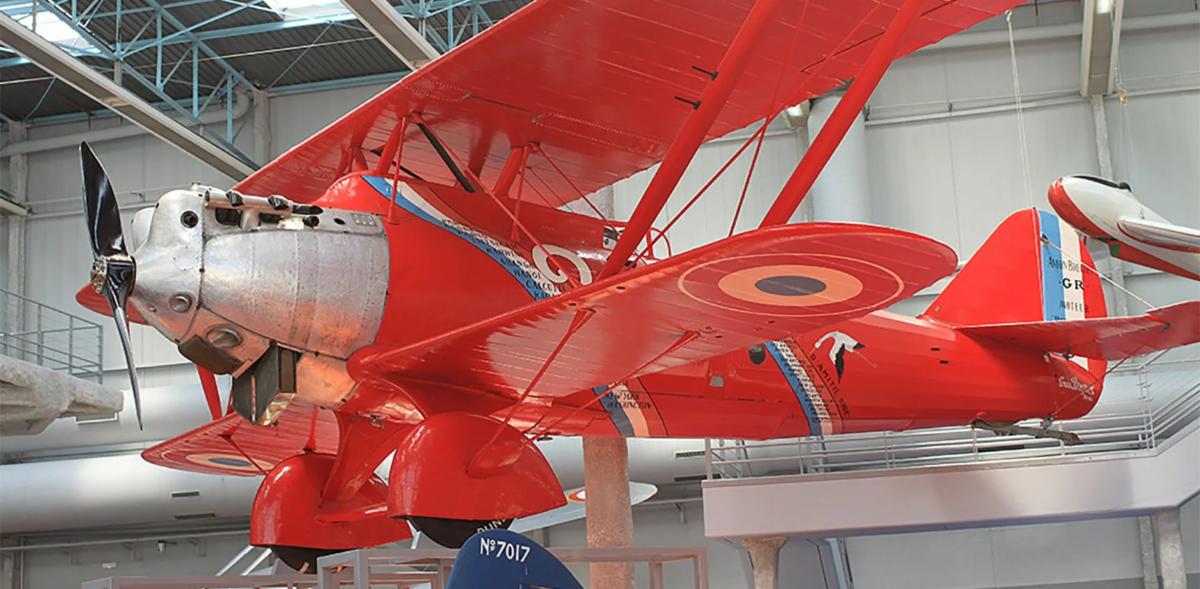
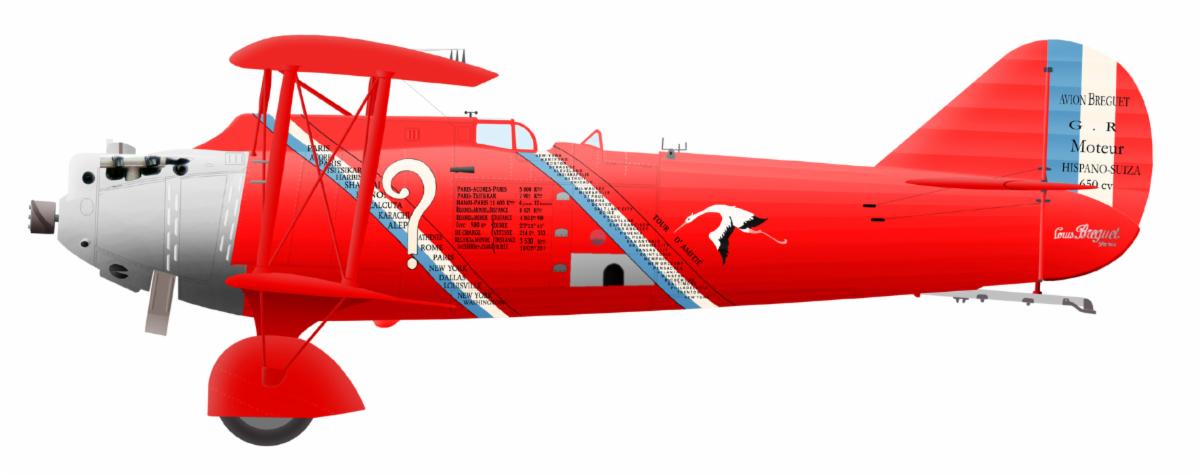
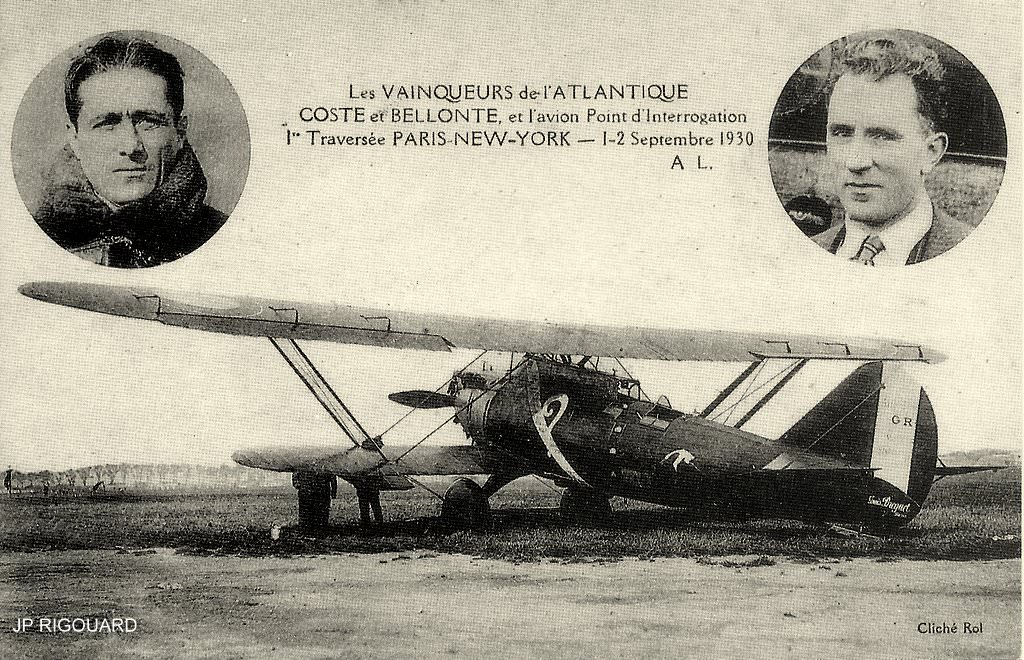
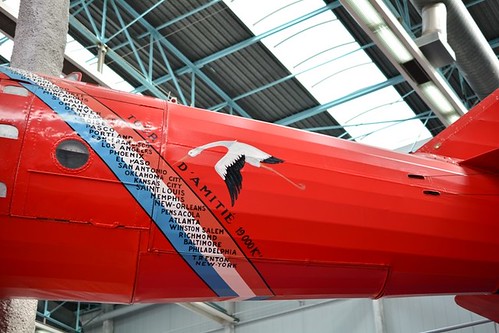
Cover illustration: Bréguet XIX "Point d'Interrogation" ("Question Mark") aboard which Costes and Bellonte made the first Paris-New York flight in 1930.
On display at the Musée de l'Air et de l'Espace, Aéroport de Paris-Le Bourget, 93352 Le Bourget, France
|
|
EDITORIAL
We hope you are enjoying a delightful summer. We are currently busy preparing for the installation of our sculpture of Le Petit Prince, which will take place next month on the wall of Villa Albertine - Services Culturels in Manhattan. The President of the French Republic, Mr. Emmanuel Macron, has indicated his intent to unveil the sculpture while he is in New York to address the General Assembly of the United Nations. Once we have the date for the inauguration, we will send a special announcement.
A member of the City of New York Landmark Commission noted that the sculpture will undoubtedly be popular with both New Yorkers and tourists from around the world. Many people will likely take selfies next to our Little Prince while strolling along Fifth Avenue. A bronze plaque will be placed next to the sculpture, reminding visitors that this masterpiece of world literature, translated into more than 550 languages and dialects, was entirely written in New York by Antoine de Saint Exupéry. In addition to being a literary giant, he was an aviation pioneer, a patriot and a WWII hero.
If you are reading this while on a plane, consider the extraordinary advances of aviation, in less than a century! What was an exploit in 1930 is now commonplace, and we don't even remember the extraordinary deeds of many intrepid pioneers.
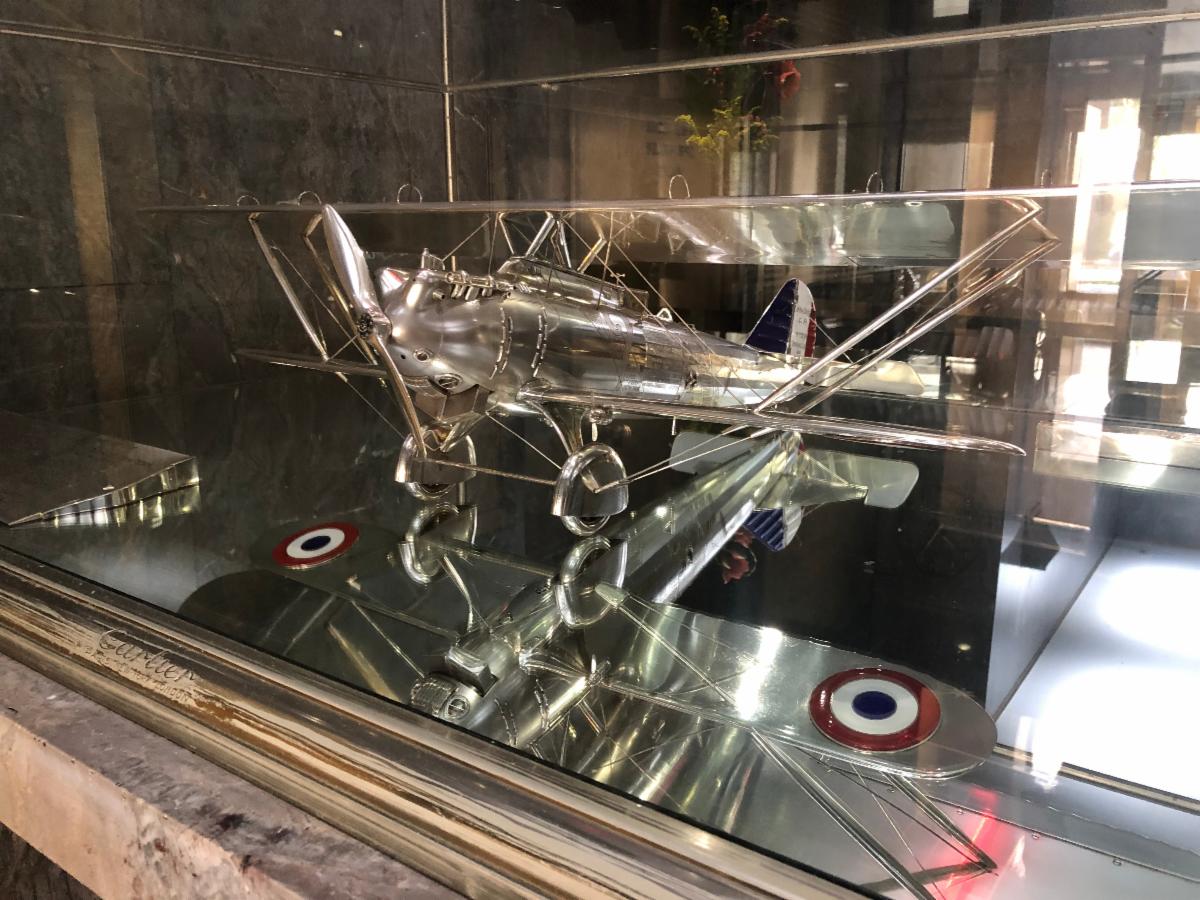
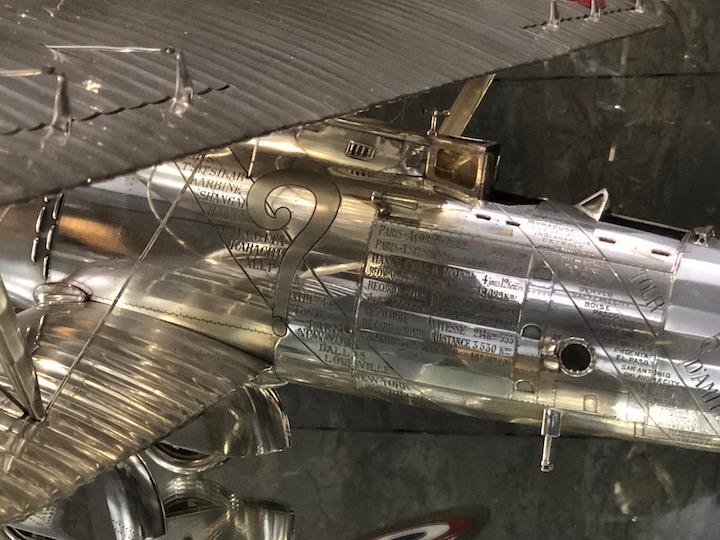
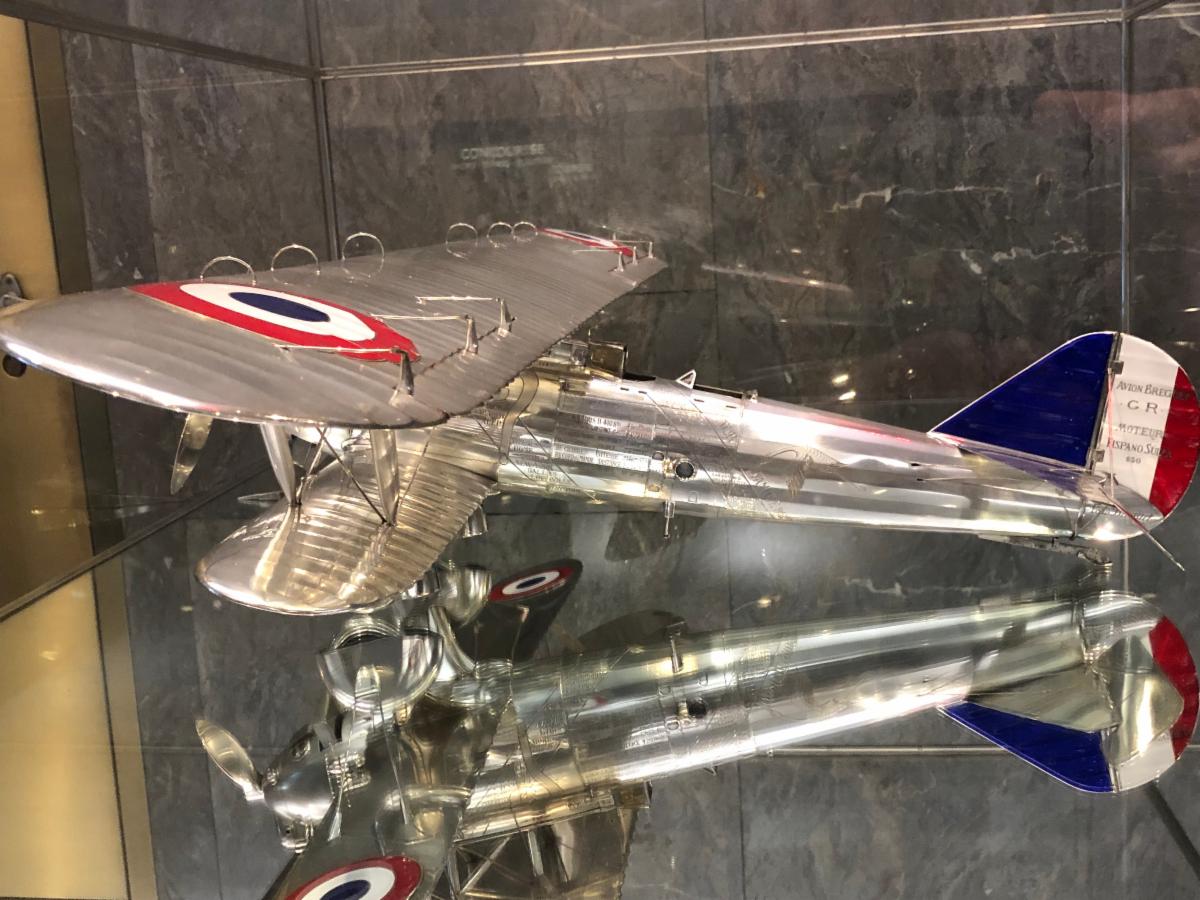
Case in point: very few know that there is a very special site to visit only a few blocks south on the same prestigious avenue, at the "Maison Française" of Rockefeller Center. Placed inside a lobby few would ever think of entering, a stunning replica in sterling silver of an airplane, "Le Point d'Interrogation" is exhibited.
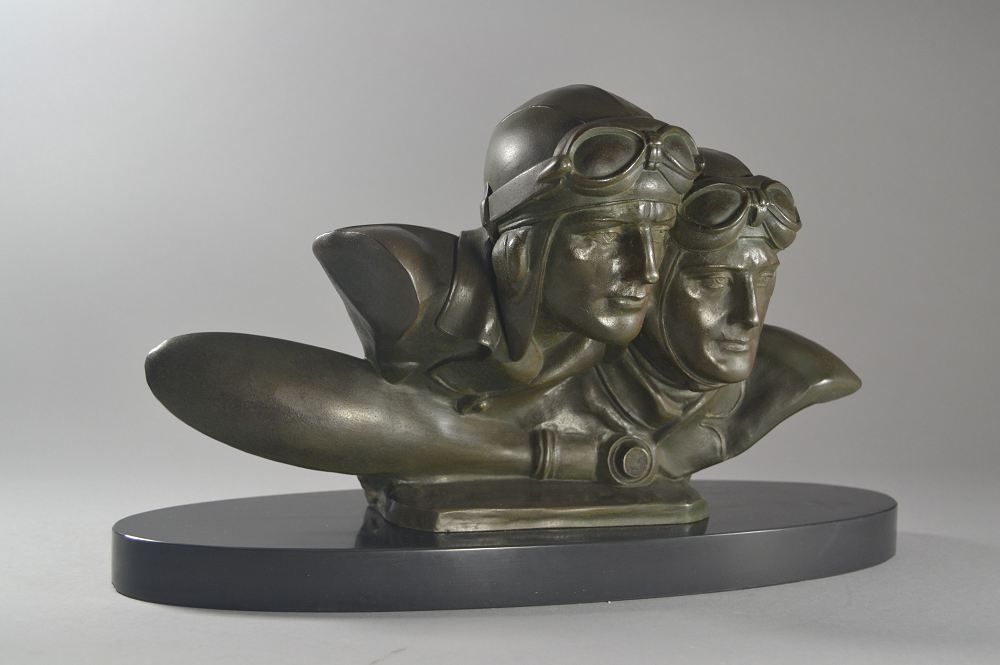
As a prelude to next month's festivities honoring Antoine de Saint Exupéry, it is therefore fitting that this month's Bulletin be dedicated to two French aviation pioneers, Dieudonné Costes and Maurice Bellonte, who were the first ones to cross the Atlantic from east to west, taking off from Paris on September 1st, 1930, and who landed 37 hours later at Curtiss Airfield on Long Island.
They were welcomed on September 2 by an enthusiastic crowd, with Charles Lindbergh present at the airfield, were treated with a ticker-tape parade on Broadway, were received by president Hoover at the White House and did a triumphal tour in 37 cities throughout America... and yet they are mostly forgotten today.
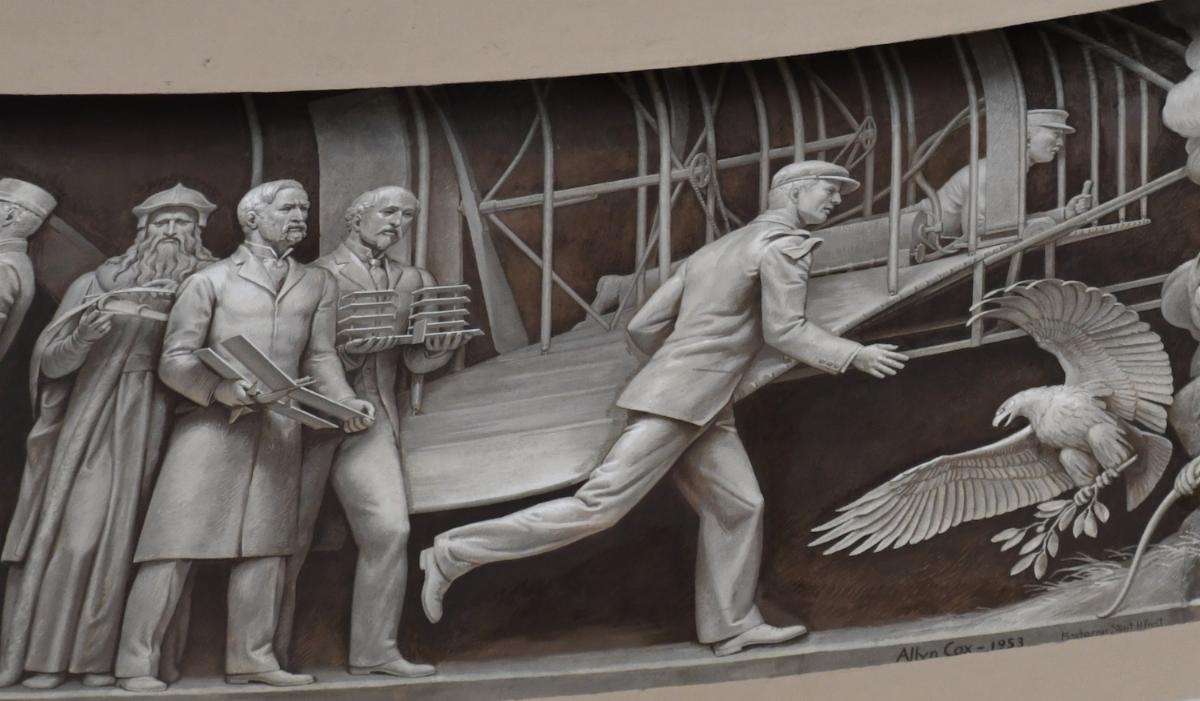
Beyond honoring the tombs and the memories of the more than 2,000 French soldiers, sailors and aviators who are buried in the United States, it is also our mission to honor Frenchmen who accomplished great deeds in America. Therefore this Bulletin will also pay homage to French-born Octave Chanute, often referred to as "the father of aviation", who worked closely with the Wright Brothers and who is depicted right next to them in a frieze under the dome of the US Capitol! ...and yet mostly forgotten.
Our Bulletin would not be complete without highlighting General Lafayette's triumphant tour of 1824-1825, which is coming to its final leg before his farewell in September 1825. Originally invited to stay for three months as the "Guest of the Nation" following an invitation from President James Monroe, Lafayette ended up staying a total of 13 months and was celebrated in all 24 states.
As usual, towards the end of this Bulletin we will announce several upcoming events and "Save the Date" from like-minded organizations that should be of interest to our members and sympathizers.
If you are flying back from a vacation in Europe, please take a moment to gaze above the clouds across the Atlantic and please raise a toast to Dieudonné Costes and Maurice Bellonte!
On behalf of the Board of Directors,
Thierry Chaunu, President,
American Society of Le Souvenir Français, Inc.
|
|
A race to be the first one(s) |
|
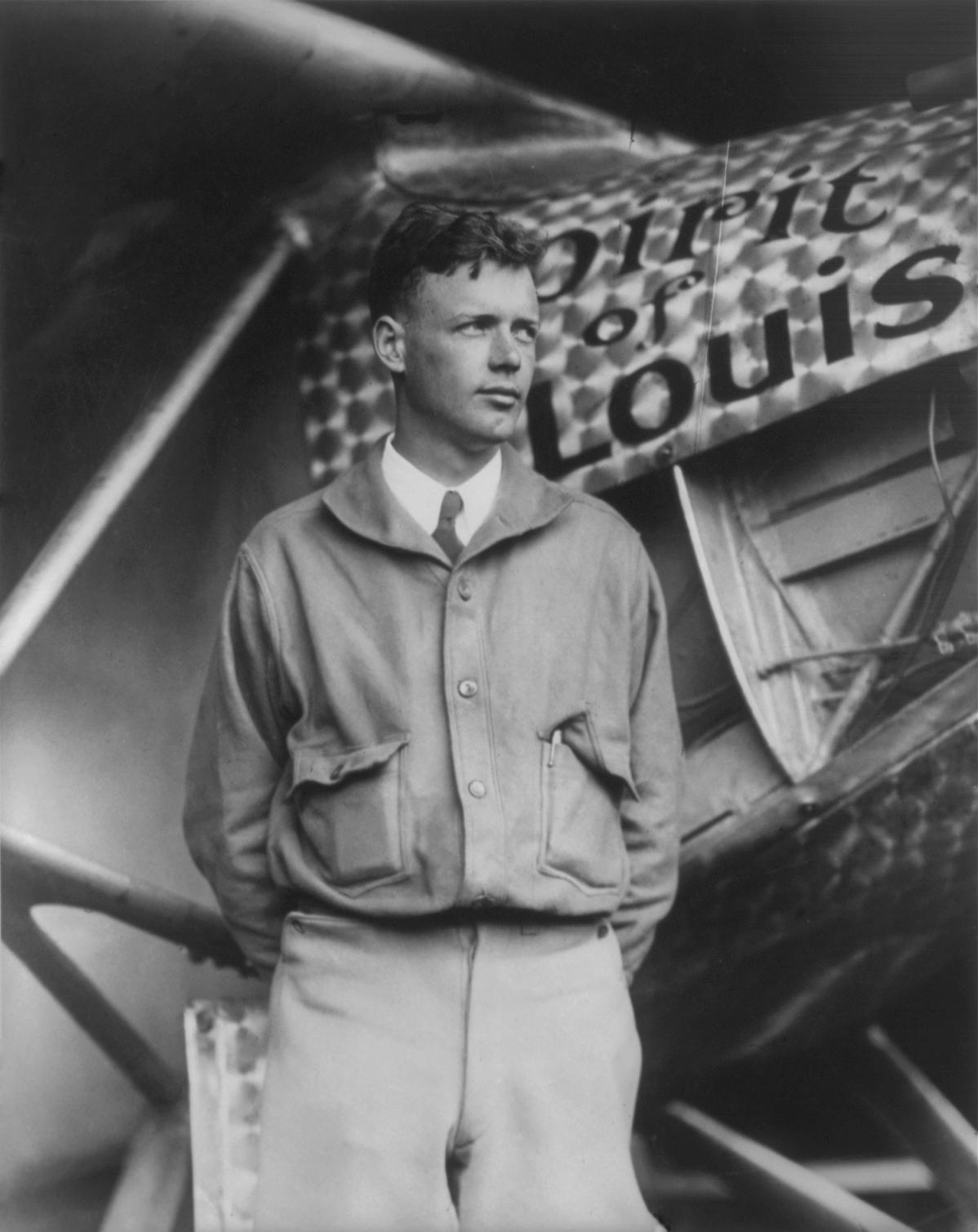
Illustration:
Lindbergh with the Spirit of St. Louis prior to his flight
|
|
Historical Context:
• WHO first flew the Atlantic? The answer seems straightforward: Charles Lindbergh was the first aviator to fly solo across the Atlantic Ocean. On May 20-21, 1927, he accomplished this incredible feat by flying from New York to Paris.
However, it's worth noting that the first successful Atlantic crossing by air was achieved in 1919 by a group of Navy-Curtiss NC-4 flying boats. Although they didn't fly solo or non-stop, one of the flying boats did manage to reach London after making stops in the Azores and Lisbon with the assistance of a US Navy flotilla who provided radio guidance.
A month later in 1919, the first non-stop transatlantic flight was made by British pilots John Alcock and Arthur Whitten Brown in June 1919. They flew a twin-engine Vickers Vimy from St. John's, Newfoundland, directly to County Galway, Ireland. Similar to Frenchman Louis Blériot's historic flight across the English Channel in 1909, Alcock and Brown were awarded a prize from London's Daily Mail newspaper for their accomplishment.
• This in no means diminishes the historic importance of Lindbergh's exploit. Indeed, he was the very first to fly solo across the Atlantic, from New York to Paris. When he landed at Le Bourget airport, the crowd was justly celebrating a milestone in aviation history. His achievement made history, and he will be forever remembered as a giant of aviation.
Yet, quite unfairly, hardly anyone remembers a very similar exploit which took place three years later, after several (and tragic) failed attempts.
• In this bulletin, we will be recounting the odyssey of French aviation pioneers Dieudonné Costes and Maurice Bellonte. On September 1, 1930, they became the first individuals to fly non-stop westward, from Paris to New York, in their biplane named "Point d'Interrogation" (“Question Mark" in French).
This was also a significant milestone as they were the first to successfully cross the Atlantic from east to west, a more challenging route due to prevailing winds. The journey required additional fuel and more hours of flight compared to Lindbergh's solo flight.
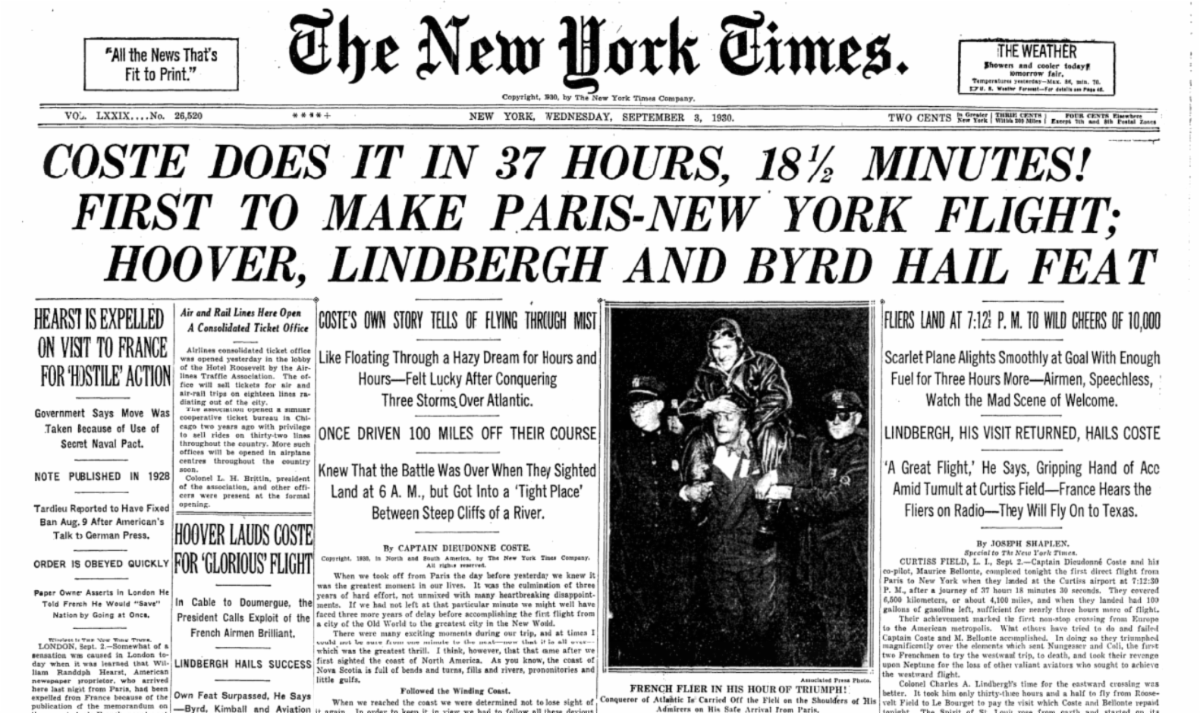
• After 37 hours and 18 minutes, they landed on September 2, 1930 at New York's Roosevelt Field, where they were welcomed by 25,000 spectators, including Charles Lindbergh himself.
Dieudonné Costes greeted Lindbergh with the words "Comment ça va?" ("How are you?") to which Lindbergh replied, "I congratulate you! I congratulate you!"
At that moment, they understood that they too had become legendary.
• It was also the first event in the history of the world ever to be broadcasted live over the radio, heard live, simultaneously on both sides of the Atlantic.
• At the time, national pride played a significant role. France was a leader in aviation at the end World War One, producing thousands of aircraft. However, competition was fierce, and Lindbergh's achievement in 1927 served as a wake-up call for the French. It was important for them to showcase their own capabilities. In this context, the reverse Atlantic crossing, which is regarded by aviation experts as more challenging due to the opposing winds, presented the perfect opportunity to demonstrate their aviation prowess.
• The aerial crossing between Paris and New York was considered the most challenging but also the most prestigious for those who managed to accomplish it. Other aviators had attempted this feat, and unfortunately, some lost their lives. For example, in 1927, the French aviators Nungesser and Coli disappeared aboard their plane "Oiseau Blanc" ("White Bird"). Although Lindbergh successfully crossed the Atlantic in the same year, his west-east route benefited from more favorable winds.
Let us now introduce our two heroes, as they are preparing to undertake the first Paris-New York journey on a specialized long-distance raid aircraft, the "Question Mark".
|
|
1927 South Atlantic crossing from St. Louis, Senegal to Natal, Brazil in Breguet XIX "Nungesser Coli"; 1930 first heavier-than-air westbound transatlantic crossing to North America in Breguet XIX TF Super Bidon "Point d'Interrogation (Question Mark)"
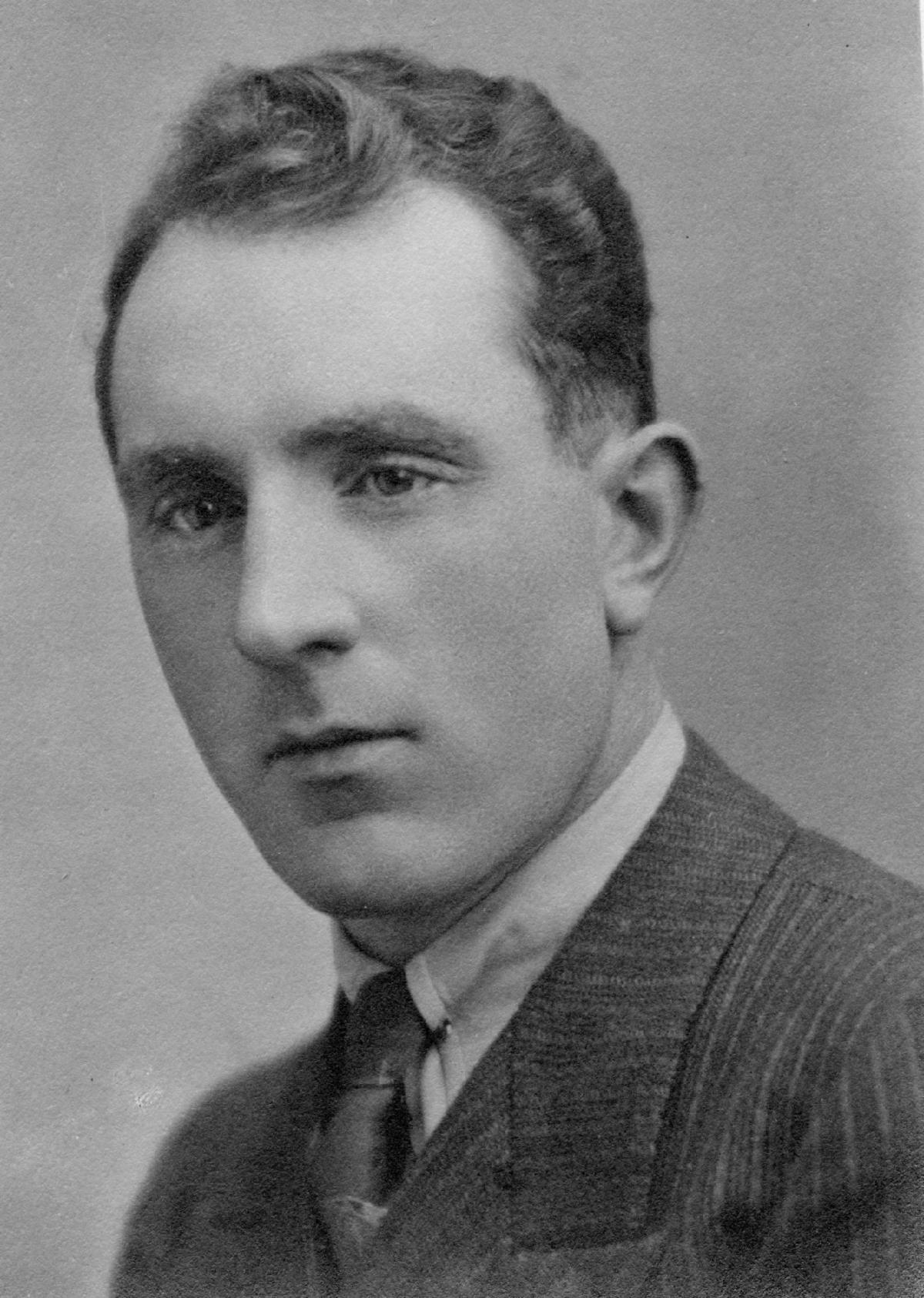
Photo: Dieudonné Costes, National Air and Space Museum, Smithsonian Institution
|
|
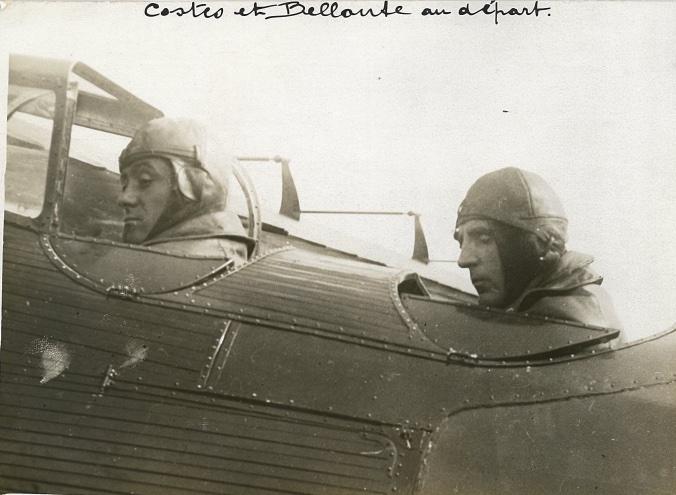
• Dieudonné Costes (14 November 1892 – 18 May 1973) was a French aviator known for his achievements in flight distance and his service as a fighter ace during World War I.
• But first, is it "Costes" or "Coste"?
Several newspaper use the spelling Coste...
An article explains the controversy:
"Dieudonné Coste and the Air Ministry have disagreed over the proper way to spell the famous flyer’s name. Not long ago the flyer said he preferred to spell his name “Coste,” dropping the final ”s.” which he used until a year ago. He signed autographs without the final “s” before departing for New York. The Air Ministry insisted, however, that the official spelling is “Costes.” Coste’s name is pronounced to rhyme with “lost,” making the final letter silent. Bellonte’s name is pronounced “Bell-ont,” to rhyme with “jaunt.”
—The Evening Sun, Baltimore, Maryland, Vol. 41, Monday 1 September 1930, Page 1, Column 3.
We chose to stick to the official spelling, "Costes" in this Bulletin.
• Costes was born in Septfonds, Tarn-et-Garonne. He earned his pilot diploma on 26 September 1912. During World War I, he served in the French Air Service, initially in MF55 and MF85 Farman squadrons, and later in N506, N507, and N531 fighter Nieuport squadrons on the Balkan front. He achieved 9 victories (6 confirmed) during this time, with his first victory in April 1917 and the remainder between January and September 1918. He ended the war with the rank of 2nd Lieutenant.
• After the war, Costes pursued a career in civil aviation. He began with Latecoere in 1920, flying the Toulouse-Casablanca mail route. In 1921, he flew the Bordeaux-Paris route, and in 1923, he joined Air Union airlines to fly the Paris-London route. In 1925, he became a test pilot for Breguet works and started undertaking long-distance and record-breaking flights using Breguet 19 aircraft.
• On 26 September 1926, Costes embarked on a 4,100 km (2,546 miles) flight from Paris to Assuan in Egypt with René de Vitrolles, aiming to break a world distance record. He successfully achieved the world distance record on 28 October 1926, flying 5,396 km (3,351 miles) from Paris to Jask, Persia, alongside J. Rignot, as part of a 19,625-km (12,187-mile) Paris-India-Paris flight. Between 10 October 1927 and 14 April 1928, Costes and Joseph Le Brix completed a 57,410 km (35,652 miles) journey around the world in a Breguet 19GR aircraft named Nungesser-Coli. They flew from Paris to Argentina, Brazil, the United States, Japan, India, and Greece, making the first non-stop aerial crossing of the South Atlantic Ocean on 14–15 October 1927, flying between Saint-Louis, Senegal, and Natal, Brazil. While in South America, they flew through every country on the continent. On 15–17 December 1928, Costes, along with Paul Codos, set a world distance record in a closed circuit, covering 8,029 km (4,986 miles).
• On 13 July 1929, Costes and Maurice Bellonte attempted to cross the North Atlantic Ocean from Villacoublay near Paris to New York, New York, in the Breguet 19 Super Bidon (also known as "Point d'Interrogation" or "Question Mark"). However, they had to turn back after 17 hours due to adverse weather conditions.
• On 27–29 September 1929, Costes and Bellonte set the world distance record, flying 7,905 km (4,909 miles) from Paris to Qiqihar, China.
After all these remarkable achievements, Costes, along with his partner Maurice Bellonte, prepared for another daring attempt to cross the Atlantic Ocean...
But before we do, let us not forget to introduce his partner, Maurice Bellonte!
|
|
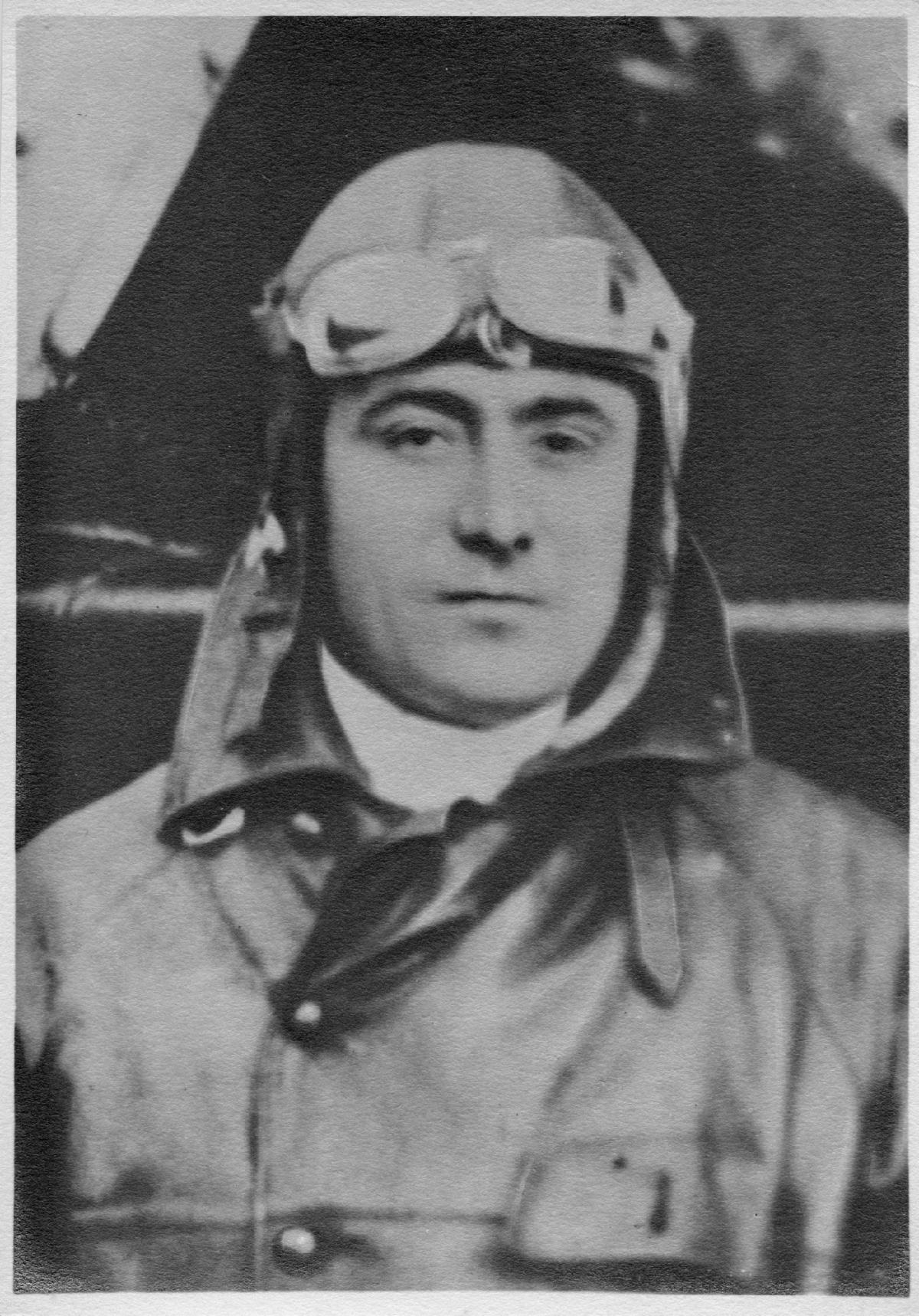
Photo: Maurice Bellonte, National Air and Space Museum, Smithsonian Institution
|
|
• Maurice Alexis Jacques Bellonte, born on October 25, 1896 in Méru (Oise) and died on January 14, 1984 in the 16th arrondissement of Paris, was a French aviator. Alongside Dieudonné Costes, he achieved the first east to west crossing of the North Atlantic by plane in 1930, aboard the Breguet XIX "Point d'interrogation."
• As the son of a Miss Petit and a cutler worker, Bellonte developed an early interest in technology. In 1910, he became an apprentice at Anzani, a small engine manufacturer that had produced the engine for the Blériot XI, the first plane to cross the English Channel in 1909.
In 1913, he worked as a fitter at the firm of Hispano-Suiza. At the age of twenty in 1916, he graduated as a mechanical engineer and served in the aviation during World War I. In 1918, he served as a machine gunner. After the armistice, he completed his military service in Morocco, where he learned the basics of flying. Upon his demobilization, he returned to his position at Hispano and then joined the Franco-Colombian company that manufactured hydrofoils.
• He worked as a mechanic and navigator on the earliest airline routes after the end of the Great War. In 1923, he met pilot Dieudonné Costes on the Paris-London route. After a failed attempt to fly non-stop from Paris to New York in 1929, they both broke the distance record with a flight from Paris to Tsitsikhar (Manchuria) spanning 7,925 km. This flight demonstrated that the Breguet XIX with a Hispano-Suiza 650 HP engine could cross the North Atlantic against unfavorable winds from east to west.
Before we fly alongside our two heroes, let us say a word on the plane, which was about to make history:
|
|
The plane... and the meteorology... |
|
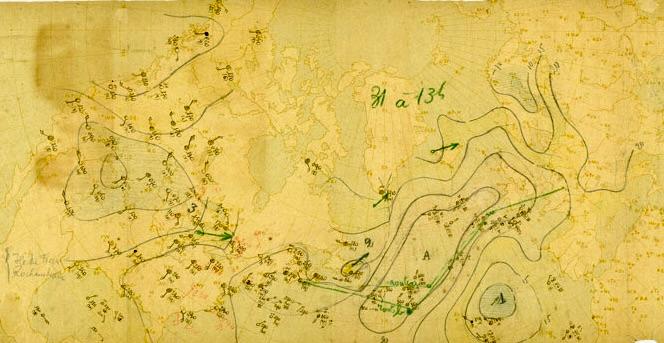
Middle: Map: (detail) In 2016, the Musée de l'Air et de l'Espace acquired a large collection of relics from this historic raid, including the North Atlantic weather map used by the two airmen.
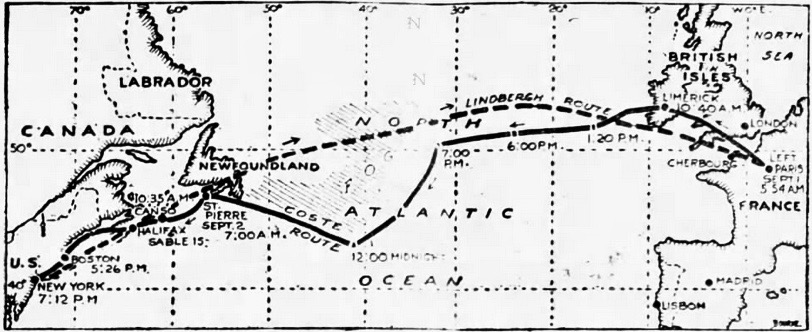
Bottom: compared itineraries with Lindbergh's (in dotted line)
|
|
• Finally, in 1929 Breguet specifically designed the type Br19 TF "Super Bidon" ("Super Tank") for that transatlantic flight.
The engine of the Breguet XIX "Question Mark" was situated between the crew's cockpits, with two primary fuel tanks positioned in the same area, forming the fuselage surface. The combined fuel capacity of these tanks was 5,570 liters (1,471 U.S. gallons). The plane also had 220 liters of lubricating oil. The engine was a Société Française Hispano-Suiza 12Nb single-overhead-cam (SOHC) 60° V-12, which had a displacement of 36.050 liters (2,199.892 cubic inches). This liquid-cooled, normally-aspirated engine generated 650 cheval-vapeur (641 horsepower) at 2,100 r.p.m. The V-12 engine directly drove a two-bladed metal propeller. The Super Bidon could reach a maximum speed of... (please do not smile...) 250 kilometers per hour (155 miles per hour) and had a range of 6,700 kilometers (4,163 statute miles).
• Their plan for the two flights, as well as another record-breaking journey from Hanoi to Paris, involved a Breguet sesquiplane with an open cockpit covered in red cloth. A "sesquiplane" a type of biplane where one wing (usually the lower) is significantly smaller than the other. The word, from Latin, means "one-and-a-half wings". The arrangement can reduce drag and weight while retaining the biplane's structural advantages.This particular aircraft, named Point d'Interrogation or "Question Mark," featured a large upper wing and a smaller lower wing. It was equipped with dual controls for the pilot and the navigator.
• Interestingly, the very concept of a biplane was the brainchild of Octave Chanute, often referred to as "the father of aviation", who collaborated closely with the Wrigth Brothers (he is depicted next to them in the frieze under the dome of the US Capitol). We are we are devoting a few pages
a few pages further down below to this "most illustrious forgotten" French-American.
• The reason behind the name "Question Mark" is also quite interesting. Due to the numerous failed attempts to fly over the Atlantic, the French government had revoked all flight authorizations. However, Costes and Bellonte were determined to proceed with their Atlantic crossing preparations, despite not being able to disclose their intentions to the reporters. One day, a reporter rhetorically remarked to Costes and Bellonte, "What is your plane? It is a question mark..."
...This comment prompted the mechanics to paint two white question marks on the aircraft. Although there were plans to remove them the next morning, Costes and Bellonte insisted that the question marks remain. On a three-day whirlwind trip to the United States, which took place on the anniversary of Bellonte's first flight, Bellonte's wife, Raymonde, even wore a dress adorned with a question mark-shaped pin.
• In order to give themselves every chance of success, Costes and Bellonte surrounded themselves with the best specialists. They had a "Favé bubble quadrant", a radio capable of communicating with land stations and ships, new orthodromic maps by engineer Louis Kahn as well as studies by meteorologist André Viaut.
• For several months, the two airmen waited for an ideal climatic configuration. The day before this attempt, like every day, Viaut receives Bellonte, the navigator, and examines the probabilities of evolution for the next three days. The conditions are favorable. The final decision to leave is made after examination of the 1 p.m. card (pictured above). The route is marked out before departure. It is a question of circumventing disturbance n° 1 (on the right on the map), taking advantage of the favorable winds of anticyclone A (in the center), then escaping disturbances n° 2 and 3 (on the left).
|
|
The westward flight across the Atlantic |
|
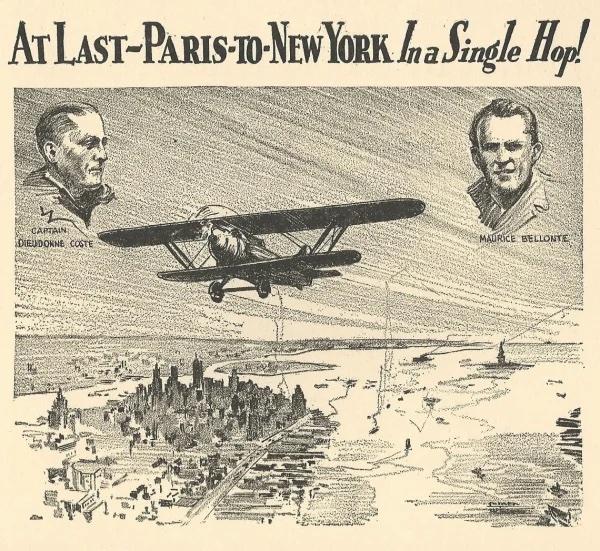
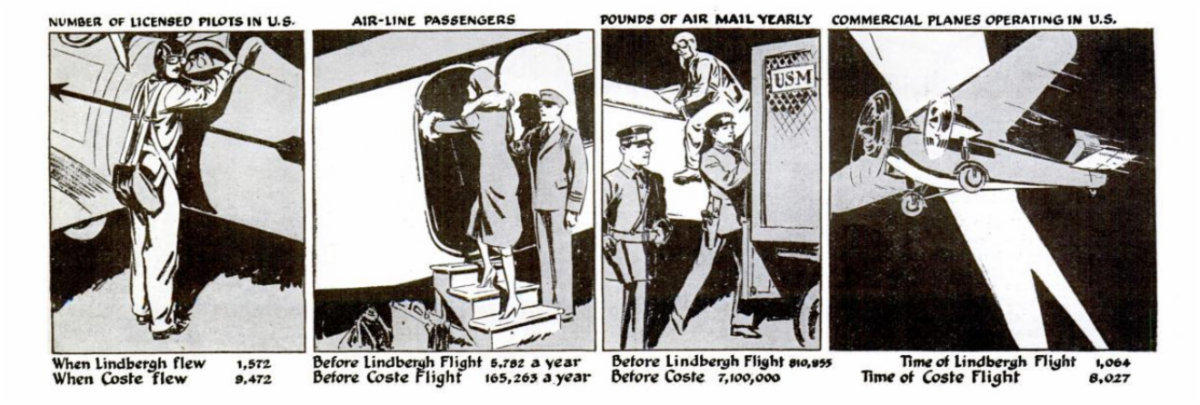
Illustration: More than three years after Lindbergh’s famous 1927 flight, aviators achieved the first westerly trip. Image from Minute Epics of Flight, Lumen Winter and Glenn Degner, Grosset & Dunlap, 1933,
For a newsreel of 1930, click on:
|
|
For a newsreel of 1930, click on:
|
|
• The August 31 card at 1 p.m. will be part of the 37-hour journey to reach New York. Taking advantage of favorable weather conditions on August 31, 1930, the two aviators made the decision to embark on their transatlantic crossing. With a small group of planes as their escort, the large red Breguet took off at 10:54AM local time with some difficulty after building up momentum on the runway.
• Heading north, it reached the French coast above Saint-Valery-en-Caux at 10:50AM GMT. From that point onward, the two men were left to face the vast Atlantic Ocean alone, relying solely on a radio to maintain contact with land. At 1:15PM, the Question Mark flew over the English coast, followed by the Irish coast at 1:30PM Despite encountering a significant disturbance along their route, which significantly slowed them down, the plane persevered.
• After a challenging night, the weather improved on the morning of September 1st. The aircraft passed Halifax Bay at 10:00AM, marking the beginning of its descent towards the United States.
• Finally, at 6:12PM, it touched down at the Curtiss Field aerodrome in New York, where an eager crowd awaited the two men. Among the spectators were notable figures such as Charles Lindbergh, the French ambassador, the French community in New York, singer and actor Maurice Chevalier, tennis player Jean Borotra, (the founder of the world-famous Lacoste shirts brand) and navigator Alain Gerbault.
• With barely enough time to halt their plane and exit the cabin, the aviators found themselves engulfed by the reaching hands of the crowd. Exhausted after a grueling 37-hour flight over the ocean, they were swept away by the human tide before being hailed as heroes in New York
• Here is the official timeline:
"1 September 1930: At 10:54AM, local time (09:54 GMT), Dieudonné Costes and Maurice Bellonte took off from the Aéroport de Paris – Le Bourget, in a red Breguet Br.19 TF Super Bidon. Their destination was New York, non-stop across the North Atlantic Ocean. At 6:12:30PM, Eastern Daylight Time, 2 September (10:12:30PM GMT), they landed at Curtiss Field, Valley Stream, Long Island, New York. The two aviators had flown 5,913 kilometers (3,674 statute miles, 3,193 nautical miles) in a total elapsed time of 37 hours, 18 minutes, 30 seconds."
|
|
...The map fell from the plane!.. |
|
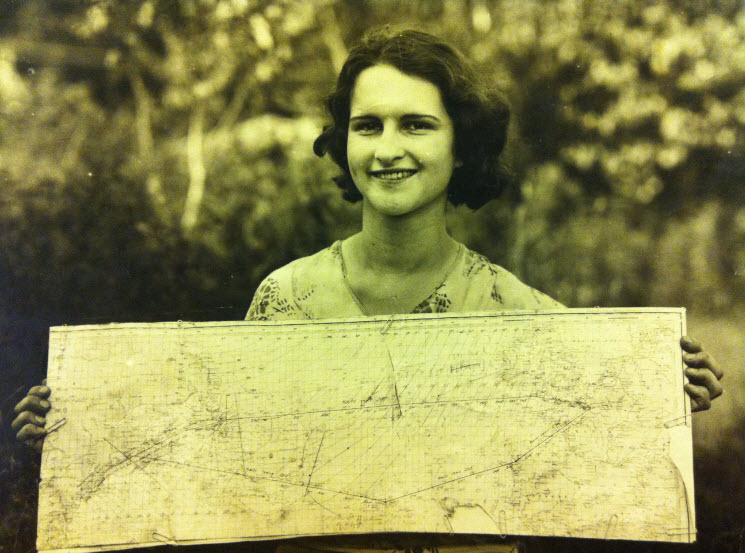
Photo of Louise Stef holding the map that fell from the Point d'Interrogation taken on September 30th, 1930 in Portsmouth, NH on her family's farm.
By Elizabeth Stef - Family Photo, Public Domain,
|
|
• While flying over Portsmouth, New Hampshire, they lost their navigational map out of an open window of the plane. Two children saw the map falling from the sky while they were watching for the flight to cross over their farm. The children, Louise Stef and her brother John, returned the map to Costes, who had asked for its return through the media..!
|
|
A triumphal ticker tape parade |
|
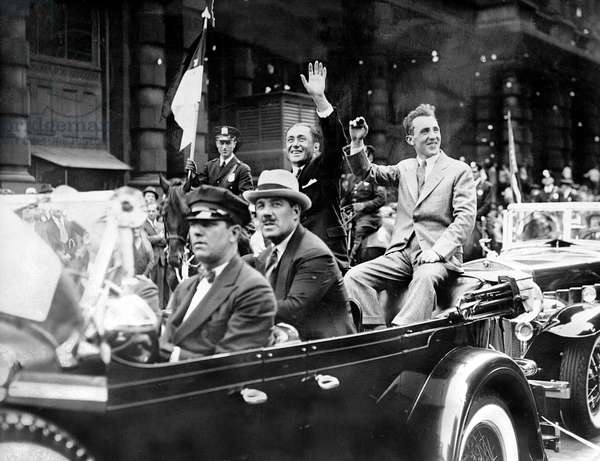
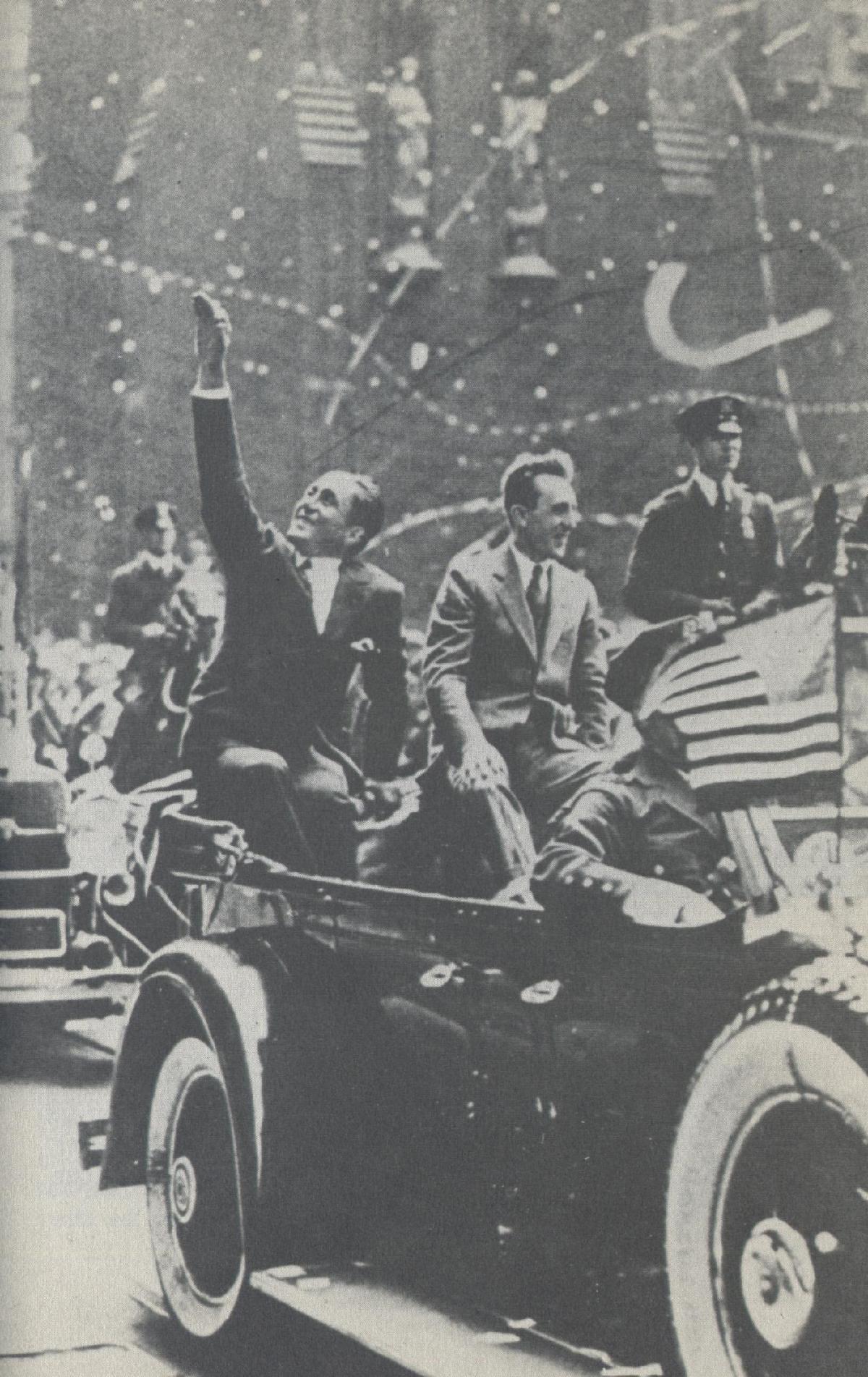
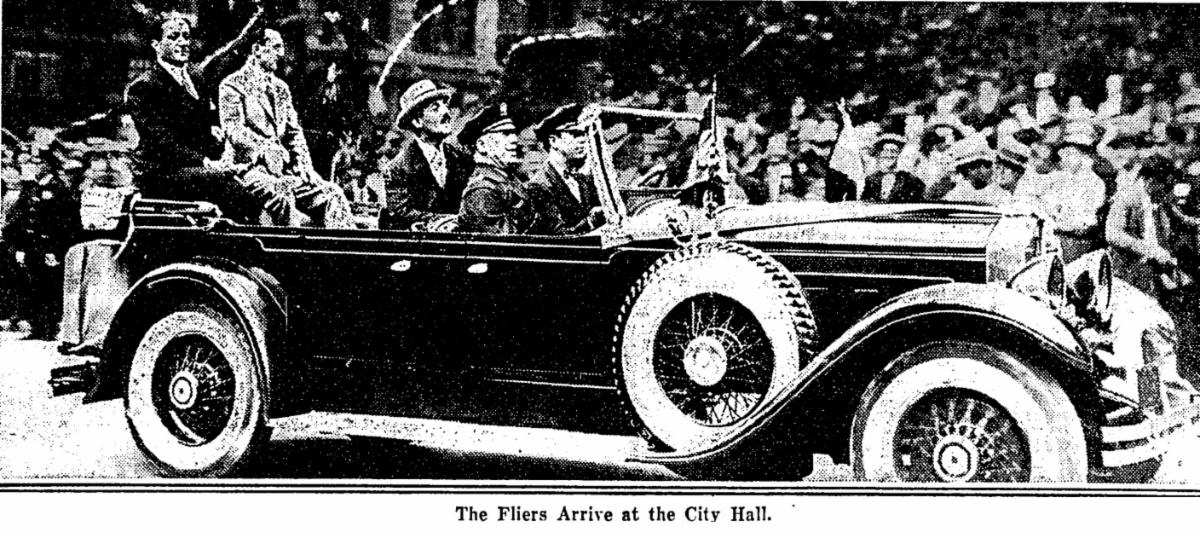
Times Wide World Photos, Sept 5, 1930
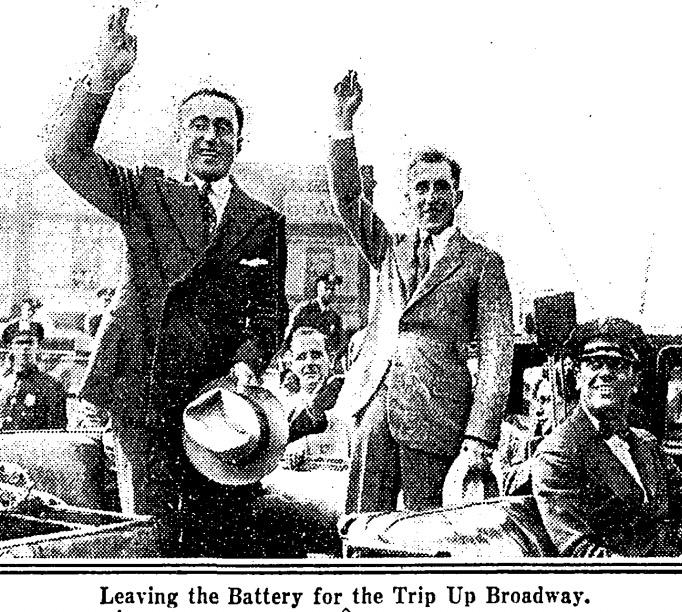
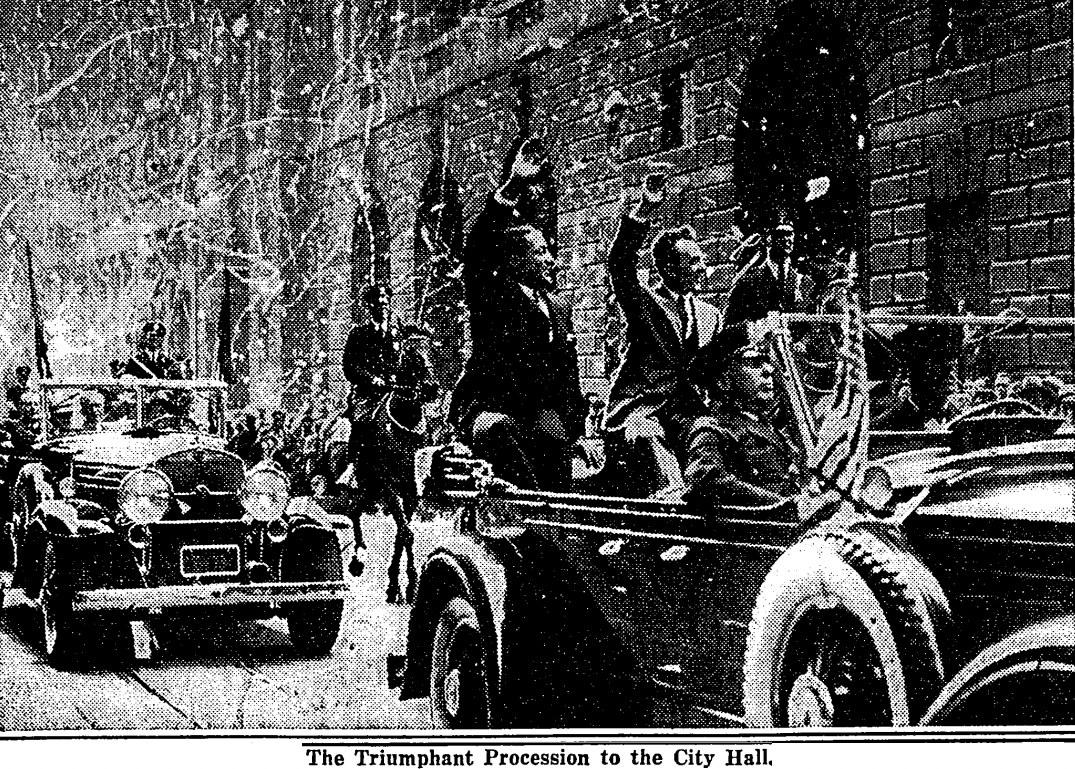
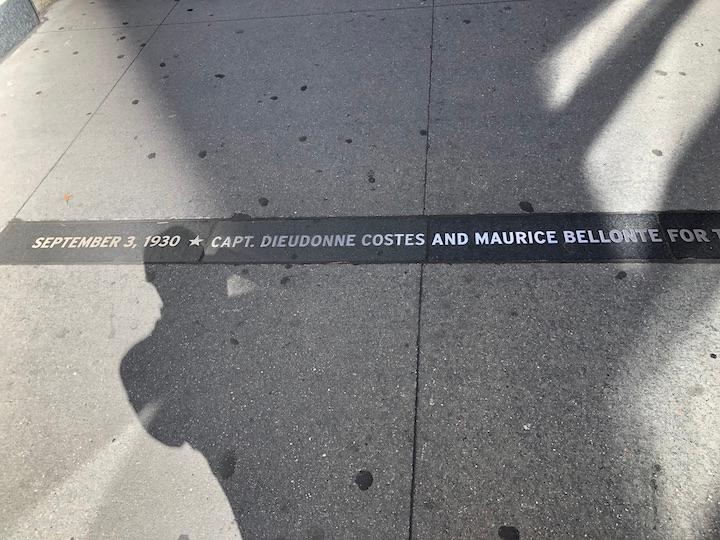
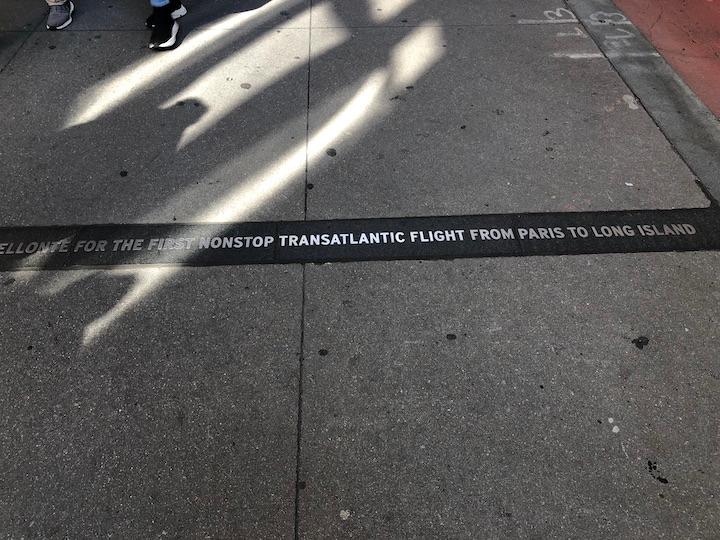
New York, New York: September, 1930 - French aviators Dieudonné Costes and Maurice Bellonte in the parade given them up Broadway after being the first to fly nonstop from Paris to New York.
Photos of granite strip markers on Broadway sidewalk: Thierry Chaunu 2022 © American Society of Le Souvenir Français, Inc.
|
|
• The reception in New York was delirious, and simultaneously in Paris.
It was the first time an event was broadcasted live on both sides of the Atlantic!
• This article from the New York Times captures this incredible moment:
Flyers Greet Paris in Radio Speeches
“France hears clearly”
"...Listeners in New York and vicinity heard the greeting teo the French flyers as brought to them over WEAF, WJZ, WOR, WNYC and WABC. Two coast-to-coast radio chains, totaling more than 1— broadcaster, carried the word picture of the event and the brief addresses of the airmen from Maine to Texas and from Florida to the State of Washington…
[...]
"As soon as the excited throng could be penetrated the fliers were brought before the microphone of the National Broadcasting Company, accompanied by Colonel Charles A. Linidbergh (sic), in Hangar No 2, and sent their greeting back to France via the short-wave transmitters. A battery of loudspeakers had been held in readiness at the Place de la Concorde, Paris, and around it were throngs eagerly awaiting news of the arrival of the airmen aboard the Question Mark. Soon after the broadcast was completed a long-distancer telephone call from the French radio system at Paris told the NBC engineers that great throngs in the French capital heard the word-picture and the speakers with “exceptional clarity and with great enthusiasm…” - Excerpts from The New York Times, Wednesday, September 3, 1930
|
|
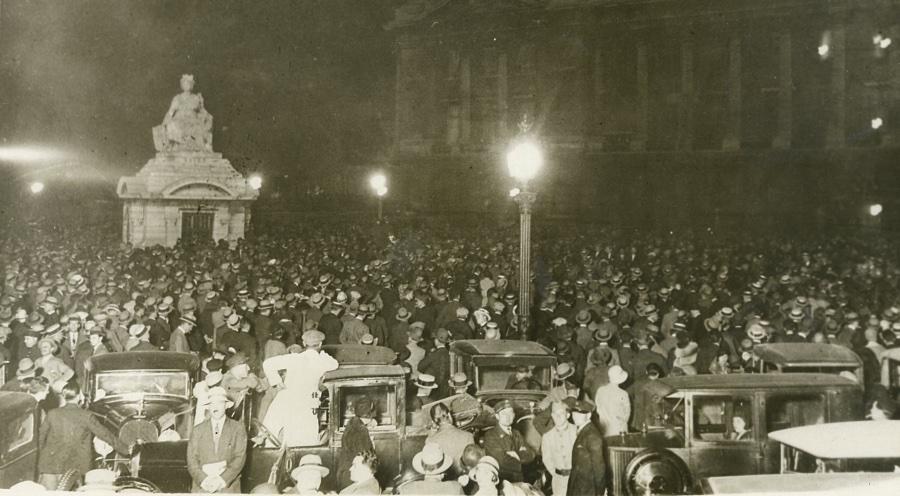
Crowd reveling in Paris at night at Place de la Concorde |
|
A large crowd at the Plaza de la Concordia in Paris await radio news of Costes & Bellonte’s arrival in the Point d’Interrogation, in New York. Credit A.C.M.E
|
|
• At the very same time, a large crowd gathered at the Place de la Concorde to celebrate the event.
• The celebration in Paris happened simultaneously with New York, and it was an incredible event to hear on public loudspeakers the two aviators addressing their compatriots live over the radio.
• In return, Costes and Bellonte received thousands of telegram, starting with the French President Gaston Doumergue with these words:
“To Consul of France NY. Please send Messrs. Costes and Bellonte the following message: I am happy to send you my warmest congratulations for your magnificent achievement. Gaston Doumergue. »
• Automotive industrialist legend André Citroën sent them a cable telegram with these words:
"Under the spell of an unforgettable evening where a hundred thousand Parisians cheer your historic raid and hear your speeches place de la Concorde expresses to you my admiration and gratitude for great French propaganda and memorable achievement. - André Citroën. »
• Beyond the hundreds of telegram they received from celebrities, what is particularly moving is the postcards sent by children from all over France.
To cite only three:
- " I am very happy to tell you my admiration for the great raid you have just completed. Since you left Le Bourget, we followed you with great emotion thanks to the radio. And yesterday we stayed tuned until you arrived in New York. […] Long live aviation! Long live Costes and Bellonte! »
- "Long live Costes and Bellonte and their beautiful French bird" - Irenée (5 years old)
- "I love you very much because you bring honor to France and show the Americans that we are as capable and brave as they are. »
|
|
The historical significance of this flight...
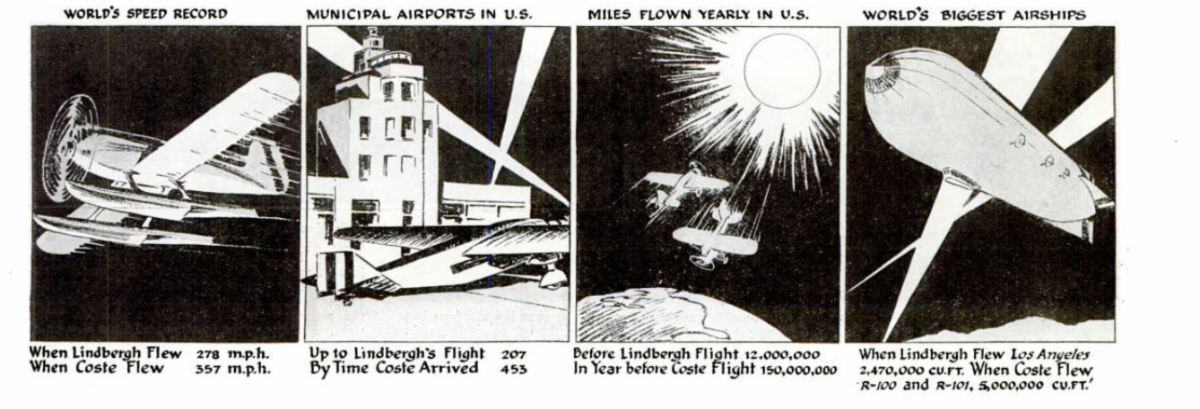
Aviation and radio progress
|
|
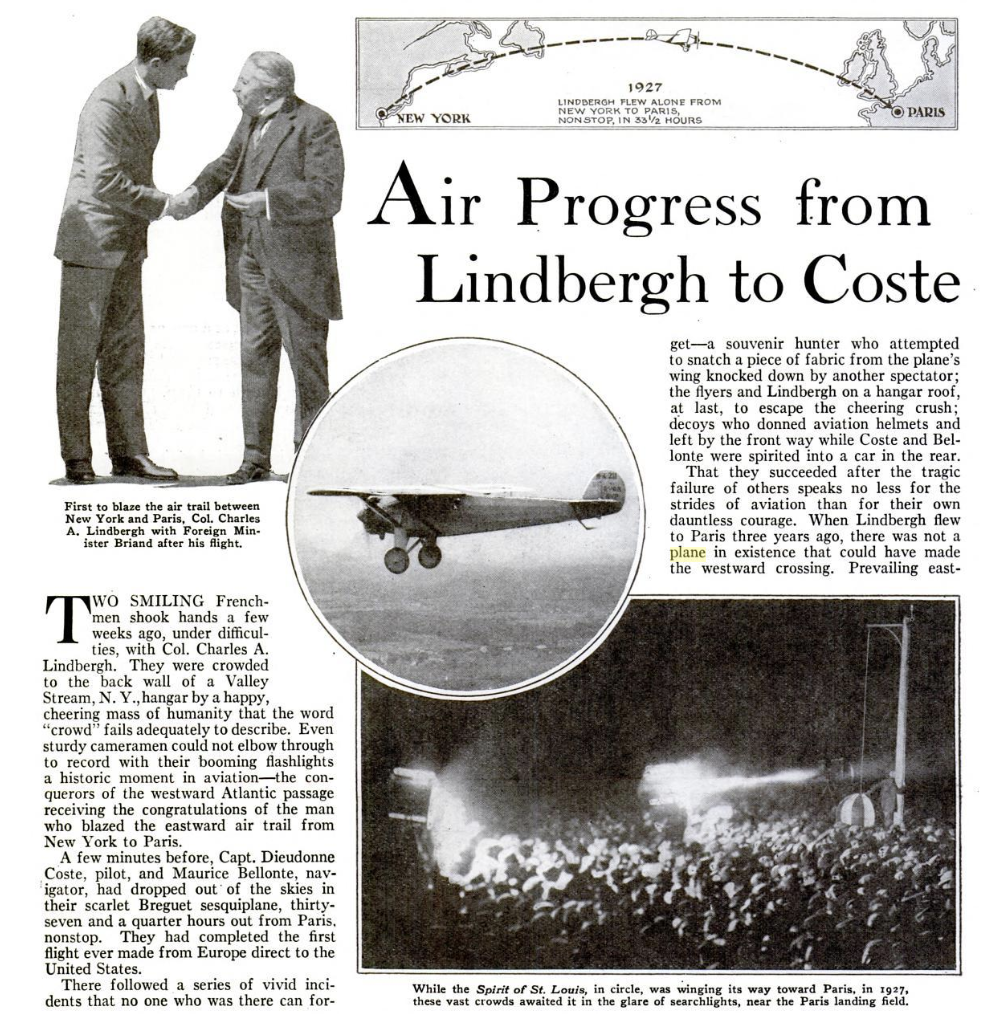
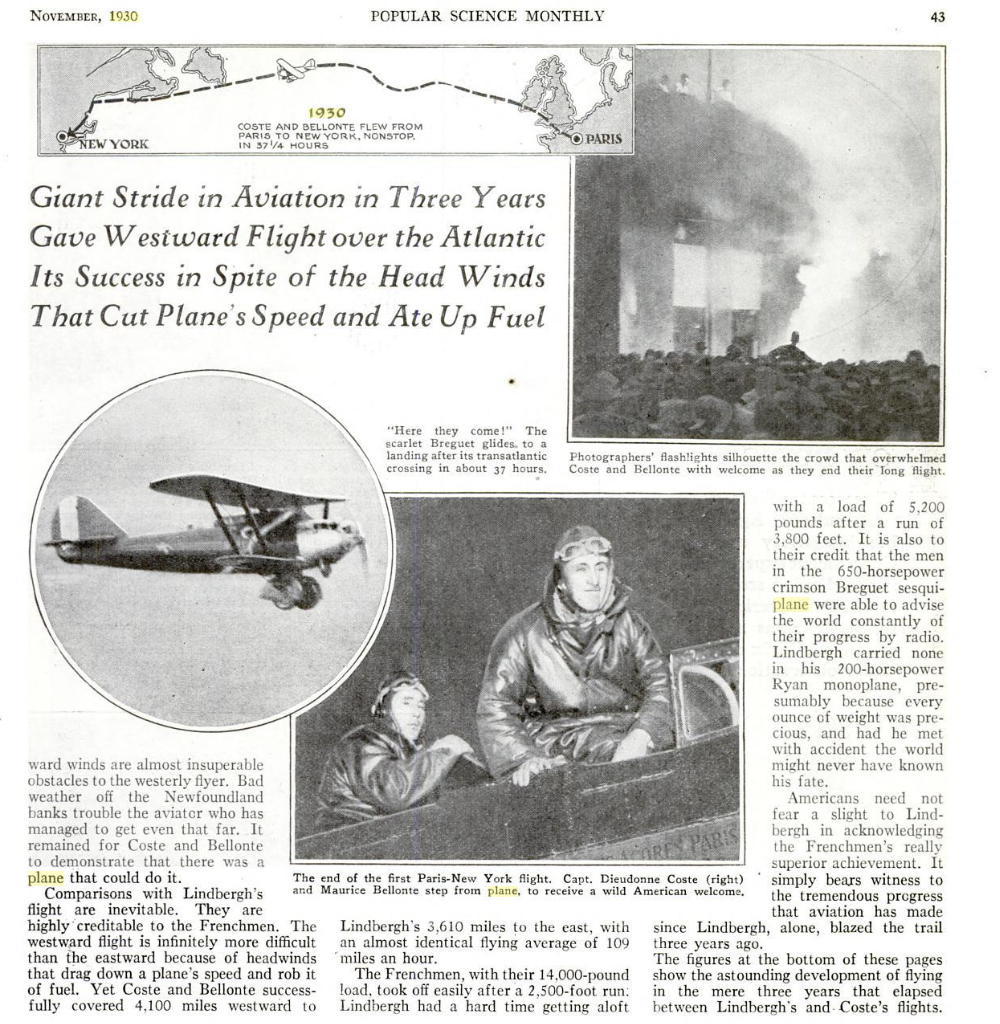
Excerpts Popular Science Monthly, November 1930
|
|
• The technical aspect of radio transmission can make us smile. It may be hard to believe, but less than 100 years ago, the mere fact that a plane could communicate with the ground was a technological breakthrough...
Witness this report from the New York Times:
"On the evening of September 3rd, when the Question Mark emerged in the skies above Long Island, radio reporters from America were prepared at Curtiss Field with microphones to capture the fliers' responses. They intended to share these reactions with listeners in France and North America..."
..."September 3 marked not only the first successful flight from Paris to New York, but the first successful retransmission by a French broadcasting company of an American radio program", the Chicago Daily Tribune reported.
• Costes and Bellonte's accomplishment in aviation history also served as a significant international radio event. It demonstrated the capabilities of short-wave broadcasting in reaching a worldwide audience.
|
|
Reception at the White House and
a tour of 37 American cities
|
|
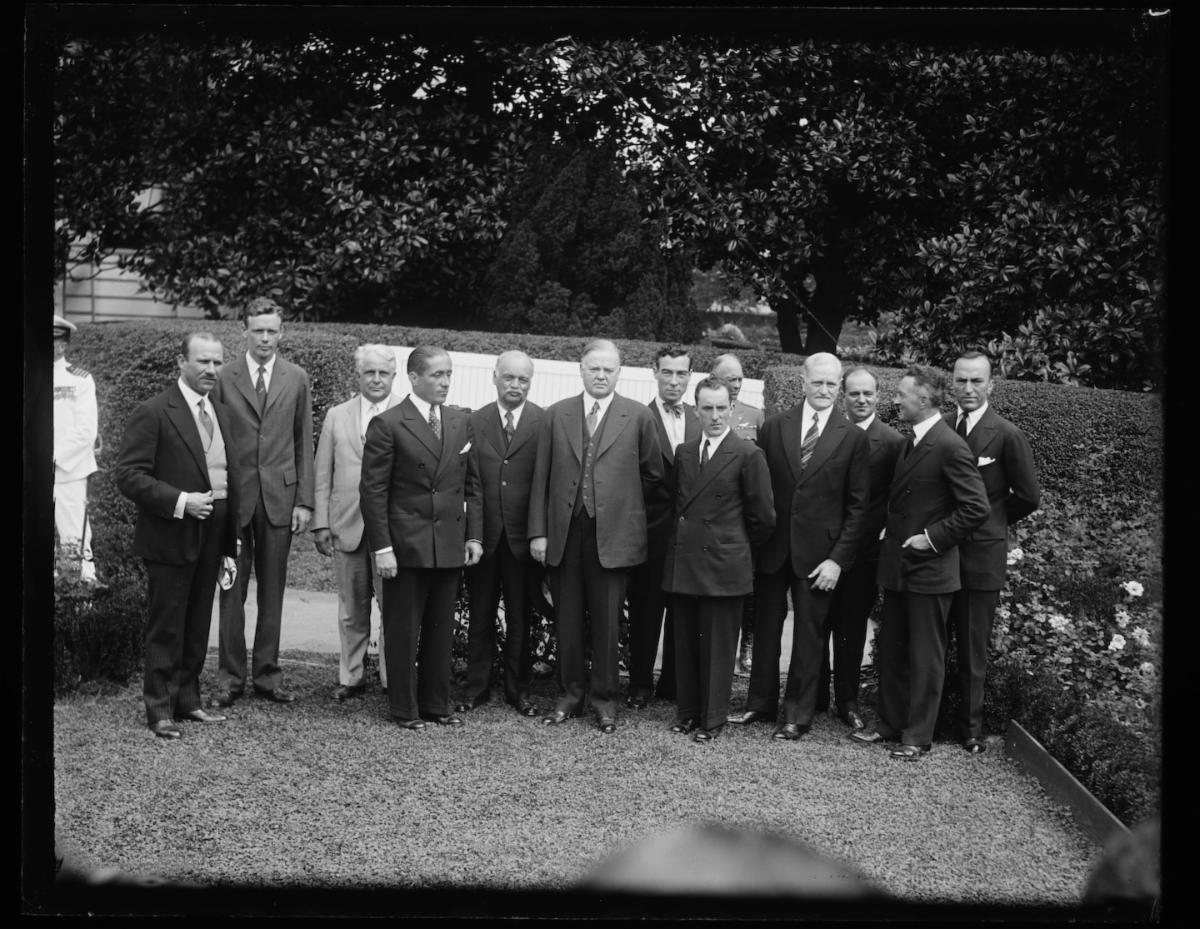
Top photo: Title: White House photograph for french pilots Dieudonne Coste and Maurice Bellonte. Left to Right: Jules Henry, French charge d'affaires; Charles Lindbergh; James J. Davis; Captain Dieudonne Coste; Vice President Charles Curtis; President Herbert Hoover; Clarence Young; Maurice Bellonte; John J. Pershing; Assistant Secretary F. Trubee Davison; Admiral Richard E. Byrd; Eddie Rickenbacker.
Bottom photo: showing the list of American cities visited
By Natacha Charles
|
|
• The two Frenchmen were warmly welcomed by enthusiastic New Yorkers in a ticker-tape parade in Manhattan, USA. They were honored guests of President Hoover at the White House, and they were given heroic receptions throughout their 25-day goodwill flying tour across the United States.
• Upon their landing in New York, President Herbert Hoover sent them a telegram:
« The news of your successful flight thrills the people of the entire American nation and upon their behalf and my own I send to you and your gallant companion Monsieur Maurice Bellonte our heartiest congratulations we shall delight to honor the heroic compatriots of those other brave Frenchmen whose undaunted efforts foreshadowed this triumph our people welcome to you is wholehearted and universal. Herbert Hoover. »
• And had the following exchange with his counterpart French President Gaston Doumergue:
Herbert Hoover [Released September 3, 1930. Dated September 2, 1930]
to [His Excellency Gaston Doumergue, President of the French Republic, Paris, France ]
" I join with the people of the American nation in rejoicing over the brilliant exploit of your distinguished aviators Captain Dieudonné Costes and Mr. Maurice Bellonte in successfully completing for the first time in history a nonstop flight from France to the United States.
France has established a glorious record. I hope that in the future many others of your citizens will come to us in this manner.
I extend to Your Excellency and to the people of France my heartiest congratulations.
Herbert Hoover"
• President Doumergue's response, dated September 3 and released with the president's message, follows:
"Deeply touched by the message which you have been good enough to send me in your name and in the name of the American people, I thank you therefor in the name of France. The exploit of the aviators Costes and Bellonte, in forming one more tie between France and the United States, will contribute greatly to the development of their friendship for centuries."
Gaston Doumergue
• This welcome climaxed at the White House:
Remarks Welcoming Captain Dieudonne Costes and Lieutenant Maurice Bellonte, September 08, 1930:
"It gives me great pleasure to welcome you here today. Every American recalls the 30 hours and more of intense emotion that gripped us all while our own Colonel Lindbergh was winging his way to Paris, and the sense of relief and joy that swept over the Nation when word came that he had safely landed. Our pride and happiness were redoubled when we heard of the magnificent reception given to him by the Government and people of France. Our hearts went out in fraternal warmth to those who had so royally welcomed our national hero.
Today, therefore, every American knows exactly what pride and happiness possesses every French heart, at the knowledge that these two gallant sons of France stand safely on our soil. We wish the people of France to know that our welcome of their two heroes is warm and spontaneous and universal. We rejoice that this brilliant feat has been accomplished. We are delighted to honor these two men who have thus dramatically recalled Colonel Lindbergh's call.
This return visit of French aviators is even more than an occasion for national rejoicing and international felicitations. What they have done, what the great American aviators have done, Byrd, Rickenbacker and the rest, both those who sacrificed themselves wholly and those who live, is a glory of the whole human race. It demonstrates again the high courage of mankind. It gives heart to all of us in whatever tasks engage us, for it proves that there are no limits to the courage of men and that there are no limits to what that courage can accomplish.
Again, gentlemen, I welcome you, on behalf of the American Government and on behalf of the American people."
Note: The ceremony was broadcast both on national radio and through an international hookup to France, Great Britain, and Germany.
• What is amazing is that on September 4, a few hours after being feted in Broadway, and presumably still fatigued from their 37 hours crossing the Atlantic, Costes & Bellonte took to the skies again, this time flying to Dallas, Texas, to collect the $25,000 prize that had been offered by Col. Easterwood, and then flew back east to Washington to meet with President Hoover....
For an account of this episode, and savory anecdotes, (Costes had forgotten his white scarf at his hotel and wouldn't fly without it), click on:
• In September and October, our two airmen embark on a highly celebrated American tour of prominent cities. Their plane, which has achieved legendary status, receives a triumphant welcome in each of these cities. This extraordinary journey across America, known as "the Friendship Tour," spans a remarkable flying distance of 19,000 km.
|
|
A jewel on display at Rockefeller Center, Manhattan |
|
Tribute to French Aviators Costes & Bellonte
Rockefeller Center, Maison Française
610 Fifth Avenue & 49th Street, New York, NY 10020
All photos: Thierry Chaunu 2021 © American Society Le Souvenir Français, Inc.
|
|
• Inside the black and grey lobby (side entrance of "La Maison Française", from the central alley nicknamed “the Channel”), there is an incredible reproduction in sterling silver of the famous plane "Point d'Interrogation" flown by French aviation pioneers Costes and Bellonte. It measures 28 1/2 inches in overall length, stretches 48 inches from wing-tip to wing-tip, and reaches 10 1/2 inches in height.
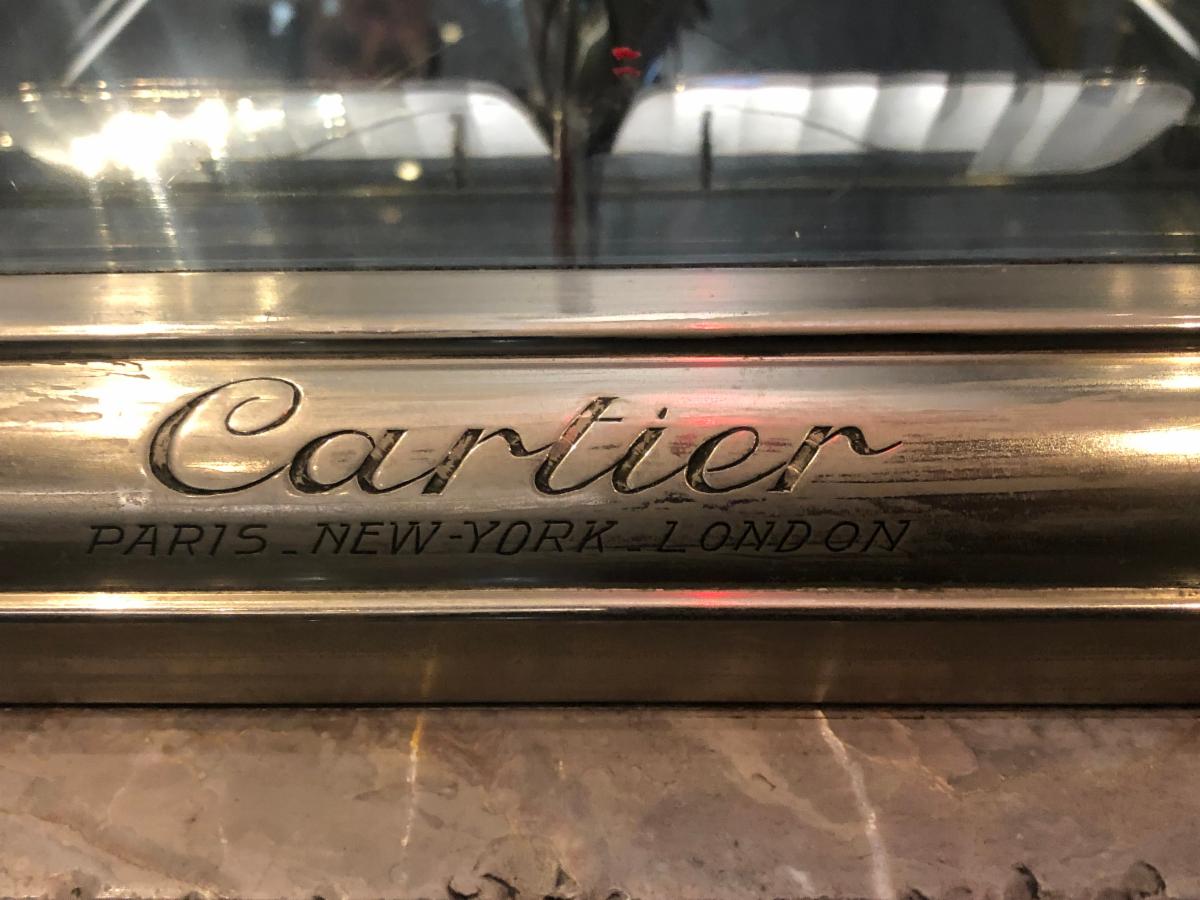
• It was executed by Cartier (whose 5th Avenue Mansion is two blocks away)
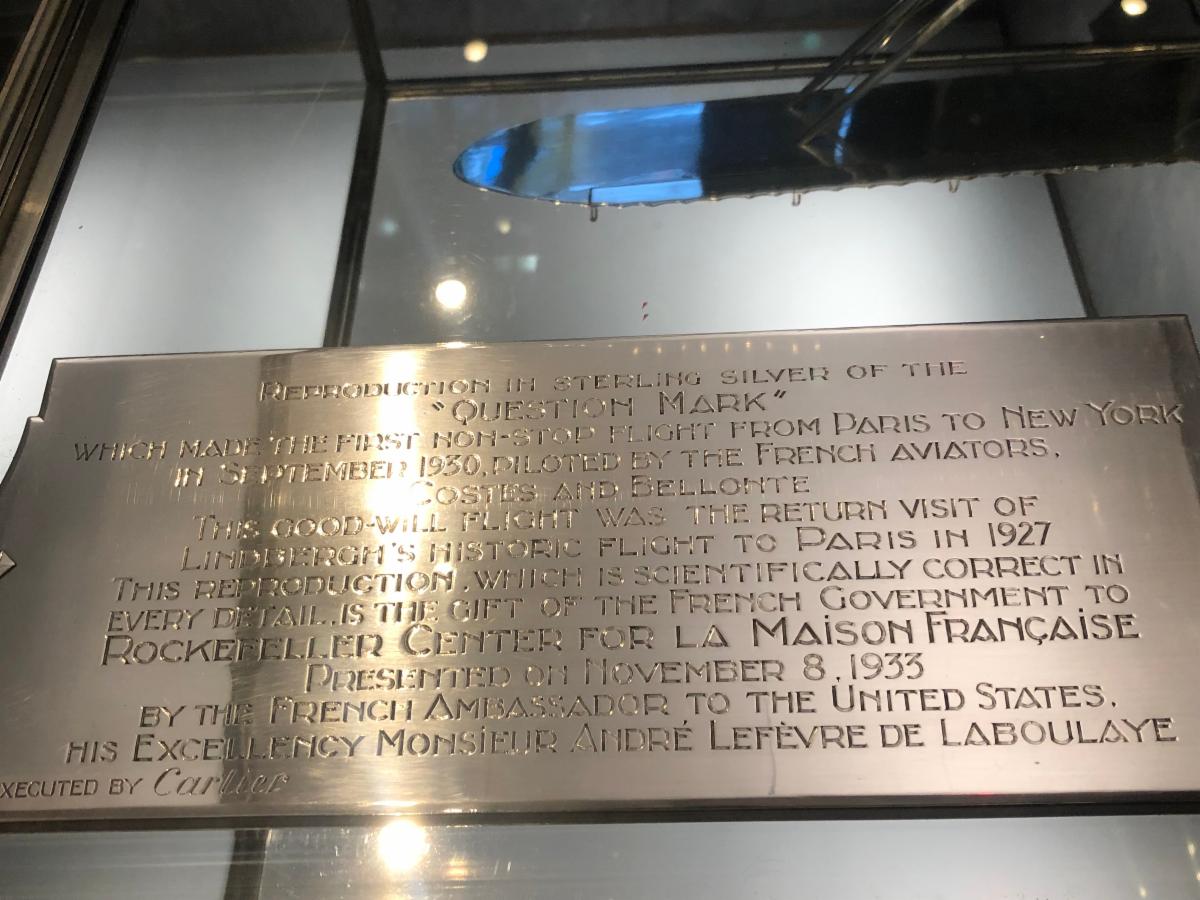
• Inscription of plaque:
“Reproduction in sterling silver of the
“Question Mark”
which made the first non-stop flight from Paris to New York
in September 1930, piloted by the French aviators
Costes and Bellonte
this good-will flight was the return visit of
Lindbergh's historic flight to Paris in 1927
this reproduction, which is scientifically correct in
every detail, is the gift of the French government to
Rockefeller center for la Maison française
presented on November 8, 1933
by the French ambassador to the United States.
his excellency monsieur André Lefevre de Laboulaye
executed by Cartier”
|
|
A triumphal homecoming in Paris and throughout France |
|
Homecoming to Paris prior to a "tour de l'amitié" around France.
click on photo above or click on the YouTube link below for a newsreel:
|
|
• Just as Lindbergh returned home on board an ocean liner in 1927, The crew of the Point d'Interrogation embarked with their disassembled plane on the liner France on October 17, 1930 in New York and arrived in Le Havre on the 24th. Quick reassembly and, on October 25, he flew to Le Bourget where he was welcomed like it should be. Upon their arrival that day, Gaston Doumergue, President of the Republic, decorated with the Legion of Honor Dieudonné Costes and Maurice Bellonte. The following weeks and months, the two aviators did a "Tour de France" with their revised "Point d'Interrogation" plane and were feted by enthusiastic crowds all over the country.
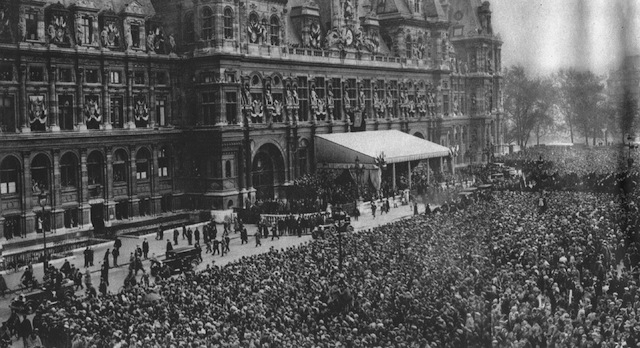
Costes and Bellonte were entitled to their return to France, at the end of October 1930, to an unusual ovation from the Parisians. Received at the Hôtel de Ville in Paris, an innumerable crowd had gathered in the square.
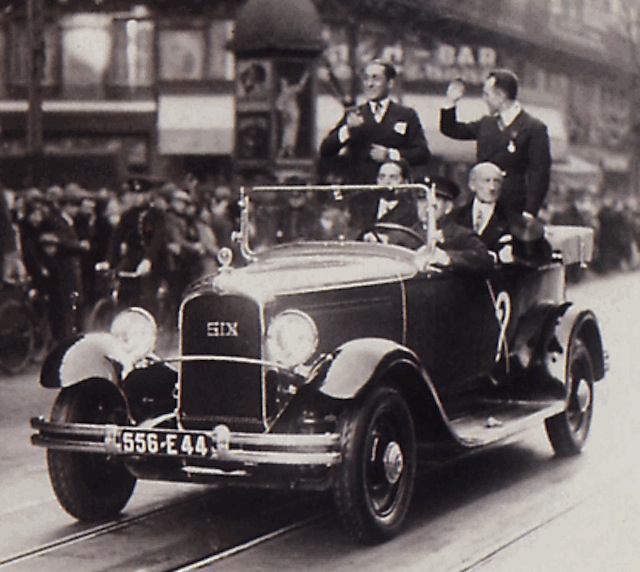
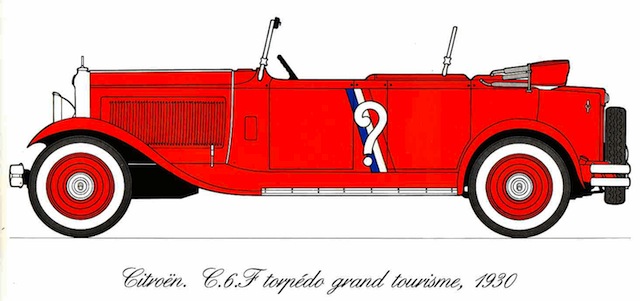
• For this occasion, André Citroën had a C6 F Torpedo grand tourer made in the colors and bearing the now famous question mark. The airmen were invited to pose in front of the model with which, to celebrate the event, they toured the major French cities following the triumphant welcome given to them at the Paris City Hall.
• André Citroën, passionate about aeronautics, like many people in the automotive world, took advantage of this event to offer this nice gift to the pilots, and expressed its avant-garde spirit by showing this vehicle everywhere in France, another PR "coup" from this gifted entrepreneur who was the first to advertise on the Eiffel Tower.
• In fact, this C 6 family torpedo painted in bright red reminiscent of the color of the plane adorned with the French flag and the famous question mark was also sold as miniature toys to French children.
|
|
What happened to our two heroes afterwards? |
|
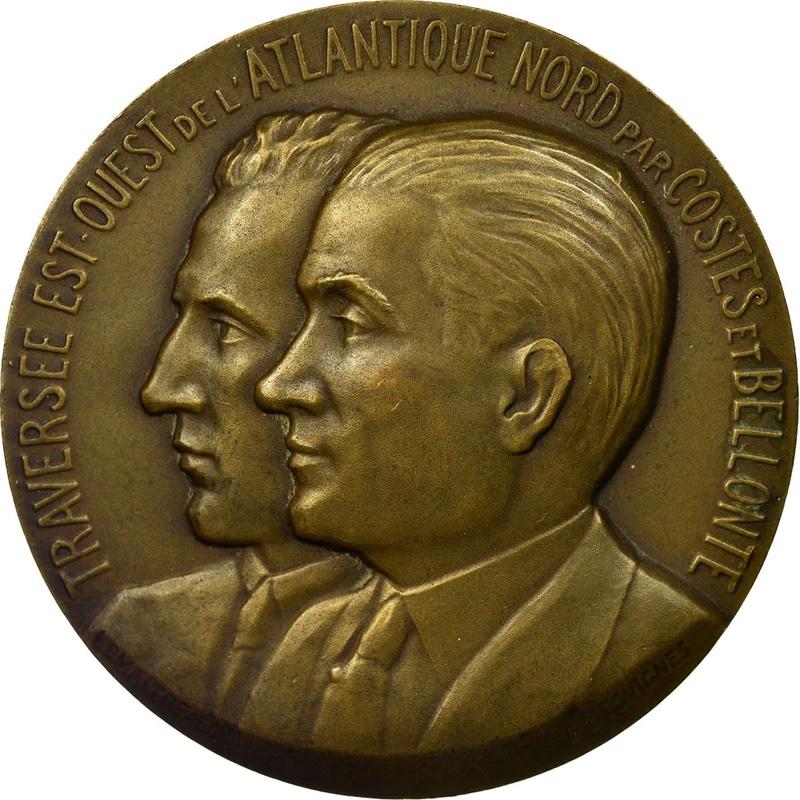
Photo: commemorative medal
|
|
• After their last exploit and their universal fame, both still had many decades of active life and, eventually retirement. Naturally, aviation remained their prime professional interest, but Dieudonné Costes was more of an entrepreneur. And, most importantly the advent of World War II impacted them in different ways...
Dieudonné Costes:
Costes served in various roles in the years following his accomplishment.
• In 1933, he held the position of technical inspector when Air France was established.
• Subsequently, in 1936, he became the administrator of Hispano-Suiza, a company specializing in engine manufacturing, where he was responsible for handling commercial affairs.
• He also founded in 1936 the Mont Dore ski resort in Central France.
• After the sudden collapse of France in 1940, he was approached by the Abwehr (the German espionnage service) and is asked to collaborate on aviation matters. He first declined, but eventually accepted, only to give them information without much importance on the French Air Force in North Africa, and when he was sent to America through Spain and Argentina, he immediately reported to the FBI and Edgard Hoover, who arranged for him to pass fake informations to the Germans.
• After the war when he returned to France he was accused of treason, but eventually proved his innocence with the help of the US Embassy and resumed his entrepreneurial career, mainly developing his ski resort and serving as Deputy mayor of his town.
• He died in Paris on May 18, 1973.
Maurice Bellonte:
• In November 1941, he joins the underground Resistance movement "Combat".
• February 1943: he is Chief of Staff in the 3rd office of the French A.S. (Secret Army) of the Eastern Pyrenées region in occupied France.
• July 1944: he is wounded, arrested and imprisoned by the German Gestapo police in the citadel of Perpignan. Miraculously released after the German retreat, he resumes his place in the F.F.I (French Forces of the Interior).
• After the liberation of France, he participates in the organization of the Directorate of Civil Aviation in February 1945.
• In 1946, he is nominated Chairman of the Air Safety Commission at the General Civil Aviation Inspectorate. He directed the BEA (Bureau d'enquêtes et d'Analyses pour la sécurité de l'aviation civile, the French equivalent to the National Transportation Safety Board) between 1959 and 1962.
• In 1960, his visit to New York on board a Boeing prompted interviews in several American newspapers and magazines.
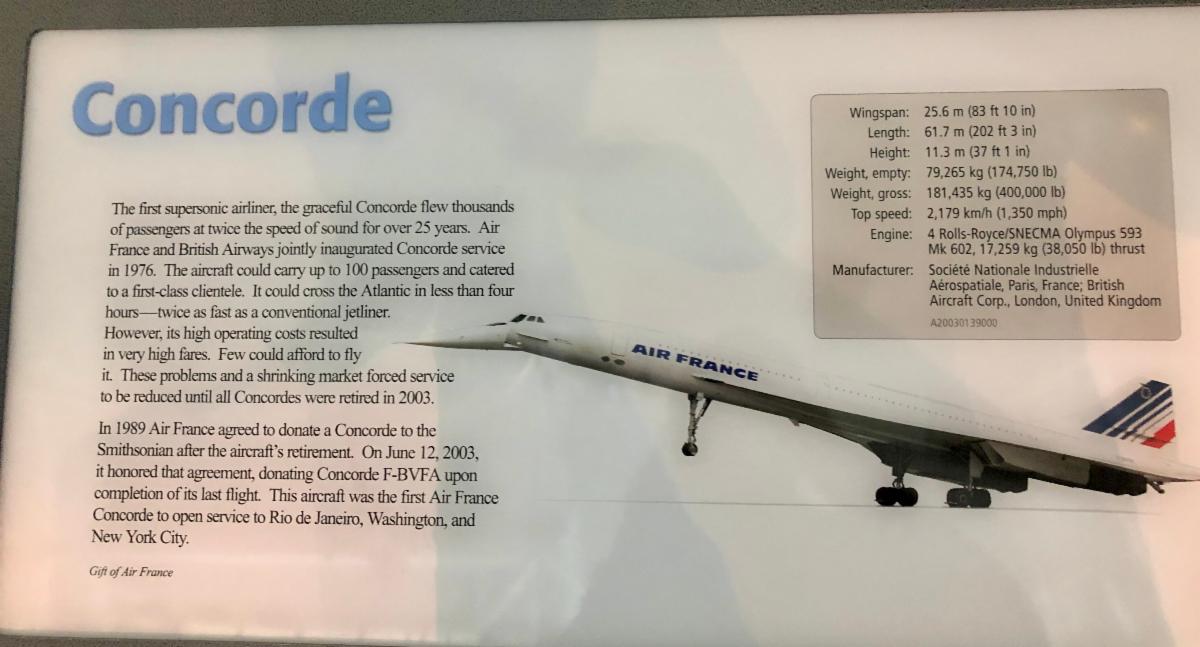
• A guest of Air France in 1977, Maurice Bellonte flew a Concorde on the first Paris-New York supersonic commercial flight, which this time lasted 3:30 hours. That year, he publishes "Le Premier Paris-New York" with Plon, where he recounts the period from his meeting with Costes until the exploit of 1930.
• 1980: he is promoted to the Grand Cross of the Legion of Honor by French President Valéry Giscard d'Estaing.
In 1979, Maurice Bellonte wrote to a friend:
“I was eleven years old when every Thursday, with my young classmates, I took the road to Bagatelle to see Santos-Dumont fly on one of his funny machines. In front of these flea jumps, the conquest of the air still seemed to me to be a dream. And since ! I have witnessed the dizzying progress of aviation. I saw the performance increase by shaking up all the forecasts. In 1909, Louis Blériot crossed the English Channel on a plane of his construction pulled by a 25 horsepower engine. Today, a little over seventy years later, Concorde in regular operation on the North Atlantic connects the two largest economic communities in the world at a speed of 2300 km/h. The birth of aviation was yesterday..."
|
|
France and America, two pioneering nations |
|
Tribute to Octave Chanute
French-American "Father of aviation"
|
|
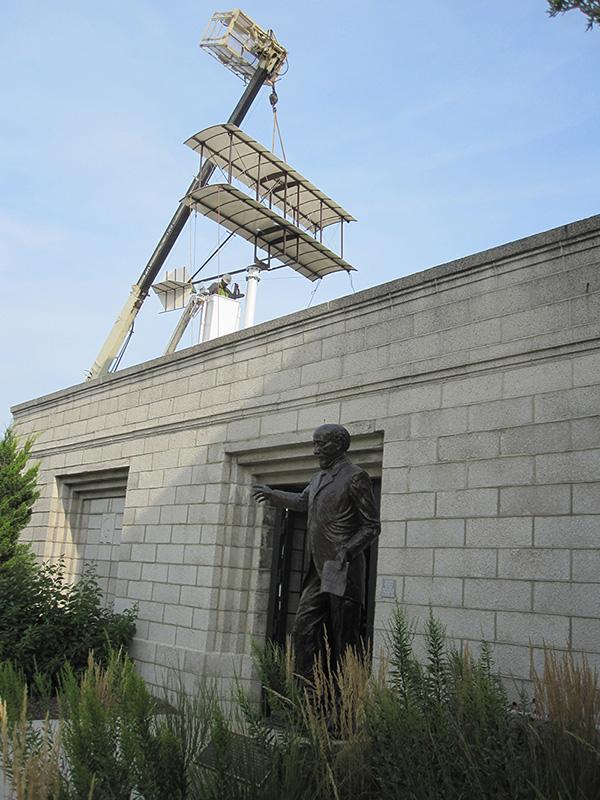
Marker & Statue, Octave Chanute
Marquette Park, 6918 Oak Ave, Gary, IN 46403
Middle: The Frieze of American History at the US Capitol depicts Leonardo da Vinci, Samuel Langley, Octave Chanute, and the Wright Brothers.
|
|
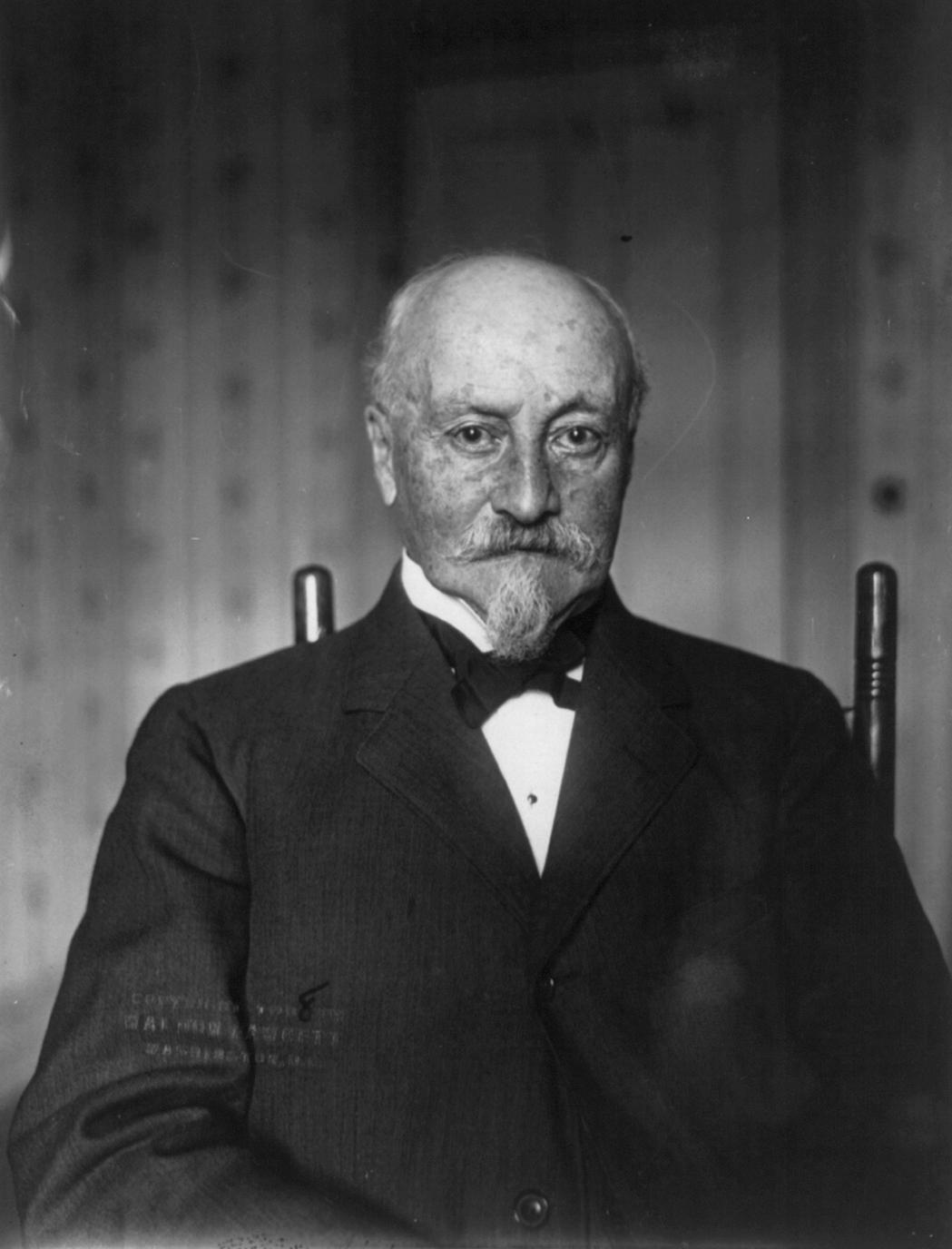
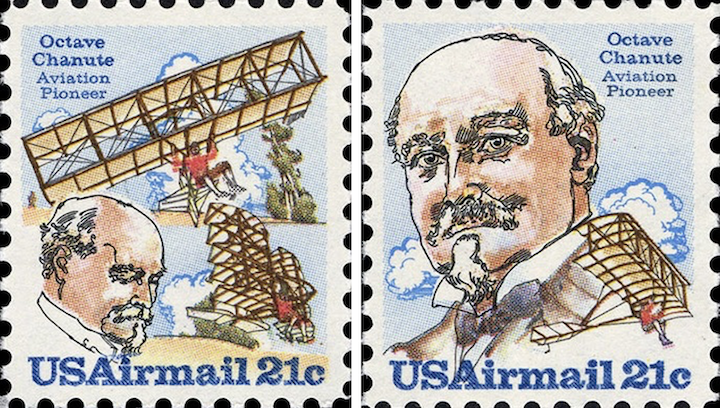
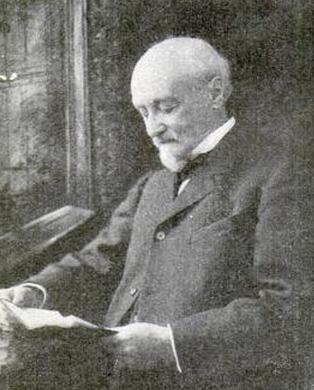
• If Costes and Bellonte have faded into a relative oblivion, they are not the only ones, unfortunately. Unless one is well versed in the history of aviation, the name Octave Chanute is unknown to the general public.
• Octave Chanut, later spelled Chanute (born in Paris, Feb 18, 1832, died in Chicago, Nov 23, 1910) came to the US with his family when his father, Joseph, a professor at the Collège de France, received a job offer to become Vice President of Jefferson College in Louisiana. Octave studied civil railroad engineering and built many railroads throughout America.
He devoted his later years to aviation and became one of the pioneers of flights. Too old to fly himself, he became a mentor and close friend to the Wright Brothers.
• Plaque on the pedestal:
“The figure of Octave Chanute is pointing toward the dune where, in July of 1896, he conducted his famous experiments with gliders. These experiments had a dramatic impact on the history of aviation. The publicity generated by the experiments prompted the Wright Brothers to contact Octave Chanute. Chanute became their mentor and advisor and was the first person that the Wright Brother contacted after their successful flight at Kitty Hawk on December 17th, 1903. It is said that Octave Chanute is the grandfather of flight."
This statue was dedicated by the Society for the Restoration of the Gary Bathing Beach Aquatorium and Octave Chanute's Place In History, Inc. on December 17th, 2003”
• Inscription of the marker:
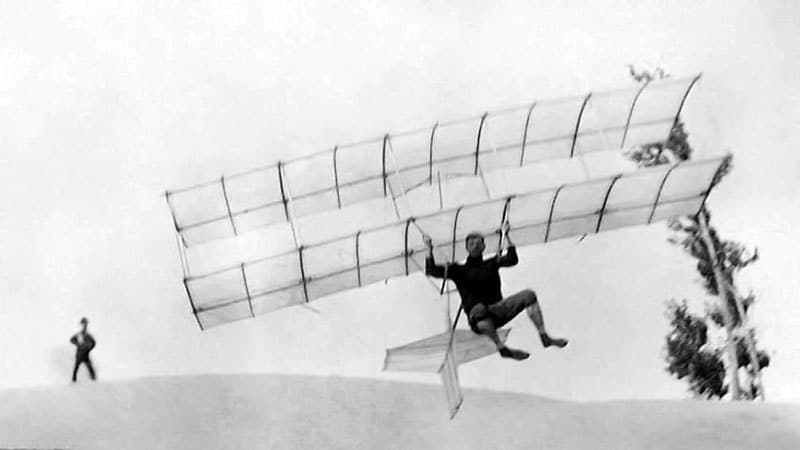
“Octave Chanute arrived at Miller Beach, Gary, Indiana on June 22, 1896 to perform gliding flight experiments in the dunes just west of this site. Over 700 successful flights provided him with significant aerodynamic data. Chanute willingly shared his data enabling the Wright Brothers and other pioneers to develop powered flying machines. This marker is dedicated to Chanute and his assistants whose gliding experiments here helped make sustained flight a reality."
Erected 1996 by National Soaring Museum, Affiliate Of The Soaring Society Of America; sponsored by The Chicagoland Glider Council.”
|
|
Marker, Octave Chanute, "the father of aviation" |
|
Marker «Octave Chanute, 1832 – 1910 — "The Father of Aviation”
5 W Main St, Chanute, KS 66720
|
|
• Inscription:
"If he (Chanute) has not lived, the entire history of progress in flying would have been other than it has been, for he encouraged not only the Wright Brothers to persevere in their experiments, but (his) private correspondence with experimenters in all parts of the world was of great volume.
"No one was too humble to receive a share of his time.
In patience and goodness of heart, he has rarely been surpassed.
Few men were more universally respected and loved." - Wilbur Wright
"the Father of Aviation"
Octave Chanute • 1832-1910
Erected 2003.”
|
|
Marker «Chanute Announces Wright Brothers' Flight"
Chanute - Wright Memorial
5 W Main St, Chanute, KS 66720
|
|
• Inscription:
“The Wright Brothers received their copy of Mr. Chanute's book personally from the author, who became both their friend and advisor.
Mr. Chanute visited the Wrights at Dayton, Oh. and Kitty Hawk, N.C.. Illness caused Mr. Chanute to miss the Wright Brothers' first flight; he was first to formally announce that the Wrights had flown in a heavier than air machine.”
Erected 2003."
|
|
Plaque , Octave Chanute
Marquette Park, 6918 Oak Ave, Gary, IN 46403
|
|
• Inscription:
“Octave Chanute arrived at Miller Beach, Gary, Indiana on June 22, 1896 to perform gliding flight experiments in the dunes just west of this site. Over 700 successful flights provided him with significant aerodynamic data.
Chanute willingly shared his data enabling the Wright Brothers and other pioneers to develop powered flying machines.
This marker is dedicated to Chanute and his assistants whose gliding experiments here helped make sustained flight a reality.”
Erected 1996 by National Soaring Museum, Affiliate Of The Soaring Society Of America; sponsored by The Chicagoland Glider Council."
|
|
Marker «Octave Chanute's Progress in Flying Machines"
Chanute - Wright Memorial
5 W Main St, Chanute, KS 66720
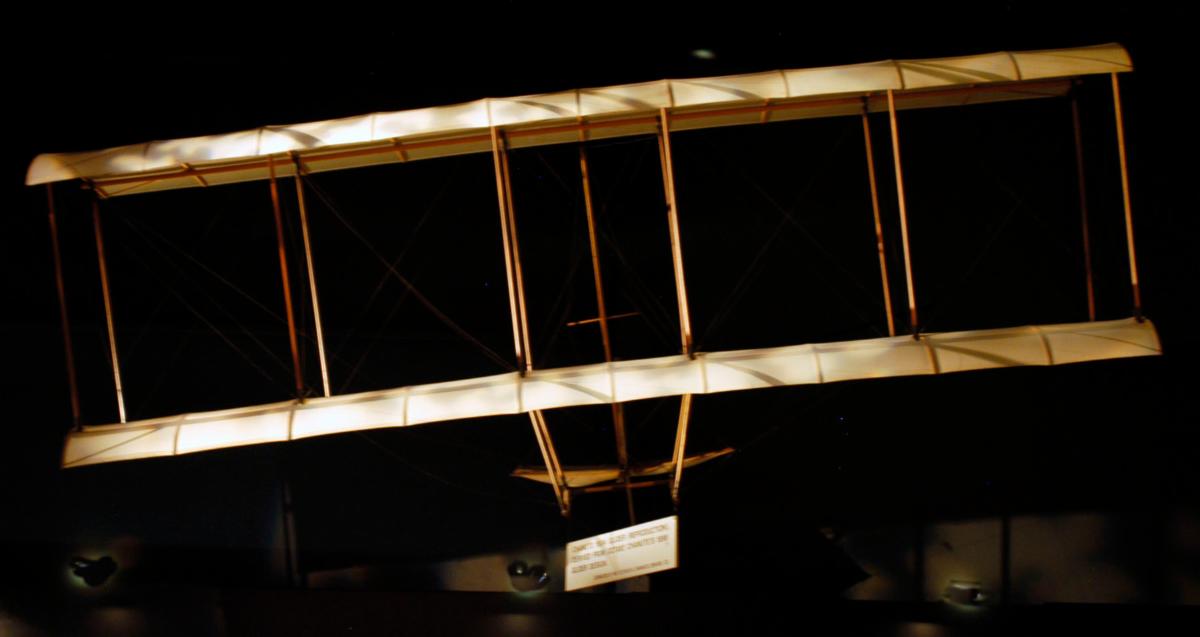
Photo: U.S. Air Force photo - Dayton, Ohio -- Reproduction of Octave Chanute's glider in the Early Years Gallery at the National Museum of the United States Air Force.
|
|
• Inscription:
“Mr. Chanute's 1891 book "Progress in Flying Machines" made him the world's first aviation historian, but, more importantly, for the first time experimenters could read of work done before them and not waste time by repetition.
His 1896 biplane design was so successful that it underwent few changes during the next 50 years and was a model for the "Wright Flyer" at Kitty Hawk, N.C.”
Erected 2003."
|
|
EPILOGUE:
From Paris to New York under 3 hours
|
|
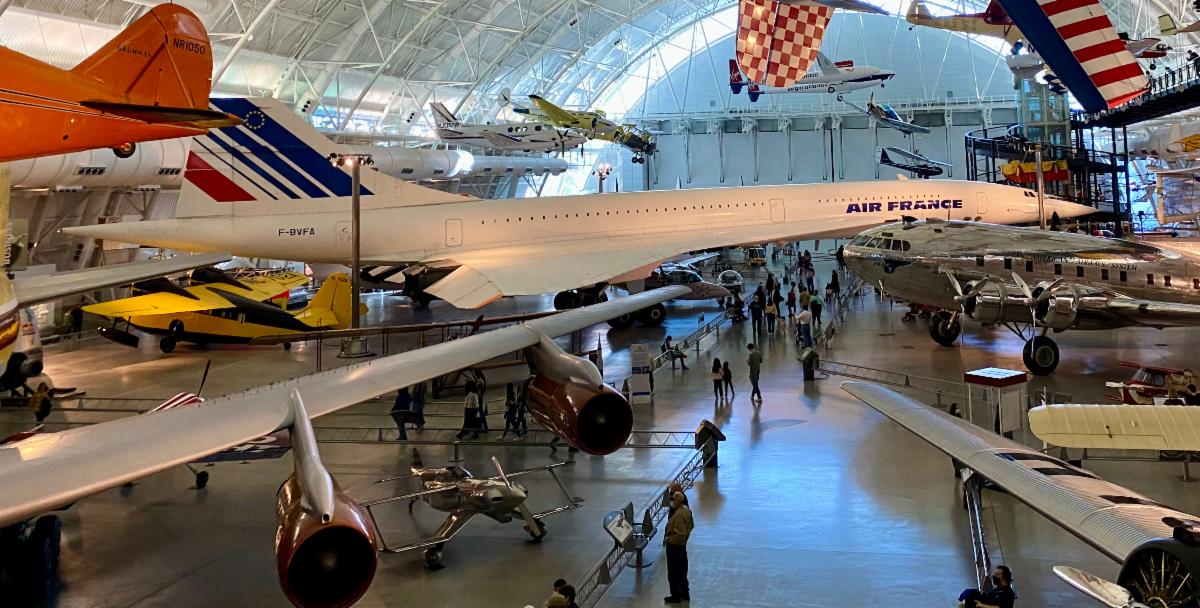
Concorde on display at the National Air & Space Museum, Smithsonian
Steven F. Udvar-Hazy Center, 14390 Air and Space Museum Pkwy, Chantilly, VA 20151
Photo (top): Katia Graytok 2021, Photo (bottom): Thierry Chaunu, 2021
|
|
A new record was set on December 24, 1989, when the Concorde plane made it from Paris to New York in 2 hours, 59 minutes, and 40 seconds – ten times faster than the time set by Charles Lindbergh in 1927!
In 1989, Air France signed a letter of agreement to donate a Concorde to the National Air and Space Museum upon the aircraft's retirement. On June 12, 2003, Air France honored that agreement, donating Concorde F-BVFA to the Museum upon the completion of its last flight. This aircraft was the first Air France Concorde to open service to Rio de Janeiro, Washington, D.C., and New York and had flown 17,824 hours.
• Inscription of plaque:
AIR FRANCE: "Lorsque viendra le jour d'exposer Concorde dans un musée, la Smithsonian Institution a d'ores et déjà choisi, pour le Musée de l'Air et de l'Espace de Washington, un appareil portant les couleurs d'Air France."
"When the day comes to exhibit Concorde in a museum, the Smithsonian Institution has already chosen, for the Air and Space Museum in Washington, an aircraft bearing the colors of Air France."
|
|
Legacy: two heroes who deserve more recognition
• T. J. C. Martyn, in an article in The New York Times, wrote that flight signified that ''not only France and America, but other countries, too, look forward to the day when regular air travel across the ocean will be a commonplace.''
• More than just the first transatlantic flight from Paris to New York, the success of Costes and Bellonte is a vindication of French aviation in the eyes of pilots, builders, and politicians. Considering the superiority of French aviation over the rest of the world after the war, Lindbergh's first transatlantic crossing was poorly received in Europe, even though the young American was triumphantly welcomed at Le Bourget. Following this "affront," Costes and Bellonte's feat is seen by the French as a rehabilitation of French aviation. The press triumphantly reports on the success of this crossing and glorifies, in a patriotic manner, the achievement of the two pilots and the power of the French aeronautical industry which continues after the Concorde, to glow today with Airbus and military fighter jets such as the Rafale.
|
|
FINAL - PART TWELVE OF THE SERIES
"LAFAYETTE, GUEST OF THE NATION"
If you missed the episodes from our past Bulletins...
• President James Monroe invited Lafayette, the last surviving major general of the American Revolutionary War, to tour the United States, officially to celebrate the nation's 50th anniversary but also to instill the "spirit of 1776" in the next generation of Americans at a time of great political divide. His tour drew large crowds and sparked a renewal of patriotism.
• From July 1824 to September 1825, Lafayette made a tour of all 24 States in the United States. He was received with a hero's welcome everywhere he stopped. Immense crowds, children, old veterans would come from miles away and wait hours to have a chance to see him, approach him, touch him. Many honors and monuments were presented to commemorate and memorialize the visit.
• The 24 states visited were: Alabama, Connecticut, Delaware, Georgia, Illinois, Indiana, Kentucky, Louisiana, Maine (ex-Massachusetts / North part), Maryland, Massachusetts, Mississippi, Missouri, New Hampshire, New Jersey, New York, North Carolina, Ohio, Pennsylvania, Rhode Island, South Carolina, Tennessee, Vermont, Virginia, Washington D.C.
• The main means of transportation were stagecoach, horseback, canal barge, and steamboat.
• Throughout the years 2024 and 2025 each city will celebrate this most illustrious Frenchman, ranked alongside the Founding Fathers, practically on a par with George Washington. If anyone harbors any doubt about it, one only needs to read some of the hundreds of local newspaper articles and the accounts or memoirs of contemporary witnesses accounts.
|
|
• Several of his stops are memorialized with markers and plaques, some decades-old, and an increasing number of brand new ones, thanks to the energy and enthusiasm deployed by Julien Icher, president of the LafayetteTrail.org, whose goal is to dedicate all 175 markers by 2024.
• These new markers from the LafayetteTrail.org are all made in the same distinctive blue and red cast metal and signed by the William C. Pomeroy Foundation which is generously funding this gigantic project.
• The American Society of Le Souvenir Français Inc. is honored to partner with these two like-minded organizations, as well as all other American patriotic associations and volunteers who are participating in these celebrations, under the umbrella of America250.
|
|
This month we complete our narration of this remarkable journey of the corresponding month 199 years ago, while keeping you abreast of the many celebrations planned by the local committees of the American Friends of Lafayette in 2024 and in 2025.
For this series we borrow primarily from the testimonies of a privileged close witness, Auguste Levasseur, Lafayette’s personal secretary, who traveled along with the Marquis and his son, George Washington Lafayette, and who published his extensive daily journal: “Lafayette en Amérique 1824-1825, ou Journal d'un voyage aux Etats-Unis" (Published by the Librairie Baudoin, Paris, in 1829). We also rely on other well-documented sources, such as Samuel Lorenzo Knapp. “Memoirs of General Lafayette : with an Account of His Visit to America and His Reception By the People of the United States; From His Arrival, August 15th, to the Celebration at Yorktown, October 19th, 1824”(Published in November, 1824)
|
|
ITINERARY AUGUST & SEPTEMBER 1825 |
|
• Late July – Departs Lancaster for Baltimore, Maryland, via Port Deposit and Havre de Grace, Maryland. Spends two days in Baltimore.
• Late August – Lafayette returns to Mount Vernon.
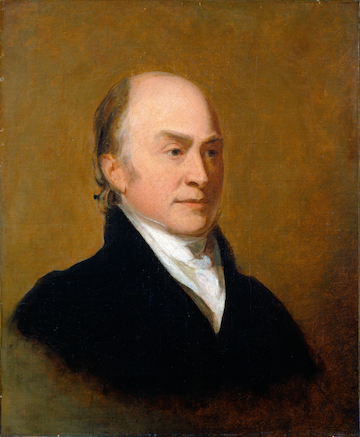
• September 6 – Lafayette arrives in Washington, D.C., where he meets the new U.S. President John Quincy Adams, and celebrates his 68th birthday at a White House banquet with President Adams.
• September 7 – Lafayette leaves Washington and returns to France on the frigate USS Brandywine.
|
|
Visit of Lafayette, Leesburg, VA
August 9, 1825
|
|
Marker, Lafayette Tour, Baptism at Leesburg, VA
August 9, 1825
15789 Temple Hall Ln, Leesburg, VA 20176
|
|
• In early August, while visiting with President John Quincy Adams in Washington, Lafayette expressed the wish to visit with his old friend James Monroe, who had retired to his plantation south of Leesburg. John Quincy Adams personally took Lafayette in his carriage. This is when the famous anecdote of the bridge toll keeper happened: he recognized Lafayette and wanted to let him pass for free, to which the President of the United States answered that on this occasion, the visit was private...and gladly paid the toll...!
• “We left the table about sunset, and went to a Mr. Mason’s, where two children were baptized, one named Mary La Fayette, to which the General stood sponsor, and the other Maria Louisa, for whom, at the request of the parents, Mr. Monroe and myself were sponsors.” Memoirs, John Quincy Adams.
• Inscription:
“Lafayette's tour
On august 9, 1825, general
Lafayette, an abolitionist,
attended baptism of Maria
and Mary, youngest daughters of
William Temple Thomson mason.
William G. Pomeroy Foundation 2022”
|
|
Visit of Lafayette, Jeffersonton, VA
August 23, 1825
|
|
Marker, Lafayette Tour, Jeffersonton, VA
August 23, 1825
5073 Jeffersonton Rd, Jeffersonton, VA 22724
|
|
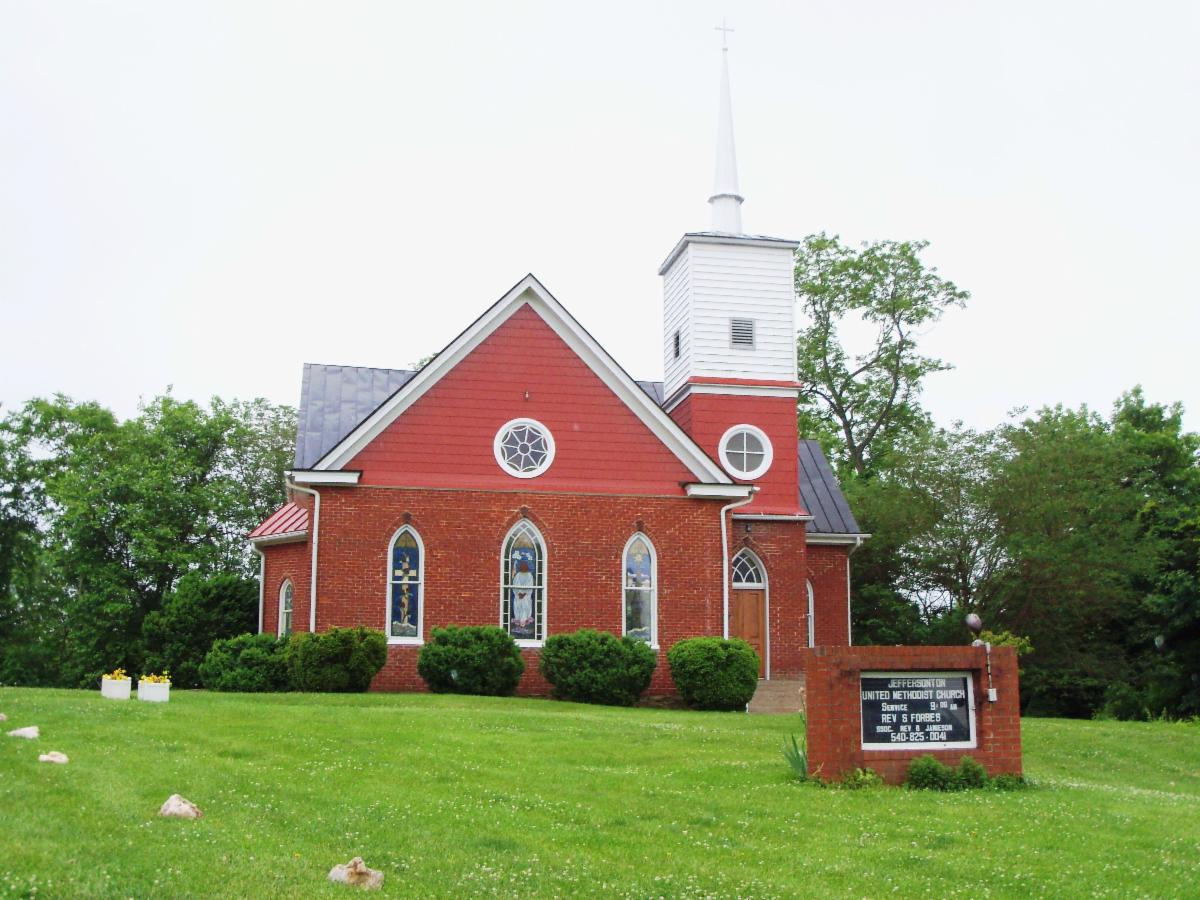
• On Aug. 23, 1825, General Lafayette arrived in Jeffersonton, Virginia, where he was greeted by “about 50 soldiers and at least 100 men.”
• Inscription:
“Lafayette's tour
On august 23, 1825, general
Lafayette was received here
by the citizens. After dining,
he traveled north with a large
escort of mounted horsemen.
VA Sons of the American Revolution
William G. Pomeroy Foundation 2022”
|
|
Visit of Lafayette, Warrenton, VA
August 23, 1825
|
|
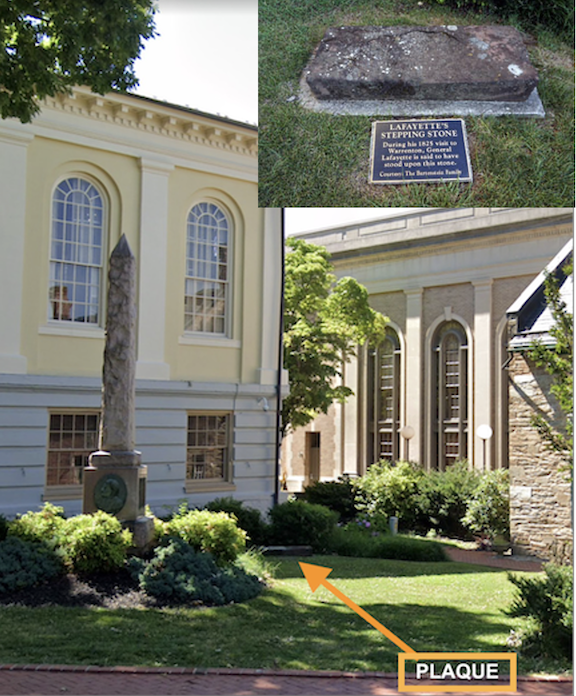
Lafayette’s Stepping Stone, Warrenton, VA
August 23, 1825
Courtyard, Between the Fauquier History Museum and the Old Jail
10 Ashby St, Warrenton, VA 20186
Photo: Image capture June 2022 (c) Google 2022 (annotated by Thierry Chaunu)
|
|
• It is touching to see that even the most trivial and anecdotical aspect of Lafayette's whereabouts are memorialized in such a way. It is a fine illustration of the veneration that this great man elicited then, and continues to inspire nowadays in America. No other country would be so faithful to his memory.
Indeed, Lafayette was, and still is, the "best friend that America ever had".
• Inscription:
"Lafayette Stepping Stone"
“During his 1825 visit to Warrenton,
General Lafayette
is said to have stood upon this stone.
Courtesy: The Bartenstein Family”
|
|
Lafayette is honored by new President Adams at a White House banquet on his 68th anniversary, the day before his departure. |
|
• Lafayette carried on with his travels in Virginia, concluding with a final visit to former presidents Jefferson, Madison, and Monroe. A sense of profound sadness lingered as Lafayette bid farewell to this gathering, as they were aware that it would probably be their last time together.
• Excerpts from Auguste Levasseur's Journal:
..."On the 6th of September, the anniversary of Lafayette’s birth, the president gave a grand dinner ... Although a large company partook of this dinner, and it was intended to celebrate Lafayette’s birth-day, it was very serious, I may say, almost sad. We were all too much pre-occupied by the approaching journey to be joyous: we already felt, by anticipation, the sorrowfulness of separation. Towards the conclusion of the repast, the president, contrary to diplomatic custom, which forbids toasts at his table, arose and proposed the following:
“To the 22d of February and 6th of September, birthdays of Washington and Lafayette.” Profoundly affected to find his name thus associated with Washington, the general expressed his thanks to the president, and gave this toast: “To the fourth of July, the birth-day of liberty in both hemispheres.”
[...]
..."At eleven o’clock (Sept 7) he (Lafayette) left his apartment, slowly passed through the crowd which silently pressed after him, and entered the principal vestibule of the presidential dwelling, where the president, surrounded by his cabinet, various public officers, and principal citizens, had waited for him a few minutes. He took his place in the centre of the circle which was formed on his approach [...] the president, then visibly agitated by emotion, addressed him as follows, in the name of the American nation and government:
—
“The invitation was transmitted to you by my venerable predecessor; himself bound to you by the strongest ties of personal friendship, himself one of those whom the highest honours of his country had rewarded for blood early shed in her cause, and for a long life of devotion to her welfare. [...] It were scarcely an exaggeration to say, that it has been, to the people of the Union, a year of uninterrupted festivity and enjoyment, inspired by your presence. You have traversed the twenty- four states of this great confederacy: You have been received with rapture by the survivors of your earliest companions in arms: You have been hailed as a long absent parent by their children, the men and women of the present age: And a rising generation, the hope of future time, [...] have vied with the scanty remnants of that hour of trial, in acclamations of joy at beholding the face of him whom they feel to be the common benefactor of all.
[..]
“Go, then, our beloved friend—return to the land of brilliant genius, of generous sentiment, of heroic valour; to that beautiful France, the nursing mother of the twelfth Louis, and the fourth Henry; to the native soil of Bayard and Coligni, of Turenne and Catinat, of Fenelon and D’Aguesseau. In that illustrious catalogue of names which she claims as of her children, and with honest pride holds up to the admiration of other nations, the name of Lafayette has already for centuries been enrolled [...]Yet we, too, and our children, in life and after death, shall claim you for our own. You are ours by that more than patriotic self-devotion with which you flew to the aid of our fathers at the crisis of their fate. Ours by that long series of years in which you have cherished us in your regard. Ours by that unshaken sentiment of gratitude for your services which is a precious portion of our inheritance. Ours by that tie of love, stronger than death, which has linked your name, for the endless ages of time, with the name of Washington..."
• To conclude our series we leave the last word to Lafayette, who responded with an address thanking his hosts. We will cite only his last sentence, and Levasseur's description of the scene:
..."God bless you, sir, and all who surround us. God bless the American people, each of their states, and the federal government. Accept this patriotic farewell of an overflowing heart; such will be its last throb when it ceases to beat.”
In pronouncing these last words, General Lafayette felt his emotion to be rapidly increasing, and threw himself into the arms of the president, who mingled his tears with those of the national guest, in repeating those heart-rending words, Adieu! Adieu! "
|
|
Return to France on board the frigate USS Brandywine...
|
|
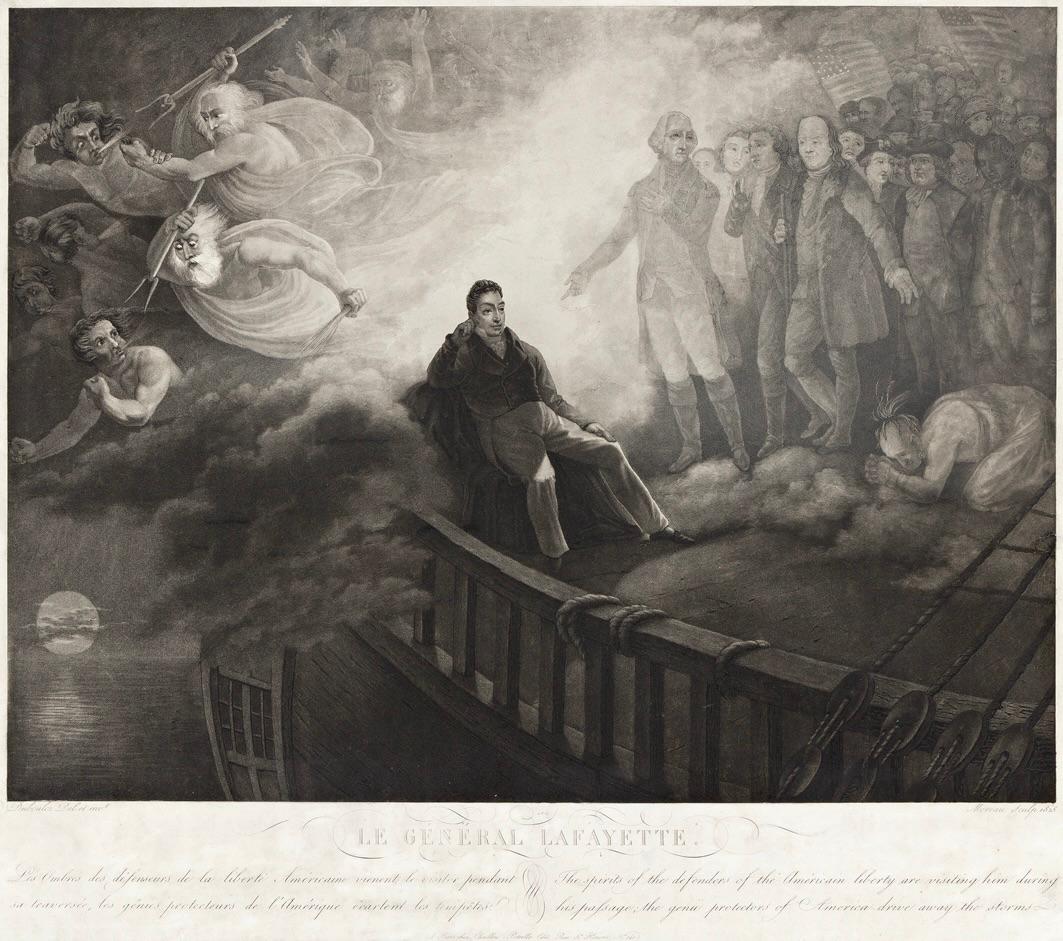
Le Général Lafayette, by Achille Moreau, engraver; after Jean Auguste Dubouloz, artist, 1825, The Society of the Cincinnati, The Robert Charles Lawrence Fergusson Collection. In this allegorical image of Lafayette’s return voyage to France in 1825 on board the frigate Brandywine, the old general remembers the heroes who achieved American independence.
Fittingly, this engraving captures the deep sorrow that Lafayette must have felt.
Sometimes known as "Lafayette's Dream on the Deck of the Brandywine," this print imagines the Marquis on his return to France after his grand American tour. Spirits of Washington, Franklin, Jefferson, and other old American patriot friends share the deck with him. The caption (in parallel French and English) reads "The spirits of the defenders of the American liberty are visiting him during his passage; the genii protectors of America drive away the storms."
|
|
• The United States government insisted that Lafayette be brought back to France on board its latest frigate, the 44-gun frigate named Susquehanna for this honor. However, in remembrance of the battle where the Frenchman had sacrificed his life for American freedom, and as an expression of the nation's fondness for Lafayette, it was renamed USS Brandywine.
• An anecdote to illustrate Lafayette's generosity and loyalty to his Revolutionary war friends: while seated on the Brandywine, preparing for departure, General Isaac Fletcher delivered regards on behalf of his Revolutionary War comrade, General William Barton. He also detailed that Barton had spent a lengthy 14 years in a debtors' prison situated in Danville, Vermont. Without delay, Lafayette settled Barton's outstanding fines, granting him the opportunity to reunite with his loved ones in Rhode Island.
• We can only imagine the melancholy and sadness felt by this man, knowing that it would be the last time he would cross the Atlantic, leaving behind a Nation and its people he so deeply loved and admired... Anyone in love with the United States and France...has undoubtedly felt similar emotions, when the time comes to end their days in one country or another.
|
|
THUS ENDS OUR 13-MONTH TRIP THROUGHOUT 24 STATES IN THE COMPANY OF THIS ILLUSTRIOUS FRENCHMAN
"THE BEST FRIEND AMERICA EVER HAD"....
HOWEVER, WE WILL RE-ENACT HIS JOURNEY UNDER THE AEGIS OF THE AMERICAN FRIENDS OF LAFAYETTE
JOIN US AT THE KICK-OFF BROADWAY PARADE, AUGUST 16, 2024!
|
|
PAST MONTHLY BULLETINS
OUR GOAL: turn the spotlight on a famous, or less famous, episode or historical figure during the long shared history between France and the United States, with illustrations and anecdotes.
You can have access to all our past Monthly Bulletin
since February 2021 by visiting our website:
You can click on the photos throughout our bulletins and also on the links indicated in blue for more information and direct access to sources.
|
|
Next month in September we will narrate the contribution of the Duc de Lauzun and his Legion of hussards to American Independence.
This will coincide with the ceremonies at Yorktown, and the dedication of our plaque commemorating the "Battle of the Hook" in Gloucester, VA.
|
|
THE SCULPTURE OF LE PETIT PRINCE
WILL BE INAUGURATED NEXT MONTH NEW YORK!
|
|
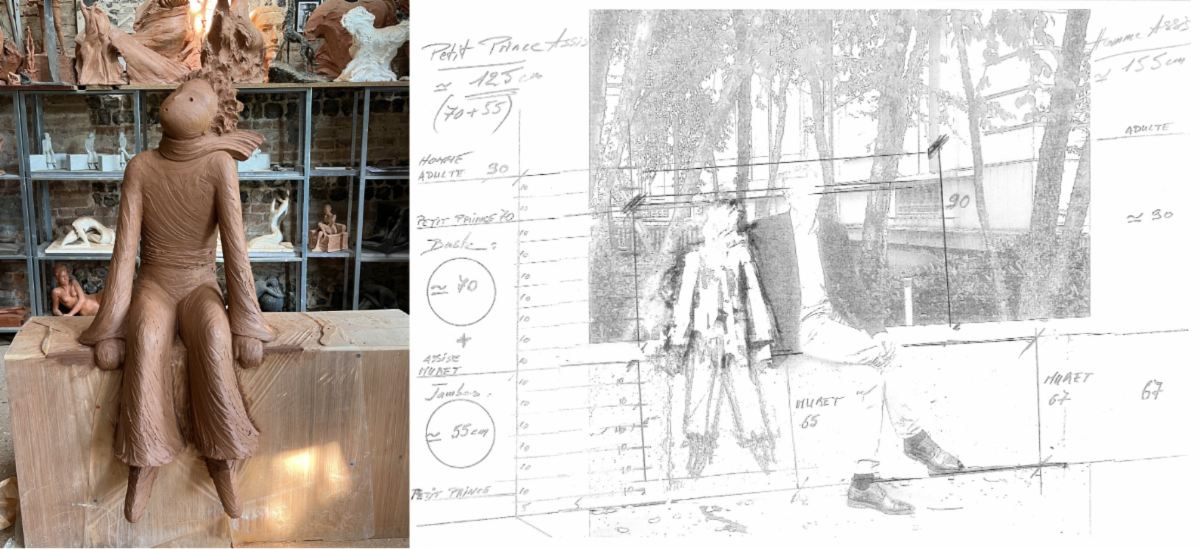
Photos and illustration courtesy of sculptor Jean-Marc de Pas. LE PETIT PRINCE® in the artist's studio at the Château de Boisguilbert, Normandie, looking at the stars and soon to be installed at its new home facing Central Park at the French Cultural Services - Villa Albertine, NY.
|
|
Our association The American Society of Le Souvenir Français is at the origin of the Little Prince sculpture project in Manhattan, with the support of the Saint Exupéry Youth Foundation. It will be permanently installed facing Central Park, sitting on the wall near the entrance of the Services Culturels of the French Embassy / Villa Albertine bookstore.
The sculpture arrived in New York for an installation later in August and an inauguration scheduled for around September 18-19, 2023.
Note: as of this writing, we are still awaiting the exact details. A special Announcement will be sent, likely the first week of September.
Our special thanks to sculptor Jean-Marc de Pas, Stéphanie de Pas and family for delivering the sculpture on time, to Air France, the official partner of Le Petit Prince, for flying the sculpture "first class", to the entire team at Nord-Sud-CTI freight forwarders for facilitating the entire logistics chain, to U.S. Art Company Inc. for speedily helping Le Petit Prince's immigration to the US, and of course the French Cultural Services - Villa Albertine in New York for this wonderful logistical teamwork.
The list of our "Grands Donateurs" will be publicized and be permanently featured on our website as well as the website of the Antoine de Saint Exupéry Youth Foundation:
The d'Agay Family • Pierre-Olivier & Alexandra Bouée • Henri & Elisabeth Gazay • Jean-Hugues & Véronique Monier • Gildo Pallanca Pastor, Consul General of Monaco in New York • Rémy Raisner • Lionel & Jinus de Saint Exupéry • Stacy Schiff
And the following companies: Dassault • Air France • Venturi
We will keep you further informed in a special Announcement.
|
|
A whimsical new video released by
The American Friends of Lafayette
to kick start the Lafayette tour Bicentennial 2024-2025
|
|
A message from Chuck Schwam, COO, American Friends of Lafayette,
dated August 16, 2023:
"199 years ago today, Lafayette made his first public appearance in the United States after a forty year absence. 199 years ago today, Lafayette's 13-month Farewell Tour of America officially started. And of course....ONE YEAR FROM TODAY OUR BICENTENNIAL COMMEMORATIONS START !
Our goal is to celebrate Lafayette's legacy and to educate the American public about his contributions to the world.
In an effort to kick things off, the American Friends of Lafayette have produced a short, two-minute promotional video for you to see (and more importantly share). Our goal is to generate excitement, donations and momentum as we hurdle towards August 16th, 2024.
Please share with your family...your children and grand children.
Please share with your friends and co-workers.
Please use this video as a tool for fundraising.
Please use this video to promote your local Bicentennial efforts.
Enjoy !!! Spread the word (and the video) !!!
"
Our Society is proud to be working hand in hand with the AFL and other patriotic associations to make this Bicentennial a memorable success.
|
|
August 26, 202
Hosted by
the National Washington-Rochambeau
Revolutionary Route Association, Inc.
|
|
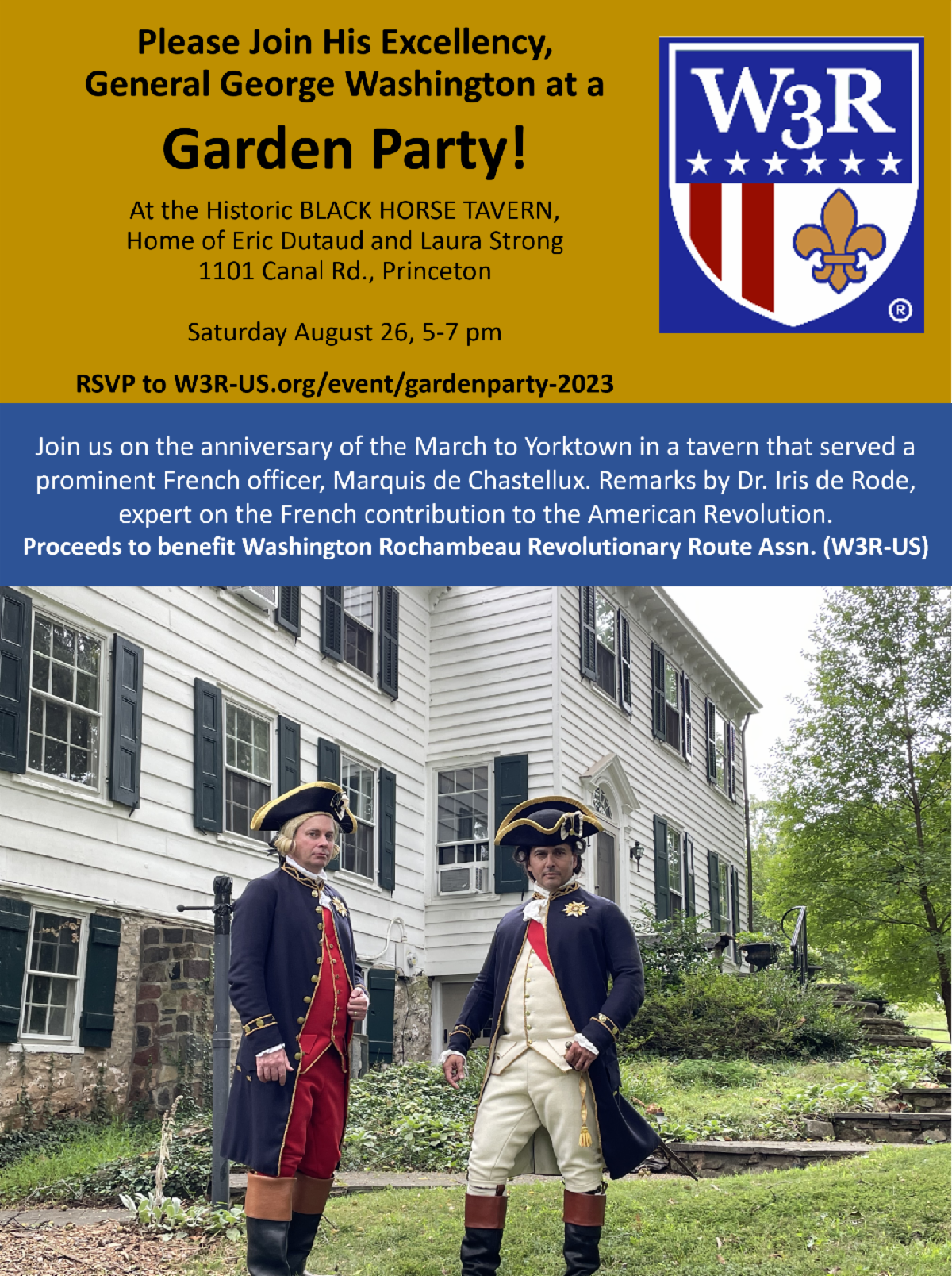
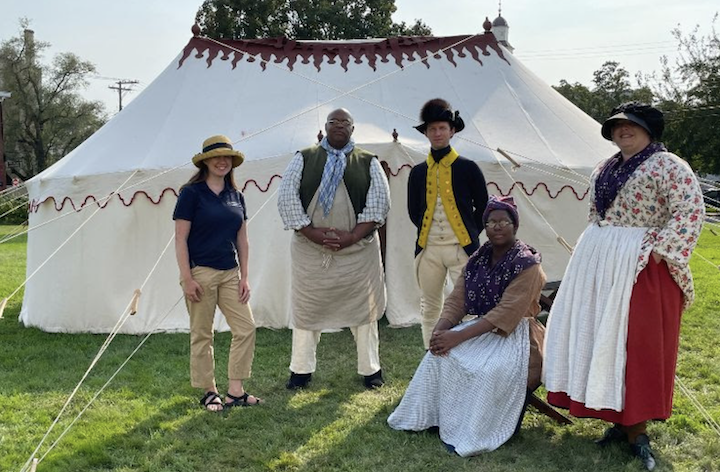
Come join General Washington, his valet Billy Lee, and W3R-US on August 26th, 2023 from 5:00 pm to 7:00 pm at the Historic Black Horse Tavern in New Jersey! This is the tavern that hosted the French officer Marquis de Chastellux, confidant of George Washington, on his travels to Yorktown in 1781.
Dr. Iris de Rode will provide insights from the Chastellux archives.
Details:
Date: August 26
Time: 5:00 pm - 7:00 pm
Cost: $60 – $1000
Venue:
Black Horse Tavern 1101 Canal Rd Princeton, NJ 08540
Organizer:
W3R-US Email: contact@w3r-us.org Website: w3r-us.org
|
|
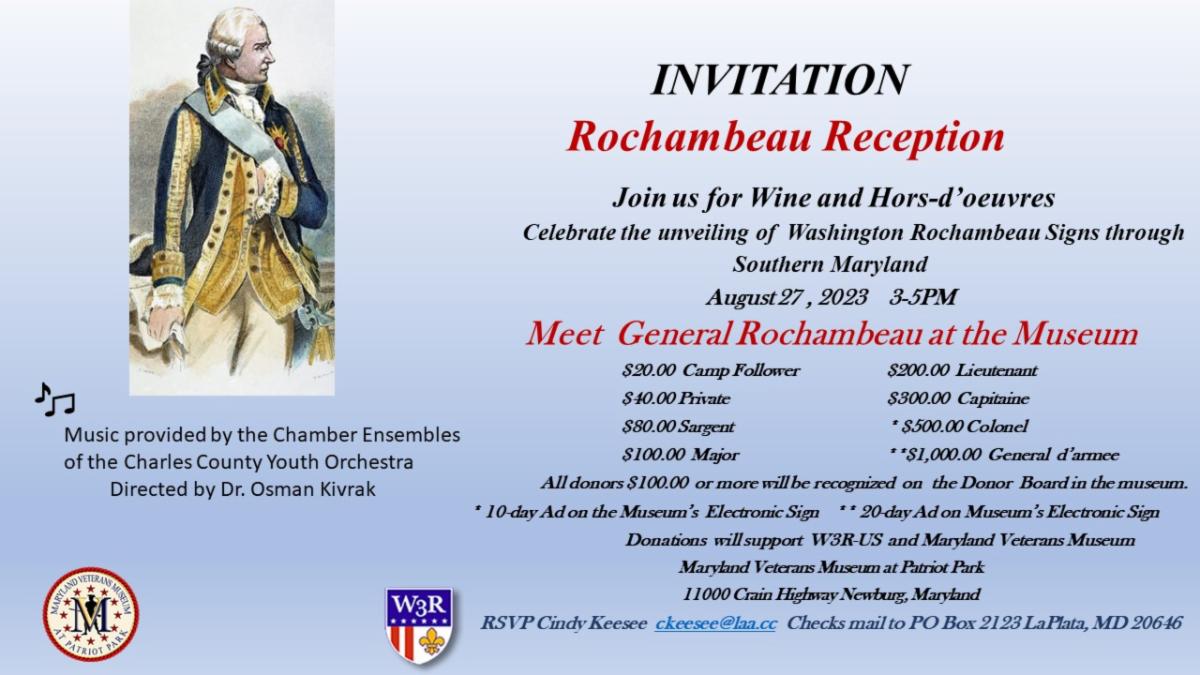
August 27, 2023
Rochambeau Reception at the Maryland Veterans Museum
|
|
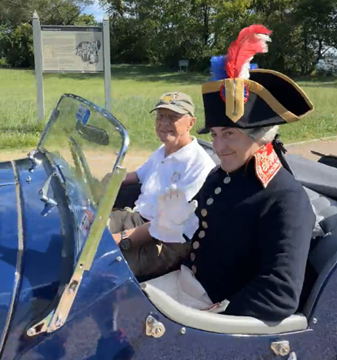
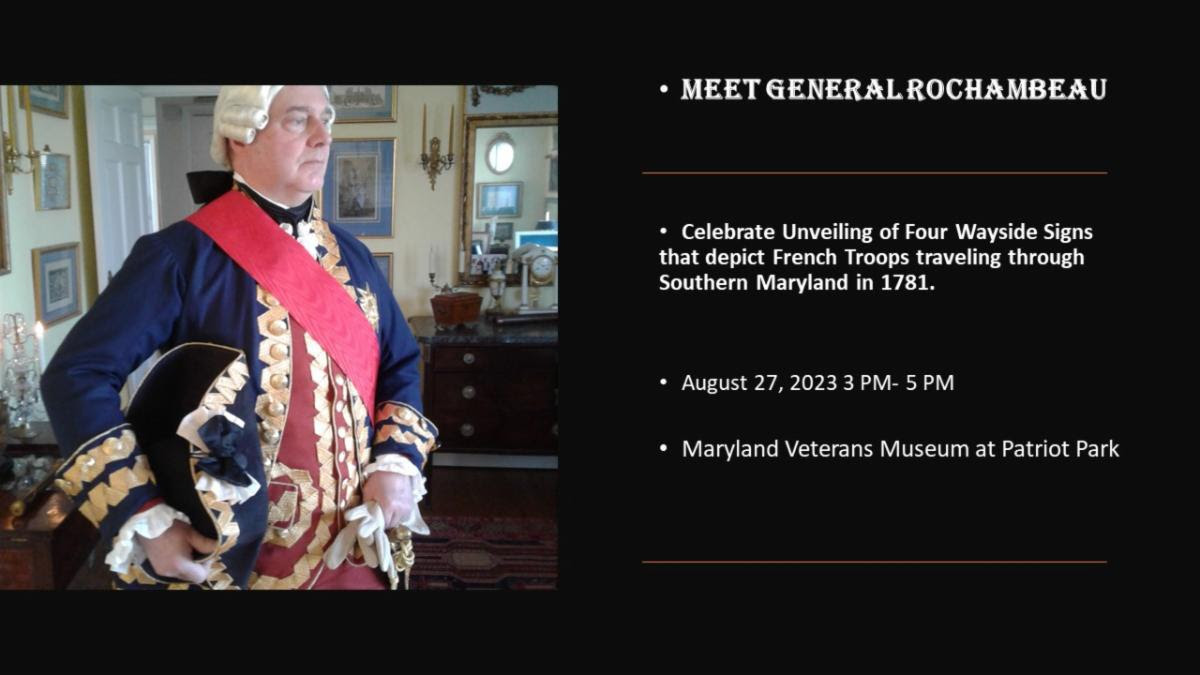
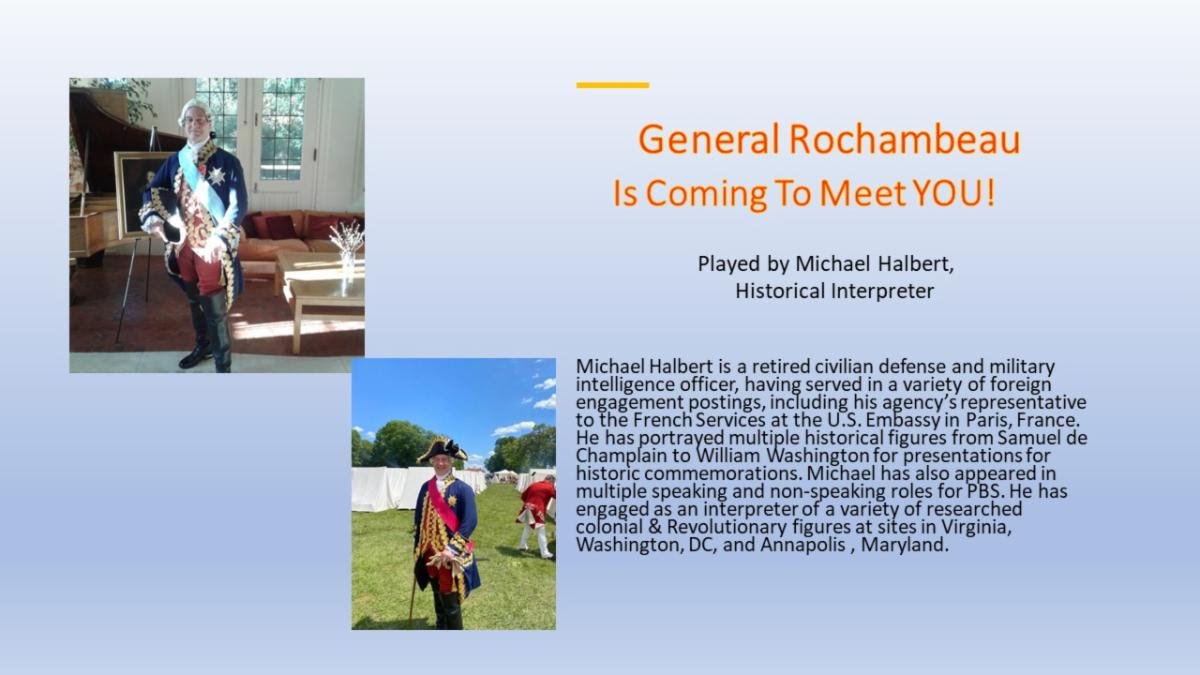
Join the Maryland Veterans Museum and W3R-US to celebrate the unveiling of the new Washington Rochambeau Signs throughout Southern Maryland! Meet the General himself, played by Michael Halbert, enjoy live music, wine and hors-d’oeuvres!
|
|
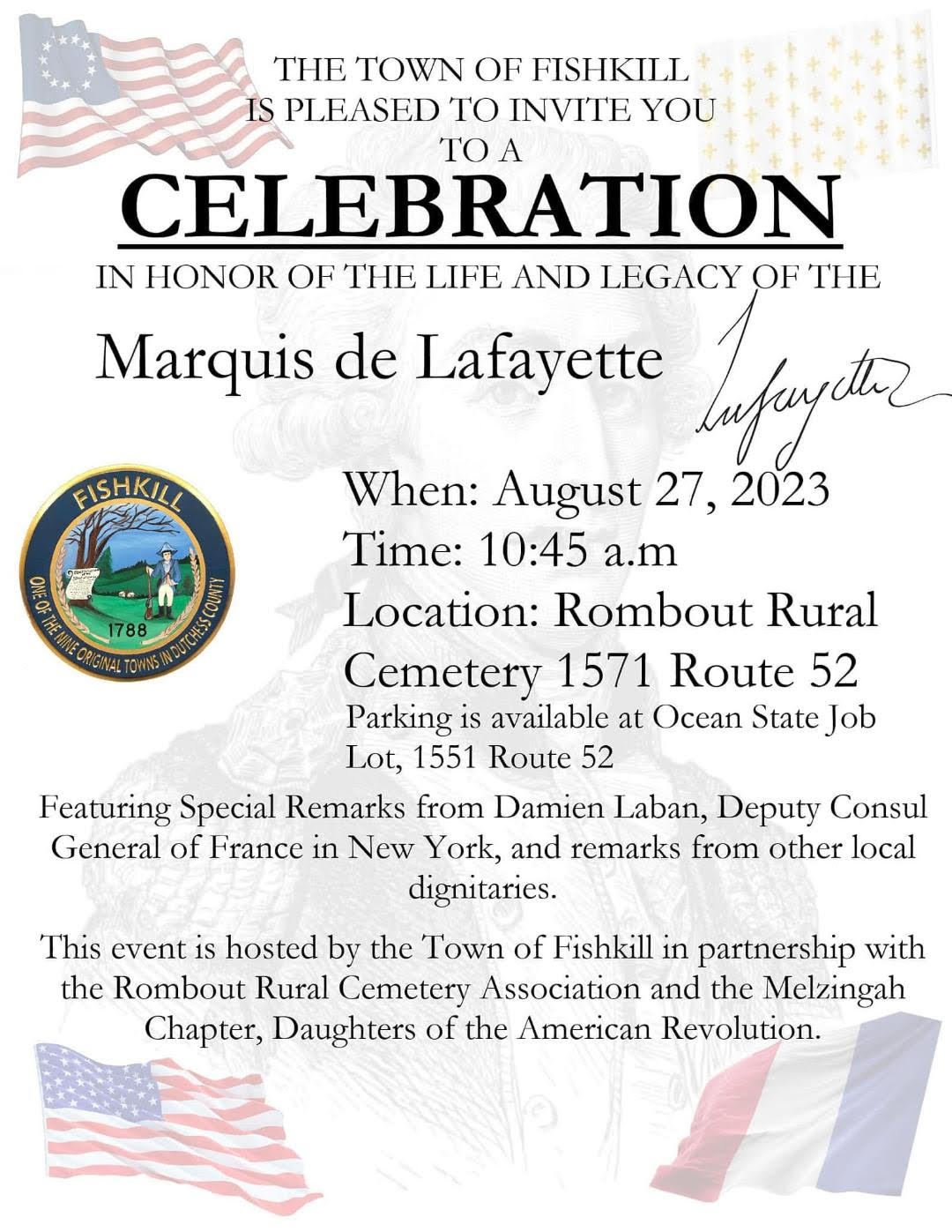
August 27, 2023 in Fishkill, NY |
|
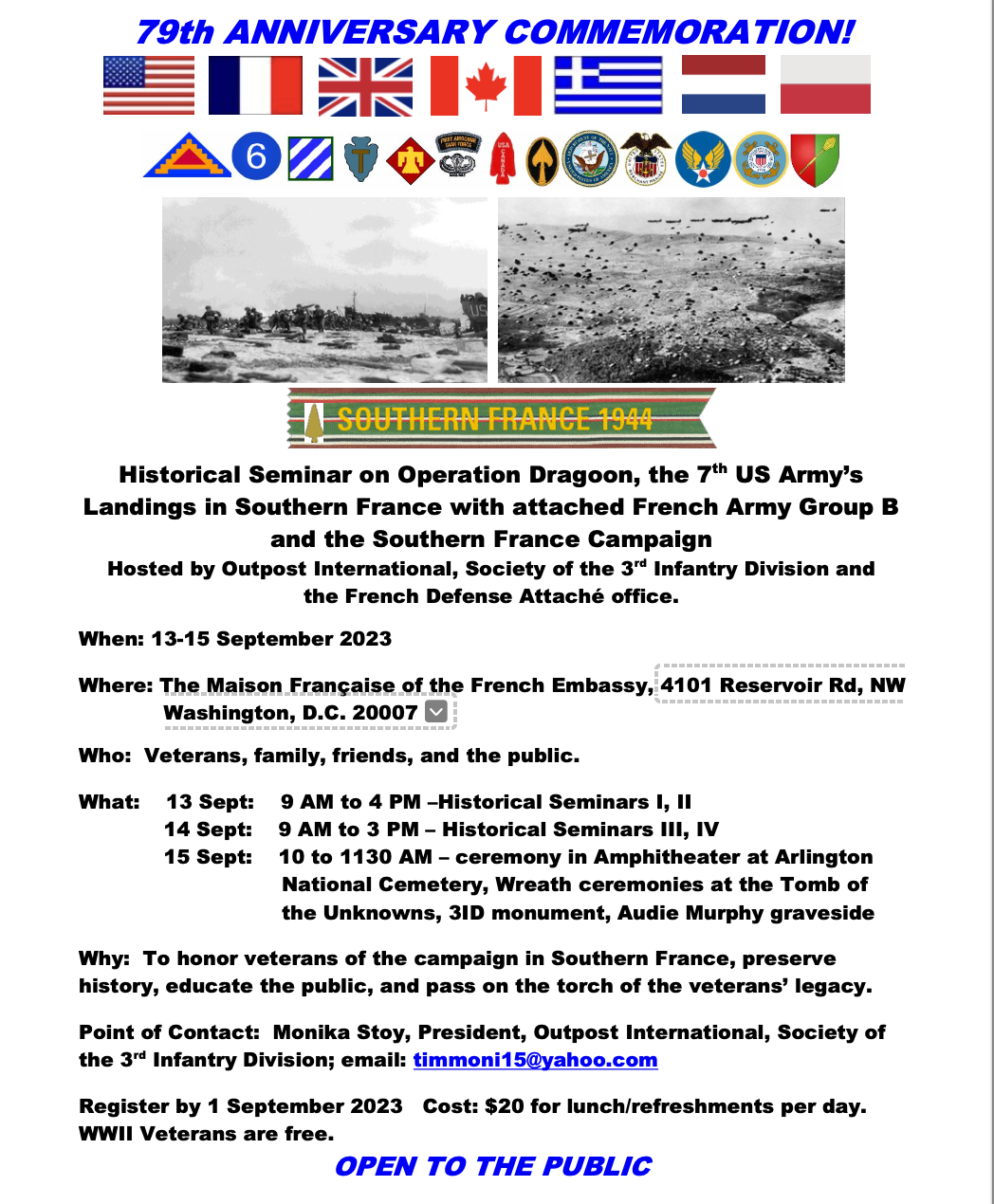
From the Society of the 3rd Infantry Division
13-15 September 2023
at the Maison Française, French Embassy in Washington D.C.
|
|
Touring Exhibition, Châlons-en-Champagne, Sept 1-15, 2023
Verdun Memorial Oct 1-7, Château de Castries, Oct 10-30, 2023
“ The US Unknown Soldier of WWI in France”
by
The Society of Honor Guard / Tomb of Unknown Soldier
Military Women’s Memorial, Arlington National Cemetery
and under the auspices of Le Souvenir Français
|
|
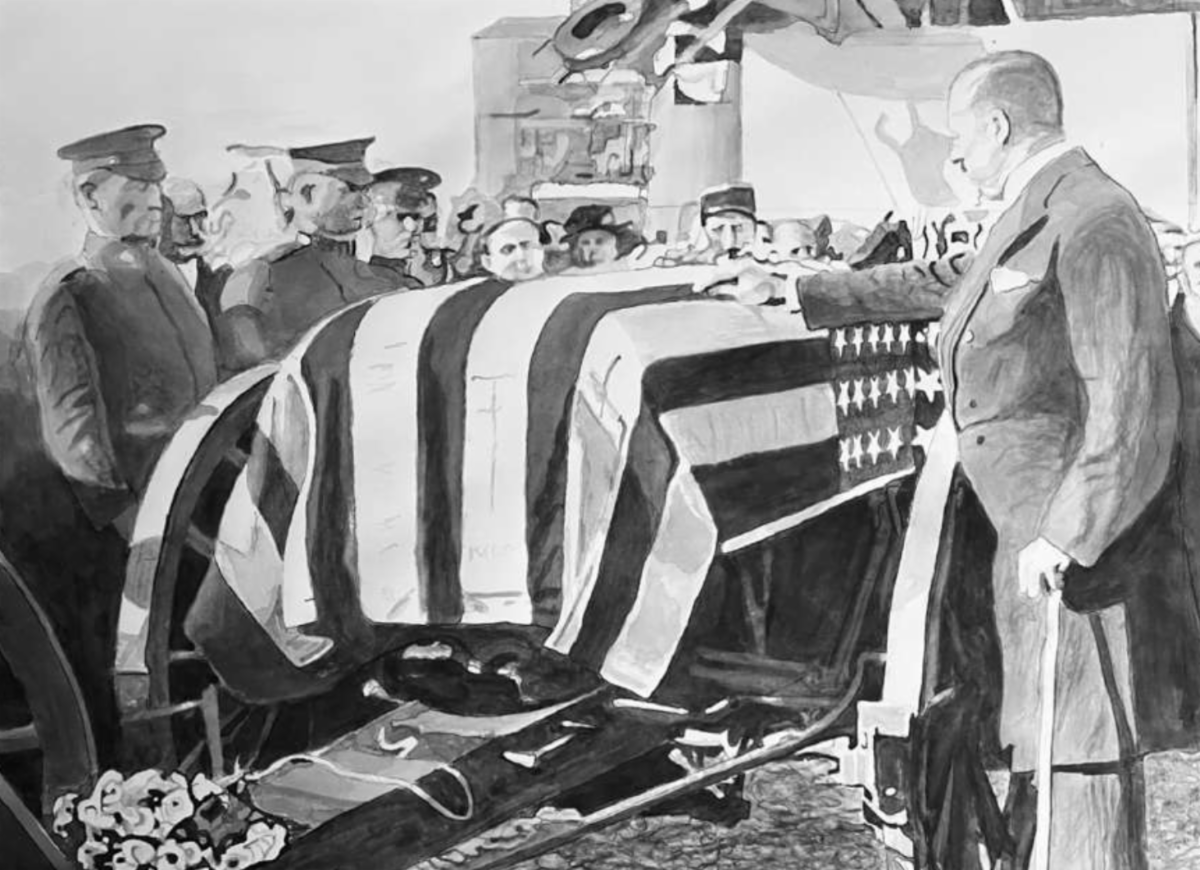
“The whole of France bows down with me before your coffin, brother from America, they can take you back to the great land from which you came, but your French family will always piously preserve your memory and the land of France will not forget that it was to it you entrusted your last dreams.”
- André Maginot, Minister of Pensions, Le Havre, Oct 25, 1921
Illustration above: One of 26 paintings by Dave Rappaport, artist
|
|
• On October 25, 1921, Minister André Maginot pinned the Legion of Honor on the coffin of the Unknown Soldier at the pier in Le Havre, moments before it was hoisted on board the USS Olympia for the voyage back home. This exhibit of 26 black & white paintings by artist Dave Rappaport retraces key moments of this poignant journey, from the battlefield of Eastern France and Châlons-sur-Marne, to Le Havre, with the people of France lining up to pay tribute to this American soldier who “Died for France” and for the cause of Freedom.
• Inspired by this exhibition that took place at the Military Women's Memorial at Arlington National Cemetery this past November, which coincided with the State visit to the United States of French President Emmanuel Macron (who laid a wreath at the Tomb of the Unknown Soldier and who laid a rose on top of Major L'Enfant's monument nearby, next to the marker inaugurated by your Society the preceding June), we worked hand-in-hand with Richard Azzaro, co-Founder and past President of the Society of Honor Guard, Tomb of the Unknown Soldier and Donna Houle, Senior Director of Memorial Engagement & Impact at the Military Women's Memorial to have this very moving and informative exhibition travel to France.
• Thanks to the support and patronage of Le Souvenir Français in Paris, its President-General, Contrôleur Général des Armées(2S) Serge Barcellini, and Mr. Pierre-Marie Delaborde, General Delegate, Souvenir Français Marne, this exhibition will be first unveiled at the Foire de Châlons-en-Champagne on September 1st, then travel in October to the Verdun Memorial and the Château de Castries (residence of the marquis de Castries, Louis XVI's Minister of the Navy during the War of Independence). We express our gratitude to Général d'armée Elrick Irastorza, former Chief of Staff of the French Army, président of the Fondation du Souvenir de Verdun, to Mr. Nicolas Barret, Director, and Mme Amélie Delobel, responsable collections et expositions at the Mémorial de Verdun - Champ de Bataille, and Dr Patrick Bernier and Jacques Fournier of the Amis du Château de Castries for hosting this exhibition illustrating the enduring bonds of alliance and friendship between France and the United States.
Our thanks go also to Col US Air Force (Ret) Pierre Oury, member of our Society, United 4 Veterans, and United Airlines for transporting the 26 paintings to France graciously.
|
|
From the American Friends of Lafayette:
September 16 & 17, 2023 in Drexel Hill, PA & Stanton, DE
|
|
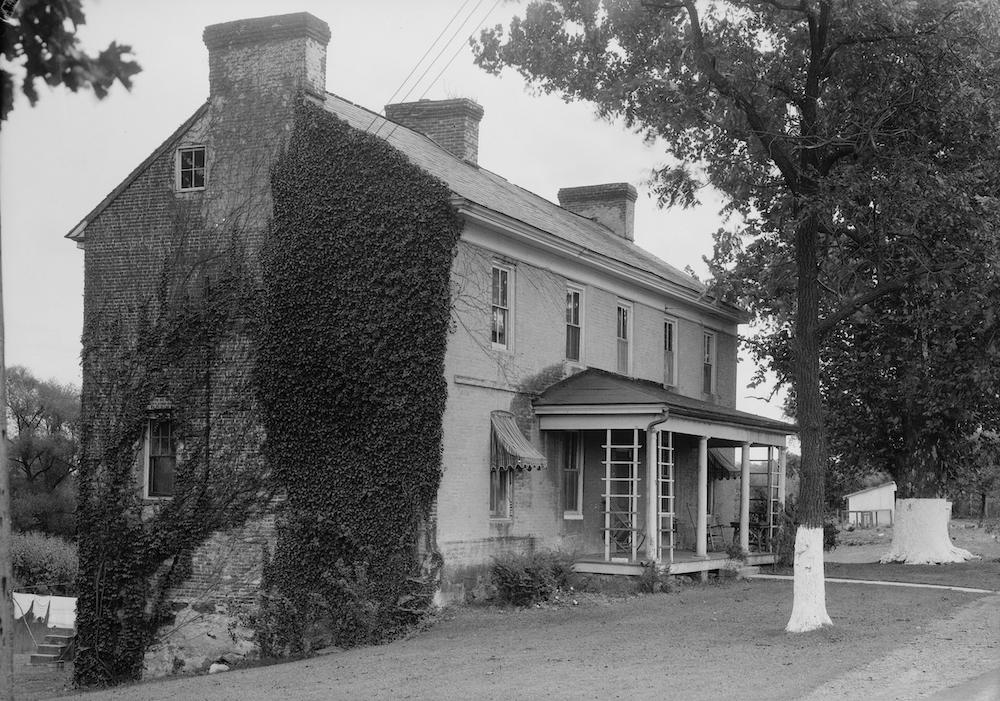
Front of the Hale-Byrnes House, located at the junction of Delaware Routes 4 and 7 in Stanton, Delaware, United States. Built in 1750, the house is listed on the National Register of Historic Places.
On September 6, 1777, (Lafayette's twentieth birthday) George Washington held a war council at the Hale-Byrnes House. George Washington, Nathaniel Greene, Henry Knox, Lafayette and other Continental Army officers attended. Their goal was to plan the defense of Philadelphia.
|
|
On Saturday, September 16, 2023, our friends and partners at The American Friends of Lafayette will be holding two events in the Philadelphia area:
At noon on Saturday, September 16th, we will be unveiling a new beer called THE LAFAYETTE. The beer is a collaboration among the American Friends of Lafayette, the Artillery Brewing Company of West Chester and Heavy Seas Beer of Baltimore. This is the first of a series of beers honoring Lafayette and the Bicentennial of his Grand Tour as America’s guest. The beer is made from French inspired ingredients.
Michael Loveless of Artillery Brewing said, “We are honored to work with the American Friends of Lafayette and Heavy Seas Beer in crafting this French-inspired homage brew. We’ve researched the recipes of Lafayette’s day. Our company’s brand was founded in honor of our nation’s fight for independence.”
Caroline Sission of Heavy Seas Beer added, “We are headquartered in Baltimore and Lafayette has strong ties to both Baltimore and all of Maryland. We’re excited to be part of this grand celebration and The Lafayette.”
The unveiling of The Lafayette will take place at Artillery Brewing’s new location, 4221 Ferne Blvd., Drexel Hill, Pennsylvania (noon on Saturday, September 16). AFL members can order lunch and sip their newest beer. Lafayette will be there as well !!!!
...and then 12 miles away....
At 5:30 p.m. on Saturday, September 16th, there will be a pre-game tasting at the soccer match between the Philadelphia Union and FC Cincinnati. Artillery Brewery is a partner of Major League Soccer’s Union team and the American Friends of Lafayette will have an opportunity to interact with fans as they enter the stadium for the match (which starts at 7:30pm).
This is a wonderful opportunity to promote Lafayette and the AFL's bicentennial plans to thousands of folks all at once. We will have our traveling exhibit panels on hand and will be giving out brochures and other "Lafayette swag". This will be fun and meaningful. Lafayette will be here as well !!!
On Sunday, September 17, 2023, we will celebrate Lafayette's birthday (belated) at the very place where he turned twenty years old...
At 3:00pm on Sunday, September 17, we will gather 40 miles south of Philadelphia at the historic Hale-Byrnes House. AFL President, Alan Hoffman will be giving a talk about Lafayette's Farewell Tour. After his talk, food and beverages will be served. We will be collecting $10pp at the door.
The Historic Hale-Byrnes House is listed on the National Register of Historic Places and is a site on Washington-Rochambeau National Historic Trail. Hale-Byrnes House is on old Route 7 just south of Stanton, Delaware, near the intersection of Route 4 East and Route 7 North. The street address is 606 Stanton-Christiana Road, Newark, Delaware.
|
|
From Odell House - Rochambeau Headquarters
Sept 29, 2023 from 5 to 7:00PM
425 Ridge Rd, Hartsdale, NY 10530
|
|
You’re Invited to a Special Event!
SAVE THE DATE!
September 29, 5 to 7 p.m.
Please join us for a private tour of
George Washington’s Revolutionary War Pavilion and Tents,
guided by historic interpreters from Philadelphia’s
acclaimed Museum of the America Revolution.
Please join Friends of Odell House Rochambeau Headquarters for a private showing of General George Washington’s Revolutionary War Tent, coming to Hart’s Brook Park & Preserve from the Museum of the American Revolution (MAR) in Philadelphia. Reenactors from MAR, in period costumes, will take you through exact replicas of Washington’s personal tent, the baggage and dining tents and the soldiers’ quarters. When American troops camped in Ardsley in 1781, Washington’s tents were erected on Appleby Farm nearby, while General Rochambeau stayed at OHRH.
Our 2023 fundraising event will take place
Friday, September 29, 2023 from 5 to 7 p.m.
at Hart’s Brook Park & Preserve, 156 Ridge Road, Hartsdale N.Y.
Come for a fantastic evening and help us create exciting and unforgettable exhibits for the future museum at Odell House Rochambeau Headquarters.
Hors d’oeuvres and mocktails will be served in the historic Geisman Barn.
Dress code: Country causal. Handicap parking available.
Minimum donation is $75 per person. Please give generously!
Click below to donate online or by check.
Please RSVP by September 15, 2023
Space is limited, so please respond early.
|
|
From the Lafayette Trail Inc.
Inaugurations of three Lafayette tour markers
Sept 27 & 28, 2023
|
|
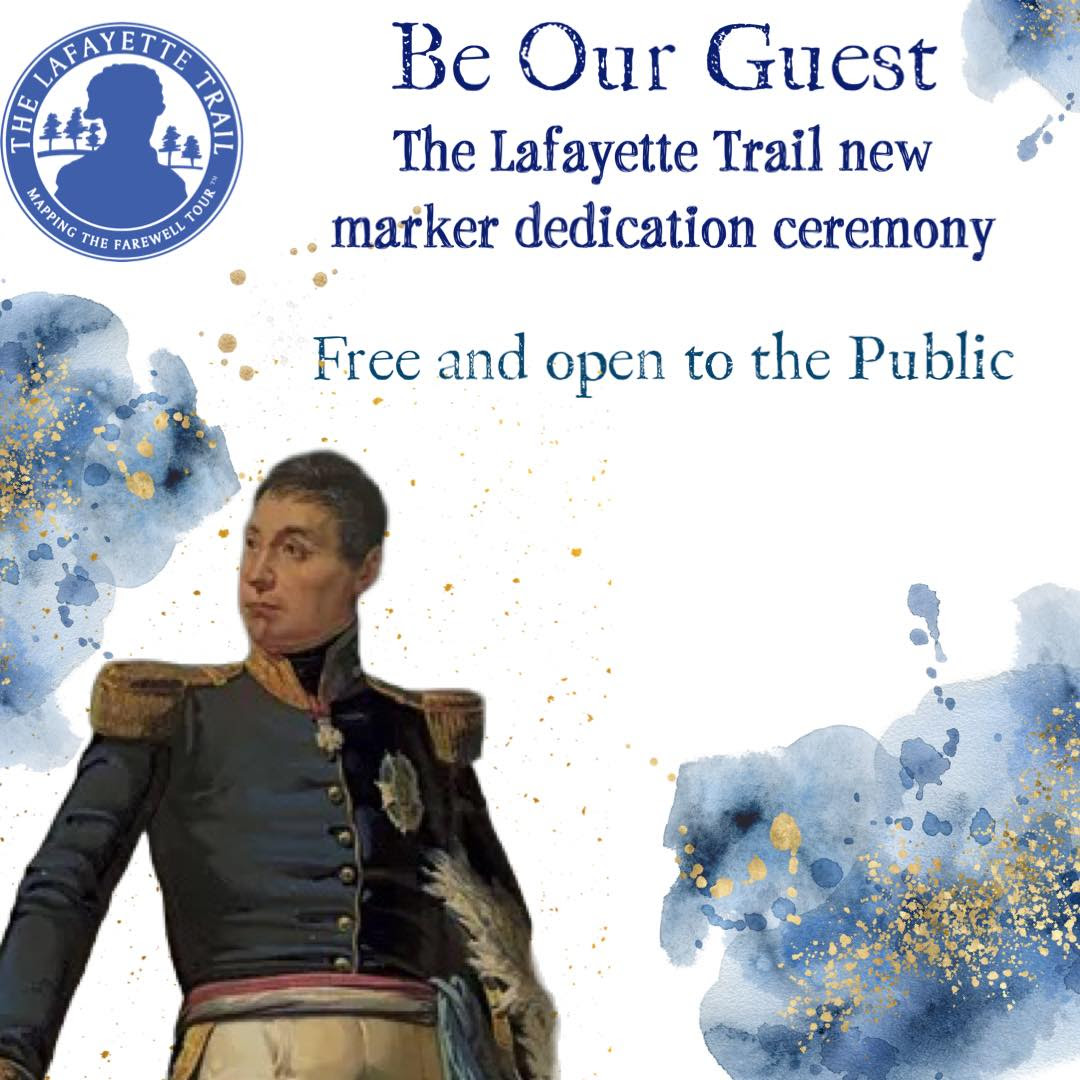
We received these exciting announcements from Julien Icher, President:
Wednesday, September 27, 2023, at 10 am ET:
The Lafayette Trail, Inc. is pleased to announce the upcoming dedication of a new Lafayette Trail historic marker in Mendon, NY. The marker dedication ceremony will take place at 1371 Pittsford Mendon Rd, Mendon, NY 14506.
Plenty of off-street parking will be available for attendees near the marker location.
Wednesday, September 27, 2023, at 3:30 pm ET.
The Lafayette Trail, Inc. is pleased to announce the upcoming dedication of a new Lafayette Trail historic marker in Lockport, NY. The marker dedication ceremony will take place at 13 Park Ave, Lockport, NY 14094.
Limited street parking will be available for attendees near the unveiling site.
Thursday, September 28, 2023, at 10 am ET.
The Lafayette Trail, Inc. is pleased to announce the upcoming dedication of a new Lafayette Trail historic marker in Fredonia, NY. The marker dedication ceremony will take place at the Darwin R. Barker Museum located at 7 Day St, Fredonia, NY 14063.
.Limited street parking will be available for attendees near the unveiling site.
The 3 events will include formal remarks from all the stakeholders involved in the preparation of the marker, the actual unveiling, as well as photo opportunities with local officials. Each ceremony is expected to last 45 minutes.
|
|
OTHER SAVE THE DATES:
Tuesday, October 18 (TBC): dedication of our new historical marker "Duc de Lauzun and his Legion of hussars" at the Battle of the Hook at Gloucester, VA, prior to the dinner at the American revolution Museum just across the York river in Yorktown (10 minutes drive).
Thursday, October 19: Celebration of the combined French-American Victory at Yorktown, VA. with wreath-laying ceremonies at the French Cemetery at 8:30AM, the French Memorial Monument at 9:30AM and patriotic exercises at the Monument to Alliance and Victory at 11:00AM.
We will publish more details in our upcoming September Bulletin.
|
|
SUPPORT US AND BUY (OR OFFER) OUR E-BOOK ON AMAZON! |
|
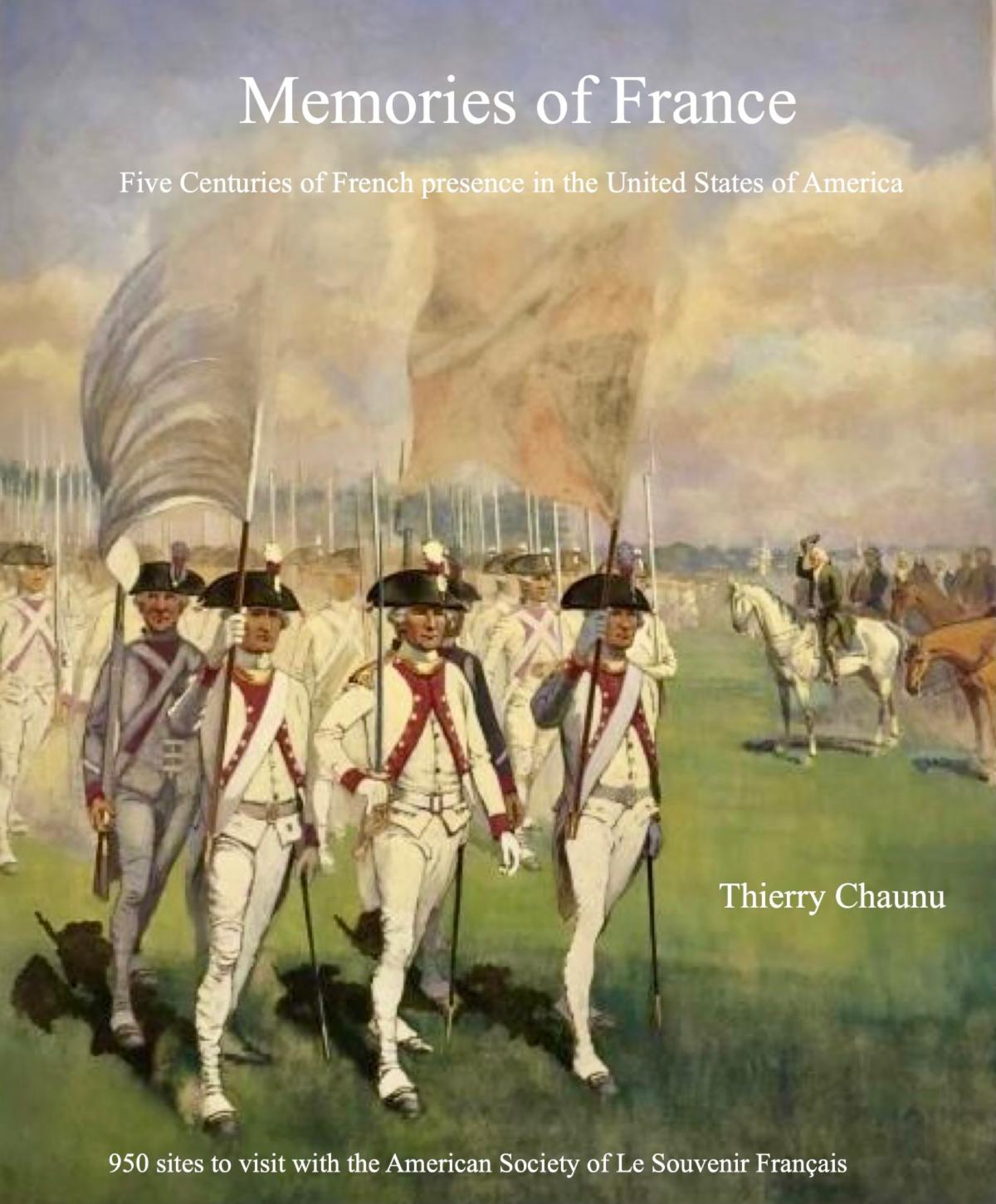
Book Cover : "Scenes from the American Revolution: The French "Soissonnais" Regiment Being Reviewed at Philadelphia by President Washington and Congress, 1781". By Charles MacKubin Lefferts (American, 1873 – 1923). Reproduced with permission of the New York Historical Society Museum. |
|
Support our organization! Purchase or offer this e-book which makes great reading for all ages. All royalties go to the American Society of Le Souvenir Français, Inc. Simply click on this link: Amazon.com
We are pleased to have given to the Consulate General of France several dozens of sites for the application mapstr. The complete and extensive descriptions are only available in our book, copyrighted by our organization.
MEMORIES OF FRANCE
950 sites of French presence in the United States over the past 5 centuries
Everyone knows that Lafayette, the Statue of Liberty, or New Orleans, were all French imports…
But did you know what the first protestant prayer in America, the first recorded birth of a European in North America, the first commercial artist, the first free school west of the Mississippi, the first discovery of Niagara Falls, the first grapefruit planter in Florida, the first discoverer of oil in America, the first Pulitzer Prize in history, the first archbishop of New Mexico, to name just a few, have in common? (Hint: they were all French)
CONTENTS:
Guide - historical directory of more than 950 sites where a French footprint has been left across the 50 states of the present United States, from 1524 to the turn of the 20th century.
It is written in two versions: in English and in French.
It is a tribute to explorers, missionaries, soldiers, adventurers, French, illustrious or unknown, who left their mark in the United States and are recognized, whose memory is honored by a monument, a statue, a stele, a panel, a billboard, a plaque...
Each page corresponds to one site and includes:
• Photo (with url link)
• Address with postal code
• Exact GPS coordinates
• A brief historical explanation
• The exact transcription of the inscription appearing on the pedestal or plaque
• One or more internet links directing the reader to more detailed information
• Some divider pages are dedicated to a brief biography of a related historical figure
This Guide can thus be compared to:
• An “Enthusiast’s dictionary” compiling the traces left by Frenchmen in the United States
• A collection of French postcards from the 50 States
• A tourist guide for all lovers of US history
Available in e-book
• E-book price: $19.50
• The book is copyrighted © American Society of Le Souvenir Français, Inc.
|
|
OUR MISSIONS:
• To preserve the memory of the French soldiers, sailors and airmen who gave their lives for freedom, and who are buried in the United States.
• To honor French Citizens who did great deeds in the United States, or with a strong connection with the United States,
• To promote the appreciation for French culture and heritage in the United States, and the ideals that unite our two nations, in order to pass the torch of memory to younger generations.
• To strengthen the long-standing traditional bonds of friendship between the American and French peoples, and to this end: erect or maintain memorials and monuments and encourage historical research, public presentations and publications in the media.
We are looking to complete our geographic coverage with Regional Delegates for the SouthWest in cities such as Austin, or Houston, and Louisiana, in cities such as New Orleans or Baton Rouge.
The American Society of Le Souvenir Français, Inc. is an independent American corporation, apolitical, established in 1993 in NY, with 501 (c) 3 non-profit status.
|
|
Board of Directors
American Society of Le Souvenir Français, Inc.
Members (2023):
Françoise Cestac, Honorary President • Thierry Chaunu, President, and General Delegate, Le Souvenir Français in the United States • Yves de Ternay, Treasurer • Patrick du Tertre, 1st Vice President • Henri Dubarry • Francis Dubois • Alain Dupuis, 2nd Vice President & Deputy General Delegate, Le Souvenir Français in the United States • Daniel Falgerho, General Secretary • Pierre Gervois • Caroline Lareuse • Clément Mbom, Education Advisor • Jean-Hugues Monier, Auditor • Harriet Saxon • Nicole Yancey
Regional Delegates:
Jacques Besnainou, Great Lakes and Midwest • Bruno Cateni, South
Prof. Norman Desmarais, New England • Alain Leca, Washington D.C. •
Marc Onetto, West Coast • Brigitte Van den Hove – Smith, Southeast • Nicole Yancey, Yorktown & Virginia, former Honorary Consul of France in Virginia
|
|
Help us implement several historic commemorative projects celebrating the 245-year-old Franco-American friendship and alliance! |
|
The American Society of Le Souvenir Français, Inc. is a registered NY State non-profit corporation and has full IRS tax exempt 501(c)3 status. All donations are tax deductible.
Copyright © 2023 The American Society of Le Souvenir Français, Inc.
All Rights Reserved
Merci de nous contacter si vous souhaitez recevoir ce bulletin dans sa version traduite en français.
Contact: Thierry Chaunu, President
697 Third Avenue #341 New York, NY 10017
|
|
|
|
|
|
|