|
The sun is shining on India’s renewable sector. The burgeoning demand for renewable energy in India is driven by a multitude of factors that include the nature and size of our population, expansive economic growth, development of infrastructure with smart cities and fluctuating rates of fossil fuel (natural gas, oil and coal). Elsewhere and across the globe, while wind energy has been an effective source of power for decades, the deployment of solar energy, which has been a relatively late entrant, is currently growing in India, even faster than the wind!
With the growth of renewables in their popularity & utility, ongoing policy support and reducing cost of capital; the time for 50% of India to be electrified by renewable energy can be a reality.
In the light of the foregoing and after evaluating the valuable perspectives with choices expressed by the respondents of our recent survey, we are setting forth an executive summary of the opportunities and risks relating to the renewable energy sector in India.
| |
|
Policy support
India has set targets to reduce the carbon intensity of our economy by less than 45% by the end of this decade, achieve 50% installation of cumulative electric power from renewables by 2023 and attain net-zero carbon emissions by 2070. Experts believe that this will also create a market of ~US$ 80 billion for low-carbon technologies in India by 2030.
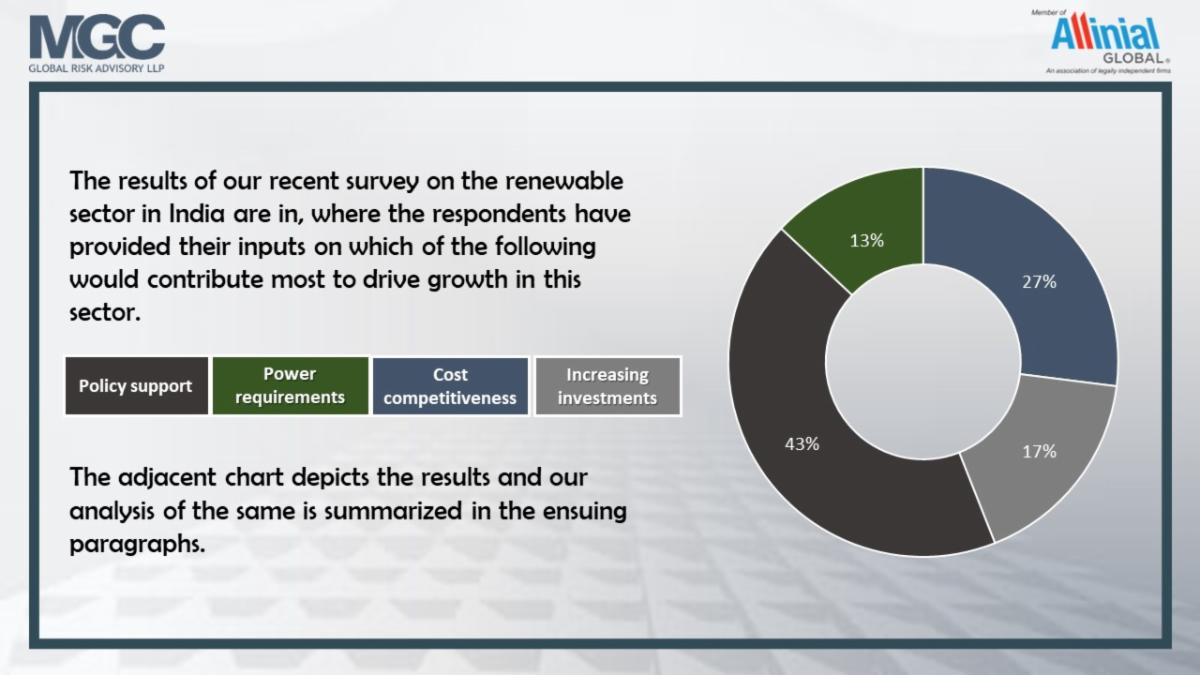
The role of policy measures in the growth of the renewable sector in India was identified to be the single most important factor by 43% of the respondents. Foreign domestic investments of up to 100% are currently allowed in the renewable energy sector under the automatic route. The Union finance budget of 2023-24 has laid emphasis on this sector and green growth has been identified as one of the nodes in the SAPTARISHI (7 priorities). In addition, the Government of India is undertaking initiatives such as dedicating a 600 MW power station in Arunachal Pradesh, approving the Sovereign Green Bonds framework of India which will also aid in attracting foreign and domestic capital to green projects and has allocated US$ 2.57 billion for a PLI scheme to boost manufacturing of high-efficiency solar modules. The Indian Railways is also enhancing its efforts through sustained energy efficient measures to optimize the use of clean fuel and cut down emission levels by 33% by 2030.
As India sets its sights on net zero, we face a number of pressing challenges. We have in this paper identified specific risks and believe that a key factor to address several of these challenges and accelerate our shift to cleaner and more efficient technologies; is the complete, inclusive and integrated implementation of our policy framework.
| |
|
Cost competitiveness
Nearly 27% of the respondents have attributed cost competitiveness to be the most important factor to drive growth for renewable energy in India. Studies show that the cost of solar photovoltaic electricity has fallen 85% since 2010 and the costs of both onshore and offshore wind electricity have been cut by about half in the same period. Both these renewable sources are now cost-competitive with fossil fuel generated electricity. India is believed to be amongst the most cost-effective countries in terms of generating rooftop solar energy at a cost that is estimated to be in the region of US$ 65 per megawatt-hour. The wind power generation capacity in India has significantly increased in recent years and research reports show that the total installed wind power capacity in India was 41.983 gigawatts on January 31, 2023 - the fourth largest installed wind power capacity in the world. Bio-based energy is also well-set grow at a faster pace, with the Indian government expressing their committed to increase the share of non-fossils fuel in total capacity to 40% by 2030.
The main risks in this context are the volatility of the local currency and clogging of the supply chain. Financing, especially in the early stages of renewable energy projects, has also been identified as a risk. While stability of policy and polity are imperatives to enhance the cost competitiveness in this sector, diversification across geographies and early adoption of latest technologies (such as the RTSPV [i.e. rooftop solar photovoltaics] technology, which facilitates solar panel mounting on rooftops) along with effective usage of financial derivates are viewed as tools to mitigate these risks.
| |
|
Increasing investments
Investment is central to tackling the multiple strands of today’s energy crisis - to relieve pressure on consumers, to get the world on a net zero pathway and to spur economic recovery. Stakeholders (governments, companies and investors) face a complex situation as they decide on the energy projects to support. With India having been recently ranked 3rd globally in terms of its renewable energy investments and plans, investments in renewable energy in India had reached a record of US$ 14.5 billion in the year ended March 31, 2022 - an increase of 125% over the previous year. However, experts believe that investments in renewables would need to more than double to US$ 30 billion to US$ 40 billion per year for India to reach its target of 450GW by 2030.
17% of our respondents believe that investments would be the largest factor for growth in the renewable sector in India. The main risks seen by investors in this sector relate to intricacies of land acquisition, uncertainties over the expiration, initiation & extension of central or state subsidies or incentives, projects delays & overruns and supply chain disruptions. These risks can be mitigated with a thorough assessment of the political, policy and compliance environment for the renewables sector in the state where they wish to invest, which should include a consideration of variables such as upcoming elections, fiscal health and dispute resolution options. Project planning needs to be detailed with realistic assumptions and downsides need to be factored in the assumptions for financial forecasts. Development of alternative supply options (wherever feasible) are additional measures for risk mitigation. Moreover, in order to address potential disputes relating to local partners and lenders, investors should evaluate their ‘litigation readiness’, by mobilizing key information and analysis early in the process and our policy regime should facilitate an effective dispute resolution environment.
| |
|
Power requirements
The scale of transformation in India has been stunning, with its economic growth being amongst the highest in the world over the past two decades. India’s sheer size and its enormous scope for growth means that its energy demand will grow more than that of any other country in the coming decades. In a pathway to net zero emissions by 2070, most of the growth in the energy demand would need to be met with low-carbon energy sources. Our Hon’ble Prime Minister has announced specific targets for 2030, which include the installation of 500 gigawatts of renewable energy capacity and reduction of the emission intensity of our economy by 45%, while reducing a billion tonnes of CO2.
While these targets are formidable, the good news is that the clean energy transition in India is well underway. We have overachieved our commitment made at the COP 21- Paris Summit by already meeting 40% of its power capacity from non-fossil fuels - almost nine years ahead of our commitment and the share of solar and wind in India’s energy mix have grown significantly.
Ongoing technological developments with consistent policy support, along with the vibrancy of the private sector will ensure that solar power plants get cheaper to build than coal ones. By leveraging on its potential to produce of modern bioenergy, India could well become the third largest ethanol market worldwide after the United States and Brazil over the ensuing 3 to 5 years. Experts also believe that continued impetus on electric vehicles, green hydrogen and subsidies for the local manufacture of solar equipment can result in nearly half of the total electricity generation in India being from renewable energy by its target date.
| |
|
We trust that you have found our analysis to be informative. Should you have any questions or require assistance, please do not hesitate to reach out to contactus@mgcglobal.co.in.
Enjoy the rest of your weekend.
With best wishes,
Markets team
MGC Global Risk Advisory
| |
|
About MGC Global Risk Advisory
Recognized as one of the '10 most promising risk advisory services firms' in 2017, as the 'Company of the Year' in 2018 &, 2019' (both in the category of risk advisory services), one of the 'Top Exceptional Companies to Work For’ in 2020, amongst the ‘Top 25 Customer Centric Companies’ in 2020 and 'The Consultant of the year' in 2021 (in the category of risk advisory services); MGC Global is an independent member firm of the US$ 4.6 billion, Atlanta headquartered - Allinial Global.
MGC Global provides services in the areas of internal audits, enterprise wide risk management, control assessments (SOC, IFCR & SOX), process re-engineering, governance frameworks, IT risk advisory, GDPR, VAPT, ISO readiness, cyber security, CxO transformation and forensic services. Our Firm has the capabilities to service its clients through its offices in Bengaluru, Mumbai, NCR; and has service arrangements in all major cities in India.
| |
|
About Allinial Global
Allinial Global (formerly PKF North America) is currently the world's second-largest member-based association (with collective revenues of approximately USD 4.6 billion) that has dedicated itself to the success of independent accounting and consulting firms since its founding in 1969. It currently has member firms in 99 countries, who have over 26,000 professional staff and over 4,000 partners operating from 688 offices across the globe.
Allinial Global provides its member firms with a broad array of resources and support that benefit both its member firms and their clients in the key impact areas of learning and development, human resources, international outreach, technical support, knowledge-sharing platforms through its specialized communities of practice, marketing resources, information technology and best practices in practice management.
| | | | |