|
APRIL 2026
Closed-End Fund Activism:
A Market For Control Emerges
| | While the core premise remains unchanged, the scale, sophistication, and intensity of these campaigns have increased significantly. Today’s activist playbook is not only more aggressive, it is more public, more coordinated, and increasingly focused on driving control. For issuers, identifying these dynamics early, before they translate into activist pressure, can be a meaningful advantage. | | |
Several factors are accelerating this evolution. Persistent discounts across segments of the closed-end fund market, particularly in fixed income and international equity strategies, have created a durable and repeatable opportunity set for activists. At the same time, a higher interest rate environment has intensified scrutiny on fees, performance, and capital allocation.
Equally important, activism itself has matured. Dedicated capital, refined playbooks, and increased coordination have enabled activists to scale campaigns and revisit targets over time. What was once opportunistic has become institutionalized.
Activity levels in early 2026 suggest this is not a temporary surge, but a sustained trend.
| | |
Today’s activists (most notably firms such as Saba Capital) are no longer simply proposing strategic alternatives. They are executing multi-step campaigns designed to deliver outcomes and, increasingly, control:
-
Forcing large liquidity events: Tender offers remain the most common outcome, but are increasingly used as interim solutions rather than final resolutions, with activists returning if discounts persist.
-
Demanding full exits at NAV: Campaigns are increasingly centered on providing shareholders a path to exit at or near NAV, rather than remaining in structurally discounted vehicles.
-
Running full proxy contests: Activists are more frequently seeking to replace entire boards, signaling a shift from influence to outright control.
-
Challenging advisory contracts and fee structures: Some campaigns are targeting the underlying economics of fund management, including efforts to renegotiate or terminate advisory agreements.
This represents a clear transition from persuasion-driven engagement to control-oriented activism.
| | The scope of activism is also widening. In a March 2026 interview on the Money Stuff podcast, Boaz Weinstein, founder of Saba Capital Management, discussed extending activist strategies into private closed-end funds and business development companies (BDCs) trading at substantial discounts to their marked NAV. | |  | He pointed to a growing liquidity imbalance in “semi-liquid” private credit and real estate vehicles, where redemption queues and high distribution costs are creating structural pressure. As Weinstein noted, these dynamics are not isolated, they may increasingly influence public market behavior as capital flows adjust. | | |
“There’s a growing liquidity mismatch in semi-liquid private markets, one that may not stay contained.”
— Boaz Weinstein
This perspective reinforces a broader theme: the activist playbook is not only becoming more aggressive, but more expansive across asset classes.
Where to listen or watch:
-
iHeart: Full Money Stuff episode with Matt Levine and Katie Greifeld
-
YouTube: Recorded segment of the discussion
-
Apple Podcasts: “Boaz Weinstein – Money Stuff”
| | |
In 2026, closed-end fund activism has evolved into a persistent and increasingly aggressive force. Campaigns are more control-driven, more institutionalized, and more expansive, extending beyond traditional strategies and, in some cases, into adjacent structures such as semi-liquid vehicles.
The implications are significant: closed-end funds are no longer occasional targets of opportunity, but recurring participants in an active market for control.
Implications For Boards And Sponsors:
For fund sponsors and boards, preparedness is no longer optional. Activists are approaching campaigns with defined strategies, long-term capital, and a willingness to escalate quickly and publicly.
Proactive shareholder engagement, real-time visibility into ownership, and a clearly articulated approach to addressing persistent discounts are increasingly critical. Firms that remain reactive risk ceding control of both the narrative and the outcome.
In this environment, understanding shareholder composition and monitoring trading activity is particularly important, as positions are often accumulated ahead of public campaigns, sometimes with reduced visibility under evolving disclosure practices.
| | |
|
Looking Ahead:
As activism in the closed-end fund space continues to evolve, several key questions remain:
- Will activists continue expanding into semi-liquid and private fund structures?
- Will boards adopt more proactive measures to address discounts before campaigns emerge?
- Will reduced transparency in exempt solicitations change how campaigns develop?
- Will repeated activism drive broader structural changes across the closed-end fund model?
| | | |
What is clear is that the landscape has fundamentally changed. Closed-end funds are no longer passive investment vehicles, they are now active arenas for control-driven activism. | | |
Recent developments at the SEC are also reshaping how activism in closed-end funds is conducted, particularly in the area of exempt solicitations.
“Exempt solicitations” (e.g., under Rule 14a-2(b)(1)) allow shareholders or third parties to communicate voting recommendations without filing full proxy materials. Historically, market participants, including smaller activists and ESG-focused groups, were able to voluntarily file notices of exempt solicitation (PX14A6G) even if they did not meet the formal ownership threshold.
That practice is now being curtailed.
Under Rule 14a-6(g)(1), a filing is required only if a shareholder:
- Owns more than $5 million of a company’s stock, and
- Is engaging in an exempt solicitation
Recent SEC staff guidance indicates that voluntary PX14A6G filings from holders below this threshold may be rejected. The intent is to restore the rule’s original purpose and limit EDGAR filings to material stakeholders.
The practical impact is significant. The use of PX14A6G as a broad “broadcast” mechanism, particularly by smaller activists, has been reduced, narrowing public visibility into certain campaigns.
At the same time, questions remain around enforcement. If a filing does appear on EDGAR, the market may reasonably assume the filer meets the $5 million threshold. If not, that filer could be exposed to meaningful legal risk.
|
| InvestorCom CEO to Speak at 2nd Annual Princeton CorpGov Forum: Endowments, Activism And Entertainment | | |
As shareholder activism continues to evolve, becoming more control-driven, expansive, and persistent. These themes will be front and center at the upcoming 2nd Princeton CorpGov Forum: Endowments, Activism and Entertainment.
John Grau, President & CEO of InvestorCom, will be participating in discussions alongside other industry leaders, focusing on the forces reshaping activism, governance, and capital flows across both public and private markets.
The forum will explore many of the same dynamics highlighted in this piece, including the expansion of activism into new structures, increased pressure on boards, and the growing importance of preparedness in an increasingly complex shareholder landscape.
Join the conversation as industry leaders examine the forces driving activism and governance in 2026.
| |
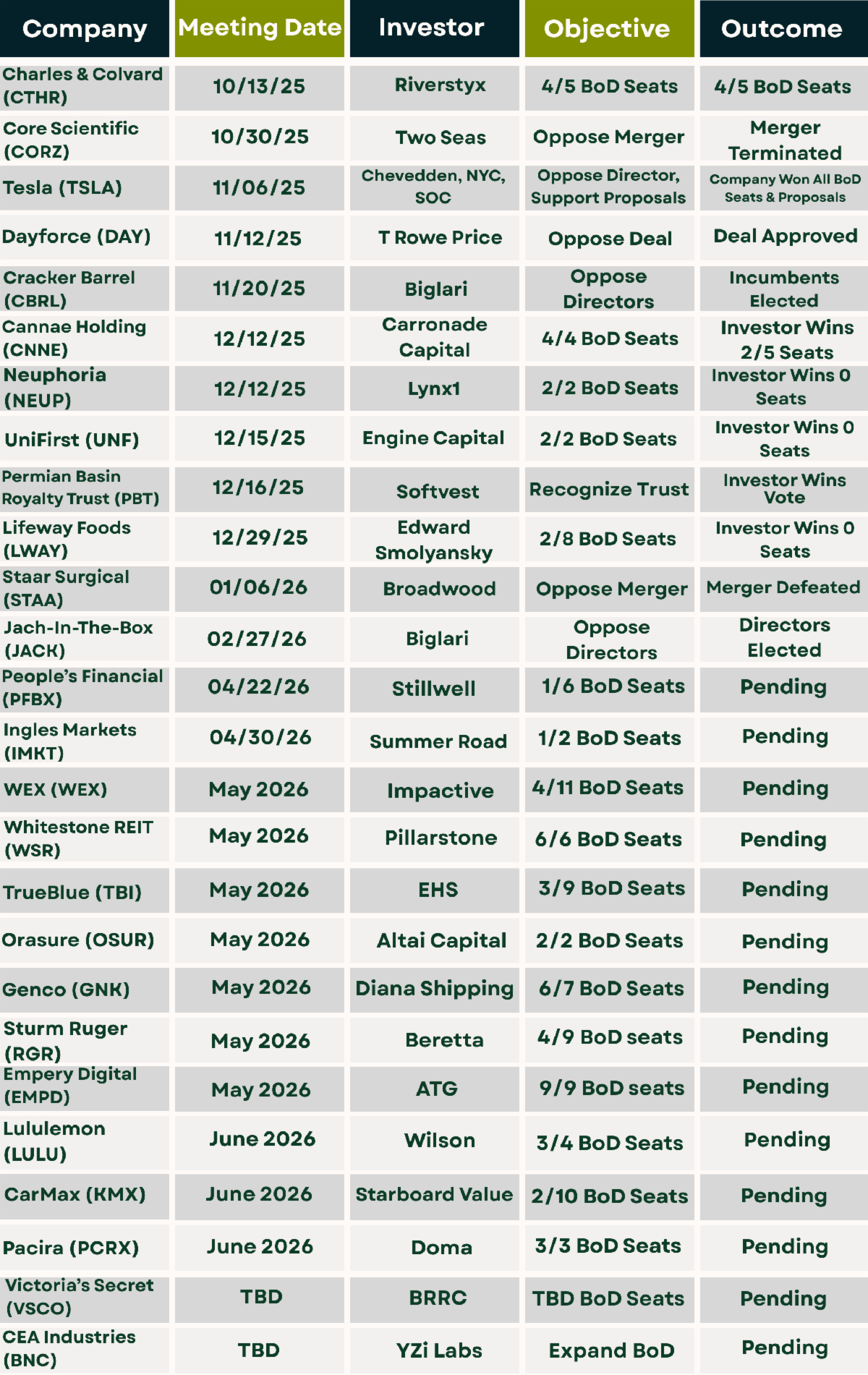
ACTIVIST SOLICITATION CAMPAIGNS TO WATCH:
The table below highlights notable active or recently filed solicitation efforts. These campaigns provide insight into how investors are adapting their strategies ahead of the 2026 proxy season.
| | | InvestorCom works with companies to guide them in identifying how their shareholders vote for board elections in addition to complex proxy proposals. For more information, contact us. | | | |
STAY AHEAD IN A CHANGING PROXY LANDSCAPE | As the proxy landscape grows more nuanced, issuers are encouraged to stay ahead of evolving trends in shareholder engagement. Investorcom provides tailored proxy solicitation, proactive stock surveillance, and strategic governance advisory services designed to keep you informed, engage effectively with shareholders, and anticipate key voting trends. We help clients navigate this changing proxy environment. Contact us to learn how we can support your next vote! | |
LET’S STAY CONNECTED!
Join the conversation and keep up with us on socials! Be the first to know about exclusive industry updates and insight, exciting announcements and company news you don’t want to miss. Why stop here? Follow us on social media and tag us, we’d love to connect. Engage with us today!
📲
SEE YOU ONLINE!
|
InvestorCom at Skytop Media Group's Shareholder Activism Summit in NYC | Small-cap companies are increasingly becoming the "sweet spot" for activist investors in 2026. Navigating these unique dynamics requires a different playbook than large-cap defense. | | |
InvestorCom At The 5th Annual Palm Beach Corp Gov Forum | |
InvestorCom once again took part in the 5th annual Palm Beach CorpGov Forum which has become a cornerstone event for business and governance leaders, offering timely discussions on the issues shaping today’s markets.
Last year’s expansion to a two-day format proved to be a major success, creating space for deeper conversations and meaningful networking. The attending ICom team was delighted to reconnect with peers and form new industry relationships. At the Forum we encountered another robust agenda and the opportunity to hear from leading voices across the investment and governance community including InvestorCom President and CEO John Glenn Grau.
Thank you once again for hosting this influential event John Jannarone, and Jarrett Banks, MBA
| | |
The Art of The AGM: Strategy, Shareholders, And Seamless Execution | In a recent conversation hosted by Christopher P. Skroupa, Founder & CEO of Skytop Media Group, InvestorCom President & CEO John Glenn Grau discussed the dual forces shaping a successful Annual General Meeting (AGM): | | |
|
Contact Us
203-972-9300
Info@Investor-Com.com
|
| We can't wait to serve you soon! | | InvestorCom | 19 Old Kings Highway South | Darien, CT 06820 US | | | | |