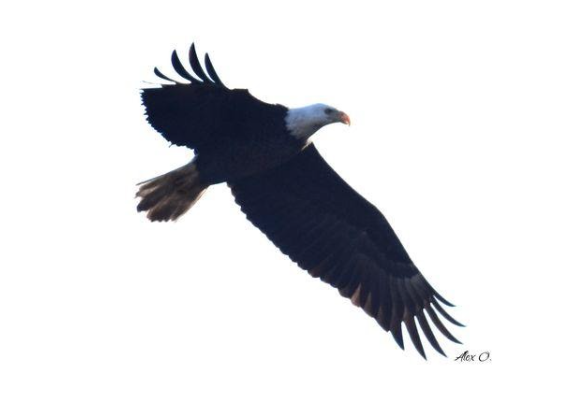
Monroe Township resident Alex Ostrow spots a bald eagle soaring over Thompson Park in Monroe Township on Saturday, February 5. Photo provided by Alex Ostrow.
The New Jersey Department of Environmental Protection Division of Fish and Wildlife recently issued its New Jersey Bald Eagle Project 2021 report.
Two active nests were reported in Middlesex County, including one successful nest at the Upper Millstone site in Monroe Township. The Upper Millstone nest was first discovered in 2017.
The Bald Eagle egg began incubation in the nest on February 4, 2021. According to the National Eagle Center, “once the egg is laid, the egg must be constantly kept warm, or incubated, and protected from predators. The body heat of the parent keeps the developing egg warm.
The egg was hatched on March 13, 2021 and became a confirmed fledgling as of June 10, 2021. Young golden eagles typically fledge when they are around 10 -12 weeks old. ... Fledglings continue to return to the nest and stay near their parents for a month or more, learning how to hunt and hone their flying abilities.
“It’s exciting to see these beautiful creatures thriving in their habitat here in Monroe and it’s so important that we take great care to protect them,” said Mayor Stephen Dalina. “We’re lucky to catch a glimpse of these majestic birds that serve as a national symbol of freedom, but we must remember to leave them be and always observe from afar.”
According to the U.S. Fish & Wildlife Service, bald eagles usually mate for life, choosing the tops of large trees to build nests, which they typically use and enlarge each year. They require a good food base, perching areas, and nesting sites. Their habitat includes estuaries, large lakes, reservoirs, rivers, and some seacoasts. In winter, the birds congregate near open water in tall trees for spotting prey and night roosts for sheltering.
According to the NJ Bald Eagle Project 2021 report, nesting bald eagles in the state face many threats of disturbance and habitat loss. Disturbance is defined as any human activity that causes eagles to change their behavior, including the mere presence of people in nesting or foraging areas which can distract them from normal feeding rituals as well as caring for and protecting their young.
Viewing eagles from safe distances is best for their survival and satisfies our natural desire to see them. Enthusiasts are cautioned to never approach a nest or take measures to touch or feed these natural predators.
Findings indicated that most bald eagle nests were in the southern portion of the state and that the majority of nests were located on private land, while the rest were on state, federal, county and conservation-dedicated lands.
The 28-page report details the findings from the Division of Fish and Wildlife’s Endangered and Nongame Species Program (ENSP) biologists, Conserve Wildlife Foundation (CWF) staff and volunteer observers who located and monitored bald eagle nests and territories in New Jersey throughout the January - July 2021 nesting season.