Your Monthly News & Updates | |
|
Something That May Help Tear Down Our Silos | |
|
I’ve been doing this column for over ten years, and this has been the hardest of all to grasp and write.
I have always tried to be open to new ideas, but as I look around, I think I and the people I regularly associate with are more or less still stuck in a silo – an ever-widening silo, but a silo nevertheless.
I’m a third of the way through an [only!] 300-page book called Culture: The Story of Us, From Cave Art to K-Pop, by Martin Puchner.
I thought the fascinating, eye-opening, 800-page Sapiens – A Brief History of Humankind covered a lot, mostly grounded in factual events. But Culture is harder to pin down and wrap my head around because so much of it is still foreign to me, a suburban American white male child of the 1950s and 60s. My education, which I had thought was pretty good, was totally Euro- and U.S.-centric, as if nothing of consequence came out of Asia or the Middle East or Africa or south of the Rio Grande.
There are just so many people and cultural institutions I was only dimly even aware of – or had never heard of – that borrowed from each other or were created anew!
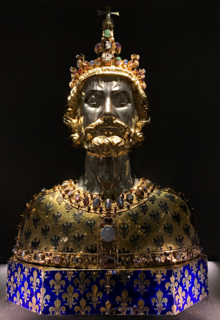
| I was surprised to learn that in the ninth century the semi-literate Charlemagne, king of the Franks (768–814), king of the Lombards (774–814), and first emperor (800–814) of what was later called the Holy Roman Empire, laid critical foundations for renewed literary production and creation of a world knowledge center. Much of that work was done in monasteries, which I knew a little about. | |
The Bust of Charlemagne, an idealised portrayal and reliquary said to contain Charlemagne's skull cap, is located at Aachen Cathedral Treasury, and can be regarded as the most famous depiction of the ruler. | |
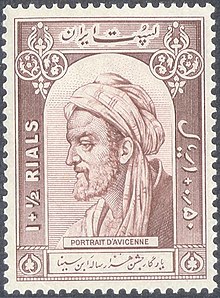
Portrait of Avicenna on an Iranian postage stamp, whose notable works include The Book of Healing and The Canon of Medicine. | |
|
At about the same time, Baghdad – the now capital of Iraq and the second-largest city in the Arab world after Cairo – was established as a brand-new city, to be a political and material center. It was also to become a world knowledge center, using organizational principles outlined by Aristotle. Paper, a new invention imported from China, helped make this possible. You might want to check out, for example, Avicenna Ibn Sina, the preeminent philosopher and physician of the Muslim world, who flourished during the Islamic Golden Age, and served in the courts of various Iranian rulers. He is often described as the father of early modern medicine. Spoiler alert: this is long, but worth the read.
Whew! And I haven’t yet come to the chapters about Asia and Africa. Maybe next month.
--
A brief shout-out to History with David Rubenstein, shown on WGBH tv, Channel 2, Monday through Friday from 7 - 7:30 pm eastern. Interviews with eminent historians and other public figures of note.
| |
Sheryl Faye To Perform at The Center as Amelia Earhart | |
|
Wednesday, Sep 13
6 pm - 7 pm
The Center
1 Ice House Road, Medfield
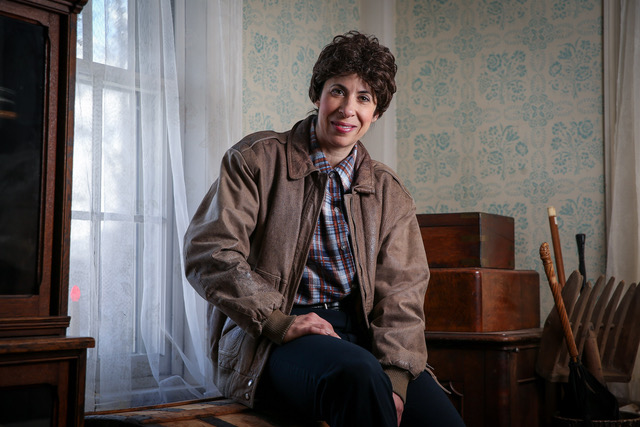
Sheryl Faye, a popular performer of one-woman shows featuring historically significant women, will be offering her show – "Amelia Earhart: Pioneer in Aviation!” – at The Center at Medfield on Wednesday, September 13 from 6-7 pm. The event is co-sponsored by Friends of the Medfield Library, The Center at Medfield, and The Medfield Historical Society.
Admission is free, but please register in advance by clicking the button below or by calling The Center at 508-359-3665.
| Faye has recently performed in Medfield to delighted audiences as Ruth Bader Ginsberg and Eleanor Roosevelt. Since 2003, she has masterfully brought to life important historical women in shows across the U.S. Her performances immerse the audience in multimedia learning experiences that captivate and spark interest to explore more. The upcoming show will depict Amelia Earhart’s fearless and adventuresome spirit, her wonder of the new “flying machine,” and passion for the science of aviation as flying becomes her career. | |
|
Saturday, Sep 23
10 am - 4 pm
26 North Street, Medfield
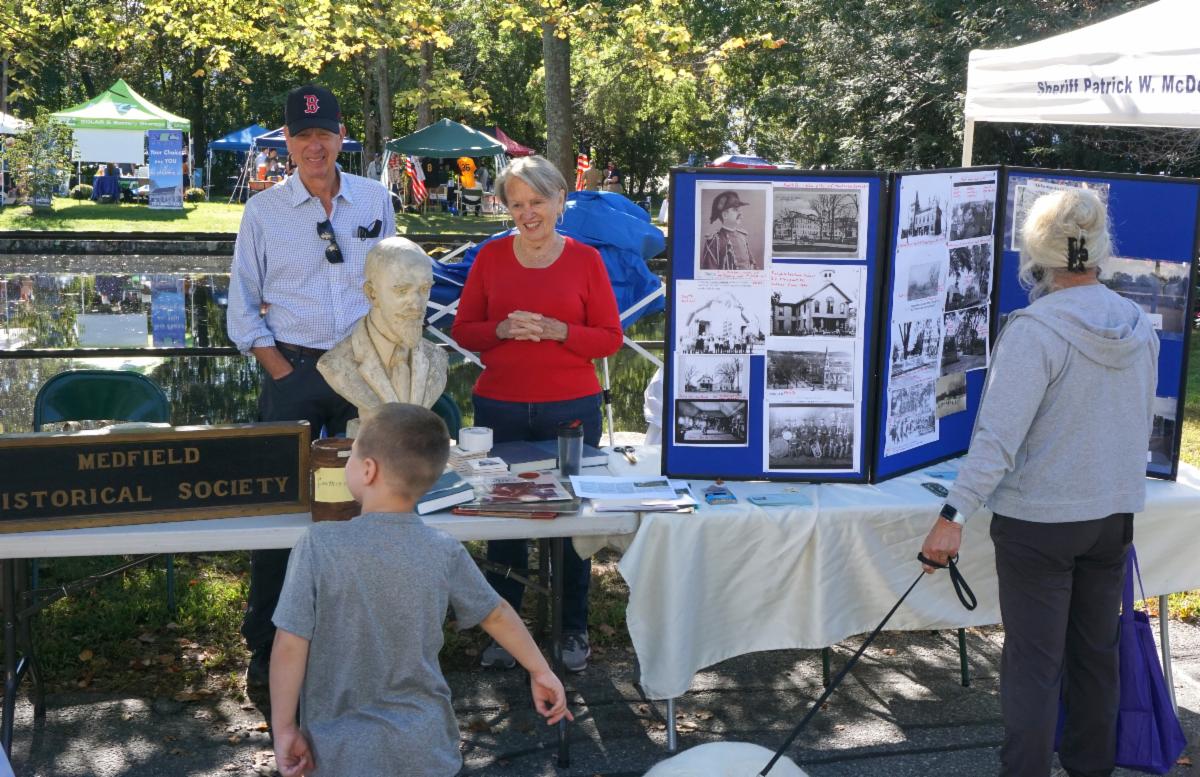
Discover Medfield Day, now in its 43rd year, is slated for Saturday, September 23rd, rain or shine! The event consists of over 150 booths highlighting Medfield businesses and organizations. To add to the fun, there will be an entertainment stage and kids’ alley filled with rides. The theme has yet to be announced, but it will be fun.
Come visit us at the Medfield Historical Society booth #39, across from the Dwight-Derby House. Bring along a few friends and introduce them to what the Historical Society has to offer.
| |
Return to Norumbega with Joe Hunter | |
|
Monday, Oct 2
7:30 pm
First Parish Unitarian Universalist Church
26 North Street, Medfield
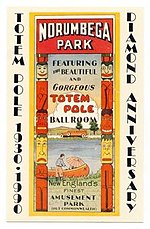
If you grew up in or near Medfield in the 1940s, 50s, or 60s, you’ll probably remember fun times at end-of-school-year outings to Norumbega Park with its tilt-a-whirl and other rides, penny arcade, and other attractions. Or maybe you even remember dancing at the Totem Pole ballroom. Here’s a chance, on October 2, for you to relive those happy days, even though the park itself was demolished and replaced in the 1960s by the Newton Marriott at the intersection of the Mass. Pike and Route 128.
The Medfield Historical Society will sponsor a showing of Return to Norumbega, a nostalgic and affectionate look at Newton’s Norumbega Park in its heyday. This documentary by Joe Hunter, a Newton resident and filmmaker who has created a number of award-winning films on local history, will be shown at the First Parish Unitarian Universalist Church on North Street in Medfield on Monday, October 2 at 7:30 p.m. Hunter will introduce his fifty-minute film and conduct a Q & A afterward.
Norumbega Park was an amusement park that drew hundreds of thousands from all over New England from 1897 until it closed in 1963. Located in the Auburndale section of Newton along the Charles River, the park featured canoeing, picnic areas, a penny arcade, a restaurant, a zoo, a carousel, and an electric fountain. Its Totem Pole Ballroom provided topnotch vaudeville entertainment, musical plays, comedies, and melodramas. It featured performances by Benny Goodman, Artie Shaw, Lawrence Welk, Ozzie Nelson, Frank Sinatra, Dinah Shore, and the Von Trapp Family, among others. Thousands fondly recall dancing at what was widely considered one of America’s most exciting ballrooms.
| |
|
Monday afternoons
3 - 7 pm
Medfield Historical Society
6 Pleasant Street
Anyone who has visited the Medfield Historical Society museum can attest that the building is busting at the seams with "cool stuff." We never know quite what we'll find on our explorations!
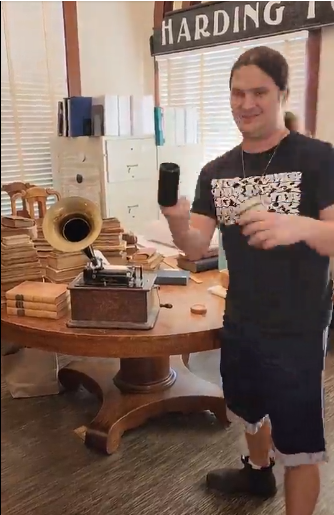
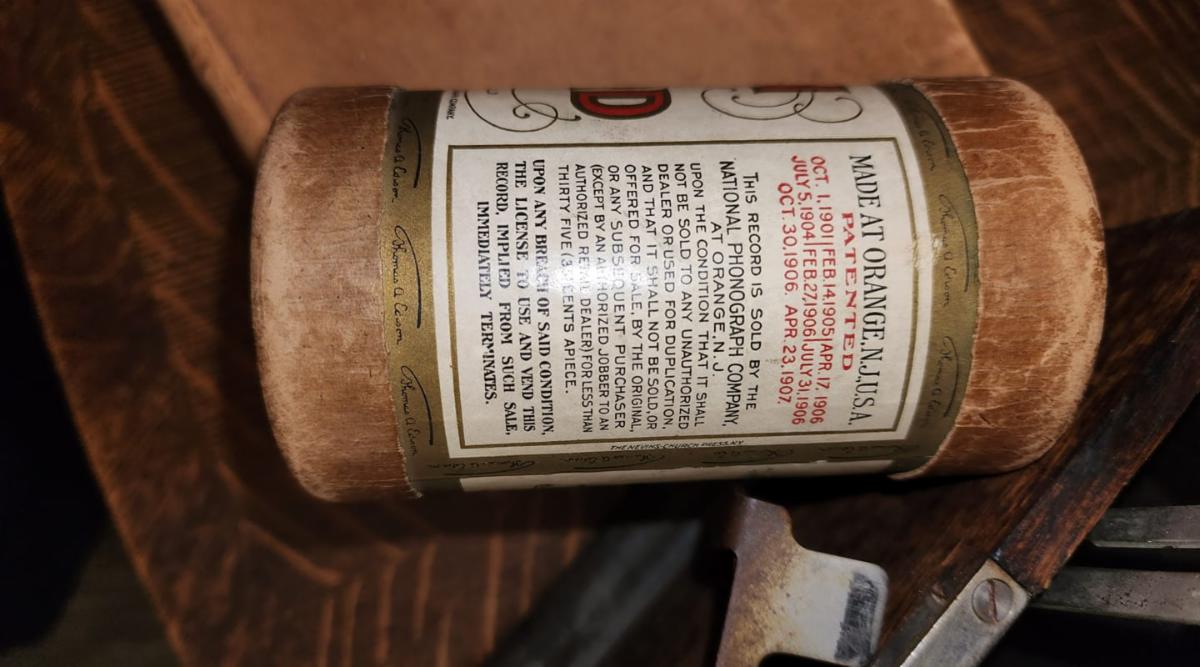
On August 14 during Mondays at the Museum visitors were treated to something special. Society volunteer Johnny Dalton of @kungpowrecording brought by an old Edison Wax Cylinder Record Player circa 1903 for us to see.
The phonograph was developed as a result of Thomas Edison's work on two other inventions, the telegraph and the telephone. It was the earliest recording technology and, at the time, was state of the art. These phonographs used a stylus to cut into wax cylinders — literally "cutting a record."
FUN FACT 1
Each early cylinder only holds TWO minutes of audio! Most songs on the radio are 3 to 3 1/2 minutes long. The more "advanced" blue cylinders hold 5 minutes!
FUN FACT 2
At the time, each cylinder was a unique recording of the artist... 100 copies sold meant singing 100 times! A very time-consuming and costly undertaking!
To read more about the history of the cylinder phonograph, click here.
|  | |
Please join us, if you are able, on Mondays between 3-7 pm. Come as often as you can and stay for as little or as long as you like. Bring a laptop if you can. There is always something to be done – dusting, sorting, scanning, cataloging, wrapping, transcribing, etc. And you never know when someone will pop in with some really cool artifact to share with visitors.
To our members, THANK YOU! Your support is what keeps us energized. We can't wait to share more about our "finds" as we go along!
| |
Backstage Tours at the Museum | |
This month's winner is away on extended travel. Stay tuned for the highlights of their visit when they're back! | |
|
Would you like a chance to win a backstage tour of the museum archives? Become a member today! All members are entered in a drawing each month and winners will be announced in the newsletter!
Not a member? Join with a Family Membership today!
| |
Collected Writings of Miss Mary Morse | |
|
Thanks to your continued support, we recently purchased a high-resolution overhead scanner making it possible to digitally preserve the various books and journals held in the museum archives that are unique to Medfield. As we go through the process of scanning these treasures, we will share one each month here.
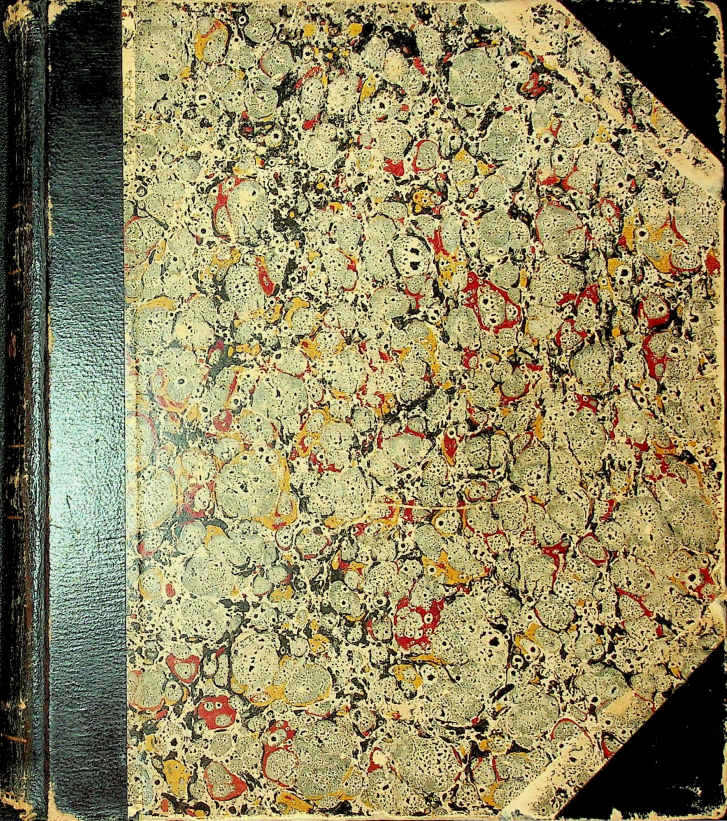
In July of 1877, Miss Mary Morse either began or completed her quest to document "items and facts connected with the early history of Medfield and Medfield families of the early time which are not accessible in any published history of the town." Ultimately the journal made its way to Mrs. William Worth of Orlando Florida who gifted it to the Historical Society in 1976.
Although the first part of the journal was clearly written by Miss Morse, the last entry of the journal was made in 1955 by Olive Penniman and it is clear that other entries were made in between. Overall, the journal is a random walk of entries – some of which are written as stories and others look to be transcriptions of other documents.
Within the pages of this book, you can read more about the old elm tree that stood by the town pump (at the intersection of North and Main) which was planted 1792, the fate of Medfield slave Newport, and the British deserter held up in the Morse woods. Beyond what amounted to only a dozen pages in Miss Morse's handwriting, the journal continues with writings signed by numerous others from about town. Included within these additional pages you will find that many citizens of Medfield contributed toward the building of Harvard College in 1678 and about half way through, you can read about the "eccentric" Hannah Adams and her ability to see ghosts.
One entry which goes on for a number of pages discusses the formation of various libraries before a public library was the norm. In 1786, the first library was simply called the "circulating library" as there was no building. Later this became known as the Medfield Social Library and was housed in the upper hall of the "Academy". Members of the library paid one dollar at a time until they had contributed 6 which were used to buy books. By 1809 the library contained a respectable 700 volumes. The Medfield library was so well established that until the 1820s, there were many subscribers from out of town.
Unfortunately, around that time the son of one of the subscribers stole many of the books so other subscribers took books out and did not return them. A number of the remaining books were brought to the poor farm for the inmates. Although the library was essentially dissolved at this point, there was still a small group that would exchange books monthly between themselves.
In 1828, a new library was formed which was made possible by a donation from Silas P. Holbrook who donated his "winnings" from a defamation suit that he won against Captain William Felt. Although still not public, this library had 920 books and was kept at the town store.
This journal is fascinating and worth the time it takes to pass over the pages of handwritten text. In addition to the main text, you will find a little scrap of paper between the pages that reads "I think that men were not allowed to vote after 80 years of age. That was the law once."
We sincerely hope that you enjoyed this month's archive treasure. Please continue to support our efforts with your membership!
We are now able to accept monthly donations! A small amount – say $5 per month – goes a long way toward our preservation efforts. Simply click here to donate!
Click here to read Mary's journal.
| |
Recollections of Living in the Clark Tavern | |
|
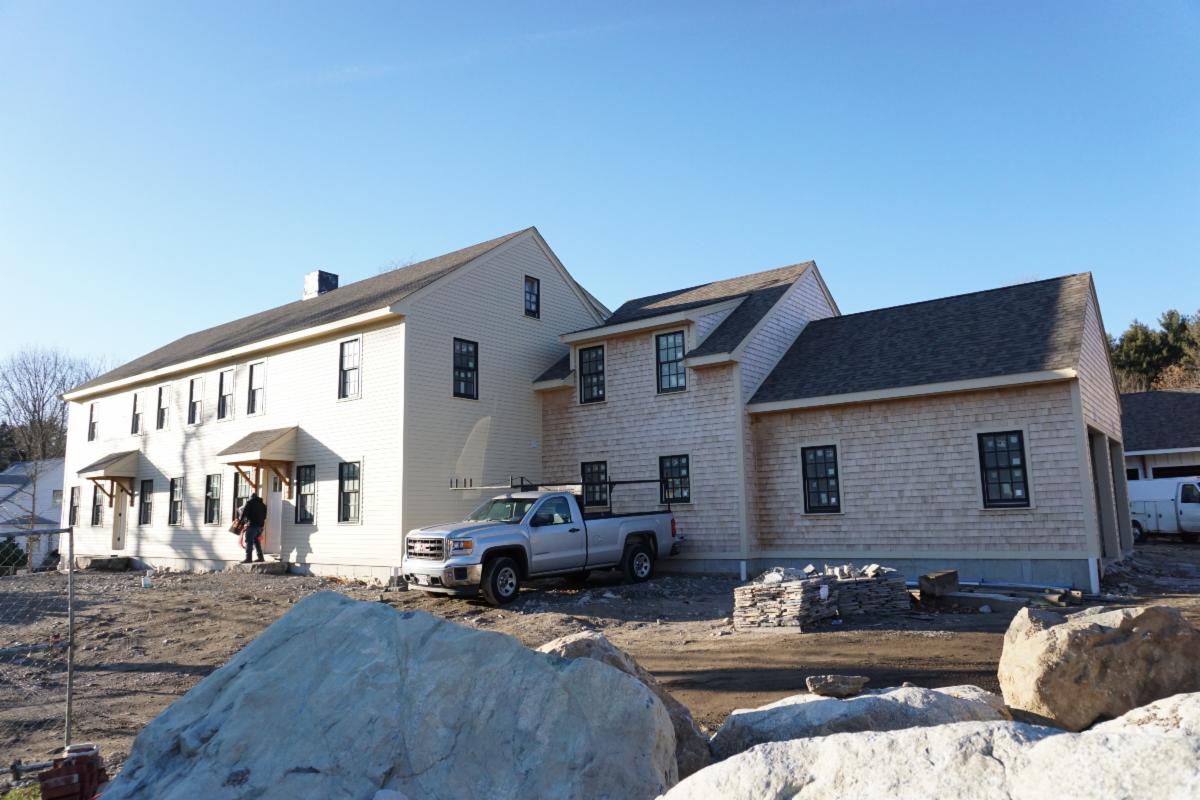
Early in August, President David Temple received an email from Beverly Dixon recounting some of her experiences living in the historic Clark Tavern. In response, David sent a photo of the Clark Tavern as it looks today. Below is her reply, as well as some of her recollections about the Tavern.
Thanks for the photo! It was so good to see the tavern in its present incarnation (considering its recent dereliction) and I am glad the footprint of the original has been so carefully maintained. Many antique buildings "evolve" during their lifetimes, often resulting in a completely different appearance based upon usage and family size, etc. I hope what is being done at this old property is positive. The Clark Tavern has a fascinating history and is worthy of being remembered.
| |
The Clark Tavern as it looked in spring 2023. | |
|
My husband and I rented half of the Clark Tavern from 1972 - 1975 until Lorraine Laverty informed us that she wanted to sell the house and that we should move. We loved the antique features of the house and our furniture fit in so well with the original décor. I was pregnant when we moved in with our 3-year-old and my younger daughter was born in April 1973. Oddly enough, she spent her childhood and teen years obsessed with architecture and building, graduating later from Wellesley College with a BA in architecture and University of Pennsylvania with a masters in historic preservation.
A historic society member was kind enough to open the Peak House for her to research information for a thesis in her senior year at Wellesley.
When we moved in, we wanted to see if the fireplaces were usable, so Miss Laverty had the fire department inspect them. We were told they were in perfect condition, and we did indeed enjoy the fires.
| 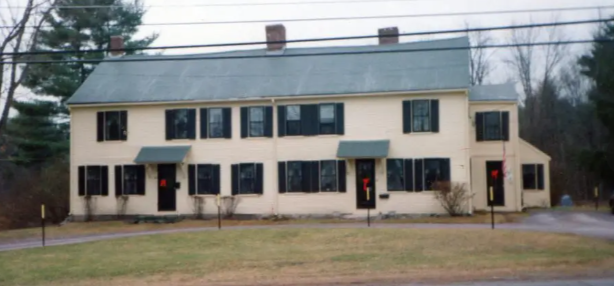 | The Clark Tavern prior to reconstruction. It looked much like this when Beverly and her family lived here. | |
We had several unusual experiences while living there. The only bathroom was on the second floor and had an antique claw-footed bathtub. The single nozzle for water had separate hot and cold handles and it took a while to get enough water in to take a bath. I wanted to bathe my older daughter, so I turned on the spigots and went downstairs for a few minutes to check something I was cooking in the kitchen.
While down there I heard the water stop running. I called my daughter, thinking she was upstairs and had turned it off, but she was on the floor sitting next to me playing with blocks. I ran upstairs and saw that the water faucets had been shut off.
This happened several times, but only when I left the room.
Click here to read more >>
| |
People and Places of the Past | |
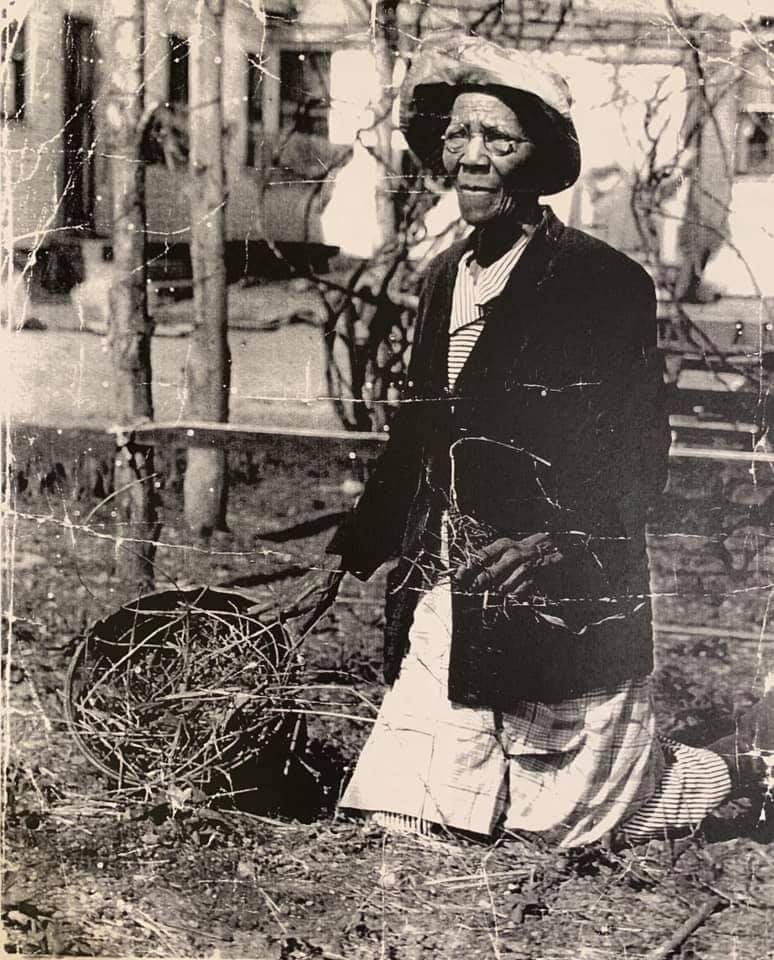
Christina "Tinah" Levant Platt | |
|
Author’s Note: As is often the case with family lore, the story below relates “facts” that aren’t borne out by Census and other records. That said, the kernel of the story, and the life of this extraordinary woman, remain true.
Christina “Tinah” Levant, the daughter of Frank LeVant and his wife who were brought over on a slave ship from the east coast of Africa1, was born into slavery in 18422 on a plantation in Marion, South Carolina.
Tinah’s first work as a slave began at the age of 13, when she was appointed as lady’s maid or nurse to her plantation’s mistress, Mrs. W. J. Baker. During this time, Mrs. Baker secretly taught Tinah to read and write – something that was illegal and quite dangerous for both.
When Christina’s mother was on her deathbed, she begged Mrs. Baker not to sell her children. Mrs. Baker granted her request and, in her will, left Tinah and her older sister to her son, William J Baker. Mrs. Baker died in 1860, the summer before the Civil War broke out.
Upon Mrs. Baker’s death, Tinah, then 17, was put in the fields by her new owner to work as a water girl. She would fill a heavy wooden pail with water and walk a mile around the plantation many times a day, toting the water bucket on her head, to bring water to the slaves working in the cotton fields. In addition to carrying water, she was a lookout, watching for the switching tail of the approaching overseer’s horse, and warning the others so that the overseer wouldn’t catch them as they secretly knelt and prayed for their freedom. She continued this work until the age of 20 when the war was over.
Click here to read more >>
| |
There was Once a Place Called Lord's | | | | |