Volume 5 Issue 6 | June 2024 | |
Wonders, challenges, opportunities, and beauty—there's lots going on in the June garden. | |
The Root of It newsletter ends with our monthly quotation. If you find your newsletter has been clipped by your email provider please click HERE for a webpage version of the newsletter. | |
|
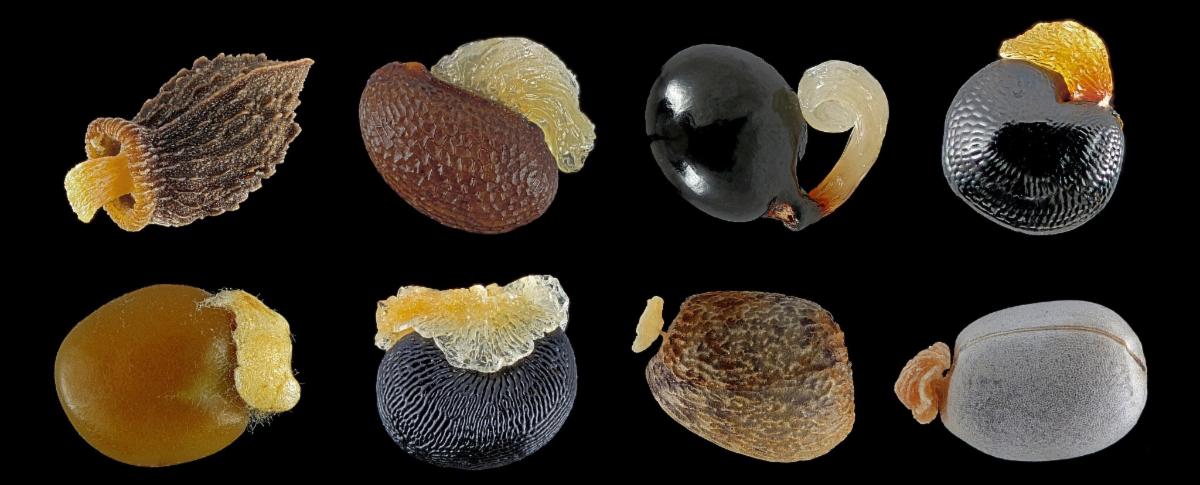
An assortment of elaiosomes left to right:
Borago officinalis · Chelidonium majus · Corydalis cava · Corydalis sempervirens
Cytisus scoparius · Dicentra torulosa · Euphorbia lathyris · Euphorbia cyparissias
photo by Hans Stuessi
partial image used by LICENSE
| |
|
The art of living together. It is always satisfying to see two organisms living in a mutualistic relationship, one in which both parties benefit. Certain ants and plants have a such a relationship, an elegant one. Close inspection of the seed of a bleeding heart (Dicentra spectabilis) reveals a fleshy structure called an elaiosome (e-LAY-o-zome) attached to the smooth, hard seed coat. The elaiosome is made of and secretes fatty cells and other nutrients. These delectable treats attract ants, which are crucial to seed dispersal and insure the survival of this species.
Ants carry these tasty tidbits back to their nests, consume the exterior goody, and then dispose of the seed in their ant “compost pile”. This ant-created seedbed contains well-aerated, fertile soil and is protected from marauding rodents and other scavengers. There the seeds find the perfect growing site and conditions to germinate and grow on. Many spring ephemerals rely on this seed dispersal strategy: trillium, bloodroot, Dutchman’s breeches, hepatica, squirrel corn. Violas, wild ginger, carex, and a host of other plants have elaiosomes and a relationship with nearby ant colonies.
To date, scientists have found elaiosomes in over 11,000 plant species across 77 plant families. They have determined that certain seeds will only germinate once the elaiosome has been removed, perhaps a mechanism to break dormancy. Yet, most seeds germinate more quickly with their elaiosomes intact. The elaiosomes on these seeds may act as a water reservoir to facilitate water absorption and seed hydration. Researchers are on the job, figuring out the how and why of this interesting plant structure. Scientists note that the anti-microbial properties present in ant nests offer these collected seeds protection from pathogens.
Seed dispersal by ants (myrmecochory) improves the odds of germination for many plant species, and ants are happy foragers when these nutrient-dense, elaiosome-bearing seeds are brought back to the communal nest. Look for the interactions of these plant and ant species, and witness the art of living together. Look Around!
K Edgington
| |
Leaf Brief - Chameleon Calamity | |
|
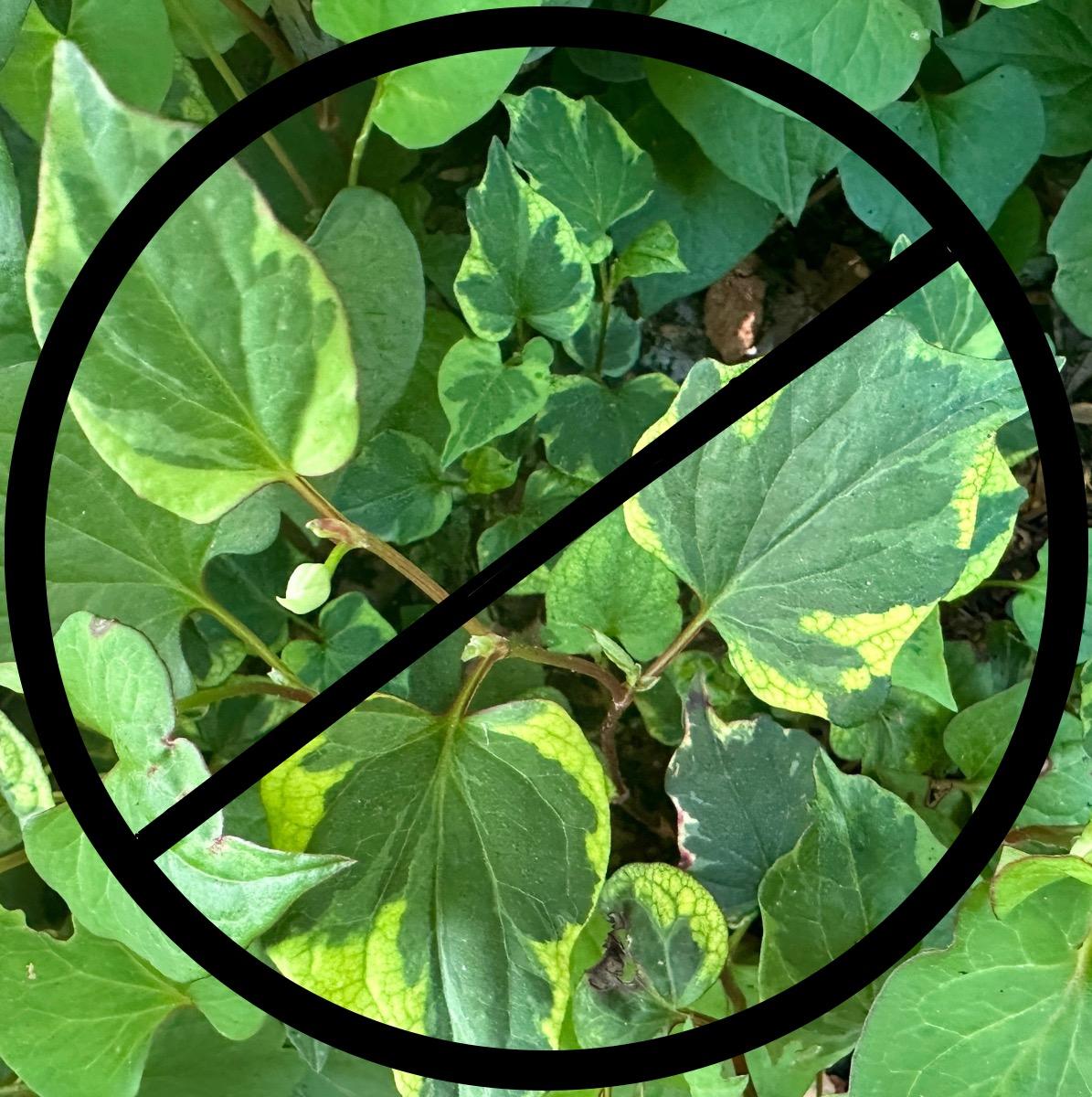
Houttuynia is a plant to be avoided!
photo by E Barth-Elias
| |
|
People are called chameleons when they change their behavior to please others or get ahead. This often applies to politicians, but in one caser5frrrrrrrrrrrrrrrrrrrrrrrrrrrrrrrrrrrrrrrrrrre4r it aptly describes a plant. The chameleon plant or houttuynia (Houttuynia cordata) transforms from a charming ground cover to a garden bully in its quest to dominate. It is sold in nurseries under a number of names, such as Court Jester, Tricolor, and Variegata.
This colorful ground cover entices with green, heart-shaped leaves splashed with shades of white, pink yellow and red and flowers that form a lime-green spike surrounded by four petals. It is a hardy perennial that will win you over with its ability to fill difficult areas.
| |
|
Native to southeastern Asia, houttuynia thrives in both sunny and shady spots in zones 5-11 with ample moisture or even standing water.
Once this attractive plant has lured you in and becomes established, it’s then that you’ll see its true colors. With a height of up to 18 inches and a creeping habit that spreads rapidly, it aggressively outcompetes neighboring plants. Attempts to dig it up result in leftover root fragments resprouting en masse, as it continues to overtake adjacent vegetation. The roots can lie dormant for years before resprouting. To make matters worse, it has an odd aroma when crushed or handled, described as “fishy” (although I have a few weird friends who like the smell). Unfortunately, deer are no help with control, since they avoid it.
Eradication of established houttuynia requires a multi-year effort. A combination of lifting the plant out of the ground with a pitchfork and crumbling the dirt away from the roots is effective but labor intensive. Black plastic covering (in sun) or repeated herbicide applications can also slow the spread. Read more HERE.
If you insist on taking a chance with houttuynia in your yard, here are some things to consider. Plant it near the sidewalk, driveway, or foundation where cement blocks the spread, or in a 1 to 2-gallon container so the roots are contained. Planting near a lawn is a mistake as your turf will disappear in a few short years. Although it controls erosion along a stream bed, this non-native should not be introduced into a natural setting.
Houttuynia isn’t all bad. In its native habitat, the chameleon plant is harvested for use in Vietnamese and Thai cooking, where it is called fish mint. The leaves have a spicy coriander flavor, and the roots can be eaten as a vegetable. Medicinal uses include relieving asthma symptoms and treating fever. Research has found that underground stems and roots have anti-inflammatory, antibacterial, and antiviral properties. Tea made from the leaves is reportedly good for cavities and mouth infections.
Truth be told, I’d stay away from this beauty. She’s not worth the trouble and like many bad relationships, the colorful plant may revert to plain boring green after a few years. It’s finally finding its way onto invasive species lists and drawing more negative attention, yet can still be found in nurseries. When spotted, walk on by, and save yourself years of regret.
HOUTTUYNIA CORDATA: North Carolina State Extension
J Gramlich
| |
Creature Feature - Two Scoops on Scales | |
|
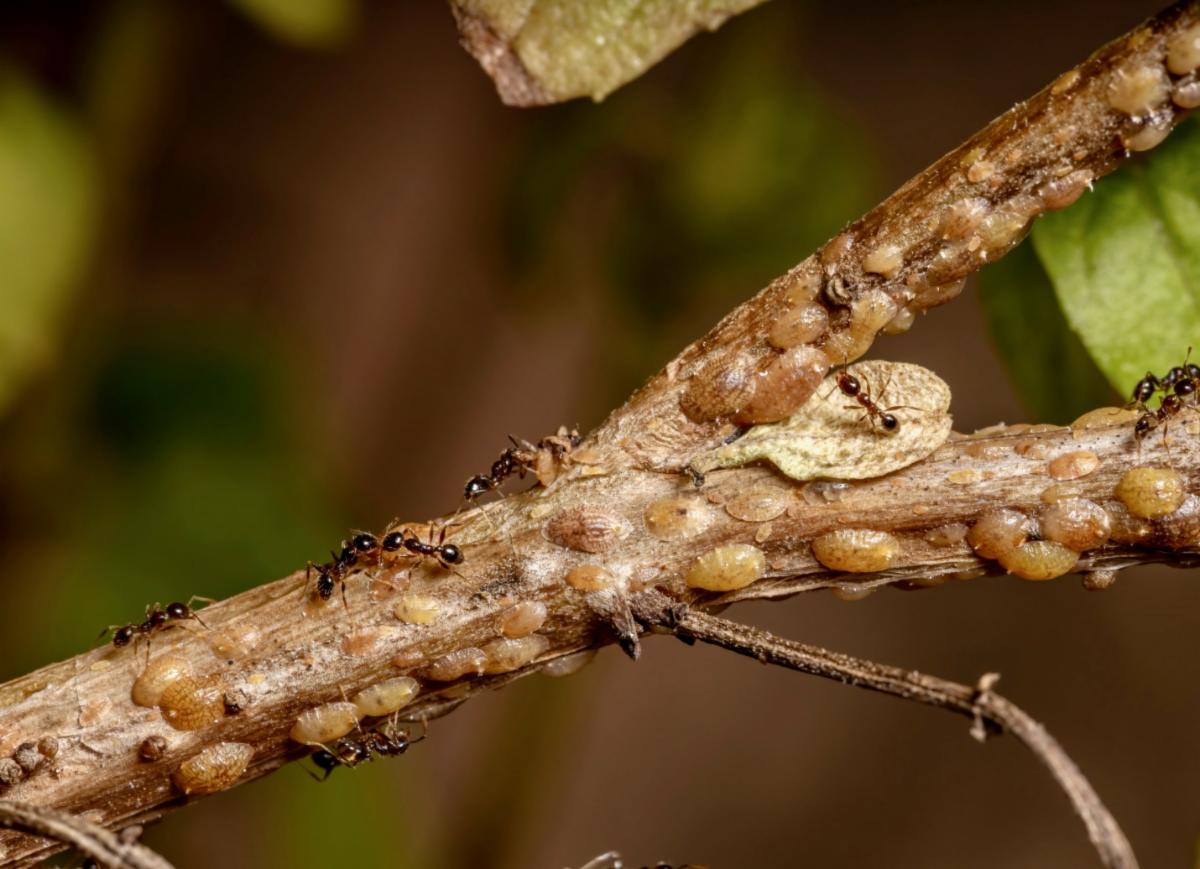
Tortoise scales on basil branch
photo by Vinicius Souza
| |
|
Dear Readers,
When my Dear Editor asked me to write about soft scale insects, I was unprepared for the onslaught of negativity surrounding this bug. There are no fun facts or cute videos about scales, and there’s lots of material on annihilating them. You may share that perspective. But in the interest of complete coverage, I sought out an alternative opinion and found this…
| |
|
Samantha Scale here, with BUGNEWS, reporting live from your backyard on the bug everyone loves to hate —me. (Honestly, I’d prefer to be a butterfly but nobody asked.) I’m here to get the word out on what you call scales, but I call heroes.
First, some background. Scale insects belong to the order Hemiptera (“true bugs”), and the superfamily Coccoidea, which contains about 8,000 very diverse species world-wide, 1,000 of which are found in North America. In Ohio, look for brown, cottony maple, European elm, fletcher and lecanium scales. We are ectoparasites—we live on the outside of plants and stick our stylets (needle-like slender tubes that can be up to 8 times longer than our bodies) into plants and suck out phloem tissue. Yes, I know it sounds gross. No, we are not related to vampires. The three most common types of scale families are soft, armored and mealybugs, but we’re just talking soft scales today.
BUGNEWS asks tough questions—like, are scales pests? Absolutely not! We are tiny bugs who lead a hard life and deserve respect. Our species can vary from the really small (1/8 of an inch long brown scale) to the small but relatively a lot bigger (½ inch long magnolia scale.) You try surviving at that size! To help, females produce a round or oval domed wax cover that sticks to our bodies. This white, grey, or brown coating looks like the scale of a fish—our name, get it?—and keeps us from drying out, provides camouflage from predators, and protects us from YOUR poisons. Preeetty amazing! And what do male scales do to survive? They don’t. Gnat-ish creatures with tiny wings, our males mate and die, without even time for a meal. Oh well.
Moms lay up to 2,000 eggs under their wax covers that hatch in 7-21 days; some species have live young. Soft scales go through three instars (growth phases). Baby nymphs (crawlers) move around their birth plant on tiny legs to find their new home. Once it finds the perfect spot, mouthparts (stylets) go in, phloem comes out, and the crawler loses the use of its legs. Most species remain immobile for the rest of their lives. Is this any way to live? You should be holding fundraisers for us.
Yet despite this hard (and boring) life, we play an important role in the ecosystem. We excrete honeydew (excess sap from phloem), which is a sticky, but yummy food source for flies, wasps, ants and birds. We scales also contribute to your economy, as some are used to produce dyes to color food and fabrics (cochineal scales), while some control invasive plant species.
So here’s to the noble scale! Next time you see one, give it a smile! I’m Samantha Scale, signing out for BUGNEWS.
Dear Readers,
After seeing Samantha’s report, I felt compelled to add the following. BUGNEWS appears to have, ahem, a slight bias in its reporting.
Sadly, Samantha, people really do hate you. Your non-stop feeding can harm and, if infestation is heavy enough, kill plants. Leaves yellow or wilt, growth is stunted, branch tip dieback occurs. Damage starts on individual limbs and spreads to the entire canopy. Plants weakened by scale are more susceptible to drought, disease, severe weather and other insect attacks. The only plus about soft scales is they are less harmful than armored ones.
And that wonderful honeydew? Honeydew creates a sticky, unsightly mess that coats cars, houses, sidewalks, benches and anything else unlucky enough to be dripped on. It attracts ants, wasps and flies, which people don’t usually want around. While honeydew doesn’t damage plants, it supports sooty mold, which is ugly and interferes with photosynthesis.
So how to STOP scales?
Natural controls include predators, such as lady beetles and parasitic wasps, and adverse weather conditions. Look for scales before purchasing plants, but they can be hard to spot. Once you find scales, identify the species. This will help identify the timing of the crawler stage, when they have no covers and are most vulnerable.
Scales may be scraped or rinsed off if infestations are small; heavily infested stems can be cut away. Once scales have their hard coatings, contact insecticides won’t work, but horticultural oils and soaps may, as well as systemic pesticides. Here are resources to help you identify the best solution for your scale problem. Just smile when you blast ‘em…
SCALE INSECTS ON MINNESOTA TREES AND SHRUBS: University of Minnesota Extension
CONTROLLING SCALE INSECTS AND MEALYBUGS: Alabama A&M and Auburn Universities
THE COMPLETE GUIDE TO GETTING RID OF SCALE INSECTS: Epic Gardening (very comprehensive)
SCALE INSECT CONTROL: Nebraska Extension (short version)
.
C Christian
| |
Crevices: Tiny Gardens with Big Impact | |
|
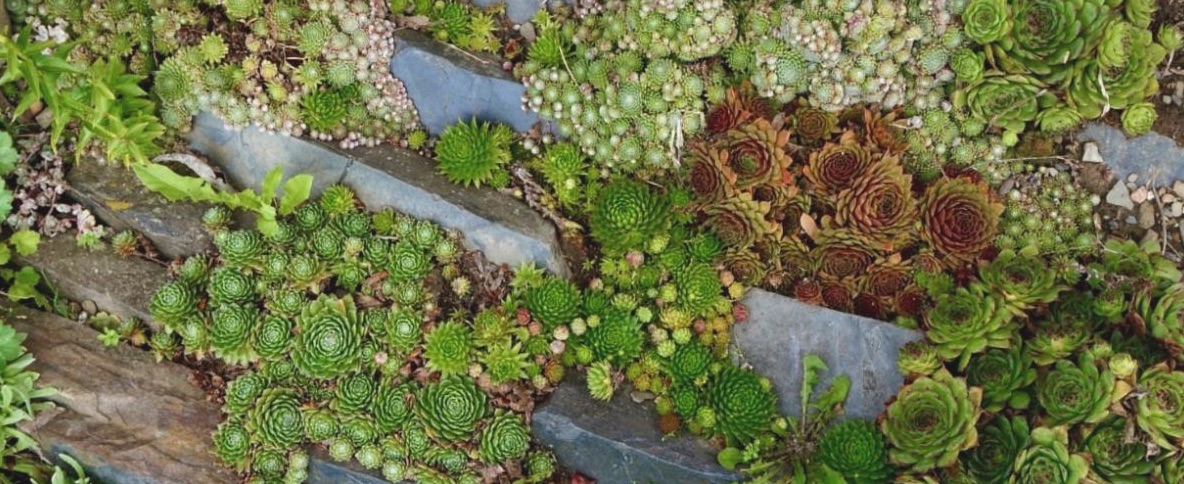
Spaced stones form ideal crevices for Sempervivums
photo by Jonny Sek
| |
As I look down my driveway, all I can see are the weeds that have taken over the cracks in the pavement. While they make me want to tear my hair out, they remind me that not all gardening takes place in flower beds. When I take a walk through the sandstone ledges that are scattered liberally throughout this region, I marvel at mature trees growing out of the sides of towering rocks.
Both these scenarios are perfect examples of crevice gardening, planting in small spaces between rocks. Stones are wonderful in themselves, but when enhanced with various textures, colors and shades of green, they come to life.
Using gaps in stone to garden shows off plants that might not be well-suited to traditional flower beds. Think of sedum, those drought-tolerant plants that can grow just about anywhere but seem to thrive in dry, inhospitable nooks. Hens and chicks (Sempervivums spp.), add a touch of whimsy as they multiply their spiky rosettes in places you might not have thought possible. Woolly thyme (Pseudolanugiosus spp.), creeping phlox (Phlox stolonifera, spp.), rock cress (Arabis causasica) are all stone stalwarts, growing in niches in a barn stone wall, cascading from ledges, or simply spreading out on a rocky outcrop.
Crevices are great places to show off unusual plants. Moss rose (Portulaca grandiflora) is a natural. It is heat and drought tolerant and insists on living in full sun. Sea thrift (Armeria maritima) is ideal for larger pockets, with its mounding habit of spiky, almost grass-like leaves that sprout small flowers, ranging in color from pink to white to almost red. The drier the better for this plant, which rots if planted in moist soils.
Cliff maids (Lewisia spp.) is named for Meriwether Lewis, who found it in the west high country he surmounted on his travels to the Pacific. It is native to that area, thriving on north-facing cliffs and rocky outcrops. Some species are deciduous, some evergreen, all are succulent and with captivating flowers. Because it’s native to higher northern altitudes, our growing zones are no obstacle.
Building a crevice garden requires rocks, although that doesn’t mean visiting quarries and renting heavy equipment—that’s a lot of money and labor. These gardens can be built on a slope, tucking plants into the spaces formed by found objects (old tools, bricks, unusual hunks of concrete). An essential ingredient is turkey grit, crushed granite that serves as the foundation for the garden and ensures that drainage will be adequate. Do you have a dry spot that turns flowers to dust? Find flat rocks and embed them on end in a layer of grit. The key is sharp drainage, which allows water to flow easily through the garden. Plant between the standing stones. Or, if space is a consideration, create a crevice garden in a container. Hypertufa troughs hold the grit. Add unusual stones or small rocks and your favorite desert flowers. Voila!
If you already have a perfect outcropping of your own or nature’s making, scrape out and set aside the material between the stones. Wash most of the soil off the roots of your plant and gently tuck it into the crevice. Replace the soil, making sure it’s snug around the roots. Give the area a light watering the first couple of weeks to be sure the roots are established. That’s it.
Nature is always willing to show off her myriad creations. Sometimes she provides dramatic backdrops, sometimes tiny niches hold the beauty. Crevices may be small, but the impact they have can’t be hidden.
TRY THIS, NOT THAT: CREVICE AND ROCK GARDENING: Sarah P. Duke Gardens
CREVICE GARDENS: LIFE BETWEEN THE CRACKS: PennState Extension
S Vradenburg
| |
Viticulture ~ The Practice of Growing Grapes | |
|
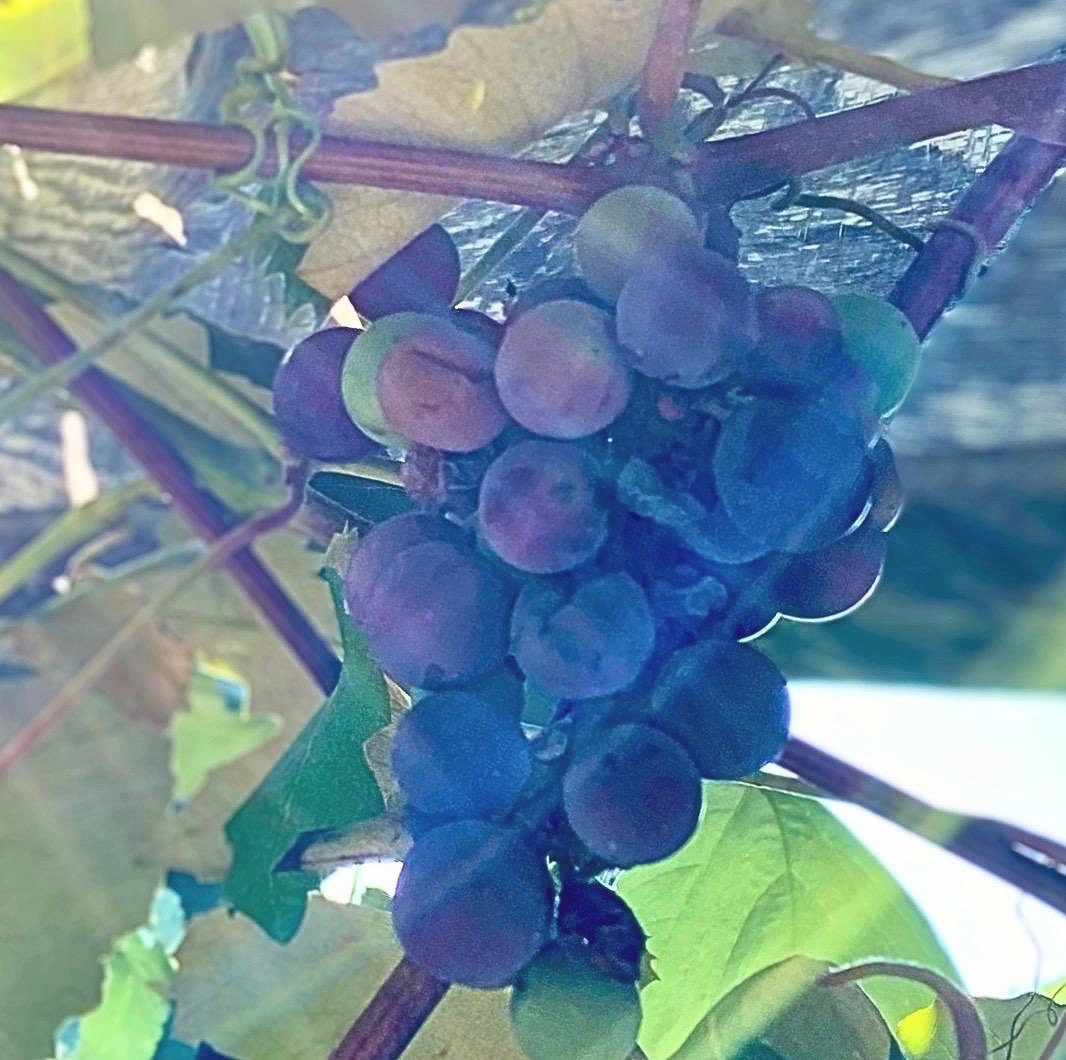
Ripening grapes
photo by E Barth-Elias
| |
|
With 8,000 years of cultivation and a myriad of applications, grapes (Vitis vinifera) are a great addition to a backyard garden. Whether for wines, table eating, cooking, jams, grape seed oil, medicinal effects, or even their edible leaves—think dolmades—grapes have a lot to offer. They bring depth and aesthetic interest to the landscape and deserve consideration when planting today’s edible gardens.
Northeast Ohio’s cool springs and gentle falls create the perfect climate for growing several common varieties, and winter hardy American and French hybrids work best. Some cultivars to consider are Candice, Mars, and Suffolk Red. In addition to cultivar selection, other considerations include location, management techniques, and the time involved.
| |
|
Plant grapes in a location with full sun for at least seven to eight hours a day. Grapes require a minimum of 155 to 160 frost-free growing days for optimal fruit production. Plant in early spring to establish a good root system before winter. If planting in the fall, plant six weeks before the first frost to allow root growth before the ground starts to freeze. Grapes have deep root systems—at least 36 inches deep—so good drainage is very important. They like warm soil—use caution when mulching after plants have become established. Because of a soil pH of 5.0 to 6.5 and high potassium requirements, expect to apply soil amendments such as lime. Soil test to determine needs.
Grapes spend their first two years establishing roots and shoots. A trellis support is necessary and should be constructed within the first year to manipulate the shoots. Trellis systems keep the vines off the ground, allow for air movement, and give more exposure to sunlight. Pruning, also vital to the success of a grape crop, increases the quality of grapes produced and allow for abundant vegetative growth for the next season.
During the third year, growers can expect a small harvest from the grape crop, meaning pest management strategies should be employed at this time. There are several types of pests, such as beetles and mites, to look for when growing grapes. Grape berry moths are one of the most common pests of Ohio grape crops. According to The Ohio State University website, “if left unmanaged up to 90% of the fruit may be destroyed.” The grape berry moth’s pupa overwinters on the leaf, then the larvae burrow into the grape in warmer weather, so identification during the larvae stage is vital to pest management. Disease management is essential to any healthy crop and grapes are no different. Black rot, caused by bacteria, as well as botrytis bunch rot and powdery mildew, caused by fungi, are a few of the common diseases growers can encounter. There are no truly disease-resistant grape cultivars; however, look for ones developed to avoid pest and disease issues.
Grapes will not produce a full crop until their fourth and fifth years, so hang in there. Properly maintained crops can grow up to twenty pounds of grapes per year. The Ohio State University’s factsheet on grape growing states that “once established, well-tended grapevines can be productive for forty years or more.” It can be worth the wait. Try your hand at viticulture and add a beautiful plant and superfood to your landscape.
GROWING GRAPES IN THE HOME FRUIT PLANTING: OSU Extension
WINE GRAPE VARIETY RECOMMENDATIONS FOR OHIO: OSU Extension
N Callicutt
| |
|
June Checklist
J Gramlich
| |
More learning opportunities:
| |
|
In June, as many as a dozen species
may burst their buds on a single day.
No man can heed all of these anniversaries;
no man can ignore all of them.
Aldo Leopold
| |
|
It's time! Tickets are on sale for the
2024 Tour of Gardens
featuring a self-guided tour of six Gardens of Distinction
plus our must-visit Posie Shoppe and New-to-You Boutique
Saturday, June 22 ~ 9:00 a.m. through 4:00 pm
New this year: A virtual tour option
General admission $25 ~ General admission plus virtual tour $35
Virtual tour tickets (viewing June 28-30) $20
Become a tour Patron and enjoy a catered breakfast in a secret garden.
($150 and $120 Patron levels)
Tickets must be purchased in advance and are available on the Summit County Master Gardener website or by cash or check at Dayton Nursery, Suncrest Gardens, Graf Growers, The Bird Store & More (Fairlawn), Canton Road Garden Center, Lepley & Co. (Akron), and Leaf home and blooms (Akron).
Don't miss this exceptional event!
Visit https://summitmastergardeners.org/tour-of-gardens/ for further details and updates.
| |
We invite you to share The Root of It with your friends and family. If you would like to subscribe to our mailing list please visit our website, scroll to the bottom, and follow the link under Join our email list. | |
The Root of It staff: Karen Edgington (Editor), Emma Barth-Elias (Photo Editor), Nichole Callicutt, Carolyn Christian, Jennifer Gramlich, Sarah Vradenburg, and Geoff Kennedy (Technical Advisor) | |
We Would Like your Feedback
Contact us at: newsletterscmg@gmail.com
To discontinue receiving this newsletter please click on the UPDATE YOUR PROFILE link below. You may then choose what types of information you would like to receive from us.
| | | | |