|
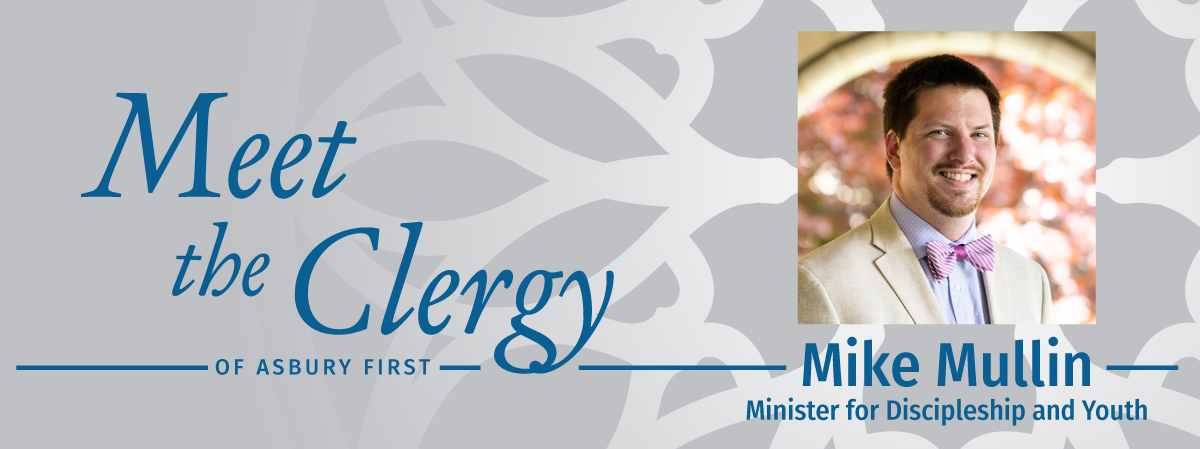
Whether you know him by his affable wit, his towering stature, his calm demeanor or his whimsy-packed bowtie collection, Mike Mullin is a fount of both knowledge and experience. As Minister for Discipleship and Youth, Mike is tasked with promoting the spiritual maturation of young and old, through youth groups, VBS and book studies. We caught up with him to talk about travel, identity, adventuring, LGBTQIA+ advocacy, mission trips, comfort zones, and much more!
When you're leading youth on mission trips to other parts of the world, how do you help young people navigate the tension between serving and learning?
This question is poignant, as mission trips are often thought of as a means to help others. In reality, some of the most significant impact happens to the missioners—the ones embarking on the mission trip. We certainly do our best to make a significant and lasting impact on the people and places we travel to—but so much of the investment of a mission trip is on ourselves as we encounter a new culture and worldview that will forever alter how we show up in the world. This is a message that we share with our young people throughout the mission trip process. We are visitors and guests in these spaces.This is just as true when we are in the homes in rural Appalachia as when we visit the communities in our border towns in Mexico as they wait and pray for asylum in the US. There is a constant reminder that we do not have all of the answers; we are not the saviors in these situations. Instead, we are all in this together, and it is this community that strengthens each of us and makes mission trips an incredibly powerful experience for all involved.
You've described yourself as someone who loves adventures and discovering new experiences. Can you tell us about a moment during your travels when stepping outside your comfort zone led to an unexpected spiritual insight or deepened your faith in a way you didn't anticipate?
When my spouse was in seminary, I had the opportunity to join her and other seminarians on a trip to Vietnam. The seminary had a connection with the Eastern Cham people, and we were going to meet and work with the pastors. In Vietnam, it was legal to be a Christian, but all Christian churches had to register with the government. Registering meant that the government could oversee and control everything. You could not have meetings without their permission; and most forms of outreach were outlawed. Churches were having challenging conversations about remaining underground so that they could be the church they were called to be, or registering so that they could more effectively share and spread their message. One of the jokes that the pastors shared with the seminarians is that one of their ordination requirements was to have been arrested. And while they shared this in jest, every single pastor we met had been imprisoned for practicing their faith. While we were there, it seemed like the government and police were causing more harm, so we decided to cancel our training day with the clergy so that we did not put them at further risk. After making this decision, some of the clergy were able to met with us and expressed their opposition to our decision. They shared that they lived with this reality regularly, and it should have been their choice to take on this risk. That was an important message to hear. Following this conversation, we were able to gather a group of pastors together for a less-formal meeting on a public beach. While we were there, the police came and asked us if we had a permit to gather. The Vietnamese tried to communicate that we were just hanging out, but one of the police members got ahold of a paper with Christian songs and Bible verses, and they told us that this was an unlawful gathering and we had to disperse. Our hosts said that the police seemed to be more polite, probably because Americans were present. This experience has continued to stay with me as a reminder of what it means to be the church. There are times when we need to give to Caesar what is Caesar’s, and there are times when we need to overturn the tables of exploitation and oppression. Often, it can be a challenge to know when and how to do the right thing. Sometimes, we cancel a gathering in an effort to protect the marginalized, only to discover that was the wrong choice to make. My hope and prayer is to continue to keep these memories at the forefront of my thinking as I try to make the best decision I can in any situation—and then to offer myself and others the same grace the Eastern Cham showed to us when we are found to be in error.
Food seems to be one of your passions when traveling. Has there been a meal or food experience in another country that became unexpectedly sacred or meaningful to you? What did it teach you about hospitality, community, or faith?
When it comes to food, travel, and youth ministry, there is really just one story that comes to mind. Though, “sacred” may not be the word I would use… I was leading a high school mission trip to cattle country in Montana, and a local gas station had a sign letting folks know that they had Rocky Mountain Oysters. We learned that this was a seasonal delicacy—which is to say they were fresh, and when they ran out, they ran out. And if you don’t know what Rocky Mountain Oysters are, let’s just say that cattle country is the place to find this delicacy, rather than the coast. As many people know, I am always interested in trying new things—especially if it’s a local favorite or has some notoriety. So, after passing this sign a couple of times, I decided to see if any of the youth or leaders would be interested in trying this cultural cuisine with me. And, to be clear, we made sure every person new exactly what Rocky Mountain Oysters were before they agreed to try them. I enjoy trying new and weird things—and encouraging others to as well—but I do not enjoy tricking anyone into trying something they don’t fully understand or comprehend. Even so, the majority of youth and adults gathered at that gas station, and watched them fry up a bunch of Rocky Mountain Oysters, and then we took them out under the sign for a photo before sampling them ourselves. That is not a flavor or texture experience I need to have again, but the camaraderie and bonding that the experience offered is one that will stay with me throughout my life—and there is certainly something sacred about that.
You've advocated strongly for LGBTQIA+ inclusion in ministry. How have your encounters with different cultures and their varying approaches to gender, sexuality, and identity influenced your understanding of what it means to create truly welcoming faith communities?
As someone that carries the privilege of appearing to fit most of the points of innate privilege we associate with in the west (white, male, cisgender, heterosexual, tall, English speaking), I am comfortable in most spaces. Even in diverse spaces, I feel generally safe and unthreatened. I recall shopping in my local grocery store years ago and realizing I was the only white person in the store. And yet, I continued to shop there because it was convenient. Later, I learned that most of my colleagues literally drove across a river to go to a different store. Too often, we use our privilege to further divides rather than create opportunities for engagement. When I was in Vietnam, two of us were over six feet in height, and we got a lot of stares, and even strangers asked if they could take pictures with us. At the end of our trip, the two of us were walking through the city at dusk and found that two men walking together had a very different experience of propositions than we had had during the rest of our visit in the country while traveling in mixed company. In Russia, I learned that the “I” sound in Mike is not native to the Russian language. This was novel, as my spouse, Nadia, has had her name mixed up throughout her life, but this was a very common name in Russia. Our name roles were reversed. Everyone remembered Nadia, but Mike was harder to get right. All of these experiences are different, but they each point towards the importance of having varied experiences. The more we can expand our worldview, the more accepting and inclusive we are likely to become. When we have the opportunity to interact and recognize the humanity in our LGBTQ, BIPOC, other-in-any-way sibling, we are much less likely to harbor hate or resentment to the groups that they belong to. The first step towards eradicating these isms is through real connections; and that only happens one experience and one relationship at a time.
You encourage people at Asbury First to push the boundaries of their comfort zones. When you've traveled with youth groups, what's been the most challenging moment where you had to model that yourself?
I have always had a passion for adventure education, and I had the opportunity to work multiple summers at a Christian adventure camp, and even one summer building and inspecting ropes courses. One grounding element of adventure education is trying to push the limits of our comfort zones. We often used a stop light illustration to help talk people through what they were feeling. The green zone is your usual comfort level. The yellow zone is where you aren’t sure if you can go on, but you’re willing to try. The red zone is where you shut down and can no longer continue. Teaching these zones to groups before embarking on a challenge element was invaluable. When someone started asking to stop, or to come down, we could ask them what zone they were in. Just by asking the question, it takes them away from their fear for a moment—and most then decide they are in the yellow zone (or maybe orange, for those that want to articulate that they are getting close to shutting down). Just by naming this reality, they are often able to continue and push themselves a little further—and then the sense of accomplishment and self-worth are heightened as they discover expanding limits to their own capabilities. I bring this foundation in adventure education into everything I do. I am also someone that analyzes things and likes to solve puzzles. I like to enter into situations with a plan and idea for multiple different scenarios. Even so, there are times when the unexpected happen. Years ago, we had a middle school trip show up to a church stay, only to discover there was no one at the church to let us in. I took some time to call and contact everyone I could connected to that church to no avail. After exhausting those options, we pivoted a bit, and went to a local Wal-Mart to brush our teeth, use the rest room, and get ready for bed. I was also hoping we might hear back from our church stay during this time. And while that didn’t happen, we did have some conversations as a group, and many of these youth were campers. We decided on a plan to “camp out” in the church parking lot. Some folks would sleep in the vans, and those that wanted to could spread out sleeping mats and sleeping bags in the parking lot—we literally “circled the vans” to create a little campsite for ourselves. And just as we were finally getting situated—and some had already fallen asleep—our host showed up to let us in the building. These are the moments that are challenging; being met with a seemingly unsolvable problem, and trying to find our way to a solution that may be less-than-ideal, all while putting on a face of confidence and positivity. There are some things that we have no control over; and we can choose how we respond in those moments. My goal is to remain level-headed and try to help give off a sense of peace that might be shared by the community.
Different cultures have different clothing traditions and forms of expression, and you're known for your colorful bow ties (even colorful suits!) at festive occasions. How have the visual and artistic expressions of faith you've encountered in other countries influenced how you think about creativity, identity, and worship?
My approach to colorful ties and suits is actually grounded in a bit of subversion. I was never a fan of “dressing up,” and there was a time in my ministry when I was told I had to dress a certain way, and meet a certain level of decorum. Well, one way I responded to that was by shifting some of the flair. If these were the items that were necessary to have a seat at the table, while other forms of expression were unwelcome, I could at least push the envelope a bit with what was considered couth clothing. And while I’m not sure that has a direct correlation to my intercultural faith experiences, it is certainly true that worship looks, sounds, smells, feels, and even tastes vastly different across cultures. I love the calligraphy in Islamic centers, as they make sure not to create any graven images of the divine. I love the sounds of hundreds of pilgrims chanting together in Taizé. I love the smell of incense coming from the thurible in Orthodox cathedrals. I love the feeling of unity I experienced at a church in Geneva that celebrates the traditions, music, prayers, and cultures of different countries each week. I love the taste of our local Hindu temple that invited our confirmation class to eat some of the offerings left by other visitors, because no one should leave their space without receiving a bit of nourishment. It is this rich and vibrant diversity that compels me to continue to expand my knowledge and experience of different faiths and traditions. We may not begin pouring milk and yogurt on our alter at Asbury First, as I witnessed at the Hindu Temple; we may not tear down our walls to create overflow seating for an Easter service as they did in Taizé; and we may not regularly share our service in multiple languages as they did in Switzerland; but we do strive to invite and incorporate new ideas to engage our community in worship, and I look forward to how we may continue to encourage that growing edge.
|