May 2026

Stay Connected When It Matters Most — Sign Up for ALERT Spokane Today

Relaunch of system requires new registration


Spokane County Emergency Management has officially relaunched ALERT Spokane, the county’s emergency notification system, in partnership with Regroup Mass Notification. The upgraded platform is designed to provide faster, more reliable communication during emergencies and major community events.


The new ALERT Spokane system allows public safety agencies to send real-time notifications through multiple channels, including text messages, email, mobile app alerts, and voice calls. The goal is to ensure residents receive timely and accurate information when critical incidents occur, from severe weather and road closures to evacuation notices and urgent public safety updates.


The relaunch comes after the county’s previous notification provider, CodeRED, experienced irreparable damage from a cyberattack. Because of the transition to the new platform, all residents are encouraged to register or re-register for ALERT Spokane at www.alertspokane.org. Completing the online registration process and linking a home address helps ensure residents receive location-specific alerts, even when they are away from home.


“This new system allows us to communicate directly and immediately with our community when it matters most,” said Chandra Fox, Deputy Director for Spokane County Emergency Management. “ALERT Spokane strengthens our ability to provide the best possible alerting capability for Spokane County and ensures residents receive timely information they can act on to protect themselves and their loved ones.”


Residents are encouraged to sign up today to stay informed, prepared, and connected during emergencies and significant community events.

Teaching Kids About 911 Can and Does Save Lives

Emergencies can be frightening, especially for children. That’s why teaching kids when and how to call 911 is one of the most important safety conversations families can have. Knowing simple but critical information — especially a home address — can help emergency responders get help where it’s needed faster.


SREC encourages parents and caregivers to help children practice saying their full address and phone number out loud, just like practicing a fire drill. Kids should also understand what kinds of situations are real emergencies and when it is appropriate to call 911.


One of the tools SREC uses to help teach these lessons is “Loci: The Helping Yeti,” a child-friendly storybook designed to introduce emergency safety concepts in a fun and approachable way. The book teaches children the importance of staying calm, speaking clearly, knowing their address, and never using 911 as a prank.


The importance of these conversations became very real for one Spokane-area family when 8-year-old Jackson George called 911 after his mother experienced a seizure. Because Jackson stayed calm and clearly communicated with a dispatcher, responders were able to arrive quickly and provide critical medical care.


SREC recommends families continue practicing emergency scenarios at home through role-playing and open conversations. Teaching children about 911 early helps build confidence, reduces fear during emergencies, and gives them the tools to act when every second matters. Check out our website for tools to help you.


How “Time to Queue” Reflects the Speed of Care at SREC

When someone calls 911 for a medical emergency, every second carries weight. But what many people don’t realize is that help often begins moving before the call is even finished.


One of the key ways SREC measures this is through a metric called “time to queue.” This measures how long it takes from the moment a qualifying medical call is identified to when that call is actually dispatched to field responders.


At SREC, that average is just 31 seconds.


In practical terms, that means while a caller is still on the phone with a Communications Officer, answering critical questions and receiving life-saving instructions, first responders are already being sent.


It is not a step-by-step process. It is simultaneous.

A caller may be guided through CPR, bleeding control, or other urgent interventions, while behind the scenes, dispatchers are coordinating the fastest possible response. This ability to manage multiple priorities at once is a hallmark of high-performing emergency communications centers and is one of the performance measures tied to SREC’s ACE accreditation for excellence in emergency medical dispatch.


That 31-second average does not happen by chance. It reflects the training, focus, and coordination of a team that is prepared to act quickly and decisively during some of the most critical moments in a person’s life.


At the same time, SREC continues to look ahead for ways to improve even further.

Currently, fire agencies in Spokane County operate on a separate computer-aided dispatch (CAD) system from law enforcement and 911 call-taking. While strong coordination exists between systems, this separation can introduce small but meaningful delays in how information is shared and resources are deployed.


As part of SREC’s strategic plan, that is set to change.


In early 2027, SREC will launch a single, unified CAD system, bringing 911, law enforcement, and fire dispatch onto one platform for the first time in Spokane County history.


The goal is simple: remove barriers and reduce time wherever possible.


A unified system will allow information to move more seamlessly between call-takers and dispatchers, reduce the need for duplicate actions, and further streamline how emergency medical calls are processed and sent to responders. Even small efficiencies can translate into valuable seconds saved, especially in high-acuity medical situations where outcomes are closely tied to response time.


“Time to queue” is more than just a number. It is a reflection of how quickly a system can recognize a need, make decisions, and take action.


And at SREC, the focus remains clear. Continue improving, continue refining, and continue finding ways to get help moving faster when it matters most.


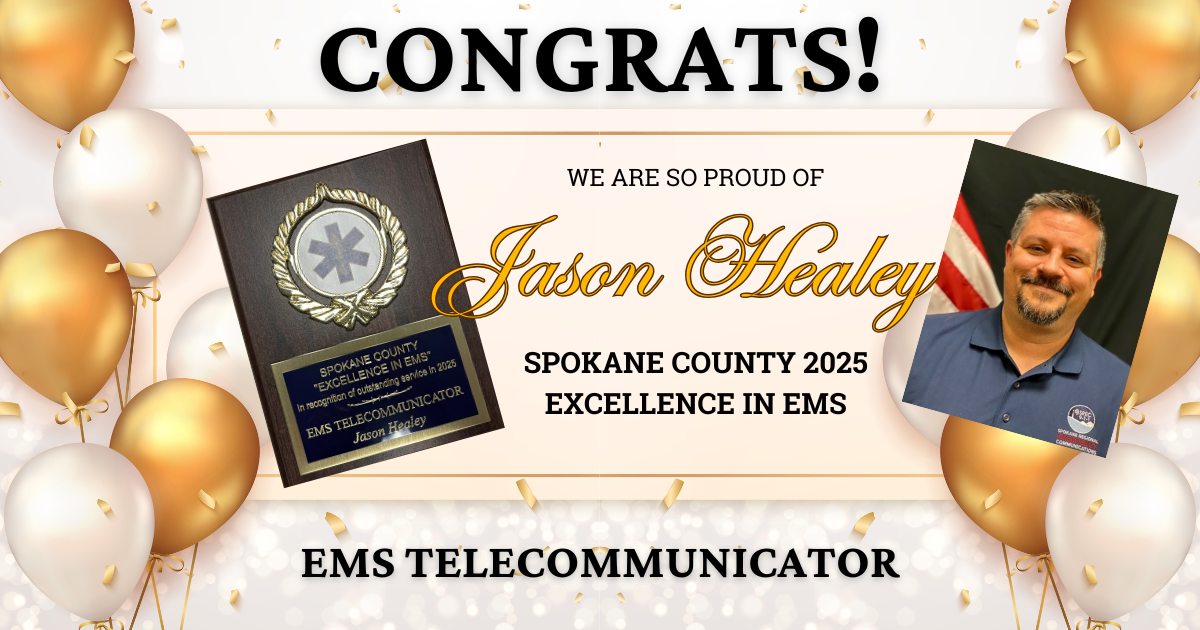
Jason Healey Honored with Spokane County EMS Telecommunicator Award


SREC is proud to congratulate Communications Officer Jason Healey on receiving the Spokane County EMS Telecommunicator Award, recognizing outstanding performance, professionalism, and dedication in emergency communications.


Since joining SREC just over two years ago, Jason has built a reputation as a calm, dependable, and highly skilled communications professional. He was recognized in part for his exceptional handling of a critical call involving a child attempting to help a 4-month-old infant who was not breathing. Despite the emotional intensity of the situation and significant language barriers within the home, Jason remained composed and guided the young caller through lifesaving CPR instructions until responders arrived.


Jason’s ability to provide reassurance, clarity, and direction during life-threatening emergencies reflects the vital role telecommunicators play in public safety. His consistent high performance, commitment to patient care, and support of his coworkers and community make him highly deserving of this recognition.


Please join us in congratulating Jason on this well-earned honor and thanking him for his continued service to Spokane County.