February is National Career and Technical Education Month | | |
Career and Technical Education (CTE) Month is an annual national campaign held every February that highlights the critical role CTE plays in equipping students with the academic, technical, and employability skills needed for post-secondary education and in-demand careers. CTE programs help students succeed in school and make a smooth transition into the workforce.
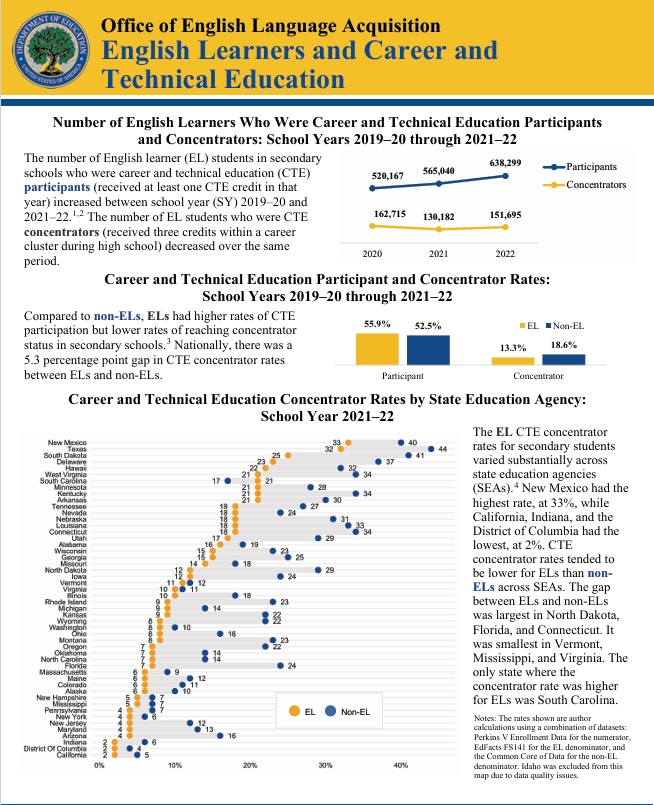
Explore NCELA’s fact sheet, English Learners and Career and Technical Education, which presents data on secondary school ELs who earned at least one CTE credit during the 2019–20 through 2021–22 school years and includes comparisons with non-EL students.
| | Supporting Classroom Teachers with Implementing the IES Practice Guide Teaching Academic Content and Literacy to English Learners in Elementary and Middle Schools | | Developed by the Institute of Education Sciences (IES), part one of this four-part infographic series introduces Recommendation 1 from the What Works Clearinghouse Practice Guide, Teaching Academic Content and Literacy to English Learners in Elementary and Middle Schools. This installment focuses on teaching a focused set of academic vocabulary words intensively over several days using varied, evidence-based instructional strategies.The infographic shows how teachers, instructional coaches, and principals can support ELs’ literacy and content growth through targeted instruction, classroom observation, and effective feedback. | | Information ELevated: Got Questions? Ask NCELA | | |
Need help navigating the NCELA website, finding resources, or learning about upcoming events? Our team is just an email away! Send your questions to askncela@manhattanstrategy.com, and we’ll point you in the right direction.
Check out this quick video to see how to reach out for fast answers. Don’t forget to like and share with your colleagues!
| | |
March 4-7, 2026
CABE 2026 Conference
In-Person Conference
| Experience hundreds of workshops and institutes aligned with the four pillars of community schools and the California English Learner Roadmap. Attendees can look forward to an engaging program featuring insightful workshops, inspiring keynote speakers, and valuable networking opportunities—all designed to share best practices and innovative strategies in bilingual education. | | Join thousands of English language teaching professionals from around the world at TESOL 2026, where we will kick off TESOL's 60th anniversary in Salt Lake City, Utah! Experience four inspiring keynotes, more than 700 engaging sessions, an expansive Expo, and countless opportunities to connect, learn, and grow. | | |
May 19–21, 2026
2026 NJTESOL/NJBE Spring Conference
In-Person Conference
| The In-Person Conference will be held at the Hyatt Regency, New Brunswick. You can register for 1, 2, or all 3 days, featuring keynote speakers Dr. Margarita Machado-Casas, Dr. Elsa Cárdenas-Hagan, and Dr. Sharroky Hollie. A Video Library Conference with select presentations will also be available from May 27 to August 20, covering topics across General Interest, Content Area Instruction, Bilingual/ESL (Pre-K–12), Higher Ed, Teacher Ed, and more. | | | |
Education Week
What New Research Reveal About Grouping English Learners Together
This resource summarizes the findings of several studies that explore the question of grouping of ELs during instruction. It challenges the traditional notion of grouping ELs together and argues that multiple and varied grouping configurations are best for ELs’ academic outcomes.
| | |
K-12 DIVE
Dallas School’s Vocabulary Program TIPs English Learners Toward Success
This article highlights how one elementary school in Dallas, TX, strengthened multilingual learners’ reading skills using TIP (Text, Information, Picture) charts in instruction. TIP charts give students the opportunity to engage with new vocabulary through multiple modalities, including reading text, examining information, and interpreting pictures, helping to boost vocabulary acquisition and comprehension.
| | |
The Hechinger Report
Kindergarten Readiness Varies Widely by Income, New Data Shows. Cities Are Stepping In to Help
This article highlights the differences in young children's kindergarten readiness based on their families’ incomes. The difference between the wealthiest and the poorest families is substantial, around 20%. It offers explanations for this discrepancy and some potential solutions to overcome these large differences in student readiness for kindergarten.
| |
Child Mind Institute
NEW RESOURCES: Why Is It Important to Read to Your Child?
This article outlines the reasons why it is important to regularly read to young children. The benefits of reading stretch beyond learning the skill of reading and include emotional connection with the parent, learning the skills of dealing with challenging feelings, and learning about the world around them.
| |
Language Magazine
TIPS FOR EDUCATORS: Prioritize the Partner Language
This article is the first in a series of publications that focus on supporting instruction for ELs. This issue focuses on providing effective scaffolding to aid ELs in comprehension and expression. In this article, several educators offer tips and practical suggestions on how to effectively and efficiently use language scaffolding in the classroom to support ELs.
| | |
Innovative Staffing Model Case Study
The International Network, in collaboration with Transcend, NewSchools Venture Fund, CART, Ember, and Washington Latin, has released an Innovative Staffing Model Case Study. This study highlights how interdisciplinary, teacher-led teams can create equitable, joyful, and sustainable learning environments for multilingual learners and educators. Drawing on years of collaboration, it offers practical insights and inspiration for schools and systems looking to strengthen support for multilingual students.
| | |
12 Buddy Systems That Support Learning and Student Well-Being
Research shows that pairing students in structured ways can enhance both academic and social development, boost motivation during adolescence, and make learning more engaging and enjoyable. Explore Edutopia’s classroom and schoolwide strategies to see practical ways to put this approach into action.
| | |
Subscribe to NCELA Nexus
Did you receive the Nexus from a colleague? You can subscribe via the form on our website.
| | |
Submit Your News
Do you have news to share with the Nexus community?
Send your alerts, upcoming events, resources, and job postings to AskNCELA
by Monday, March 2, 2026, for inclusion in the next edition of Nexus.
| |
National Clearinghouse for English Language Acquisition (NCELA)
| | Disclaimer: NCELA Nexus is intended to share information that can be of use to educators, parents, learners, leaders, and other stakeholders in their efforts to ensure that all students, including English learners, are provided with the highest-quality education and expanded opportunities to succeed. The information and materials presented in NCELA Nexus do not necessarily constitute or imply endorsement, recommendation, or partiality by NCELA, the Office of English Language Acquisition, or the U.S. Department of Education. | | | | |