There are lots of federal changes to navigate this fall and winter. SignUpNow is your one-stop resource to understand what’s changing, when, who is impacted, and how you can help! | | Want to learn more about major federal changes to Medicaid? Join us for a training! | |
| | |
Want the quick-hit overview?
SUNLight is our new 90-minute virtual workshop that breaks down the Medicaid/FAMIS fundamentals and the new federal changes. Walk away with a solid grasp of what’s changing and a “first aid kit” of resources to help keep Virginians covered.
| | | | Ready for a deeper dive? Our classic SignUpNow workshops are designed for anyone who wants the full picture, especially if you work directly with individuals and families navigating Medicaid/ FAMIS. While our 2026 workshops are booked up, you can access our on-demand training content anytime - it’s the same info we go over at our live workshops! (And check back later this year for our 2027 live training dates!) | | What federal changes are already in effect? | | |
|
Medicaid eligibility restrictions for certain immigrant adults went into effect October 1st.
Under the rules prior to October 1, 2026, non-pregnant adults with a wide range of immigration statues qualified if they met the other eligibility requirements: refugees, asylees, humanitarian parolees, victims of trafficking, and many more.
Under the new rules that went into effect on October 1, 2026, adults who aren’t pregnant need to have one of just three specific immigration statuses to qualify for Medicaid: they need to be a Lawful Permanent Resident, also known as a “green card holder,” a Cuban or Haitian Entrant, or a Compact of Free Association, or COFA, migrant.
| | New Rule (Started Oct. 1 2026) | |
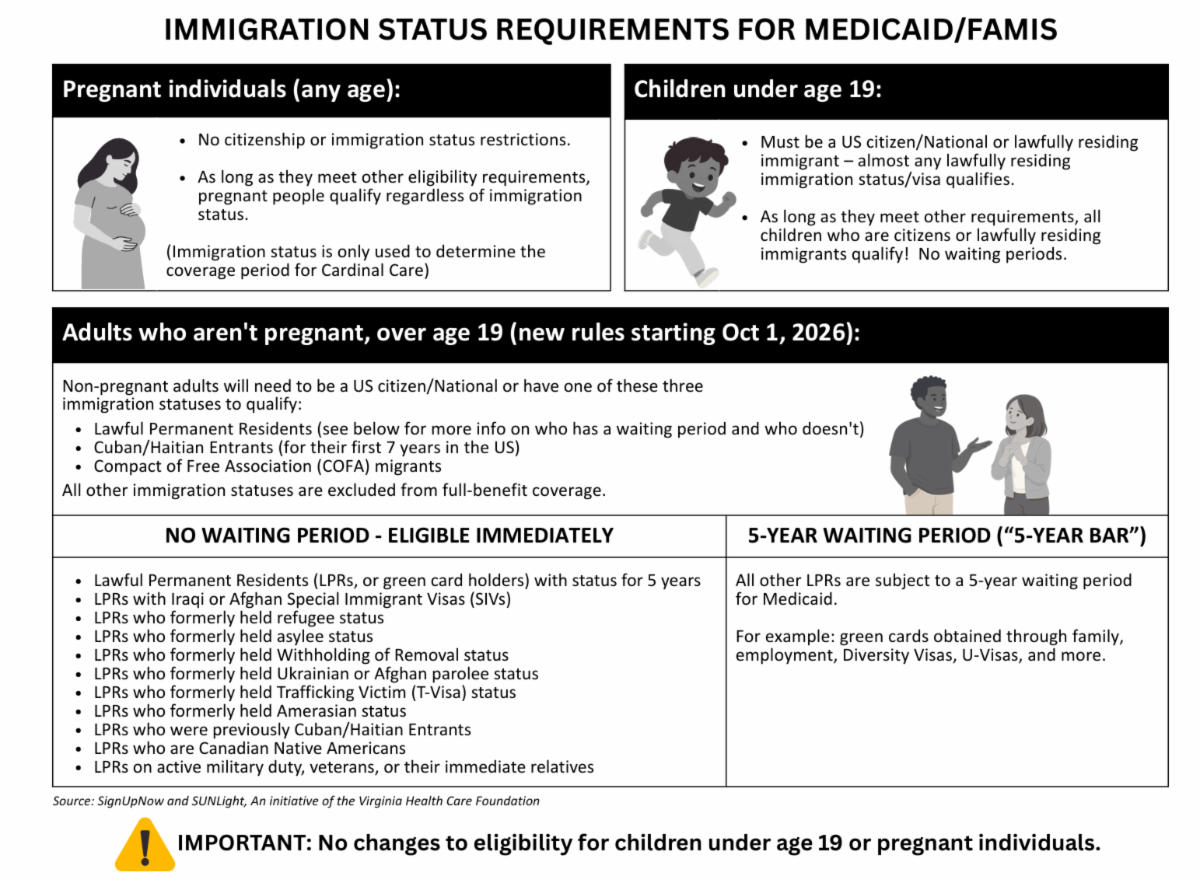
As of October 1, 2026, non-pregnant adults need to have one of these three immigration statuses to qualify:
- Lawful Permanent Residents (see below for more information)
- Cuban/Haitian Entrants (for their first 7 years in the US)
- Compact of Free Association (COFA) migrants
| |
All other immigration statuses are excluded from full-benefit coverage. Adults who do not meet these immigration status requirements, or are in their 5-year waiting period, may qualify for Emergency Services Medicaid – this is limited coverage that typically only covers payment to a hospital in the event of a true emergency.
For Lawful Permanent Residents (LPRs), also known as “green card holders,” there are some special nuances because are many different pathways to getting a green card. Some LPRs will need to wait for 5 years after obtaining their green card to get Medicaid coverage: for example, those who got their green card through family, employment, Diversity Visas, or U-Visas.
However, many LPRs can be eligible for Medicaid as soon as they get their green card: for example, those who formerly had refugee or asylee status, or certain humanitarian parolee status, among others.
LPRs with No Waiting Period - Eligible Immediately
- Lawful Permanent Residents (LPRs, or green cardholders) with status for 5 years
- LPRs with Iraqi or Afghan Special Immigrant Visas (SIVs)
- LPRs who formerly held refugee status
- LPRs who formerly held asylee status
- LPRs who formerly held Withholding of Removal status
- LPRs who formerly held certain Ukrainian or Afghan parolee statuses
- LPRs who formerly held Trafficking Victim (T-Visa) status
- LPRs who formerly held Amerasian status
- LPRs who were previously Cuban/Haitian Entrants
- LPRs who are Canadian Native Americans
- LPRs on active military duty, veterans, or their immediate relatives
- LPRs who are SSI recipients
LPRs with 5-Year Waiting Period ("5-Year Bar")
- All other LPRs are subject to a 5-year waiting period for Medicaid
- For example: green cards obtained through family, employment, Diversity Visas, U-Visas, and more!
| | | Changes to public charge, which may impact certain green card and visa applications, went into effect September 18th! | | The Trump Administration changed the public charge rule. This went into effect September 18, 2026. | The Virginia Poverty Law Center has an excellent resource on public charge available here that can be helpful for your clients, patients, and other stakeholders. The information below is a summary: | A note before you read on: this is not legal advice. It's background information to help you talk with clients who have questions. If a client is worried or unsure, encourage them to talk to an immigration lawyer. Find a local immigration lawyer using this tool from Keep Your Benefits. | |
What is public charge?
"Public charge" is a test immigration officials use when reviewing some green card and Visa applications. Some immigrants must pass this public charge test for their green card or Visa application to be approved. The test asks: is this person likely to depend mainly on government support in the future? To answer that question, officials look at things like income, education, family support, and public benefits received. If someone receives public benefits, it does not automatically mean they will fail the test.
| |
Who does the public charge test apply to?
This is important: Many people do not have to worry about the public charge test at all.
Immigration officials use the public charge test for certain green card and Visa applications. Public charge applies to:
-
Family-based green card applications, including relatives of U.S. citizens, relatives of green card holders, fiancés, widows or widowers, and “Amerasian” immigrants.
-
Some employer-sponsored green card applications, including EB-1 priority workers, EB-2 advanced degree/exceptional ability workers, EB-3 skilled workers and professionals, and EB-5 investors.
-
Some special immigrant-based green card applications, including religious workers, U.S. government employees abroad, Panama Canal Zone employees, foreign medical school graduates, retired international organization employees, and U.S. armed forces.
-
Other green card applications, including Diversity Visas, displaced diplomats, individuals born under diplomatic status, certain pre-1982 entrants, and S-Visas.
-
Green card holders who are re-entering the U.S. after being abroad for more than six months.
-
Visa applicants who are already physically in the U.S. and applying for their Visa with USCIS.
| So, for example, if your client already has a green card and hasn’t left the U.S. for more than 6 months, public charge does not apply to them. If they're getting their green card through a humanitarian pathway, like being a refugee or asylee, public charge does not apply to them. Or, if they don’t have a pathway to getting a green card, such as being undocumented, public charge does not apply to them. For a full list of who public charge does and does not apply to, see this resource from the National Immigration Law Center. | |
What changed with the new rule?
The new rule went into effect on September 18, 2026. The new rule is stricter and looks at more public benefits as part of the test.
For green card and Visa applications filed on or after September 18, 2026 with a public charge test, the new policy allows immigration officials to look at many new factors, including whether the applicant, or their dependent child, has been enrolled in government/public benefits that are based on having a low income and/or limited assets. This means that immigration officers can look at many types of benefits received, including Medicaid/CHIP (aka FAMIS), financial assistance for Virginia’s insurance Marketplace, and SNAP, when doing a public charge test.
The rule is not retroactive. This means immigration officials can generally only look at benefits received on or after September 18, 2026 when conducting the public charge test, and, again, it only applies to the groups of people outlined above. (Note: some public benefits have already been part of the public charge test for a long time, like cash assistance and when Medicaid pays for someone to receive nursing home care.)
So, in short, being enrolled in Medicaid/FAMIS, receiving financial assistance from the Marketplace, or receiving other benefits, like SNAP, could impact someone’s green card or Visa application if they are subject to the public charge test. However, immigration officials will still look at a variety of other factors when completing this test, like the person’s income, education, and family support. Receiving a public benefit does not automatically mean that someone will fail the public charge test. Other positive factors, like having a job or degrees, can help someone pass the test.
For more information and resources for your clients, please see VPLC’s public charge resource.
| What federal changes are coming next? | | |
Reductions to the Medicaid retroactive period
Retroactive coverage helps Medicaid applicants pay for prior medical bills, especially for things like unexpected hospitalizations, for up to three months prior to the month of application. Starting January 1, 2027, this window shrinks.
Note: Currently, CHIP (FAMIS) coverage does not have a retroactive coverage period with the exception of newborns, whose retroactive coverage period has been reduced to two months.
| |
New Rules Starting January 1st, 2027 | |
ONE MONTH retroactive coverage for Medicaid Expansion Adults
Up to TWO MONTHS of retroactive Medicaid coverage for kids, pregnant people, older adults, people with disabilities, and other categories.
| | | | |
Work requirements and six-month renewals begin for certain adults on January 1st, 2027!
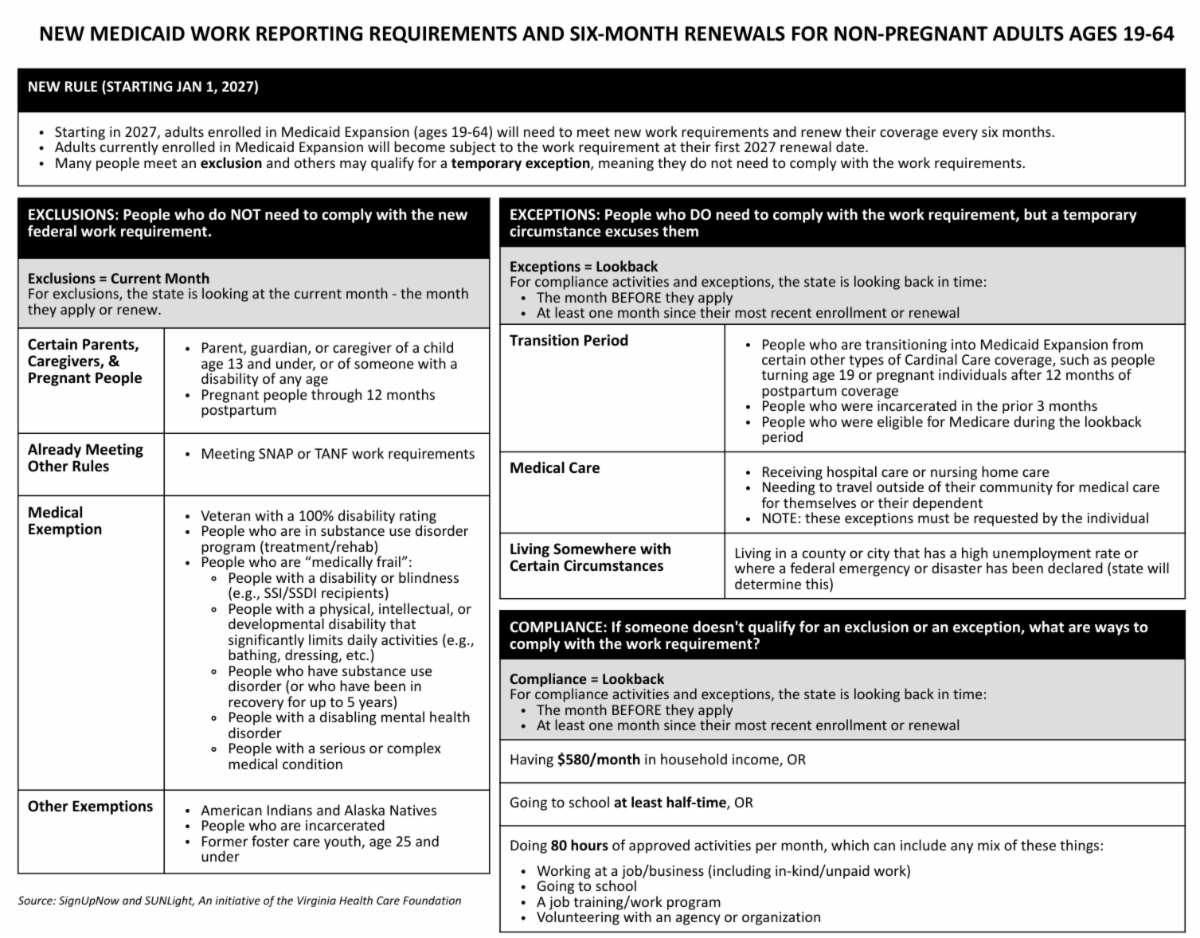
Starting January 1, 2027, adults enrolled in Medicaid Expansion (that’s adults ages 19 to 64) will need to renew their coverage every 6 months instead of every 12 months. They will also need to meet a new work requirement either by being exempt, or by doing certain activities, or by having a certain household income. Adults currently enrolled in Medicaid Expansion will become subject to these requirements at their first renewal date in 2027.
Want to learn more about what’s required, who is exempt, and how all of this will be rolled out? Take our SUNLight training to understand the details and how you can help people navigate these new requirements.
| |
New Rules Starting January 1st, 2027 | |
Most individuals enrolled in Medicaid Expansion (ages 19-64) will need to renew coverage every 6 months instead of every 12. American Indians/Alaska Natives enrolled in Medicaid Expansion will continue to renewal on an annual basis.
They must also meet the new work requirements (if not exempt) by:
- Working, volunteering, going to school, or participating in a work program for a combined
- total of at least 80 hours/month
- Being enrolled in school at least half-time
- Having monthly household income of at least $580/month (the federal minimum wage multiplied by 80 hours)
| | | | |
What should I tell my clients/patients to do now?
Your clients/patients should continue to:
| | Resources for navigating these changes | |
|
DMAS Toolkits
There are 3 versions of the toolkit: a toolkit for members, providers, and advocates /stakeholders on Medicaid work requirement.
These toolkits include messaging that you can adopt to inform members about upcoming changes related to Medicaid work requirements and 6-month renewals.
These are also live on the DMAS website here!
| | | | |
| | |
Immigration Eligibility Resource
Notices for members who will be impacted by the eligibility restrictions for lawfully present immigrants have been mailed out.
Here is a link to what the notice looks like: Noncitizen Eligibility Change Notice _ VCL
Need a quick cheat sheet to remember the new Immigration Status Requirements? Check out our SignUpNow resource: Immigration One Pager
| | | |
|
Work Requirement Resource
Notices for members who will be impacted by the work reporting requirements/six-month renewals have started being mailed out.
Here is a link to what the notice looks like: HR1 Work Requirements_Initial Outreach Notice_FINAL.pdf
Need a quick cheat sheet to remember the NEW work requirements? Check out our SignUpNow resource: Work Requirement One Pager
No action is needed at this time! Work requirements do not begin until 2027.
| | | | | Additional Work Requirement Resources | | Adult Education Opportunities | | Marketplace Open Enrollment is Here! | | |
Do you work with people whose income is too high to qualify for Medicaid/FAMIS? They may qualify for affordable coverage options available through Virginia’s Insurance Marketplace with new financial help. Open Enrollment for 2027 coverage started November 1st!
About Virginia’s Insurance Marketplace:
-
Open Enrollment began Nov. 1 and runs through Jan. 29, 2027.
- Virginia has a state-based Marketplace, where people can shop for private health plans and get help paying for those plans through premium subsidies and other assistance that lowers their cost-sharing.
- New in 2027: The Virginia Premium Savings program can help eligible Virginians lower the cost of monthly premiums.
- This additional assistance is available to consumers between 138% to 250% of FPL who are eligible to purchase a qualified health plan through the Marketplace.
- Consumers who do not qualify for premium tax credits may still qualify for Virginia Premium Savings.
- Virginia Premium Savings will be automatically applied for consumers who qualify, are enrolled in a 2026 plan, and selected to be automatically reenrolled for 2027.
-
Free assistance is available through the Marketplace's statewide network of certified agents, navigators and application assisters. They can help you understand how to access financial assistance and choose coverage that meets your needs and budget.
- The Marketplace will also check to see if someone applying might be eligible for Medicaid/FAMIS, so this is also a “door” for people to apply for Medicaid/FAMIS.
- Applicants who appear to be eligible for Medicaid/FAMIS are either automatically enrolled or have their information sent to Virginia Medicaid to complete the eligibility review – it is important that individuals read all Marketplace and Medicaid notices carefully.
| |
Learn more:
The Marketplace is administered by the Health Benefit Exchange, a division of the Virginia State Corporation Commission. Contact The Marketplace’s Stakeholder Engagement Manager, Kendra Weindling, to learn more about partnership opportunities: Kendra.Weindling@scc.virginia.gov.
| | Project Connect outreach workers are here to help! | | |
VHCF’s Project Connect application assisters/outreach workers help individuals and families apply for, enroll in, and renew eligibility for Virginia’s Medicaid/FAMIS programs. Project Connect assisters can help with completing Medicaid/FAMIS applications and renewals, navigating eligibility and enrollment processes, troubleshooting issues, and answering questions about Medicaid and FAMIS.
Looking for additional locations, or need assistance with the Virginia Insurance Marketplace? Click on this link to find assistance near you from our partners at Enroll Virginia.
| | | | | |