Wednesday, April 8, 2026

ASSOCIATION NEWS

Water Quality Changes to Central Valley Dairies

By Paul Sousa, Director of Regulatory and Environmental Affairs


There are two water quality regulatory changes currently underway in the Central Valley that will affect all water quality permit holders, including dairies.


The first is the implementation of the CV-Salts program, which WUD has been involved in for over a decade. This effort is being implemented at the groundwater basin level, starting with the Modesto Groundwater Subbasin. Water quality permit holders in that area, including dairies and feedlots, should be receiving correspondence from the Regional Board regarding this action. This change to the regulatory framework is generally positive for dairies, as it allows additional time to meet water quality standards. Following adoption of the Modesto order, similar requirements will be rolled out to other groundwater subbasins across the Central Valley over time.


The second regulatory change we are anticipating is the State Water Board’s remand of the Central Valley Water Board’s dairy permit. This is a separate process from CV-Salts and should not be confused with it. While this action will likely bring a new set of challenges, the specifics are not yet known. Once the State Board releases the updated order, I will provide additional information to our members on what to expect. However, the process to adopt updated regulations through this process will likely take years and there will likely be timelines for meeting the goals of the revised order. This gives dairies the opportunity to anticipate what changes they need to make and to find funding to help them stay ahead of these requirements.


Both processes will result in changes to how dairies are regulated. While some of these changes may present challenges, others offer added flexibility, and there are resources available to help dairies prepare.


One of the closest opportunities is the Dairy Plus Program, which is expected to release applications this summer for its final round of funding. Dairy Plus supports practices such as advanced solid-liquid separation and vermifiltration, which can help dairies move toward a whole farm nitrogen balance—an approach that will be beneficial under both regulatory frameworks. More information on Dairy Plus can be found at: cdfa.ca.gov/oars/dairyplus/. This is also where the application will be posted when it becomes available. Now is a good time to begin learning about these practices and evaluating how they might fit into your operation.


Please feel free to reach out to me with any questions about these upcoming changes or the opportunities available to help position your dairy for what lies ahead.


WE ARE HIRING: Northern California Farmer Relations Representative

Do you - or someone you know - have hands-on dairy experience and want to join our team?


We are hiring a Farmer Relations Representative serving the North State (Sonoma, Marin, Humboldt, and Del Norte counties).


This position is fully mobile, field-based, and built for dairy-savvy professionals who want to work directly with producers, providing technical support, navigating regulatory and environmental challenges, and helping dairies access programs and funding opportunities. The position is heavily field-focused, with extensive travel and direct engagement with California dairy families.


Applications are open now and will be reviewed on a rolling basis.


STATE NEWS

Got thoughts on the Water Plan? Now’s the time.

WUD is working to make sure agriculture’s voice is heard as planning begins for Water Plan 2028, and we need your input. WUD CEO, Anja Raudabaugh, has been selected to serve on the Water Plan Advisory Committee and will bring industry feedback directly into the process.


We’ve set up a simple way for ag stakeholders to share feedback, concerns, and priorities related to water policy and Senate Bill 72. Whether it’s a big-picture issue or something you’re seeing on the ground, we want to hear it.


Your input will help shape how we represent agriculture in early conversations with the Advisory Committee.


Every week, Western United Dairies connects directly with the people making decisions on California dairies.


Through the WUD Weekly Industry Update, the Seen & Herd Podcast, and industry events, WUD reaches more than 800 dairy families across the state with trusted updates on labor, environmental, and policy issues.


The 2026 WUD Business Sponsorship program offers companies a way to gain consistent visibility with dairy producers while supporting the advocacy work WUD does on behalf of the industry.


For questions or to become a sponsor, contact Norma Castillo at norma@wudairies.com.


MARKET UPDATE

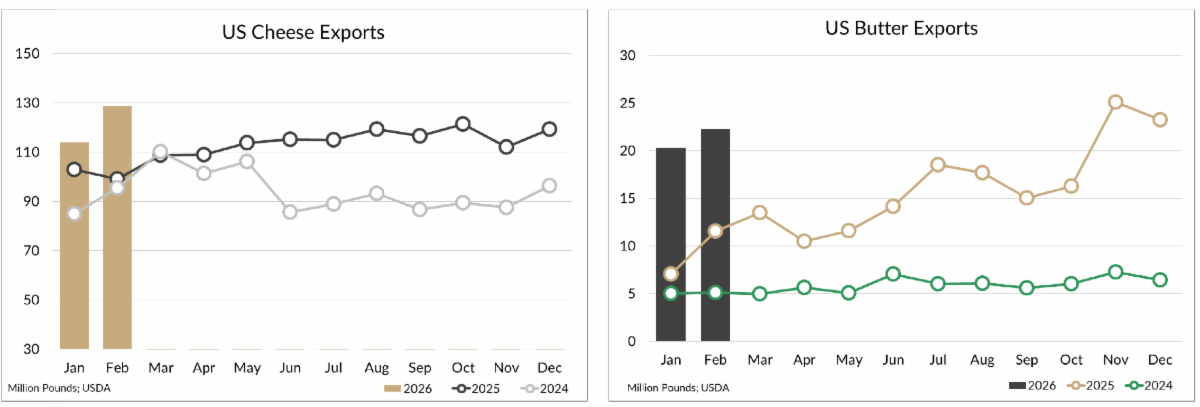
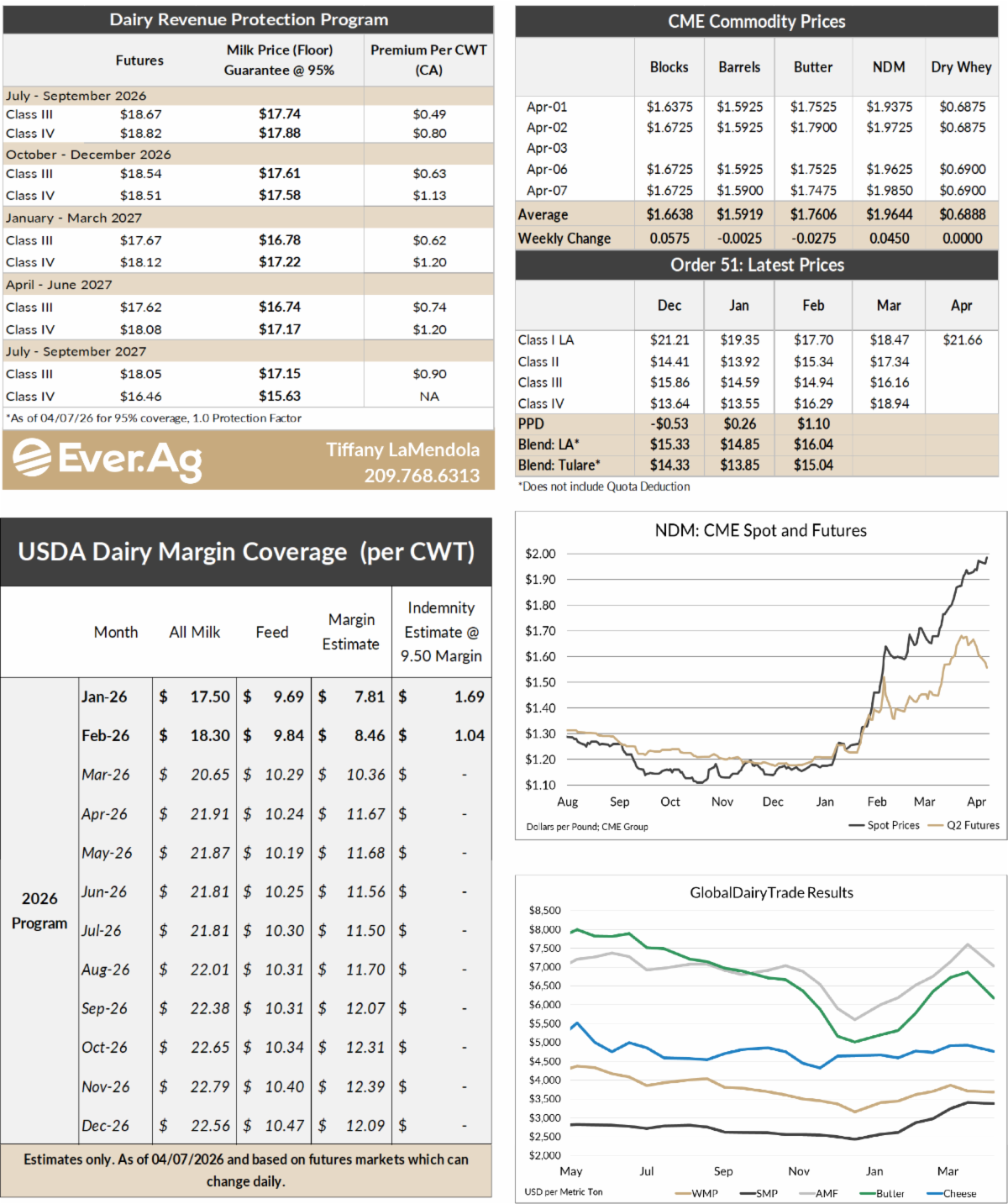
US cheese exports reached a new record high in February, up 30% year-over-year to 129 million pounds. Butter exports remained strong, and outbound milk powder volumes surpassed prior-year levels. But will the US be able to maintain this export pace as global dairy prices decline?

  • The CME nonfat dry milk market is following a pattern: moving lower, then regaining lost ground to reach new year-to-date highs as it inches closer to $2.00 per pound. The spot price hit a new 2026 high of $1.9850 per pound, a level last seen in 2014. But nonfat futures are shrugging off spot gains, continuing their trek lower.
  • And while US nonfat spot prices pushed higher, skim milk powder values in the GlobalDairyTrade auction moved lower. On average, the contract slipped to $1.53 per pound with EU product dropping as low as $1.40 – creating a massive gap with US spot levels. Butter tumbled 10% versus the previous auction, while cheddar and mozzarella dropped 3% and 6%, respectively.
  • Butter trading remains heavy in Chicago, with volume still at record-high levels for the year. So far in April, 75 lots have changed hands. Strong export data gave the CME butter market a bump to the upper-$1.70s. But there wasn’t enough support to keep the market at that level and the spot price slipped back to the mid-$1.70s.
  • Spot blocks climbed past $1.67 per pound, then stayed there as decent demand at home and abroad gave the market some support.
  • According to USDA’s February Dairy Products report, US cheese, butter and milk powder production increased year-over-year. But nonfat dry milk inventories remain below prior-year levels.
  • Conflict in the Middle East continues to impact US grain futures. Analysts are also keeping a close eye on the weather and soil moisture as planting season gets underway.


THANK YOU TO OUR CURRENT SPONSORS


Facebook  Instagram  LinkedIn  Web