Rail Workers Weekly News Digest
Number 34 - November 12th, 2019
|
|
Below is a series of articles compiled over the previous week.
They are of interest to railroad workers.
_____________________________________________
|
|
Article 1
Class I roads make official their desire for one-man crews
WASHINGTON — After hinting at it for months, Class I railroads have officially asked that single-person crews be part of a new national contract with a coalition of a dozen labor unions.
In the
seven-page Section 6 notice
, railroads call for conductors to be taken out of the locomotive cab to become a “ground-based” position. The plan is similar to one that BNSF Railway negotiated with SMART-TD General Committee GO-001 back in 2014 that called for having a single-person aboard each train and a conductor in an automobile working with multiple trains on a specific territory. That proposal was later rejected by a 5-to-1 margin in a committee-wide vote.
In the new notice, the railroads argue that single-person crews are necessary for the industry to remain competitive.
Industry-wide improvements in average train speed and terminal dwell have stalled, suggesting that railroads are not as concerned about moving lower volumes as quickly as they have been as they size their employment levels to a dwindling traffic base, Tranausky says.
Through the week ending Oct. 26, total U.S. rail traffic was down 4.3% for the year to date, according to the latest data from the Association of American Railroads.
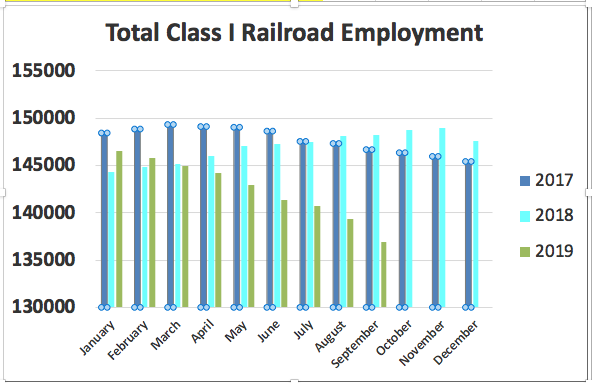
Separately, the Surface Transportation Board last week released the latest U.S. Class I railroad employment data for September. Overall railroad employment declined 7.6% year over year and by nearly 2% compared to August
.
|
|
Article 2
Railroads lead all U.S. industries in rate of job losses during October
WASHINGTON — American railroads shed jobs faster than any other industry in October.
The data point, contained in the Bureau of Labor Statistics jobs report for the month, measures the year-over-year decline in monthly payroll. Railroads were down nearly 8%, leading a group of the fastest-contracting industries, according to Avery Vise, an analyst at FTR Transportation Intelligence.
The employment decline comes primarily from two factors: Class I systems furloughed crews as the year’s traffic decline accelerated, along with broad operational changes related to the implementation of Precision Scheduled Railroading at Norfolk Southern and Union Pacific.
“Rail transportation has been on this list for some time because of structural changes that are ongoing related to Precision Scheduled Railroading and the industry changing how it moves traffic,” says Todd Tranausky, a rail and intermodal analyst with FTR. “What has changed over the last several months is that the rail industry has steadily moved up that list.”
|
|
Article 3
Precision Scheduled Railroading Threatens to Gut America's Freight Rail System
Since the first U.S. freight trains departed from Baltimore nearly 200 years ago, the freight rail industry has served as the backbone of domestic commerce, providing reliable, safe and responsive service and in the process creating and sustaining good union jobs. The success of the rail industry is premised on the fair treatment and utilization of its frontline workforce, balanced economic regulations and an expectation that railroads will meet their service obligations. Unfortunately, the introduction of an operating model known as Precision Scheduled Railroading (PSR) threatens to weaken these conditions and undermines our freight rail industry.
Freight railroads today are generating record revenues and operating at high levels of efficiency. But for some, these profits are not enough. To satisfy their outsized needs, short-term investors and hedge fund managers have forced PSR on large segments of the freight rail industry. This decision is not based on what is best for customers, workers, or even the long-term needs of the industry—it is about satisfying what Transportation and Infrastructure Committee Chairman Peter DeFazio described as the “Wall Street Jackals” who now dominate this sector.
Whereas carriers once sought to accommodate shippers’ unique requirements and schedules, PSR dictates that rail cars operate on a set and often arbitrary schedule, arriving and departing at specific times regardless of the needs of its customers. PSR proponents claim that this improves train velocity—how quickly they can move trains from one location to another. However, we know the ultimate goal of PSR is to cut every possible corner and to slash every penny out of a capital-intensive industry that needs a long-term perspective to survive.
Mass layoffs have been a disturbing and central component of PSR operations. In just the first two years after CSX implemented this model, the carrier fired 22% of its equipment maintenance workers, 16% of its train crews and 11% of its maintenance-of-way employees. In a 2018 interview, Union Pacific’s CEO proudly stated that, “We’re in the process of eliminating about 500 jobs [and] there’s more of that to come.” Railroads may want us to believe these workers are extraneous, but it has become clear that reductions are simply about cutting costs, even if those cuts result in the degradation of safety. Workers who remain have been forced to do more with less, and are faced with discipline or dismissal if they refuse to comply. The consequences of these choices are no longer hypothetical.
As carriers that have prescribed to PSR run fewer trains, understaffed shop craft facilities are reporting increasingly idle locomotives and equipment, but lack the workforce to keep the equipment in a state of good repair. In some cases, carriers are closing facilities entirely, increasing the workload for employees elsewhere who are already overwhelmed.
|
|
Article 4
Three NS Trains Collide in Western Pennsylvania
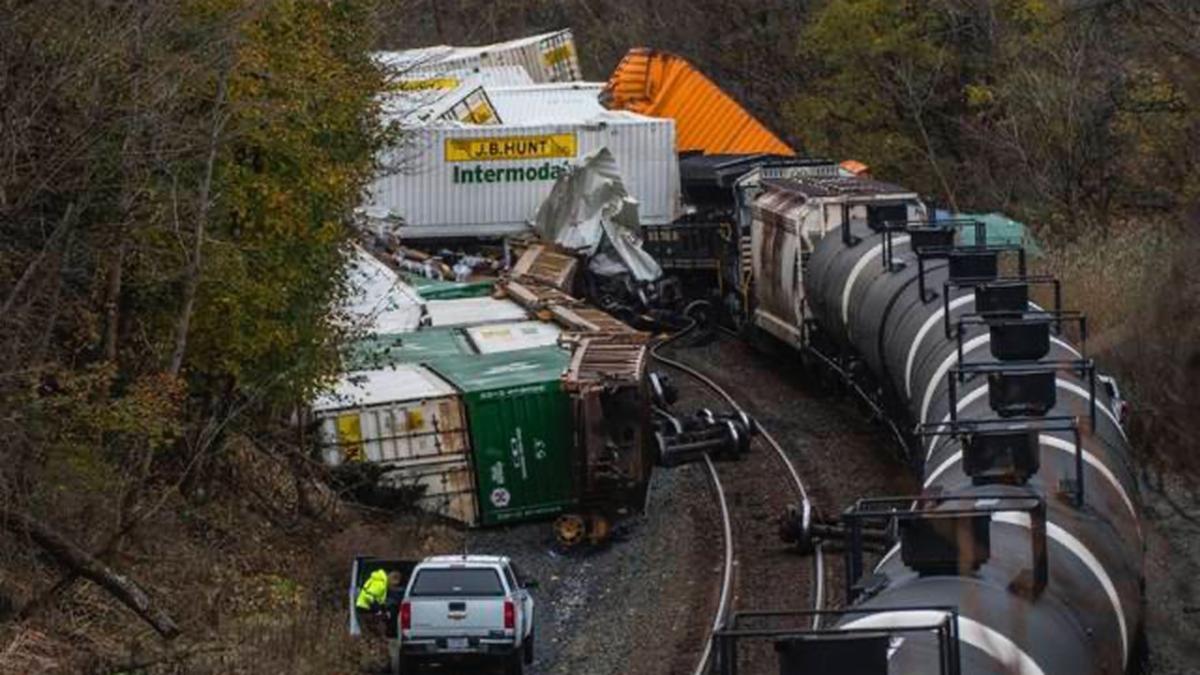
A westbound freight train transporting empty crude oil tank cars from Altoona, Pa., to Conway Yard outside Pittsburgh collided with the rear of a stopped westbound double-stack intermodal train. The impact caused nine intermodal platforms carrying 18 J.B. Hunt containers on the stopped train to derail into the side of an eastbound double-stack intermodal train operating on the adjacent main line,. Sixteen intermodal platforms carrying 32 containers on the eastbound train derailed. The two lead locomotives on the westbound crude oil train derailed but remained upright.
The railroad is equipped with PTC (Positive Train Control) that has not yet been activated. However, PTC would not necessarily have prevented this restricted-speed collision, per the current regulation. This is because PTC enforces a railroad’s maximum restricted speed (15/20 mph), but is unable to determine the exact position of obstructions ahead (a stopped train, broken rail, improperly lined switch, etc.). PTC also cannot determine “half the range of vision” for a railroad’s restricted-speed rule. Based on
Federal Railroad Administration RSAC (Railroad Safety Advisory Committee)
proceedings, the acknowledgement was that PTC would mitigate the severity of restricted-speed accidents.
|
|
Article 5
BNSF posts higher Q3 operating income, lower revenue
BNSF Railway Co.
reported third-quarter operating income rose 3 percent to $2.2 billion, while total revenue fell 2 percent to $6 billion compared with the same period a year ago.
Increased rates per car were partially offset by a 3 percent decrease in unit volume caused by flooding on parts of the network, according to a financial statement on
BNSF's website
. BNSF is owned by
Berkshire Hathaway Inc.
Year over year, BNSF's third-quarter results also showed:
• Consumer products volume fell 1 percent primarily due to lower intermodal volumes.
• Industrial products volume decreased 3 percent primarily due to overall softness in the industrial sector, lower sand volume and reduced car loadings. Strength in the energy sector, which drove higher demand for petroleum products and liquefied petroleum gas, partially offset the decrease in other volumes.
• Agricultural products volume slumped 6 percent due to export competition from non-U.S. sources and the impact of changes in international trade policies.
• Coal volume dropped 4 percent partly due to the impact of lower natural gas prices.
On the expense side of the ledger, third-quarter operating expenses fell 5 percent to $3.8 billion from $4 billion last year.
The railroad's third-quarter operating ratio was 62.6 percent versus 64.5 percent a year ago.
BNSF also announced that its 2019 capital expenditures plan will cost $3.67 billion, or $100 million higher than previously announced, "with a continued emphasis on maintaining and expanding its network."
|
|
Article 6
UP says more layoffs coming as traffic declines
CHICAGO — More layoffs are coming at Union Pacific as traffic volume continues to fall amid global trade disputes, tougher competition from trucks, and the ongoing slide in coal.
By the end of the year, UP expects its workforce to be at least 18% below the levels of the fourth quarter of 2018, Jennifer Hamann, senior vice president of finance, told an investor conference today.
That translates into a cutback of nearly 2,500 positions in the final three months of 2019, which would bring total headcount at UP to around 34,191. Overall this year, UP will have cut 10% of its workforce due to the combined impact of volume declines and efficiency gains under its shift to Precision Scheduled Railroading.
Through Nov. 4, UP’s fourth-quarter traffic volume is down 11%, and 5% for the year to date.
Energy traffic, which includes coal and frac sand, is down 19% for the quarter. Premium traffic, which includes intermodal and automotive, is down 15%, although auto volume is expected to bounce back as General Motors ramps up production after the United Auto Workers strike. Agriculture shipments are down 3%, but could improve if China buys more U.S. products.
|
|
Article 7
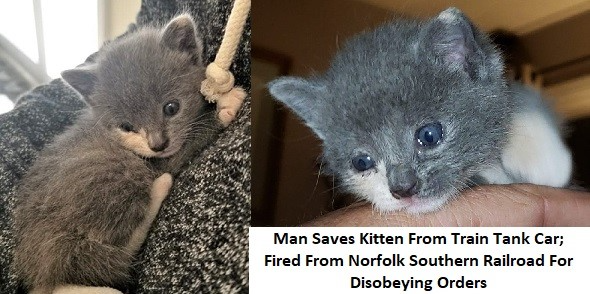
Popular Outcry Causes Norfolk Southern to Back Down from Firing Car Knocker for Saving Cat
After taking one hell of a lot of flack, NS posted this on their Facebook page:
After a review of the circumstances of the events of Oct. 30, Norfolk Southern has determined that the employee’s actions do not warrant dismissal. The employee has been notified of his return to service. We recognize the concerns raised and to underscore our long-standing commitment to the safety and well-being of animals, Norfolk Southern will be making a donation in the amount of $10,000 to an animal welfare organization in the Louisville area.
|
|
Article 8
Bond approval puts Las Vegas high-speed link one step closer to construction
Virgin Trains USA made serious progress towards beginning construction of its Las Vegas high-speed line recently when it won approval from California’s Infrastructure and Economic Development Bank to issue a record-breaking amount of tax-exempt bonds.
Virgin has moved quickly since September of 2018, when it acquired the rights to Xpress West, including its right-of-way, station sites, and environmental clearance. Virgin plans electric trains traveling on a new, high-speed line at more than 150 mph that will make the 170-mile trip from Las Vegas to Victorville, CA in about 90 minutes. A future link from Victorville to Palmdale would give trains a path to downtown Los Angeles—and a connection to the rest of California’s extensive planned rail network.
The deal authorizes Virgin to issue $3.25 billion in tax-exempt private activity bonds, which allow a private developer like Virgin access to the same low-cost financing available to governments for infrastructure projects with public benefit.
The bonds authorized by California cover the majority of the $4.2 billion Virgin needs to begin construction. It expects the rest to be covered by bonds that will be authorized by Nevada soon.
This represents a major vote of confidence in Virgin’s high-speed rail project by the State of California. It’s the largest bond issue in the history of California’s Infrastructure Bank, topping the previous record set by a 2003 issue for the seismic retrofit of the San Francisco-to-Oakland Bay Bridge.
|
|
|
|
|
|
|