Link to DRAFT Testimony to Student Affairs Committee

Topics: AI/digital advances by OCID, Financial Literacy, Revision of Vision for Hawai‘i Graduate, School Calendar


HI BOE DRAFT TESTI-MONY


email if you object

Link to DRAFT Testimony for General Business Meeting

On the Superintendent's Report topics A Federal Impacts, B Transportation, D Legislative Session.


Civil Beat reported on poor Special Ed performance of Hawai‘i students relative to national averages.

See the article here.

May Meeting will be in-person at Kahala Mall's California Pizza Kitchen. Ellen Schroeder has coupons she is dedicating to those of us who gather at noon May 13th!


Are you or your organization interested in exploring ways to stand up for Hawai‘i education in the face of potential federal cuts? If so, please email and join our May meeting at the California Pizza Kitchen. See two of the national orgs below who are now working to protect public schools against loss of funding and rights.

Heal to Win has a tool box for how to support quality public schools.

United Parent Leaders Action Network supports parents across the country with tools to lead in their communities.

April 10, 2025 Board of Ed Meetings

Human Resources Committee (9:00 AM)

The two substantive topics are the Board proposal to proceed with policy development regarding compensation philosophy and structure for 1) the superintendent of education and subordinate superintendents and 2) the state librarian. The proposal is to delegate responsibility to chair Wesley Lo to present a policy proposal to the committee.Your copy should address 3 key questions: Who am I writing for (audience)? Why should they care (benefit)? What do I want them to do (call-to-action)?


Create a great offer by adding words like "free," "personalized," "complimentary," or "customized." A sense of urgency often helps readers take action, so consider inserting phrases like "for a limited time only" or "only 7 remaining!"

Student Achievement Committee (10:00 AM) Substantive topics include:

  1. Department of Education update on artificial intelligence The Department supports AI implementation through cross-office collaboration, providing resources and guidance on an AI website (bit.ly/ocid-ai). This includes AI employee and student guidance, professional learning, pilot program access (e.g., MagicSchool), and updates via ʻEnehana magazine (bit.ly/enehana). Ongoing support ensures schools stay current with technological advancements. This presentation will focus primarily on recently developed generative AI that produces new contents or outputs, as opposed to reactive AI that responds to specific inputs or situations without learning about prior experiences (e.g., Alexa), or predictive AI that analyzes historical data and experiences to predict future events or behaviors (e.g., Netflix).  Slides describing admin uses in addition to learning usages are linked here.
  2. Board proposal to proceed with policy development regarding financial literacy Given in interest HI DOE providing financial literacy support to students, the HI BOE will hear a motion for Bill Arakaki, chair of the Student Affairs committee to develop a policy to present to the board.
  3. Department of Education update on vision of a Hawaiʻi public school graduate


Currently, Board policy 102-15 and 500-17 includes the following vision of a Hawaiʻi public school graduate: • “Realize their individual goals and aspirations; • Possess the attitudes, knowledge, and skills necessary to contribute positively and compete in a global society; • Exercise the rights and responsibilities of citizenship; and • Pursue post-secondary education and/or careers without the need for remediation.”

The Department received support from Harold K. Castle Foundation to work with Islander Institute to conduct research on existing high school visions and profiles of a graduate. Islander Institute conducted stakeholder interviews and a student focus group to inform the development. Islander Institute developed nine guiding concepts (Attachment 3) to define the scope of the revised vision. 

“The Hawaiʻi State Department of Education shall work so that every graduate has:

• Knowledge: The core academic understanding required to take their next steps in post secondary education, career, enterprise, service and/or exploration to advance their life journey.

• Skills: The abilities to think, learn contribute, communicate, and create in pursuit of excellence and the realization of their goals.

• Awareness: The social-emotional competencies to pursue wellness with a healthy concept of self and meaningful connections to others.

• Identity: The feeling of aloha and belonging, and a deep sense of place, community, responsibility, and citizenship.” The Department will gain internal and external feedback on this draft of a Hawaiʻi public school graduate through participating in Department leadership meetings, Complex Area Principals meetings, the Hawaiʻi Principal Advisory Council and Board Community Meetings. Additionally, the Department is collaborating with the Hawaiʻi State Student Council to implement strategies and opportunities for student feedback.   ???? Should parents/families and Hawai‘i employers, and P-20 staff also review and comment on the proposed vision? (P-20 has worked on future careers extensively)


Department of Education’s multi-year school calendar (2027-2028 and 2028-2029) The HI DOE has proposed calendars have been strategically designed so that 5 day weeks are maximized since attendance for both students and teachers is best in 5 day weeks. And assessment to be completed before breaks to minimize reteaching and maximize teachers who taught to assess the achievement in that area. Conclusion of semesters set to optimize college admissions deadlines.

General Business Meeting (1:30PM) After procedural topics 1 and 2, key topics follow

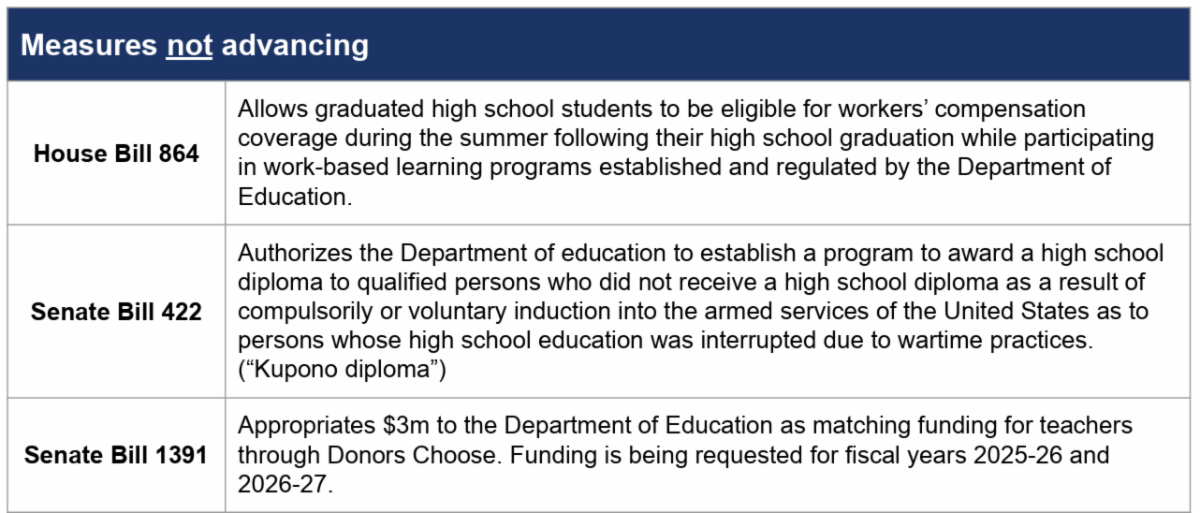
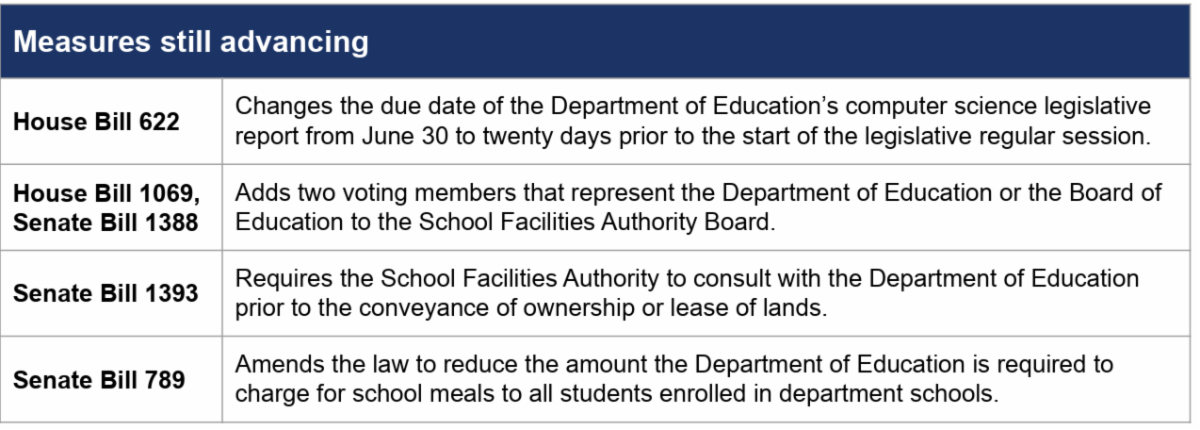
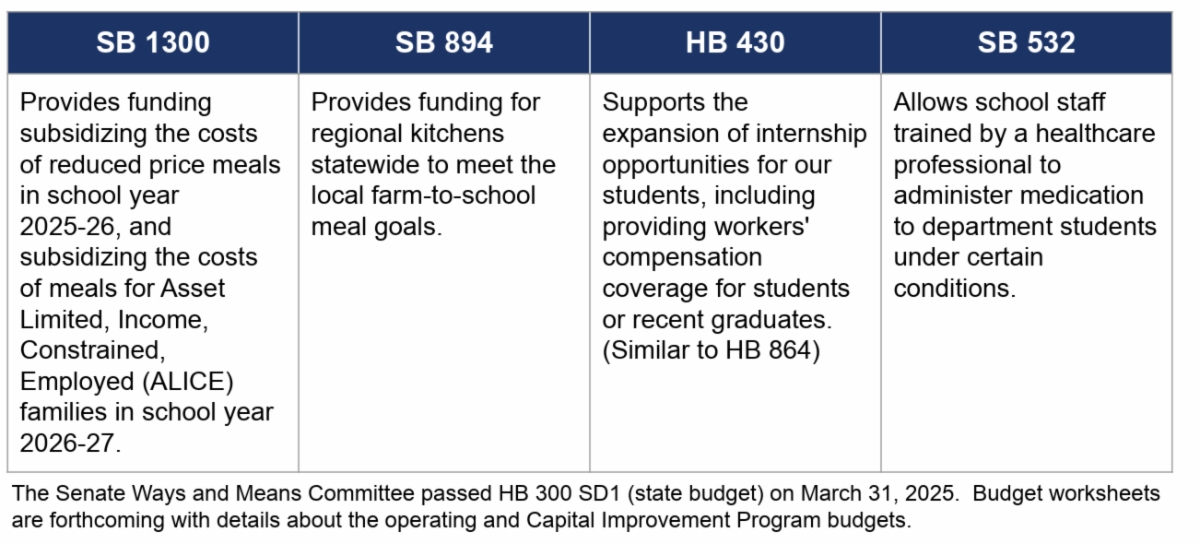
3. Superintendent's Report >> Review of Legislative session - listing of related bills The HI DOE testified on 36 bills and 35 resolutions. It appears that Community Schools and most other bills we testified on are not advancing. :( Here is the HI DOE summary:

>> Federal Funding watch (ongoing tracking of possible changes in federal and state funding


>> Law enforcement at campuses - students right to education, principals to handle any law enforcement visits (none have occurred).


>>Transportation - 14 routes are still not restored. Gov Green has issued 5th proclamation on school bus transportation to mitigate shortage of drivers-- by allowing the lower "P" level of endorsement rather than "S", and by allowing more types of vehicles.


>> Wonderful Awards, etc.

4. Talk Story by Public Schools of Hawai‘i Foundation

5. Financial and Compliance Report for 2023-24 Year

6. RESOLUTION OF THE BOARD OF ED DECLARING THAT HAWAIʻI STATE DEPARTMENT OF EDUCATION SCHOOLS SHOULD BE PLACES WHERE ITS STUDENTS CAN LEARN AND THRIVE FREE OF FEAR, CONFLICT, AND STRESS 

(assertion of rights of all children regardless of immigration status)

7. HIDOE recommendation to accept SCC Requests for Exceptions to the HSTA Collective Bargaining Agreement (CBA); Waivers of Section 302A-251, Hawaiʻi Revised Statutes (HRS); Waivers from Board Policy for School Year (SY) 2025-2026; and Waivers from Department Regulations (DOE Reg.)

Please see our last update and our request for your meeting preferences below.

Please enter your preferred time to meet on 2nd Tuesdays of each month in this Doodle poll-----just click to indicate good, ok, or no on each time

Doodle Meeting Time Poll

Federal Funding Fears Dampen Progress on Ed Bills It has been discouraging to see many good bills with plans to improve education and family horizons be deferred, not heard, or voted down.


Today I submitted testimony on the Early Learning Apprentice program bill HB549. We had submitted testimony previously to the House Education committee. But testimony today went to the Senate Ways and Means committee. It is so essential that we expand capacity to provide quality care for our youngest children, and we cannot expand unless we have qualitied trained educators and caregivers.

We’ve reached the halfway point of the 2025 legislative session.

Here are a few bills that we have supported so far.


Preschool expansion -- HB692 HD1 SD1 (Companion SB712)

Expands the Preschool Open Doors Program's eligibility criteria. Repeals the requirement that Preschool Open Doors Program providers be accredited.


Dyslexia screening -- HB637 HD1 (Companion SB1001)

Requires the Department of Education to implement dyslexia sensitive universal screenings and evidence-based interventions, offer professional development on structured literacy and evidenced-based interventions, and support pre-teacher programs in training candidates in structured literary instruction.


Community Schools -- HB754 HD2 (Companion SB821)

Appropriates funds to the Department of Education for community schools and a program manager position.


School Capital Improvement -- HB636 HD2 (Companion SB449)

Establishes a school capital improvement project modernization initiative in the School Facilities Authority to create a planning database for school facilities.

School Cellphone Ban Bills


Several bills addressing cell phone bans in Hawaii schools are still under consideration in the legislature:


House Bills:

• HB 289: Proposes a statewide ban on cell phone use during instructional hours, along with restrictions on social media access and an educational campaign about social media effects. This bill is still active16.

• HB 485: Seeks to establish comprehensive DOE policies on cell phone use, including designated areas for usage and enforcement mechanisms. This bill remains viable1.

• HB 1224 and HB 1195: Both propose identical statewide bans on student cell phone use during instructional hours. These bills are still under review13.

• HB 1303: Focuses on managing various electronic devices in schools, addressing issues like attention spans and online harassment. It is also under consideration.


Senate Bill:

• SB 684: Calls for a complete ban on cell phone use in DOE schools. However, this bill was deferred by the Senate Education Committee on February 5, 2025, making its future uncertain4.


The legislative session is ongoing, and these bills could still advance depending on committee decisions and further deliberations.


If Federal Funding to HI DOE Ceases, What is At Risk:

What types of funding might we lose with the elimination of the federal Department of Education?  Hawai‘i gets 11% of its education budget from the feds = $233M.

The Institute for Educational Leadership lists the following national line items at risk:

  • Title 1 - Aid to schools in high poverty areas $18.4 billion
  • IDEA - Aid to students with disabilities $15.5 billion
  • Pell Grants - Needs-based undergraduate student loans $33 billion
  • Title IV - Student loan program $1.6 trillion (45 million students)
  • Community Schools - $150 million
  • Promise Neighborhoods - $91 million
  • 21st Century Learning Centers - Out-of-school time programs $1.3 billion
  • CTE - $2.2 billion
  • Rural Programs $154 billion
  • Additional programs: Nation’s Report Card, Institute of Education Sciences, Statewide Education Centers, ELL Student programs


Your copy should address 3 key questions: Who am I writing for (audience)? Why should they care (benefit)? What do I want them to do (call-to-action)?


Create a great offer by adding words like "free," "personalized," "complimentary," or "customized." A sense of urgency often helps readers take action, so consider inserting phrases like "for a limited time only" or "only 7 remaining!"

If you are interested in protesting federal cuts and changes, there are events occurring locally. Please share information about your views and events. The link below goes to several events on various islands.

HandsOff Hawai‘i Events Across the Islands

HE‘E Testimony - for your convenience

Community Schools

Teacher NBCT salary bump increase

Teacher salary for longevity Community Schools

Dyslexia Screening

Early Learning Expansion

Early Learning Apprentice Program Support

Free School Meals

Cellphone Ban - letter to House and Senate chairs due to no scheduled hearings

For Reference Background: HI DOE Commissioned Council of Great City Schools Review notes

Council of Great City Schools Report Overview It is very positive that the HI DOE requested that the CGCS research our district from state, to complexes, to schools, and provide a report with commendations and recommendations for growth. Supt. Hayashi presented the findings to the Board of Education meeting Dec 13th as we reported last month. CGCS noted the high respect for the supt throughout the district and noted that our student achievement is mostly on a par wtih other districts.


The CGCS report raises problematic needs and issues we have been discussing throughout 2024 Integration of systems, Collaboration between departments, Coherent curriculum provided by the district, Disadvantageous policies on district vs school authority, Advanced digital resources Too "tall" an accountability model. We have been concerned that lacks in those areas are limiting student growth, attendance, and family engagement. Below are the specific recommendations from the CGCS. (We note that the report does not address family engagement.)

CGCS Recommendations:


1) Establish, implement, and monitor a systemic framework balancing complex area/school autonomy with system-wide consistency, ensuring equitable education for all HIDOE students. Develop clear structures, processes, guidelines, and standards for essential practices while preserving local decision making. Communicate this framework clearly throughout the organization. 


2) Implement an extensive data management strategy to consolidate and streamline the HIDOE's fragmented data systems.


3) Establish a comprehensive, multi-year program to develop and implement key performance indicators (KPIs) and other relevant performance metrics. Implement regular review cycles to assess the new structure's effectiveness and make necessary adjustments. This long-term initiative will drive data-informed decision-making, improve educational outcomes, and enhance operational efficiency across the HIDOE. 


4) Review and streamline HIDOE's administrative structure and workflows to enhance efficiency and responsiveness. Reduce the number of hierarchical layers to eliminate bottlenecks and simplify decision-making processes from the state level to the local level, enabling more agile and responsive management practices.


5) Leverage state-of-the-art technology to automate routine tasks, improve communication, and track progress effectively across the organization. 


6) Charge the deputy superintendent of Academics along with the assistant superintendent, the content and career readiness experts, and a team of the HIDOE’s expert teachers with defining what high quality, rigorous, standards-based instruction looks like and what it does not look like at each grade level (this can be used to create the portrait of a high school graduate). Articulate what student work should look like when instruction meets HIDOE expectations independent of the materials used.


7) All levels of the organization (e.g., HIDOE staff, CAS staff, school staff, teachers, and support staff) should use student data and root cause analyses to improve student learning outcomes. State office work should be directly relevant to CAS needs and address leadership, teaching, and learning challenges. 


8) Establish SMART goals for improving student outcomes across the state and regularly measure and report progress toward accomplishing those goals throughout the organization.


9) Create and invest in a research, evaluation, and strategic planning branch in OSIP designed to help evaluate programs' implementation or effectiveness and help aid the HIDOE in strategically examining questions from leadership and the board, or in support of other offices.


10) Move towards a common HIDOE-wide formative assessment.


11) Implement the recommended organizational change strategies to ensure an efficient and effective reorganization of HIDOE offices, prioritizing student success, operational excellence, and employee-centric practices.


12) Implement the recommended organizational change strategies to ensure an efficient and effective reorganization of HIDOE offices, prioritizing student success, operational excellence, and employee-centric practices. 


13)  Reduce the number of direct reports to the Superintendent to achieve a streamlined structure that allows the superintendent to focus on high-level strategic decision-making and system-wide challenges.

Mahalo for all you do! - Deborah