e-Newsletter | January 29, 2021 |
|
You were the lucky one, Captain Bligh
By Dr. Marc Cendron
The definition of sedition: a serious felony punishable by fines and up to 20 years in prison. It refers to the act of inciting revolt or violence against a lawful authority with the goal of destroying or overthrowing it.
Mutiny on the Bounty, the title of the movie will conjure up memories of Charles Laughton and Clark Gable or Marlon Brando and Trevor Howard or even Anthony Hopkins and Mel Gibson.
The power struggle that is depicted pitching the young upstart lieutenant and the evil commander is spell-binding and culminates when the mutineers take over the ship and send the captain adrift in the vast Pacific Ocean.
The mere fact that Captain Bligh survived is astounding. Mutinies such as the one on the Bounty were not unusual in the late 18th century. Life onboard a sailing ship was far worse than having to quarantine and isolate for a mere pandemic. Life, or should I say existence, was miserable, tedious, cramped and punctuated by gales, hurricanes and wrecks. Grog seemed to be the only salve for the minds of sailors who would spend weeks on end toiling for demanding and irascible ship captains with the promise of a meager return should the cargo be delivered “a bon port” and sold at profit. But this was the way of life for many in Newburyport on the morning of June 25, 1795.
|
|
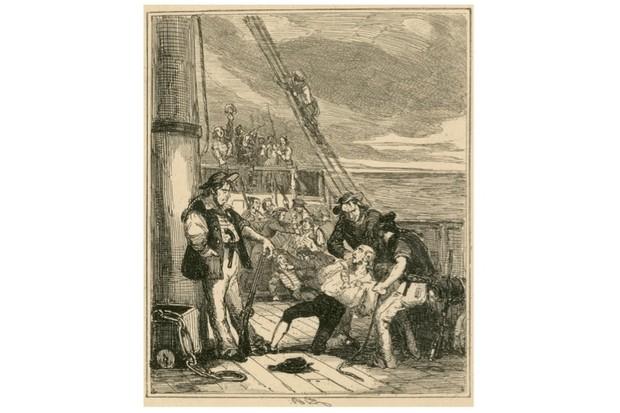
A mutiny scene of the period. |
|
And what a glorious morning it was as the sun lifted over Plum Island. A westerly breeze filed the sails of the brig American Eagle. The outgoing tide pushed the ship towards the mouth of the Merrimack. The Captain of the ship, William Little, 30 years of age, glanced back one last time towards the gleaming white steeples.
He came from that large contingent of Littles who had populated Newbury since 1640. His first mate was younger brother, Richard who, as best as he could, was trying to motivate the motley crew that had boarded the ship way before the break of dawn. Both William and Richard had heard the call of the nearby ocean: they had chosen to become seafarers, in all likelihood, having been lured by the promise of shares in the wealth that Newburyporters had been amassing after the War of Independence through ship building, maritime expeditions and overseas commerce.
The American Eagle was a medium-sized, sturdy ship that required only four or five sailors per 12-hour watch under favorable conditions. Only the captain had his own cabin, the rest of the twelve men crew bunked up in tight quarters, below deck.
The second mate, Michael Cooley, was a hard scrabble mariner with several transatlantic trips under his belt. He kept good company with the cook, Francis “Frank” Cole. The rest of the crew was made up of seven other former colonials and two Spaniards. The voyage down to Virginia was uneventful as the early summer provided consistent winds and favorable weather. By the end of September, the cargo hold was filled with tobacco and the American Eagle was on its way to Havre de Grace in France.
Within two days, Richard Little, the first mate, fell ill with a high fever. He complained of head-aches and terrible back pain. He stopped eating and was confined to his bunk where Frank Cole attended to him. Within a day, Richard’s skin turned yellow, he started having nose bleeds. He vomited blood and shortly thereafter died.
His old brother, the captain, was devastated: the youngest child of his family had perished under his watch. An hour later, the body was slid into a shroud made of old sails, weighted down with bricks and, after a very brief ceremony, dumped into the ocean.
Captain Little became increasingly morose, worried then desperate as two other members of the crew soon suffered the same fate as his younger brother. Nevertheless, and for reasons quite unclear, he decided to carry on with the trip despite the diminished crew.
Michael Cooley was promoted to first mate but clashed repeatedly with the Captain who spent more and more time in his cabin, brooding and cursing at the heavens. After a month at sea, the ship approached the southern coast of England. The crew was exhausted from the long hours of work and toil having to share extended watches.
As the ship entered the British channel on October 27th, shortly after midnight, Samuel Dearborn, one of the sailors on the evening watch (a 12-hour watch that had included the Captain, John Cassada and Archibald "Archie” Hart) dragged himself into his bunk. He felt bone-weary and fell into a deep sleep, foregoing the nauseating food that Frank Cole had left for him. He was awoken by screams. Coming to his senses, he recognized the Captain’s voice. Men seemed to be struggling up on deck. A forceful voice said: “Rub him!” More shuffling. A plaintive voice that could have been the Captain’s rose up: “I am not dead, though you think I am!”
In the darkness of the night, Dearborn heard sounds of blows and violence emanating from the captain’s quarters a few feet away. In a deep moan the captains uttered: “Frank, let me lay down and die.”
After more commotion, the sounds of a body being dragged onto the deck could be felt. Michael Blanche, a member of the night watch, came into steerage with a lantern shaking at the end of his hand. In the other, he held a marlin hook and forced Dearborn out of his bunk and onto the deck where the body of the Captain could be seen surrounded by pools of blood.
Michael Cooley pointed down at the Captain and stated: “He is gone.” Archibald Hart, who also had been roughly awoken, stood in the shadows, shaking. He and Dearborn were ordered to heave the body overboard. Both of them refused. Cole and Cooley took the captain’s blood stained trousers off and Dearborn noticed deep cuts in the Captain's thigh and groin area. A rope was roughly put around the Captain’s chest and the listless body, covered only by a shirt and stockings was lifted up and thrown overboard by the two Spaniards as Cooley muttered: “Let him go to hell.”
Cooley entered the captain’s cabin and grabbed a bottle of gin which he offered to share with the crew. Dearborn and Hart declined as Hart mumbled: “It is enough to make anybody sober to see so much carrying on as is onboard this ship.” To which Cooley replied: “Never mind, for it is the making of us. I can carry this ship to any port and then sell the ship and the cargo.”
He then threatened to kill Dearborn, but Cole convinced him not to. The crew would be too diminished “to carry the ship into port” and Dearborn could read and write and thus could not keep the ship’s log updated. Cole suggested that the log show that the Captain had died of yellow fever.
By morning light, the quarter deck was still covered with blood. The Spaniards were told to wash it off. The captain's cloths were divided amongst the crew and Cole found a chest holding $245 in silver coins.
In a corner of the captain’s cabin a tea kettle was on the floor. Cole boasted that he hit the Captain over the head with it. Telling the cook to keep his mouth shut, Cooley took charge. For the next ten days, the ship floundered about but finally reached the Isle of Wight and anchored at Cowes Harbor.
|
|
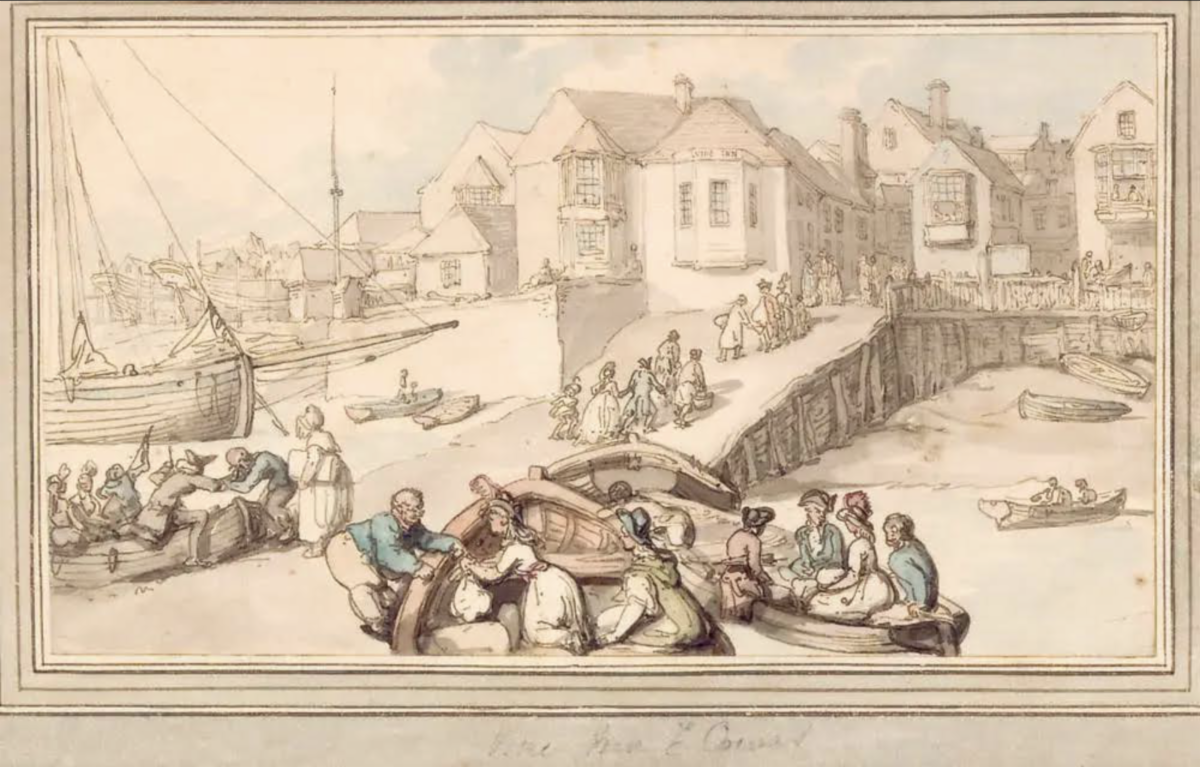
The Vine Inn at Cowes. 1790s Thomas Rowlandson, watercolor. This view shows what is now the main landing place at Cowes and near where the American Eagle anchored. The Vine Inn (center) was considered the principal inn in the town at this date and it had the best slipway. This is also the area where the crew would have disembarked before the mutineers were arrested. |
|
By rule, the crew had to quarantine for two weeks after which Cooley and his crew mates were summoned to shore where they were met by Thomas Jalgool, the newly appointed American consul. One of Mr. Jalgool's duties was to review the ship’s log-book which Cooley produced. Upon review of the latest entries, Mr. Jalgool became suspicious.
Cooley stated that several men including the Captain had died of yellow fever and that the ship was leaky and needed caulking. Cooley further explained that he was made first mate and then took over when the Captain died. The consul said he, Cooley, had no business doing so being a stranger to running the ship.
Cooley refused to give up command of the ship.
In a further conversation with Dearborn, the consul learned that the Captain had not died of yellow fever but died of a short consumption. Having realized that the logbook had been “prevaricated” with, Mr. Jalgool saw fit to notify the British naval authorities. And with that, the whole crew was brought to the local jail and interrogated.
Dearborn and Hart divulged the fate of the Captain. Cooley, Cole and the two Spaniards, Michael Blanche and Samuel Batha, were arrested and convicted.
Their trial was held at the Old Bailey in London on January 26, 1797. After two days of questioning and legal proceedings, all four were sentenced to death by hanging and afterwards they were to be dissected and anatomized. The sentences were carried out within a week.
|
|
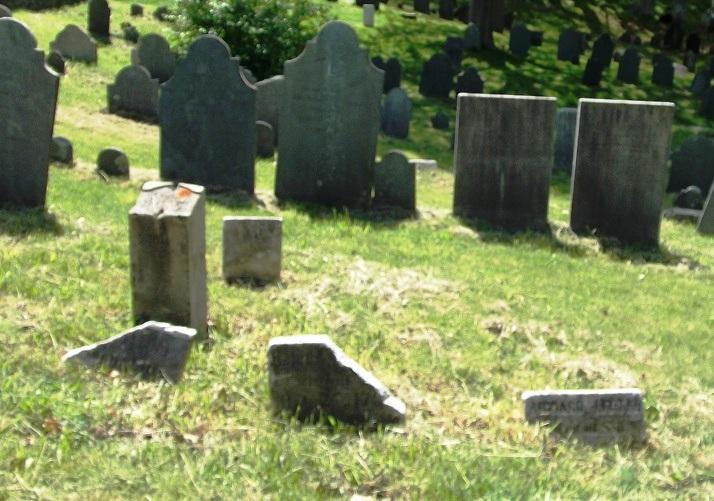
Headstones of Captain William Little (1765-1795) center front, and Richard Little (1767-1795) right front. Although the brothers died at sea, the family erected headstones in their memory at Old Hill Burying Ground. |
|
In 1797, a transcript of the trial was published by the Herald Press in Newburyport under the title “The Interesting Trials of the Pirates for the Murder of William Little, Captain of the Ship American Eagle” (see editor’s note).
It does make for interesting reading during a pandemic, but many questions remain as to the true causes of the mutiny. At any rate, this story may have some relevance to currents events: quarantine, sedition and mayhem.
Contributed by Dr. Marc Cendron, a direct descendant of Newburyport's Moulton family and the Little family through his grandmother Mary Elizabeth (Little) Whiting. Dr. Cendron serves as Co-chairman of the Museum's Collections Committee.
Editor's notes: The transcript was reprinted from a late London edition, Held at Old Bailey January 22, 1797, and published by Angier March for his newspaper the Impartial Herald. The paper was active between 1793 and 1797 when it merged with the Political Gazette to become the Newburyport Herald. Inconsistencies in spelling of names, etc., are from the historical record and not a typographical error.
|
|
Learn about upcoming programs, register, find Zoom links and catch up on previous presentations here. |
|
Miss a Recent MOON Program? Watch here. |
|
Thanks to the wonder of the Zoom platform, all of our programs are recorded and available online shortly after presentation. Visit our website for upcoming events, previous recordings, including the four 2020 Virtual Garden Tours, our Annual Meeting, children's and holiday programs, as well as all episodes of "Yeat Yeat, Don't Tell Me!"
In lieu of a printed program book, we will be featuring monthly events here, as well as maintaining a complete list on our website: www.NewburyHistory.org.
|
|
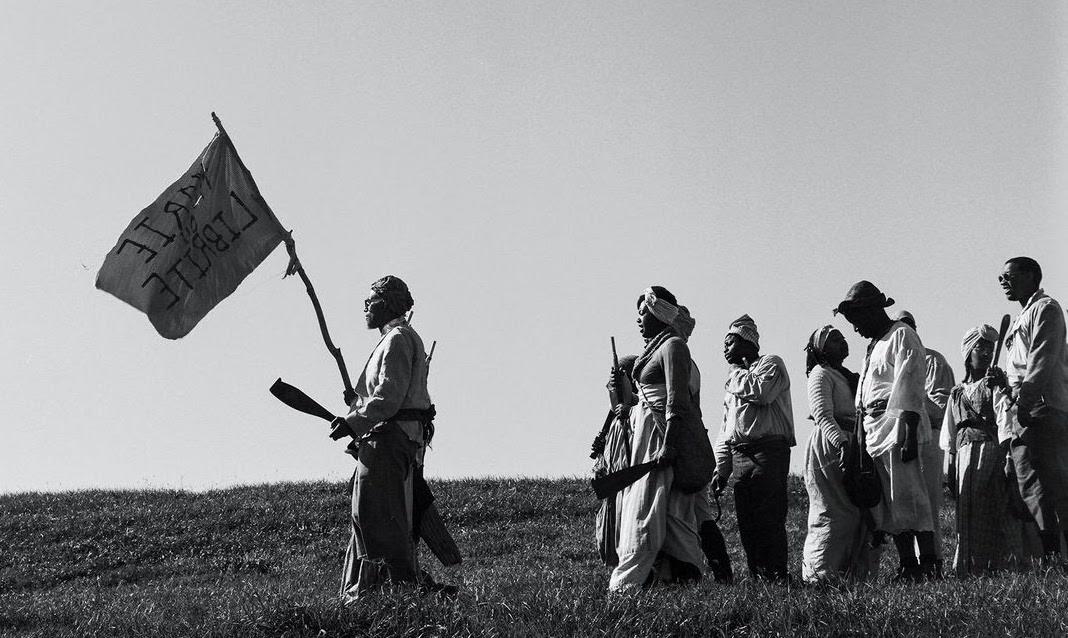
REGISTER: February 11, 2021: The German Coast Slave Rebellion of 1811: An Historiographic Analysis. Presented by Bejunior Fallon, '21, The Governor's Academy, this program looks at the largest, bloodiest slave revolt in American History. Register here.
|
|
REGISTER: February 25, 2021: Newbury and Warfare on the New England Frontier, 1689-1748. Presented by Dr. Steven C. Eames, director of history and interdisciplinary studies at Mount Ida College. His research will focus on the effect of war on soldiers and civilians, with a focus on early American history. He is the author of Rustic Warriors: Warfare and the Provincial Soldier on the New England Frontier, 1689-1748 (New York University Press). Register here.
|
|
March programs announced!
|
|
REGISTER: Thursday, March 11, 2021: More than a Tea Party: Tea's Social & Political Symbolism. Talia Jachimowicz, '21, The Governor's Academy, takes a look at tea, taxes and the American Revolution. Register here.
|
|
REGISTER: Thursday, March 25, 2021: Naomi Wade: A British Woman in 18th Century New England. Meet an 18th century woman from London who became a camp follower with a British Regiment during the American War for Independence. Register here.
|
|
WATCH: January 22, 2021: "Yeat Yeat, Don't Tell Me!" S2E18 with special guest Ghlee Woodworth, author, historian and 12th generation Newburyport native! Click on image.
And mark your calendars for Friday, February 5, 2021 @ noon, when Museum of Old Newbury Executive Director Susan C.S. Edwards joins Jack. Zoom in here.
|
|
Something is Always Cooking at the Museum
In honor of March's program on tea, taxes and the American Revolution, Liz Armstrong offers the perfect cookie to have on hand.
Sugar & Spice Cookies
3/4 cup butter
1 cup sugar
1 egg
1/4 cup molasses
2 cups flour
2 scant teaspoons baking soda
1/4 teaspoon salt
3/4 teaspoon cinnamon
3/4 teaspoon ground clove
3/4 teaspoon ground ginger
1/4 cup finely chopped crystallized ginger
Cream butter and sugar. Add egg and molasses. Beat. Sift dry ingredients and mix with creamed mixture. Drop by teaspoon onto cookie sheet. Bake 10 minutes, no longer, at 350ºF. Cookies should appear not done when removed from oven. Makes 36 cookies.
|
|
Puzzle Me This...
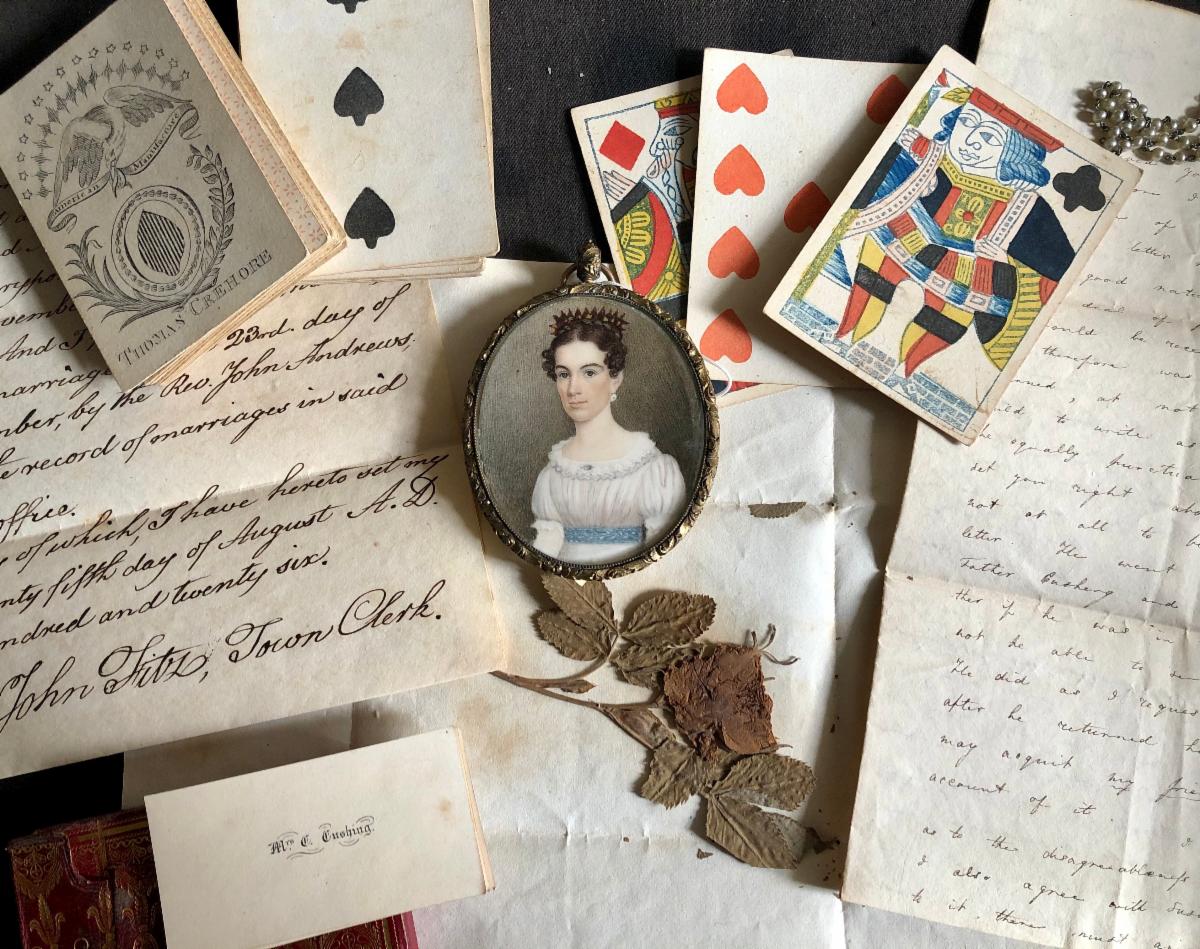
Memories and mementos. Select treasures from Caleb Cushing's memento mori for his beloved wife Caroline Elizabeth Wilde Cushing (1802-1832). Items featured include her calling card, hand-colored playing cards, a miniature portrait on ivory (featuring a dramatic tortoise shell hair comb) and the certificate of marriage. From the collections of the Museum of Old Newbury.
Click on the image to begin.
|
|
During this difficult period of COVID-19, we rely on your support more than ever. We are working to reschedule many of the programs that we have had to postpone, as well as develop new, online programs for you to enjoy and keep us connected. We hope, if you are able, that you will consider a donation to the museum. Thank you for your continued support.
|
|
Museum e-Newsletter made possible through the
generosity of our sponsors:
|
|
|
Museum of Old Newbury
98 High Street
Newburyport, MA 01950
978-462-2681
|
|
|
|
|
|
|
|