March 10, 2025

Past Newsletters

In this issue:

  • Provost's Message
  • Session 1 & 3 Faculty reminders
  • Midterm tips for Lab Faculty
  • Session 2 Faculty checklist
  • Highlighted Faculty Resources
  • WE CU Unbound Stories Podcast, Episode 2

Quick Resources

Academic Calendar 2024-2025

Mar 13: Session 1 Grades Due in Campus Cafe by 5PM

March 17: Spring Semester session 2 begins

March 23: Last day to register for spring session 2 classes

March 24: LIP and Big 10 Portfolio Submissions Due for Summer Capstone

April 8 & 9: Project Network Groups - WWL Classes Meet Online

Provost's Message

We are making our way through a period of time when how we move in the world - whether through our actions or lack of action - reveals a lot about who we are and our positionality as it relates to social issues and the harms that are occurring around us. The current political rhetoric has left many feeling destabilized. As such, people, especially those with experiences of marginalization, are scanning the landscape to determine where they might find safety and with whom they might find solidarity. 


Our ability to provide safety in higher education settings is highly contested with some arguing that we can never assure anyone’s safety, as we don’t know what constitutes true safety for other people. Others assert that spaces of learning should never be safe spaces and that some degree of risk is necessary for learning. Contrary to the latter, I have always found that while learning often comes with the discomfort of cognitive dissonance when old ideas clash with new information and insights, learning is more likely to occur in an environment that offers both challenge and support. While we may not be able to promise safety, we can promise an ethic of care and a commitment to fostering community.

The language of solidarity is not often invoked in education settings. It is often associated with social movements and community organizing spaces. When we speak of people being in solidarity with one another, we can quickly envision allies and comrades walking arm in arm in support of a common cause regardless of their identity or positionality.


But, when we think about what might constitute solidarity in the context of educational settings, it is more elusive to describe and to find. This made me wonder about whether higher education intentionally or unintentionally contains efforts toward solidarity.


This weekend, I stumbled upon a concept called “relational accountability,” which to me speaks to the essence of solidarity. As an indigenist paradigm aligned with transformative inquiry, relational accountability requires a commitment to walking a path of increased understanding of the profound responsibility we hold to each other. It means being arm and arm beyond the protest. It calls us “to be respectful of where information comes from and the views of others; attend to how our actions are meaningful and significant within the community; to look for what we can give back to others; and to acknowledge and take ownership of our accountability towards changing educational settings for the better.” 

For more information about relational accountability, please see the following:

Cultivating Relational Accountability in Curriculum Development Approaches
Working Towards Relational Accountability in Education.

--

Sylvia Spears, Provost & Vice President for Lifelong Learning


Session 1 Faculty Reminders

Final Grades in Campus Cafe


Complete and submit final Grades in Campus Cafe by March 13. Be sure to also provide final narrative feedback for students in your course.

Final Course Evaluations


Remind students to complete final course evaluations. These are also available in the final week of your Session 1 Moodle course.


Session 3 Faculty Reminders

Midterm Feedback to Students


Be sure to provide midterm feedback to students about their performance in your session 3 course(s).

Midterm Course Evaluations


Remind students to complete midterm course evaluations. These are also available in the final week of your Session 1 Moodle course(s).


Midterm Tips & Resources for Lab Faculty

As students head into the second half of session 3 and a new session 2, here are some tips & resources for maintaining robust advising practices:

Welcome Session 2 Faculty!

  1. If you have not yet done so, please send in your syllabus link ASAP.
  2. You Moodle courses have been open for course customization. Ensure your courses are ready and visible to students no later than 3/10/25. This video shows how to show your course(s) in Moodle.
  3. Please send your students a welcome announcement in your Moodle course(s) at some point in the week ahead of your first class!
  4. Bookmark the Faculty Resource Site.
  5. Check out the Lifelong Learning Directory for staff contact information.
 

Highlighted Faculty Resources

Academic Catalog & Calendar

CU's Academic Catalog and Calendar are linked on the Home page of the Faculty Resource Site. Please keep these resources handy for important dates and policies.


Weekly Engagement

Please ensure that you are entering Engagement for your students in your Moodle courses on a weekly basis. Information about weekly Moodle Engagement can be found on the Faculty Resource Site.


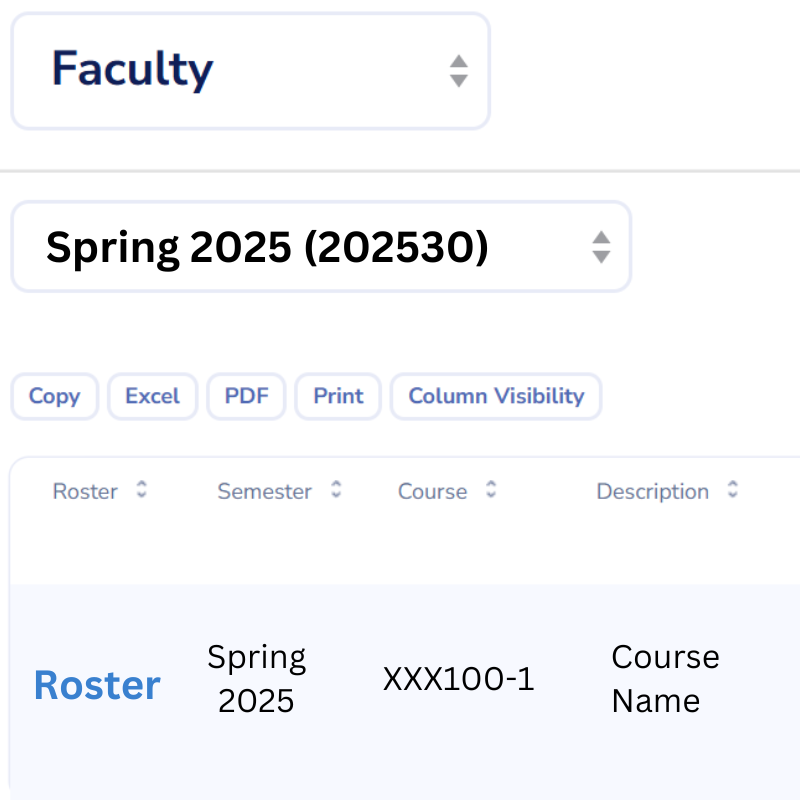
Viewing Course Rosters (Campus Cafe Guide)


  1. Visit https://www.collegeunbound.edu and click MyCU. You can also access MyCU from your CU Google Workspace Apps Menu.
  2. Click Campus Cafe and log in with your CU email and password.
  3. Click 'Roster' next to the class for which you want to see the roster.
 

Logging into Moodle (Quick Start Site)


A quick guide on your first log-in to Moodle can be found on the Moodle Quick Start Site. You can access Moodle from the College Unbound website using the MyCU link.


Student Success Connect


Student Success at CU has a landing page for access points to student support resources, including a general help form, referral form, accommodations registration, and a comprehensive Cares form for connection with community resources.


Google Meet & Calendar Basics

Be sure to familiarize yourself with the basics of Google Calendar and Google Meet. These are your primary CU apps for virtual meetings, online classes, and more.


Faculty Processes for Absences and Late Arrivals


Review important information about what to do in the event you are absent/late for class.


Spring Faculty Drop-in Support Sessions


Check out the alternating schedule of Faculty drop-in sessions here. These support sessions are open to current and upcoming CU faculty and include a range of topics. Open an event to see the theme.


Google Spaces - Instructional Faculty Groups


Google Spaces are online portals that connect you with a group of CU faculty for asynchronous chat, file sharing, and the like. We’re hoping that these spaces become places of community, learning, and sharing. To learn more, check out this resource.


WE CU Unbound Stories Podcast

Episode 2: Ten Years of the Prison Education Program at CU

In this episode of WE CU Unbound Stories, host De’Vonte Parson is joined by CU’s Prison Education Program team AVP Jose Rodriguez, Bonnie Clarke, Wanda Brown, Chris Dickson and Deb Jonfelix to lift up the 10 year anniversary of this work and discuss what it means to be resilient.

Listen now!
 

Sincerely,


All of Us at College Unbound, including:

Sylvia Spears

Provost & VP for Lifelong Learning


Karen Casper

Assistant Provost for Administration and Planning


Aubrey Schabowsky

Director of Transformative Educator Pathway


Swetha Narasimhan

TA2BA Pathway Specialist


David Bromley

Director of National Growth Implementation


Megan Demeroutis

Site Director of CU in Washington State


JoKeitha Seabrook

Site Director of CU in South Carolina


Naiommy Baret

Director of Partnerships in RI & Career Success

Elaine Plourde

Assistant Provost/ Director of Instruction and Educational Technology


Elizabeth Colon

Director of Learning in Public


Melina Kuchinov

National Director of Lab Faculty


Michael Reaves

Director of Alumni & Career Services


Nikki Andrews

Registrar


Matthew Sutherland

Assistant Registrar


Hanna Lichtenstein

Administrative Systems Coordinator

 
Facebook  Instagram  LinkedIn  Twitter