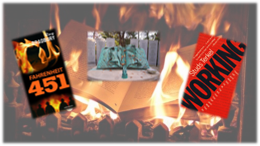
In Fahrenheit 451, a sci-fi/speculative fiction classic, Ray Bradbury depicts an America in 2049 where “firemen” burn books outlawed by the state. [1] While having nothing of the nostalgic aroma of raked autumn leaves burning along the curbside at dusk, if, at the moment only figuratively, the scent of burning books once again wafts across the American cultural landscape. Whether in Virginia, where a mother found racist the very title of a book brought into her child’s classroom, The Black Friend: On Being a Better White Person, to a Tennessee school board removing Maus, a Pulitzer Prize-winning graphic novel about the Holocaust because it contained “anthropomorhised mouse nudity” to a Washington state school district banning Harper Lee’s classic To Kill a Mockingbird “because of its depiction of race relations and use of racist language,” it’s clear that Bradbury’s “firemen” once again seek to roam American culture. [2]
After a month or two of rather benign Book Notes exploring the history of American Christmas carols, winter poetry, one or two others on poetry, and a reprise of a Note on the late Joan Didion (it’s no fun writing “the late Joan Didion”), and, quite frankly, a serious bout of avoidance behavior and procrastination on my part, it’s time to return to the culture wars and The American Tapestry Project. For whether the woke left’s attacks on academic freedom in the name of inclusivity or the right’s attacks on school curricula and library holdings, these current controversies are skirmishes, sometimes escalating into battles, in America’s ongoing culture wars – wars that are reductionist attempts to shrink the American story to a single narrative line, wars about whose story is the American story, and wars about who gets to decide which story is the American story.
Of course, there is no one American story; the story of America is a tapestry of interwoven stories. In this Book Notes, we’ll examine how the current controversy seeks to unravel that tapestry by excising certain threads. We’ll briefly look at historical examples of book burning, both metaphorical and literal, and we’ll link that to The American Tapestry Project’s essential threads, in particular “Freedom’s Faultlines” and “The Immigrant’s Tale.” We’ll note that while “the truth will out,” it often comes late and only after great suffering and anguish; and we’ll conclude by asking readers a question about America’s future.
Banning books is an old story. I’m sure the odd cuneiform tablet was smashed by Pharaoh’s minions, but the banning and burning of books is a post-Gutenberg phenomenon for the very good reason that prior to the printing press few people could read, books were rare, and they were the protected property of a priesthood in service of the state that shielded them.
It was the original public-private partnership.
Gutenberg invented the printing press circa 1455 and, you have to remember things moved slower then, a mere hundred years later in 1559 the Roman Catholic Church issued its first Index or catalog of forbidden books – the Index Librorum Prohibitorum. [3]. They were attempting to put the genie of the Protestant Reformation back in the bottle. They failed, as did Soviet censorship and Nazi book burning. In American literature, books as diverse as Mark Twain’s Huckleberry Finn, Toni Morrison’s Beloved, and Allen Ginsberg’s Howl have been banned.
The bans all failed.
In fact, not only do book bannings and book burnings fail, they actually generate increased sales for the books banned. Art Spiegelman’s Maus has once again become a best seller. Barnes and Noble, for example, has a page on its website promoting banned books. It can be found here.
I am not aware of any current attempts to ban books in Erie County, Pennsylvania, but as recently as 1982 the Girard School District was beseeched by a parent to ban Stud’s Terkel’s Working, a marvelous account of the American working class, for its lavish use of the F-word. The Girard School Board stood firm, and by a vote of 9-0 defeated the proposed ban. [4] Terkel had traveled to Girard to defend his book in an overflow community meeting.
In the current controversy, the “reawakened right’s” attempts to ban books overlaps with the woke left’s cancel culture seeking the prohibition of certain words and allusions in classroom discourse. The current controversies illustrate two things. First, “snowflakes” with tissue paper psyches sensitive to even the slightest hint of discomfort come in all political varieties and, two, there is a profound libertarian irony at play here. For libertarians of both the left and the right, upon whom none dare tread, seek to use either, sometimes both, institutional and state power to suppress that with which they disagree or that which gives them discomfort.
In Texas, Republican State Representative Matt Krause, in support of Texas House Bill 3979, wants to ban approximately 850 books that could cause “an individual to feel discomfort (emphasis added), guilt, anguish, or any other form of psychological distress on account of an individual’s race or sex.” [5] In some ways, it seems innocuous enough and very similar to a controversy currently roiling the University of Illinois at Chicago School of Law, where professor Jason Kilborn has run afoul of the Black Law Students Association, other students, and the university’s Office for Access and Equity. Kilborn’s offense? In the final exam for his civil procedure’s class, Kilborn “used abbreviated racial and gender slurs as part of a hypothetical fact pattern” he wanted the students to parse. The slurs were the “N” word and the “B” word (Kilborn only wrote “N___” and “B____”), which allegedly constituted an “offensive and culturally insensitive” use of language in the classroom. [6]
Things are always a wee bit more nuanced than a first superficial glance might suggest. Although George Will fulminated against the UIC School of Law’s Office of Equity and Inclusion as being a 21st century American incarnation of the Soviet Gulag and Mao’s Cultural Revolution’s re-education camps, [7] as the ABA Journal article cited above suggests there was more to the case than a simple exam question. There was, in fact, a history of Kilborn treating minority students with marginal or no respect.
Similarly, Krause’s House Bill 3979’s desire to shield individuals from discomfort on the basis of their race or sex is not so benign when the 850 books he proposes to ban are analyzed. They are overwhelmingly books about race relations in America, the history of American race relations, sexual identity, teenage sexuality, abortion, and student rights. In short, Krause doesn’t want any white students to feel discomfort at learning a reasonably accurate account of America’s racial history or any heterosexual student, in particular any white male student, to feel discomfort in discovering that sexual identity and sexual orientation are more ambiguous and fluid than they had perhaps been aware. And Krause certainly doesn’t want any student anxiously pondering their own sexual identity to discover that they are neither weird nor alone.
When one examines the various attempts to ban books and alter curricula now plaguing libraries and school districts, an interesting and entirely 21st century American cultural war pattern emerges. One does not find the woke left seeking to ban right-wing canonical texts like John Stormer’s None Dare Call It Treason, Steve Bannon’s film about Ronald Reagan In the Face of Evil, Phyllis Schlafly’s A Choice Not An Echo, or Pat Buchanan’s The Death of the West much less genuine works of political philosophy like Edmund Burke’s A Vindication of Natural Society. No, what one finds, according to the American Library Association’s Office for Intellectual Freedom (OIF), are that among the 273 books challenged or banned in 2020, “books addressing racism and racial justice or those that shared the stories of Black, Indigenous, or people of color grew in number. At the same time, books addressing themes and issues of concern for LGBTQIA+ people continued to dominate the list.” [8]
Here is the American Library Association’s Top Ten Banned Books List:
-
George by Alex Gino. The story of George centers on a fourth-grade transgender girl and her struggles being seen for who she really is.
-
Stamped: Racism, Antiracism, and You by Ibram X. Kendi and Jason Reynolds. Stamped is an account of racism in America through five historical figures and how racism played a role in their lives.
-
All American Boys by Jason Reynolds and Brendan Kiely. It is a story of police brutality toward a young Black teen and the white teen boy who witnesses the injustice.
-
Speak by Laurie Halse Anderson. Speak tells the story of a teen girl raped at a high school party, her immersion in art to deal with her trauma, and how she reclaims her voice after a second violent encounter.
-
The Absolutely True Diary of a Part-Time Indian by Sherman Alexie. Drawing from stories of his own life, Alexie tells the story of Junior, who leaves his school on the Spokane Indian Reservation to go to an all-white, rural high school.
-
Something Happened in Our Town: A Child’s Story About Racial Injustice by Marianne Celano, Marietta Collins, and Ann Hazzard, illustrated by Jennifer Zivion. A picture book, Something Happened … tells the story of how one Black and one white family address police violence toward the Black community with their children after the police shoot a Black man.
-
To Kill a Mockingbird by Harper Lee. Set in the Great Depression, Lee’s classic tells the story of lawyer Atticus Finch and the trial of Tom Robinson, a Black man wrongly accused of raping a white woman.
-
Of Mice and Men by John Steinbeck. A frequently challenged classic because of its use of the N-word, Steinbeck chronicles the life and bond between drifters George and Lennie and how their hopes of a simple life go awry.
-
The Bluest Eye by Toni Morrison set in 1941 Ohio. The Bluest Eye tells the childhood story of young Black girl Pecola Breedlove and how she longs for blue eyes like the much-loved blue-eyed children in America.
-
The Hate U Give by Angie Thomas Starr Carter witnesses a police officer murder her childhood friend, Khalil. While she deals with grief and the inevitable racist dialogue surrounding the event, she also grapples with her life split between her predominantly Black community and her predominantly white, privileged friends at her private school. Challenged for profanity, it was also thought to promote an anti-police message. [9]
Do you detect a pattern?
With the possible exception of Steinbeck’s Of Mice and Men, whose dated usage of racial slurs tarnish it, all of the books except George and Speak are about race in America. More specifically, with the exception of To Kill a Mockingbird, they are all contemporary attempts to come to terms with America’s racial history. They are, in fact, what the white right-wing means by critical race theory, a phrase borrowed from legal studies attempting to understand the persistence of discriminatory economic and social outcomes in American society after the civil rights progress of the latter 20th century. Most people who use the term cannot correctly define it, which is irrelevant. They use it as a shorthand code, a meme, for any attempt, particularly in America’s schools, to deal honestly with America’s racial history. Banning books is their doomed-to-failure attempt to put the horse back in the barn, to return that ship which has sailed to port, to rewrite that history they don’t want told.
So, beyond the fight over these specific books, what is going on here? What are all these states rushing to pass bills defining what can and can’t be taught in their state’s public schools doing? What are all these parents challenging school boards and libraries about what books can be taught or distributed doing? Is it a true up-from-the-people movement, what Tiffany Justice of the group “Moms for Liberty” calls “Covid Lemonade” – by which she means that an unintended result of school closings during the pandemic was parents getting a closer look at what their children were studying. Not liking what they saw, they were sparked to protest. [10] Or is it a top-down conspiracy funded by the usual suspects of right-wing dark money like the Koch brothers and the DeVos foundation seeking to privatize American public education? [11] Similar questions could be asked about activities on the woke left, whether they be equity and inclusion committees on college campuses or in corporate America or in local government or at the church across the street.
Regardless, for American society it is an existentially serious struggle (argument, fight, skirmish) in the so-called culture wars. It is about defining American society’s core values. It is about defining American culture. It is about who gets to make that definition.
What is a culture? It is the shared attitudes, values, and beliefs that bind disparate individuals together into a people, as in the U.S. Constitution’s “We the People …” Where do those shared attitudes, values, and beliefs reside? Simplistically, one might say in the people’s hearts and minds. But, since we are born knowing nothing, how did those shared attitudes, values, and beliefs come to reside in our hearts and minds? We learned them. How did we learn them? By the stories we were told instilling in us the values of our surrounding groups – first the family, then the neighborhood, then the larger community, then the nation. As Yuval Harari has said, storytelling created culture and not the other way around. [12]
And where does one find these stories? One finds these stories in two large buckets: first, in the tales we tell ourselves about the experience of being human, which range from the familial stories grandparents share with the young up through all the artifacts that constitute a culture – song, dance, film, video, poetry, novels, and stories. The second bucket, which overlaps with the first at almost every turn, consists of the stories about how we got to now – history. And history is contested ground, for how we understand the paths our people trod to get to now defines us as a people. It is that “understanding” that is contested, for “understanding” is to grasp the meaning of all the experiences Americans passed through in becoming who we are.
In short, storytelling is meaning-making and what is being contested is the meaning of America.
We’ve explored this terrain before in numerous Book Notes, which can be found here. It is also the essential threads in my The American Tapestry Project, which can be found at the Jefferson Educational Society’s website here. The essential threads directly connected to this recent spate of book banning are “Freedom’s Faultlines: Tales of Race and Gender” and “The Immigrant’s Tale,” both of which are about who gets to be an American, about who gets to have their story become part of the American story.
In “Freedom’s Faultlines: Tales of Race and Gender,” I explore the stories of those first excluded from the U.S. Constitution’s glittering “We the People …” and their fight for inclusion by appealing to America’s core values of liberty, equality, and justice for all. Or as Martin Luther King, Jr. said in his last speech, “just be true to what you said on paper.” [13]
As “The Immigrant’s Tale” reveals, America is a nation of immigrants, about which Americans are of several minds. Whether opposing Irish and German Catholic immigration in the mid-19th century, excluding the Chinese in 1882, restricting immigration in 1924, expelling Mexicans in the 1930s or building walls in the 20-teens, ironically enough, Americans have consistently been ambivalent at best and at worst opposed, sometimes violently, to the arrival of New Americans. But arrive they do. Today’s descendants of those immigrants know their grandparents or great-grandparents endured discrimination, that their parents gradually assimilated so that they might now become the new establishment ambivalent about, if not hostile to, new immigrants.
And then the cycle repeats itself.
That the cycle has often been bloody and violent, that some have never been assimilated are the parts of the story the book banners want to remain untold, want to remain untaught. For this recent attack on books is also an attack on schools and what they can teach. Book banners seem to understand that education, in addition to its practical and vocational aspects, is all about instilling society’s values in the young , teaching them society’s meaning.
And what is the meaning of America?
I’d suggest, whether or not it bends towards justice, the arc of American history, the meaning of American history has been to ever expand the inclusiveness of the “We” in “We the People …,” to continuously include more and more of America’s people in the benefits of American citizenship. First, only “free white people” were included, then all white people (but with serious restrictions on women’s citizenship rights of property and suffrage) were included, then white and black people born in the United States were included (followed by vicious Jim Crow laws to restrict or undo those rights granted in the post-Civil War Constitutional amendments). ThenCatholics and Jews and others of the great 19th and early 20th century waves of immigration clawed their way to full citizenship, then the post-1965 waves of South Asian and Latino immigrants were included, then members of the LGBTQIA plus community and, to quote Kurt Vonnegut, “so it goes.”
The woke left’s attitude toward that history can be muddled and confused. Wanting, on the one hand, to continue that expansion to its logical conclusion and, on the other, to discriminate against those who might have benefited from those earlier restrictions, they advocate virtue in the name of offices of equity and inclusion, while engaging in vile discrimination. [14] Or, for a bit of a laugh about the issue, watch the Netflix comedy The Chair about the baroquely confused thinking on America’s campuses in which good people with good intentions make vicious decisions. Less ambiguous in their aims, at the same time the right-wing book banners want to roll much of that expanding inclusiveness back. As the meaning of America becomes more diverse, less white, less Christian, less heterosexually straight, they sense that they are losing their culture. That they are losing control. They want to return to a white, Christian America that restricts full citizenship rights to those who look and think like them.
So, what are those of us who believe that the ever expanding “We” in “We the People …” is, in fact, the American story, that it represents one of humankind’s great triumphs, what are we to do? In these poisonous political times, there is no easy answer to that question for it is a question about meaning-making, about how and by whom meaning is made in a society. At the moment, I agree with Matt Bai in The Washington Post and do not trust the leadership of either political party to answer that question. [15] The Republican Party has become a cult of personality obsessed with a cultural sprint back to a 1950s-America that never existed; the Democratic Party can’t seem to find the will to rein in its virtue-signaling left fringe. In short, both parties suffer from a failure of leadership.
Specifically, their leadership failure is the failure to articulate a vision for America’s future rooted in America’s foundational values, those truths in “We hold these truths …” that spawned the American experiment almost 250 years ago. What might that vision be? Where would it arise? Who might articulate it? I don’t have the answers to those questions, but I do know that right-wing book banning, censoring school curricula, and the woke-left’s efforts to stifle free speech on college campuses and elsewhere is not the path to freedom. It is the path to serfdom. It does not matter much whether your serfdom is slanted right or left – you’re still a serf.
Let me end by asking you a question. It’s a question related to a new series that I and my colleague at St. Bonaventure University, Phil Payne, working with Ben Speggen at the Jefferson Educational Society, are developing. We are looking at the pivotal moments and documents in American history when Americans defined and redefined themselves. Those moments when they imagined – reimagined – what it meant to be an American. They are America’s meaning-making moments, if you will.
In order to make it less a mere academic exercise, we are thinking of framing it as a series exploring those pivotal moments in order to glimpse the answer to another question: How do the early-21st century American cultural wars end?
Will our libraries, both real and virtual, still be stocked? Or have the books been burned and the digital wires cut?
So, I ask you to imagine yourself not in Ray Bradbury’s 2049 but instead on July 4, 2068, one hundred years after the year, as Smithsonian magazine said, America shattered. As you nosh your picnic goodies and watch the fireworks, what will America be celebrating?
On that July 4, 2068, what does America mean? What are the core American values? What became of American democracy and that ever expanding definition of “We” in “We the People …”
And how did America get there?
Please send your responses to roth@jeserie.org.