University of New Mexico
METALS
Superfund Center
Metals Exposure and Toxicity Assessment on Tribal Lands in the Southwest

Welcome to our June 2025 Newsletter!


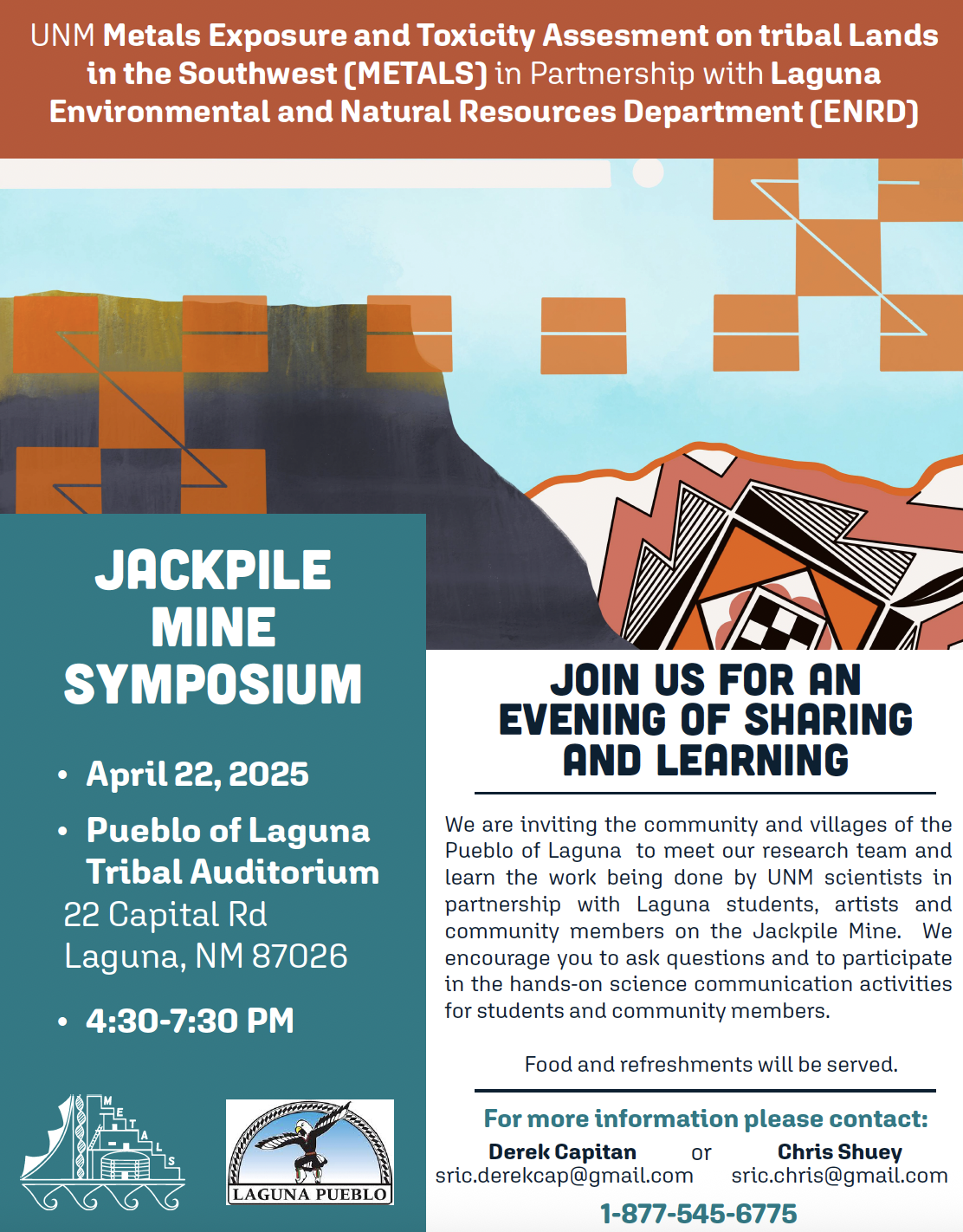
JACKPILE MINE SYMPOSIUM

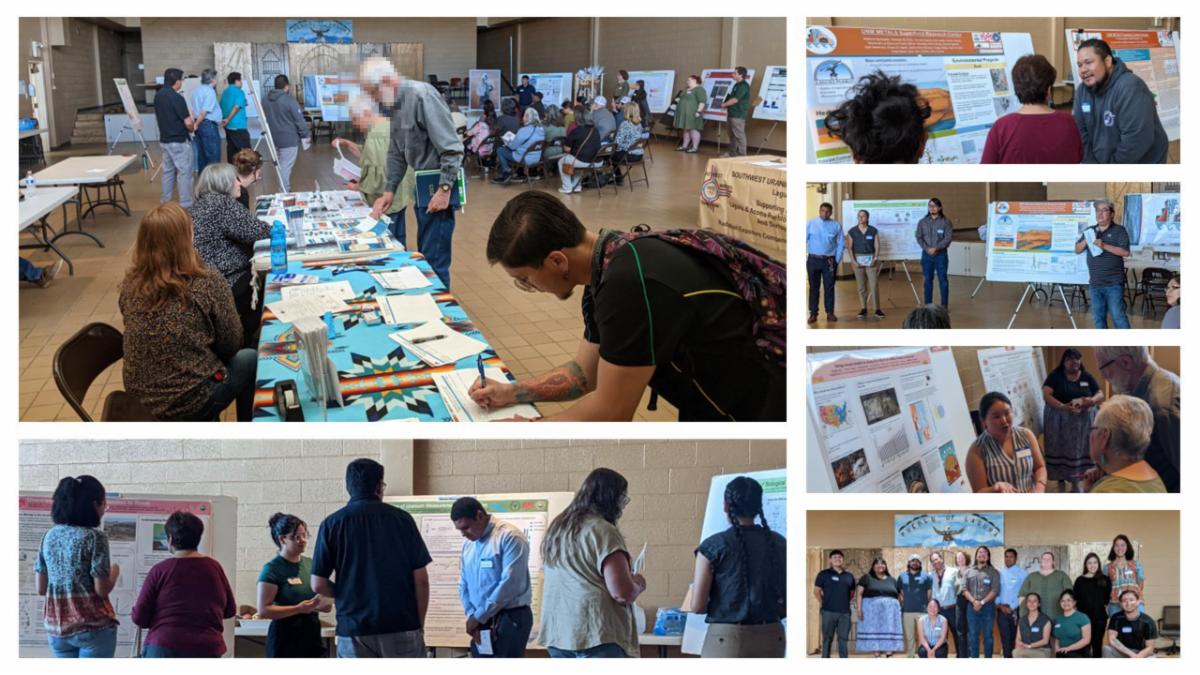
On Earth Day, April 22nd, 2025, in collaboration with Laguna Environmental and Natural Resources Department, UNM METALS hosted a Jackpile Mine Symposium at the Pueblo of Laguna. The symposium shared METALS environmental and biomedical work and information about the upcoming human subjects’ projects in Laguna beginning this summer. Our Research Translation team worked with trainees to tailor several scientific posters to the community and created summary cards for each poster which were handed out to community members.


Figure: 1

April 2025, Community Engagement at the Pueblo of Laguna Jackpile Mine Symposium.


Jackpile Mine

The Jackpile mine at the Pueblo of Laguna, NM was once the largest open-pit uranium mine in the world.

https://cumulis.epa.gov/supercpad/cursites/csitinfo.cfm?id=060703


Recent METALS publications involving the Jackpile mine:


Rodriguez et al. Radiological Analyses of 226Ra and 238U in Surface Water and Sediments from the Jackpile Member of the Morrison Formation, Pueblo of Laguna, New Mexico. Environmental Science & Technology. 2024 Aug 13. https://pubs.acs.org/doi/full/10.1021/acs.est.4c01257


Atanga et al. Single cell analysis of human colonoids exposed to uranium-bearing dust. Environmental Health Perspectives. 2024 May 21;132(5):057006. https://doi.org/10.1289/EHP13855


Quiambao et al. Interfacial Interactions of Uranium and Arsenic with Microplastics: From Field Detection to Controlled Laboratory Tests. Environmental Engineering Science. 2023 Jun 12. https://doi.org/10.1089/ees.2023.0054

(Awarded the “AEESP/Mary Ann Liebert Award for Publication Excellence in Environmental Engineering Science”)


Portman et al. Characterization of root-associated fungi and reduced plant growth in soils from a New Mexico uranium mine. Mycologia. 2023 Mar 3:1-3. https://doi.org/10.1080/00275514.2022.2156746


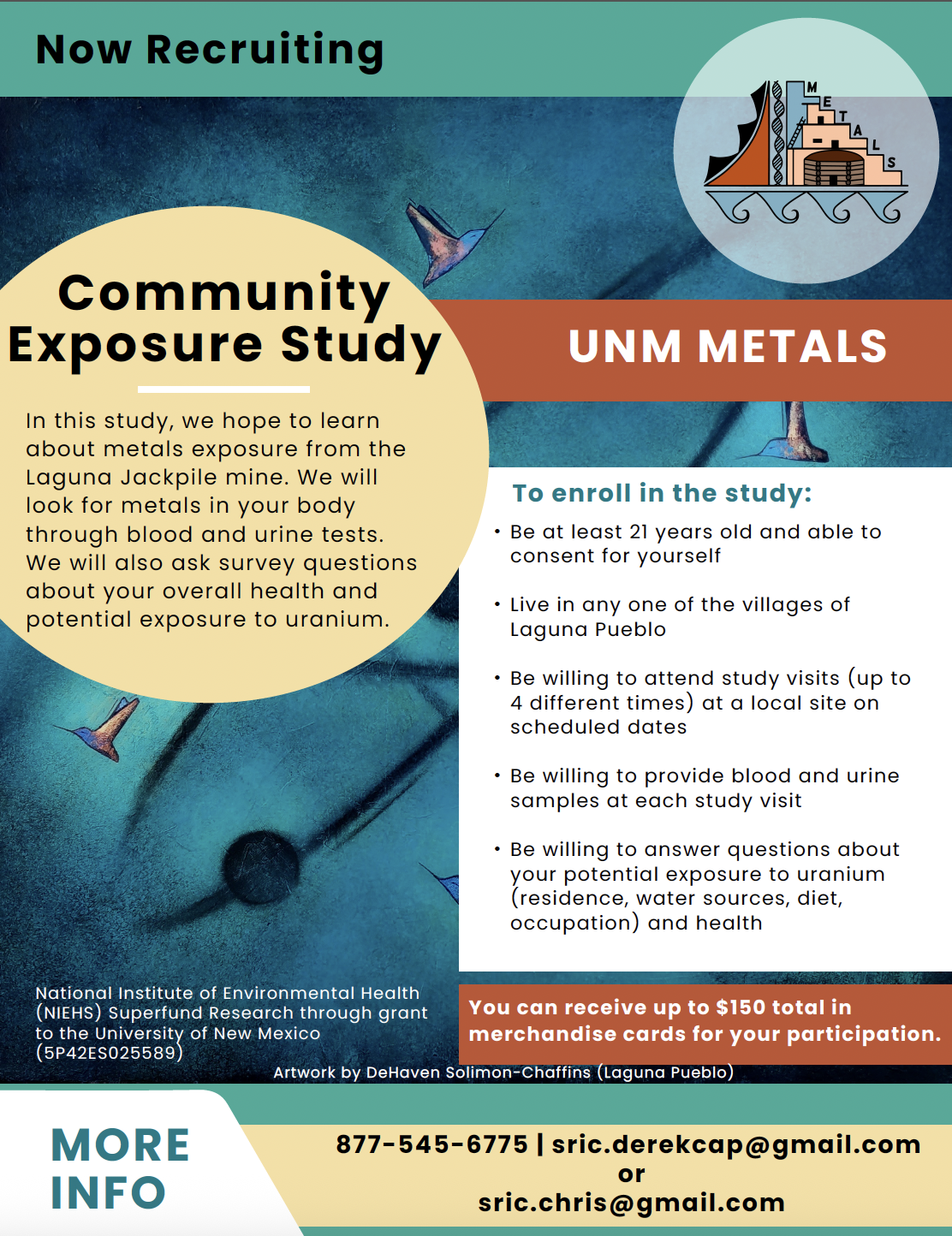
Exposure Studies to Start at Laguna, NM


UNM METALS has conducted environmental research on the Jackpile Mine and surrounding areas in Laguna (see above references) and recently received approvals from both the Pueblo of Laguna Council and Southwest Tribal IRB to move forward with human subjects studies to investigate community exposures to metals in the 6 villages of Laguna. This marks the first-ever approval to collect samples and assess the health impacts of decades-long exposures to uranium mine wastes in this community living next to the once-largest open-pit uranium mine inthe world. These studies will begin to recruit in the summer of 2025 and will focus on overall concentrations in blood and urine, effects on the immune system, and effects within the gut and lungs.


For more information, contact: Derek Capitan (sric.derekcap@gmail.com)

METALS Researcher Spotlight


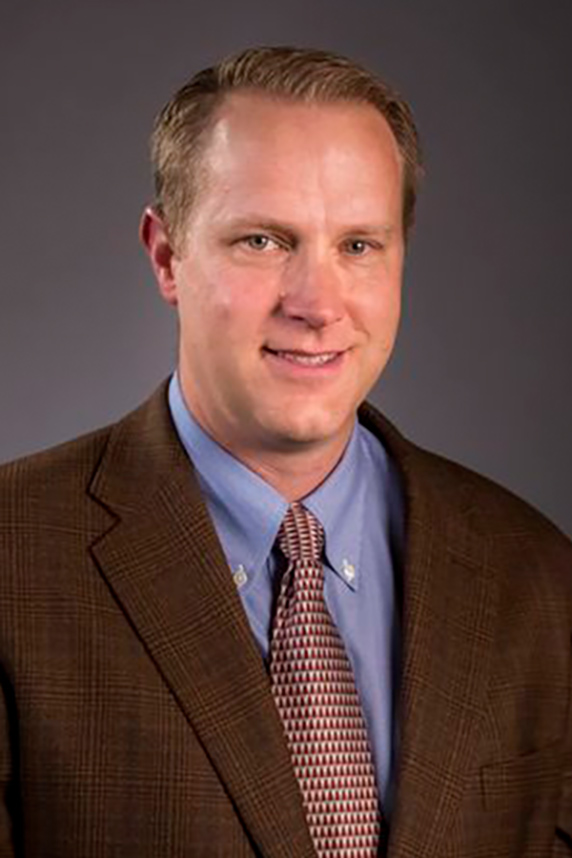
On April 2025, Dr. Matthew Campen was interviewed by Rick Woychik, director of NIEHS, for Environmental Factors on how micro- and nanoplastics enter and affect the body.


https://factor.niehs.nih.gov/2025/4/feature/matthew-campen-tackles-microplastics-and-nanoplastics

Special Issue- Fungal Ecology

METALS trainee, Dr. Geisianny Moreira, is an invited guest editor on a special issue of "microorganisms". The call for articles is currently open.

This Special Issue invites research and review articles exploring fungal ecology on a changing planet. We welcome studies that address, but are not limited to:


(i) Fungal diversity and ecological responses to environmental and human-driven stressors;


(ii) Fungal tolerance to extreme conditions (e.g., heavy metals, organic pollutants, heat, salinity);


(iii) Metabolic and physiological adaptations of fungi under environmental stress;


(iv) Conceptual frameworks linking fungal biodiversity to ecosystem functioning or linking fungal genes to traits under changing environments;


(v) Mycoremediation strategies for mitigating environmental contamination.


By advancing our understanding of fungal responses to global change, this Special Issue aims to highlight the ecological significance of fungi and their potential applications in

ecosystem restoration and bioremediation.


The deadline for manuscript submission is September 30, 2025. This Special Issue is edited by Dr. Geisianny Moreira and Dr. Helson Mario Martins do Vale, and it is part of the Environmental Microbiology Section of the Microorganisms Journal (MDPI; Impact Factor 4.1).

Trainee's Corner


METALS trainee, Abigail Granath, will be giving two oral presentations at the Mycological Society of America Conference this month. 


Abi will be presenting her work on "Bioremediation Potential of Fungi in Heavy Metal Contaminated Drylands” discussing a bioremediation study utilizing local fungal species for targeted bioremediation efforts in areas affected by heavy metal contamination, particularly in arid environments like the desert grasslands surrounding mine sites.


Her second talk, “Resilience Solutions Incubator: A New Model for Community-Engaged, Transdisciplinary Learning Experiences” will highlight the Resilience Solutions Incubator (RSI), a new, hands-on course model designed at UNM to engage undergraduate students in climate resilience research through transdisciplinary collaboration and community partnership. 


This year’s Mycological Society of America Conference will be held June 28th-July 2nd in Madison, Wisconsin. https://msafungi.org/meetings/


UNM METALS trainees and their projects can be found at https://hsc.unm.edu/pharmacy/research/areas/metals/trainees.html

Dissertation/Thesis Updates

Yanhong Huang defended her dissertation titled “Analyzing Environmental Health: Air Pollution and Human Health Using Geospatial Data Science” on May 22, 2025. Yanhong is a PhD candidate in the Department of Geography & Environmental Studies. She is a METALS DMAC trainee and is supported by the NM-INSPIRES BDSC/pilot project on Wildfire-Related Air Pollution Exposure. 

Kaelin Jeong Gagnon defended her MS thesis titled “Lead and Arsenic Removal by Fungi: Insights into the Bioremediation of Heavy Metals” on June 16, 2025. Kaelin Gagnon is a master’s student advised by Dr. Jose Cerrato in the Gerald May Department of Civil, Construction, and Environmental Engineering. She received her ACS certified B.S. in Chemistry from the University of New Mexico. Her next position is as an associate consultant with Trinity Consultants. After graduation, she will be joining Trinity Consultants as an Associate Consultant.

NEW PUBLICATIONS


Huang Y, Lin Y, Lavin RP, Luo L, Luo M, Leng S, Mullen NM, Hawley K, Gong X. Industrial air pollution and newborn hearing screening failure. Journal of Hazardous Materials. 2025 Apr 10:138241 https://doi.org/10.1016/j.jhazmat.2025.138241


Beene D, Lin Y, Hoover JH, Shi X. Deconstructing rurality to better “place” health data. International Journal of Geographical Information Science. 2025 Mar 28:128.

https://doi.org/10.1080/13658816.2025.2482718


Velasco CA, Jarvis JM, Tfaily MM, Brearley AJ, Holguin FO, Lee CO, Benavidez AD, Ali AM, Lezama Pacheco JS, Cabaniss SE, Artyushkova K,and Cerrato JM. Changes in Dissolved Natural Organic Matter Composition Induced by Reaction with U (VI) at Acidic and Neutral pH. ACS ES&T Water. 2025 Mar 26. https://doi.org/10.1021/acsestwater.4c01004


Taylor RM, Ali AM, Zhu Y, Bolt AM, Baca JT. Advancements in Heavy Metal Detection Using Microneedle Array Technology. Toxicology Mechanisms and Methods. 2025 Jan 30:1-6. https://doi.org/10.1080/15376516.2025.2461647


De Pree T. Origin Stories of the ‘Grants Uranium District’ in Northwestern New Mexico: Archives, Memoirs, and Exploratory Boreholes in the Production of Geological Regions. Engaging Science, Technology, and Society. 2024;10(3):37-64.

https://doi.org/10.17351/ests2023.2323


Read Previous Newsletters


March 2025


February 2025


December 2024


August 2024


May 2024


NIH/NIEHS P42 ES025589 (UNM METALS) This material was developed in part under cited research awards to the University of New Mexico. It has not been formally reviewed by the funding agencies. The views expressed are solely those of the speakers and do not necessarily reflect those of the agencies. The funders do not endorse any products or commercial services mentioned in this presentation.