|
|
Preventing Trauma
and Its Consequences
The Final Issue in a Series
Brought to You By
The South Southwest PTTC
|
|
In this Issue:
- Reducing Community Trauma, Repairing Communities
- Additional Resources on Community-Based Trauma Interventions
- What's Happening Around the Region?
- The Final Session in the Five-Part Webinar Series on Preventing Trauma and Its Effects, July 22, 1:30 CT
- Need Sensing: Learning with the Partnerships For Success Grantee 2019 Cohort, July 27, 1:30 CT
- Partnering With Faith Organizations to Address Substance Misuse, A Super Session August 3, 10:00 CT
-
Your Input is Needed: Training and Technical Assistance Needs Survey
- Epi Corner: Measuring Community-Level Trauma
|
|
Reducing Community Trauma, Repairing Communities
Each of us can look in our own communities to see that racism, the COVID-19 pandemic, poverty, natural disasters, violence and many other individual and community-based traumas have an effect on the overall health of a community and their readiness to address prevention issues.
We want to know what more can be done. What is that "thing" that will move the needle in my own community? What can I do to help individuals and my community be safer and healthier? To address widespread trauma at a large scale means not only providing trauma-informed care for affected individuals, but also addressing trauma at the population level, as with any epidemic. As mental health expert Dr. George Albee stated, “No epidemic has ever been resolved by paying attention to the treatment of the affected individual.” A focus solely on the treatment of individuals can only be part of a comprehensive solution.
Like Adverse Childhood Experiences, Adverse Community Experiences require attention at a population level and consideration of what can be done to prevent trauma in the first place. There are identifiable elements or symptoms of community trauma. Traumatized communities typically have deteriorated environments and unhealthy, often dangerous public spaces with crumbling built environments; damaged, fragmented or disrupted social relations, particularly intergenerational relations; damaged or broken social networks and infrastructure for social support; the elevation of destructive, dislocated social norms that promote or encourage violence and unhealthy behaviors rather than community-oriented positive social norms; and a low sense of collective political and social efficacy. While many of those living and working in impacted areas share the sense that whole communities can be traumatized, until now there has been no conceptual framework for understanding the systemic effects of trauma at a community level—and how community trauma undermines both individual and collective resiliency in the face of violence.1
The adoption of a framework for community trauma could be instrumental in the development and adoption of strategies to reduce community trauma, heal communities and promote healthy, thriving communities. A framework that holds great promise includes the areas where trauma are manifested and includes a set of emerging strategies for promoting community healing in the social-cultural environment, the physical/built environment, and the economic environment. Below are a few strategies to consider in each of these areas:
Community healing strategies include:
- Trauma-informed community building strategies;
- Restorative justice programs that shift the norms around conflict resolution;
- Healing circles that both promote healing from individual trauma and strengthen intergenerational relationships;
- Economic and workforce development strategies that improve the employment skills, capacity and readiness of community members and link them to job opportunities with a living wage;
- Improvements in the built environment (parks, housing and transportation) that create safer public spaces;
- Collaborations that promote these community-level strategies while rebuilding community social networks; and
- Efforts to change the narrative about a community.
While treatment is important to addressing trauma, it is also critical to focus on reducing the need for treatment through prevention. As more and more models are developed for treatment and addressing trauma after its onset, there is a need for prioritizing how to treat it as a public health epidemic, exploring population-level strategies and prevention.
Please attend our final session in the Preventing Trauma and Its Consequences series, Community Trauma and Systemic Intervention Strategies Thursday, July 22 at 1:30. Register here
_________________________
|
|
Additional Resources on Community-Based Trauma Interventions |
|
Community Readiness for Community Change Workbook
Colorado State University
Tri-Ethnic Center for Prevention Research
The Community Readiness Model was developed by researchers at the Tri-Ethnic Center for Prevention Research to help communities be more successful in their efforts to address a variety of issues, such as drug and alcohol use and HIV/AIDs prevention.
Trauma-Informed Community Building and Engagement
Urban Institute
San Francisco State University
This guide includes background on trauma and community healing, strategies and practices for effectively integrating trauma-informed engagement into your work, and two case studies that provide concrete examples of how these strategies were implemented in San Francisco and Washington, DC.
|
|
A Paradise Built in Hell: The Extraordinary Communities...
A Paradise Built in Hell: The Extraordinary Communities That Arise in Disaster [Solnit, Rebecca].
Read more
www.amazon.com
|
|
|
|
|
Self-Healing Communities: A Transformational Process Model for Improving Intergenerational Health
Robert Wood Johnson Foundation
Creating this kind of change is the goal of the Self-Healing Communities Model (SHCM), a process model with demonstrated success in improving the rates of many interrelated and intergenerational health and social problems.
|
|
The South Southwest PTTC is continuing to suspend in-person training and meetings until further notice. Take advantage of our many virtual products and services available for free from our website.
|
|
The South Southwest Prevention Technology Transfer Center is on Social Media! Follow us on Twitter and like and subscribe our channel on YouTube. |
|
Register Today for the Final Session in the Series
Preventing Trauma and Its Consequences: Practical Steps for the Prevention Professional
A South Southwest Prevention Technology Transfer Center Webinar Series
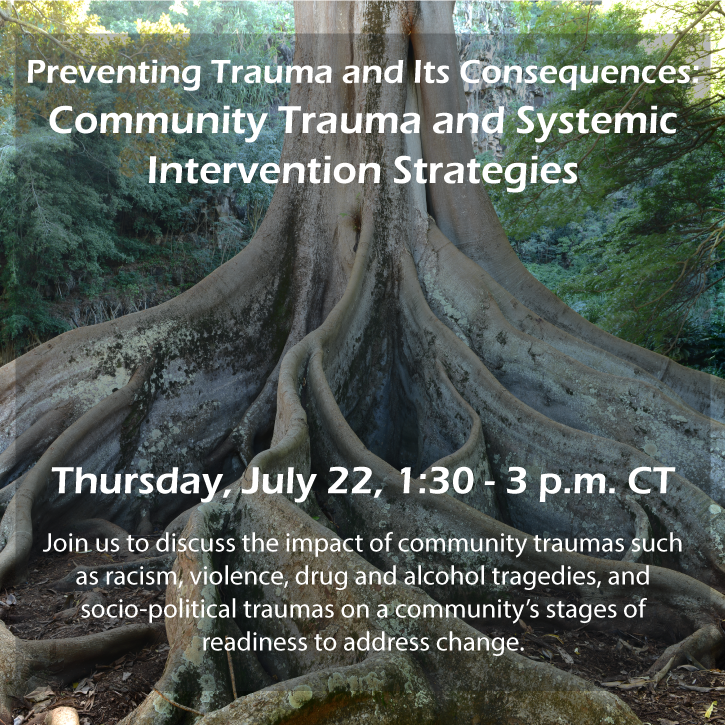
Community Trauma and Systemic Intervention Strategies
July 22, 1:30 p.m. CT
Communities, just like individuals, experience trauma. These events can fracture a community leaving it in a state of flight or freeze or mobilize it into an action phase. This webinar will discuss the impact of community traumas such as racism, violence, drug and alcohol tragedies, and socio-political traumas on a community’s stages of readiness to address change. Macro-level prevention interventions will be identified to assist the community's ability to progress toward an action stage.
Review previously recorded sessions in the series on our website.
|
|
Need Sensing: Learning with the Partnerships For Success (PFS) Grantee 2019 Cohort
July 27, 2021
1:30 to 3 p.m. CT
This webinar will provide an opportunity for the 2019 Partnership for Success grantees to share the challenges and successes of data collection, analysis, and dissemination work. Tailored for epidemiologists and evaluators, participants in this webinar will discuss preferences for how future webinars for this group will be structured, and the content/subject areas for those presentations.
|
|
Partnering with Faith Organizations to Address Substance Misuse, A Super Session
August 3, 2021
10:00 a.m. to 3:00 p.m. CT
The South Southwest PTTC will host the virtual super session, Partnering with Faith Communities to Improve Prevention Outcomes on August 3, 2021, for prevention professionals and members of faith and spiritual communities. Faith and spirituality play a prominent role in the lives of many, making it vital for prevention professionals to leverage relationships with communities of faith to improve community health and wellness. Importantly, faith is considered a protective factor for preventing or mitigating the risk of substance misuse and a contributor to resilience. Faith-based programming and communities should be included when engaging in comprehensive multi-sector prevention planning.
|
|
We're Requesting Your Input for Training and Technical Assistance Needs This Year!
The South Southwest PTTC is conducting a training and technical assistance needs survey to better respond to the needs of prevention professionals during this time. Your input is important to us! We ask that you complete the survey before Friday, August 6. The survey takes less than 10 minutes.
Click the button below or use the camera on your phone to use the QR code
|
|
Please join our email list or follow us on Twitter @SSWPTTC6 to receive notifications about training opportunities and registration details.
|
|
Prevention Online Courses
Free online courses are available through the Prevention Technology Transfer Center.
If you are new to prevention, be sure to take the course, "Introduction to Substance Abuse Prevention: Understanding the Basics (Pre-SAPST)" and the "Ethics in Prevention Foundations: A Guide for Substance Misuse Prevention Practitioners."
|
|
Epi Corner
Iris Smith, Ph.D., M.P.H.
South Southwest Prevention Technology Transfer Center
|
|
Measuring Community Level Trauma
Research on Adverse Childhood Experiences (ACEs) has identified individual childhood exposures which may lead to poor physical and mental health outcomes in adulthood. Family violence, neglect, physical, and sexual abuse are examples of experiences that can negatively influence development across the lifespan. There is also a growing body of research that has found dynamic interactions among genetic, biological, social, and environmental influences from preconception to adulthood.1 Health outcomes can also be affected by the larger social and built environment. Even in the absence of direct exposure, individuals can be exposed to environmental stressors through the experience of others. For example, research on the effects of vicarious racism has found that the indirect exposure to prejudice and discrimination can affect health outcomes. Children may be particularly vulnerable to such experiences.2
Symptoms of community trauma may include intergenerational poverty, unemployment, deterioration of the physical environment and social connections as well as a diminished sense of political and social efficacy.3 Disparities within and between communities such as poverty, lack of access to resources and supports (i.e. health services, recreation, supermarkets, transportation), neighborhood crime, violence (including suicide), drug use (based on local ER visits, trafficking and overdose data) can be used as indicators of community-level risk.
These data can also be used to heighten awareness among community stakeholders of the relationship between community-level indicators and mental and physical health outcomes. Emerging technologies can also provide useful data on neighborhood conditions. Schootman et al. (2016) provide an overview of technological measurement techniques that have been used including Google Street View, crowdsourcing, and drones. Qualitative data methods such as photovoice have also been used to document community conditions. The goal of community-level assessment is to identify geospatial areas with a convergence of potentially trauma-inducing characteristics.
Helpful Resources
Article of Interest
Schootman M, Nelson EJ, Werner K, Shacham E, Elliott M, Ratnapradipa K, Lian M, McVay A. (2016) Emerging Technologies to Measure Neighborhood Conditions in Public Health: Implications for Interventions and Next Steps. International Journal of Health Geographics 15(20).
____________________________
1 National Academies of Sciences, Engineering and Medicine (2019). Fostering Healthy Mental, Emotional, and Behavioral Development in Children and Youth: A National Agenda. Washington, DC. The National Academies Pres, doi: https://doi.org/10.1722625201 PDF available at http://nap.edu/25201.
2 Heard-Garris NJ, Cale M, Camaj, Hamati MC, Dominguez TP (2018). Transmitting Trauma: A Systematic Review of Vicarious Racism and Child Health. Social Science & Medicine 199; pg. 230-240.
|
|
|
|
|
|
|