What Are We Here For?
The Prayer Book's simple, demanding vision for the mission of the Church
One of the things I love about the Episcopal Church is that we have a Prayer Book that is remarkably good at bringing us back to the basics. We can spend hours debating theology, liturgy, church governance, and whether the altar should be moved six inches to the left. Episcopalians are quite capable of turning a relatively simple question into a three-hour committee meeting. And if we’re lucky, there will be coffee.
But tucked away on page 855 of the Book of Common Prayer, in a section called the Catechism, is a question that I think every congregation ought to return to regularly.
What is the mission of the Church?
The answer is remarkably straightforward: “The mission of the Church is to restore all people to unity with God and each other in Christ.”
I have been thinking about those words quite a bit lately, particularly as I begin to learn the rhythms of life here at Trinity Cathedral. There is so much history within these walls. Generations of people have prayed here, celebrated marriages, baptized children, buried loved ones, and encountered God in ways that shaped the rest of their lives. The building itself bears witness to a remarkable story of faithfulness.
And yet, I find myself returning to that little word in the Catechism: restore.
It is an interesting choice of words. Restoration suggests that something has been damaged, something has been fractured, something precious has been lost. We understand that experience well enough. Families become estranged. Friendships fall apart. Communities become divided. People lose their faith, sometimes because life has been unbearably cruel, and sometimes because the very Church that was supposed to offer them love became the source of their pain.
We live in a world that has become remarkably skilled at division. We know how to sort people into categories, how to identify those who agree with us, and how to keep a comfortable distance from those who don’t. We have even managed to bring those habits into the life of the Church.
And still, the Prayer Book insists that our mission is restoration.
That is a rather extraordinary claim when you think about it. God has entrusted the Church, with all its imperfections and peculiar personalities, with the work of participating in the healing of a broken world.
Of course, restoration does not mean returning everything to the way it used to be. I think that is an important distinction, particularly for congregations with long histories. Sometimes we confuse faithfulness with preservation. We imagine that if we could recover some earlier moment in the Church’s life, everything would be as it should be.
But the unity God desires is larger than our memories of what the Church once was. It is the reconciliation of human beings with their Creator and with one another. It asks us to imagine a future shaped by the reconciling love of Jesus Christ.
And that means the Church must be willing to experience some restoration of its own.
The Catechism goes on to explain how this mission happens. Through prayer and worship, the proclamation of the Gospel, and the promotion of justice, peace, and love.
I appreciate that the Prayer Book holds these things together. Our worship and our life in the world belong to the same calling. What happens around the altar ought to shape what happens around our dinner tables, in our neighborhoods, and in the way we treat the stranger standing in front of us.
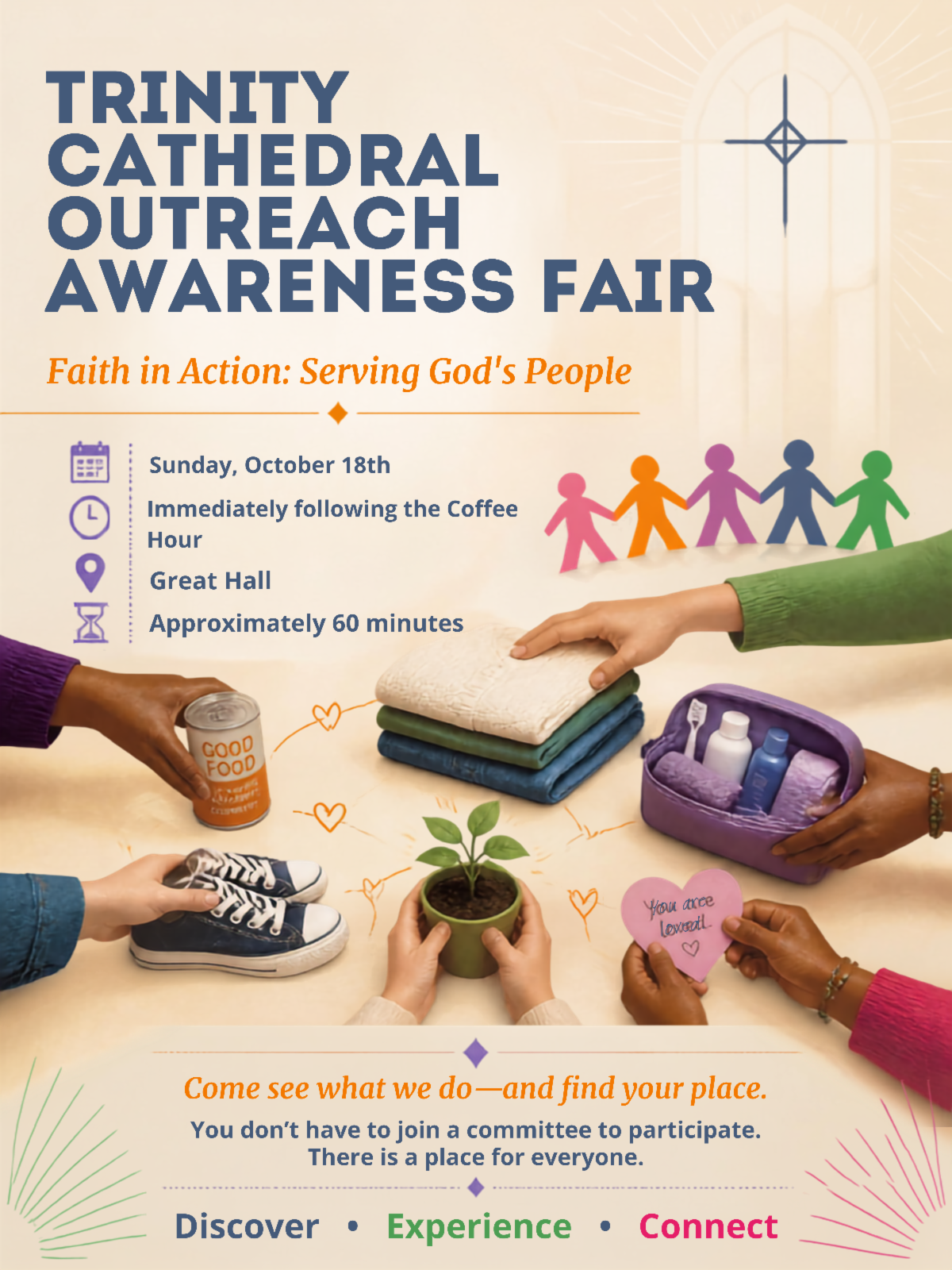
I think about the people who come to the Deacon’s Closet looking for food or clothing. I think about the work of Tapestry Farms and the relationships being cultivated in our community. I think about someone who walks into the Cathedral carrying grief, loneliness, or questions about whether God could possibly love them.
Each of these encounters offers an opportunity for restoration. Sometimes it happens through a meal or a warm coat. Sometimes through a conversation. Sometimes through the beauty of music or the familiar words of a prayer that someone has not spoken in years.
And sometimes restoration begins with something much harder. An apology. A willingness to listen. The courage to acknowledge the ways we have wounded one another.
There is one more question in the Catechism that I wish we would pay closer attention to: Through whom does the Church carry out its mission?
The answer is through the ministry of all its members.
I love that. The responsibility for the mission of the Church belongs to every baptized person. Every one of us has a part in God’s work of reconciliation. The ministry of a congregation extends far beyond the hours when its doors are open. It continues wherever its people go.
And I think this ought to shape the way we make decisions about our common life.
When we discuss budgets, buildings, programs, and priorities, we ought to ask how those things help us participate in the mission Christ has given us. Our buildings matter because of the people who gather within them and the people who find refuge through them. Our financial resources matter because they make ministry possible. Our traditions matter because they carry the faith from one generation to another, giving us a foundation from which to respond faithfully to the needs of the present.
I am convinced that the future of the Church depends, in part, on our willingness to return to this simple understanding of why we exist.
There are people all around us who are hungry for some sign that reconciliation is possible. People who have been told they do not belong. People exhausted by anger and division. People who are desperate to believe that their lives matter to someone.
What would happen if they encountered a Church so deeply committed to its mission that they began to believe those things could be true?
I suspect some of them might find their way to the altar. Others might find a friend, a community, or simply enough hope to make it through another day. And perhaps, in ways we may never fully see, the fractured pieces of their lives might begin to come together.
That is holy work. And it is work that will never be finished by any one congregation or any one generation.
As I think about the future of Trinity Cathedral, I want us to keep returning to that question on page 855. I want it to shape our conversations, our decisions, our worship, and our relationships with the community around us.
Because someday, someone may ask what difference this Cathedral has made in the life of Davenport. I hope the answer will be found in more than the beauty of our building or the length of our history.
I hope they will tell stories of people who were welcomed, wounds that were healed, neighbors who were fed, relationships that were restored, and lives that were changed by the love of Jesus Christ.
After all, if our mission is to help God put a broken world back together, people ought to be able to look at us and see some evidence that it is happening. May God give us the grace to continue that good work.
Faithfully,
Brandon +
|