|
Teaching & Leading with Intention
Bi-Weekly Insights from Research for Better Teaching
| |
Feedback That Moves Learning Forward
Turning Evidence Into Action Through Skillful Feedback
| | |
Clear instruction doesn’t happen by chance—it’s built through intentional practices.
Skillful teachers are made, not born.
We develop our craft through the consistent use of strategies such as strong objectives, visible criteria for success, modeling thinking, and formative assessment that reveals learning as it unfolds.
But even when teachers are gathering evidence of student understanding, one essential question remains: What do we do with what we see?
This is where feedback becomes the move that matters most.
| | |
“Feedback… serves as an invitation and motivation for the student to use the feedback to continue to improve.”
The Skillful Teacher, Eighth Edition
| |
Why It Matters:
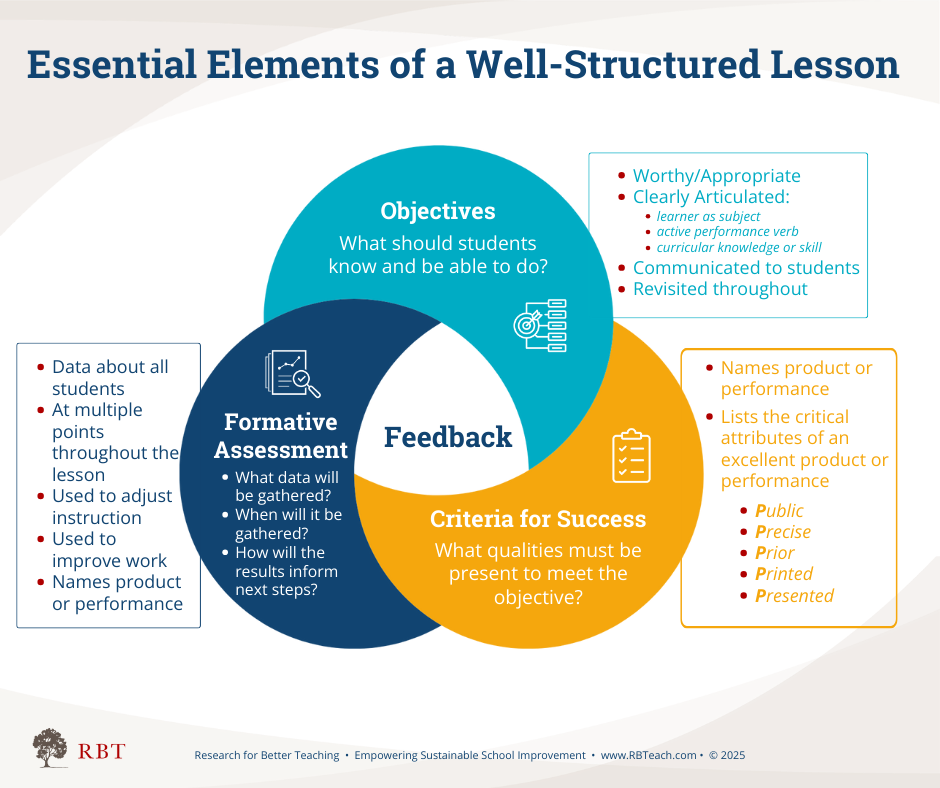
Effective instruction is not a set of isolated moves—it is the alignment of three core elements:
-
Objectives – What students should know and be able to do
-
Criteria for Success – What quality looks like
-
Formative Assessment – What students understand right now
At the center of this alignment is feedback.
Feedback is what connects all three:
- It links evidence of learning to the objective
- It uses criteria to make improvement clear
- It guides students toward the next step
|
What Makes Feedback Effective?
Feedback has the greatest impact when it is:
- Aligned to criteria for success
- Specific and actionable
- Timely—during the learning, not after
- Focused on the work, not the learner
| |
What Is Feedback?
Pure feedback is non-evaluative information we give students about how their performance compares to a model of good work.
- It is value neutral—without praise or blame
- It is objective—grounded in criteria for success or exemplars
- It is specific—identifying where the work meets or does not yet meet the standard
When we provide feedback in this way, students don’t have to guess what to improve—they know exactly what to do next.
Why This Alignment Matters
When these elements are disconnected:
- Objectives become statements, not drivers of learning
- Criteria remain unclear or unused
- Formative assessment becomes data without direction
But when they are aligned:
- Feedback becomes precise and actionable
- Students revise and improve in real time
- Learning accelerates
| | Feedback is what activates the system. | | |
“Grades and supportive comments don’t cause further learning; feedback can.”
The Skillful Teacher, Eighth Edition
| |
Try This:
During your next lesson: After a formative check, give one piece of feedback aligned to your criteria for success
Then ask students to:
- Revise their work immediately
- Show evidence of how they used the feedback
| | |
“Holding students accountable for using the feedback we provide is one of the basic tenets of making students agents of their own learning.”
The Skillful Teacher, Eighth Edition
| |
Small Shifts, Big Impact:
Small adjustments in how we give feedback can significantly increase its impact on student learning.
Shift 1: From evaluation to description: Describe the work in relation to criteria—not your opinion of it.
- Instead of: “Good job” or “This needs work”
- Try: “Your response includes the main idea. Now add one piece of evidence to support it.”
Shift 2: From general to specific: Specific feedback gives students a clear next step.
- Instead of: “Be more clear”
- Try: “Clarify your explanation by defining this term and giving one example.”
Shift 3: From delayed to immediate: Feedback is most powerful when students can use it right away.
- Instead of waiting until the end of the lesson
- Build in quick feedback moments during learning
Shift 4: From teacher-owned to student-used: Learning improves when students act on feedback—not just receive it.
- Don’t stop at giving feedback
- Ask: “Show me how you used the feedback.”
Shift 5: From judgment to growth: Keep feedback value neutral and focused on improvement.
- Avoid praise/blame tied to the student
- Focus on what will move the work forward
| |
For Instructional Leaders:
Feedback is not just a classroom practice—it is a lever for improving teaching and learning across a school. As leaders, we shape how feedback is understood, modeled, and used.
Small shifts in how we give feedback can strengthen instructional practice schoolwide.
-
Focus on evidence: Move from general praise to evidence-based feedback. Ground feedback in evidence of student learning, not general impressions.
-
Anchor in shared language: Objectives, criteria for success, and formative assessment
-
Make it growth-focused: Move from evaluation to next steps. Position feedback as part of professional learning, not just supervision.
-
Invite reflection: Make feedback a two-way process that builds teacher ownership. “What did you notice about student understanding?”
- Look for alignment:
- Are criteria visible?
- Is feedback specific and actionable?
- Are students using feedback to improve?
The way we give feedback to teachers shapes how feedback is experienced by students.
| |
Research Connection:
Research has long shown that feedback is most powerful when it is specific and actionable.
Bellon and Bellon (1992) found that academic feedback is most effective when it clearly tells students:
- what they did well
- what needs improvement
- and how to improve
When feedback includes these elements, students are significantly more likely to revise their work and improve performance.
Later research reinforces this idea:
-
Paul Black & Dylan Wiliam (1998) identified formative assessment—including feedback—as one of the highest-impact influences on student achievement
-
John Hattie (2009) found that feedback has one of the strongest effect sizes on learning outcomes
Across decades of research, the message is consistent:
Feedback works when it is clear, specific, and used by students to improve their work.
For more see Chapter 23, Assessment in The Skillful Teacher, 8th Edition
| | |
Academic feedback is more strongly and consistently related to achievement than any other teaching behavior. This relationship is consistent regardless of grade, socioeconomic status, race or school setting.
Bellon and Bellon
| |
Jon Saphier on
The Essential Elements of a Well Structured Lesson
| | |
Feedback is most powerful when it is part of a coherent instructional system.
This video explores the core elements of a well-structured lesson—objectives, criteria for success, formative assessment, and feedback—and shows how they work together to move learning forward.
As you watch, consider how feedback connects these elements, turning evidence of learning into clear next steps for students.
| | Be sure to check out all the other resources | |
Now Open:
RBT’s Summer Courses for Teachers & Leaders
| | Looking to deepen your expertise, refresh your practice, or grow your leadership impact this summer? RBT’s Summer Open Courses are now open for enrollment! These courses are designed for individuals or small groups (fewer than 25) . | | | |
Studying Skillful Teaching
Hybrid
Instructor: Chris Olansen-Rilli
In-Person Dates: June 29, 30 and July 1
Time: 8:30am - 3:30pm EST
Location: 1 Acton Place, Acton, MA
Virtual Dates: Sept. 22, Oct. 6, Oct. 20, Nov. 3, Nov. 19, Dec. 1
Time: 4:00pm - 6:30pm EST
Location : Zoom
| | | | |
Analyzing Teaching for Student Results
In-Person
Instructor: Deb Reed
In-Person Dates: July 7-10, September 30, October 22, November 18
Time: 8:30am - 3:30pm EST
Location: 1 Acton Place, Acton, MA
| | | | |
Women Leaders Program Virtual
Instructor: Pia Durkin
Virtual Dates:
-
Session 1: Tuesday, July 14
-
Session 2: Wednesday, July 15
-
Session 3: Thursday, July 16
Time: 8:30am - 12:30pm EST
Location: Zoom
Plus two (2) 1-hour individual virtual coaching sessions to be arranged with the instructor.
| | | | |
High Impact Teacher TEAMS In-Person
Instructor: Reena Freedman
Dates: August 24, 25, 26
Time: 8:30am - 3:30pm EST
Location: Somerville High School
81 Highland Avenue,
Somerville, MA 02143
| | |
Spread the Word:
Teaching and Leading with Intention
| | Missed an issue of the newsletter? You can find archived copies here. | | | | |