Making swift progress on education issues
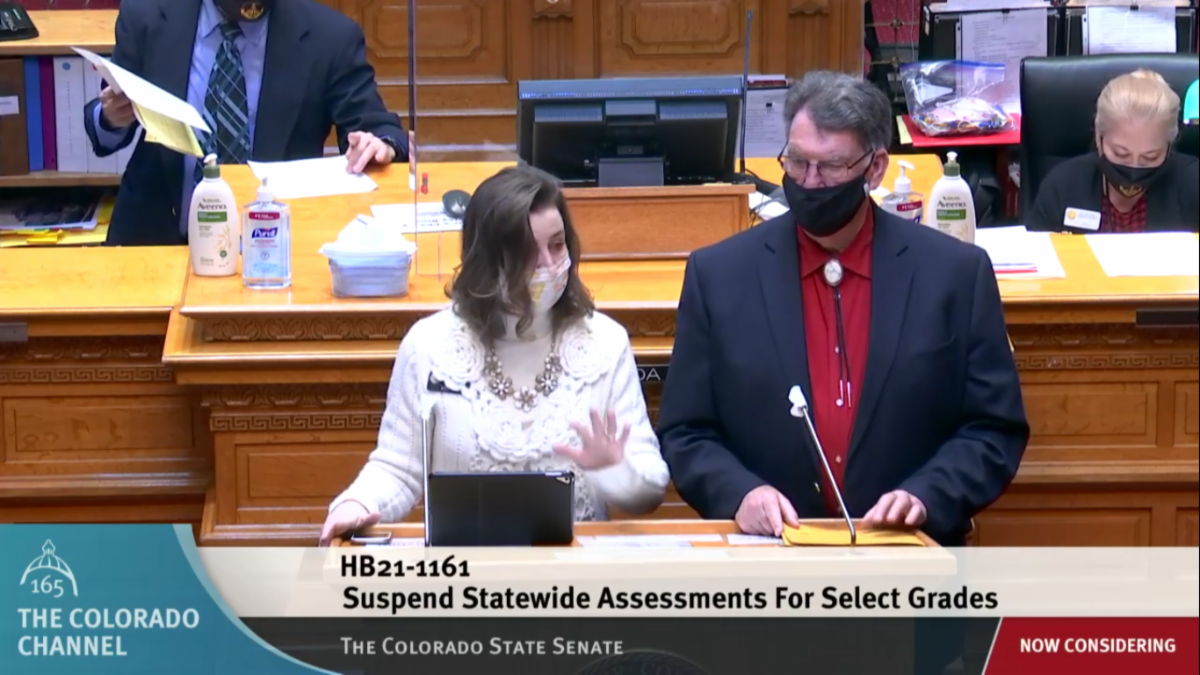
My work in the Senate last week focused mainly on a number of fast moving education bills, particularly the compromise testing bill HB21-1161. The bill to reduce the number of CMAS assessments administered by schools this spring came over from the House, was introduced in the Senate, assigned to the Education Committee, passed in committee, referred to Appropriations, passed in Appropriations, referred to the full Senate, and passed on second reading--all in a matter of two days!
In addition to addressing the testing issue, I am very pleased that we are tackling school funding issues as well. Governor Polis will be signing into law SB21-053 on Monday afternoon, which will make an adjustment to school funding mid-year. Given the drop in enrollment, increases in the number of at-risk students, increases to costs, and other challenges our schools are facing right now, these funds can't get there quick enough! Later in the session we will start discussing next year's budget, as well as how we might direct some of the federal stimulus dollars coming our way.
Another significant bill that I am working on, HB21-1164, to address structural inequities in Colorado's K-12 property tax system, passed on second reading in the House. Colorado students and taxpayers deserve fair and sufficient funding of K-12 education. The problem, is that the "local share" of school finance has been calculated incorrectly for many years, creating an arbitrary and unfair property tax system. You can learn more about the bill and our proposed solution below.
Finally, a few smaller education bills received the "go-ahead" to move out of the Senate, including SB21-115 on funding for the Talking Book Library and SB21-104 on the Special Education Fiscal Advisory Council. Both bills passed unanimously. I have one or two more education bills in the pipeline to support our educator workforce and to address higher education funding, but those efforts are still developing. For now, I am pleased with the progress we have made with regard to education and I look forward to taking up some non-education related topics in the coming weeks. |
|
A $700 million 'Recovery Plan' unveiled last week
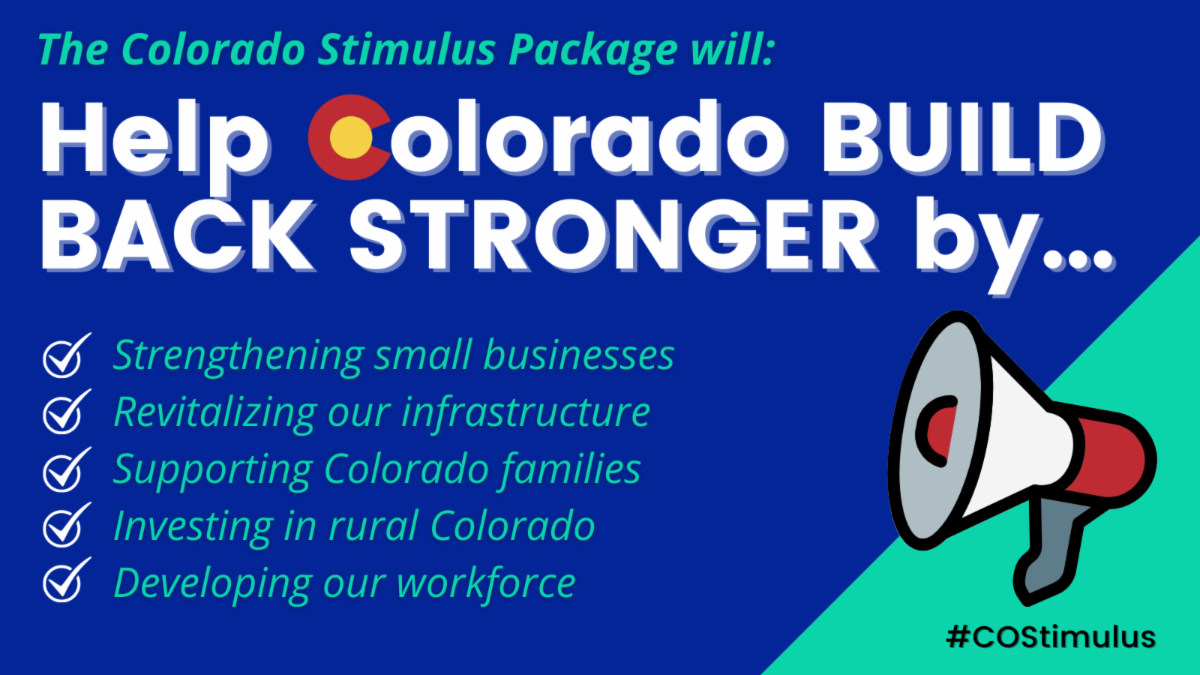
House and Senate Leadership from both parties and Governor Jared Polis unveiled last week a Colorado Recovery Plan that will invest roughly $700 million into helping Colorado recover faster and build back stronger from the pandemic.
Developed with bipartisan input from lawmakers and community partners across the state, this stimulus plan prioritizes one-time investments that will have a stimulating effect on the economy, create jobs, and benefit the hardest-hit communities.
Five big goals will guide dozens of bills narrowly tailored to meet the challenges at hand:
- Strengthen small businesses
- Revitalize our infrastructure
- Support Colorado families
- Invest in rural Colorado
- Develop our workforce
The plan will be financed by one-time dollars that are available as a result of improved economic projections for the FY 2020-21 budget year.
|
|
Colorado students and taxpayers deserve fair and sufficient K-12 education funding
Last week, the House took up HB21-1164 on Total Program Mill Levy Tax Credit, which concerns reductions in the property tax credits that apply to school districts' total program mill levies for purposes of funding the "Public School Finance Act of 1994." The problem we are trying to solve in this bill is to address an incorrect calculation of the local share of school finance.
Historically, local property tax rates to support education were consistent across districts, but today they vary widely across the state. This structural problem is not a result of intentional policy choices, but rather it is the result of an error made by the Colorado Department of Education in how TABOR was applied. This error translates into an inequitable school finance system that is unfair to students and taxpayers. Some property owners pay tax rates that are 16 times higher than that of taxpayers in neighboring schools districts on properties of the same value. This structural problem forces the state to backfill the local difference, reducing the amount of funding available to all schools.
How did this happen? Despite voter approval to permanently waive the TABOR cap on school district tax revenue (in 174 of 178 school districts), CDE instructed school districts to reduce their tax rates even though they were no longer subject to the revenue limits. In 2009, the Colorado Supreme Court affirmed that these reductions were erroneous, but yet CDE continued to advise school districts to certify mill levies in accordance with the property tax revenue limit. Over time, the average mill levy has dropped over 40 percent, forcing the state to backfill the drop in local revenue, with most of the backfill going to the wealthiest, fastest-growing districts.
We addressed this error temporarily in the 2020 School Finance Act by issuing a "credit" to districts to account for the error in calculating their total program funding. Our bill, HB21-1164, simply instructs CDE to put in place a plan of correction. Our bill will then form the basis of a constitutional question to be sent to the Colorado Supreme court to affirm the state's authority to align our property tax system with the original voter intent in those prior "de-Brucing" elections. We believe that if the interrogatory is sent to the Supreme Court early enough, we will hopefully receive an answer in time for this year's School Finance Act. |
|
Senator Zenzinger's 2021 bill list
Below you will find a list of bills that were introduced or acted upon last week, as well as bills scheduled for action in the coming week. Updates and new bills are highlighted in red text.
SB21-179 Colorado Opportunity Scholarship Initiative Advisory Board: Concerning the composition of the Colorado opportunity scholarship initiative. This bill was introduced last week and will be heard in the Senate Education Committee on Wednesday, March 17 upon adjournment.
SB21-135 Prohibit Certain Animals in Traveling Animal Act: Concerning a prohibition on the use of certain animals in a traveling animal act. This bill will be heard in the Senate Agriculture Committee on Thursday, March 18 at 1:30 pm.
SB21-115 Annual Funding for Talking Book Library Services: Concerning the use of money in the Colorado telephone users with disabilities fund to support talking book library services for certain persons with disabilities. This bill passed through the Senate on 2nd Reading unanimously.
SB21-104 Sunset Special Education Fiscal Advisory Committee: Concerning the continuation of the special education fiscal advisory committee. This bill passed through the Senate on 2nd Reading unanimously.
HB21-1164 Total Program Mill Levy Tax Credit: Concerning reductions in the property tax credits that apply to school districts' total program mill levies for purposes of funding the "Public School Finance Act of 1994". This bill passed through the House on 2nd Reading.
HB21-1161 Suspend Statewide Assessments for Select Grades: Concerning suspending required statewide assessments for selected grade levels for the 2020-21 school year. This bill passed through the Senate on 2nd Reading.
HB21-1083 State Board Assessment Appeals Valuation Adjustment: Concerning the modification on appeal of property valuation set by the county board of equalization. This bill will be heard in the Senate Local Government Committee on Tuesday, March 16 at 1:30 pm.
|
|
On Monday... I spoke on a panel hosted by CHFA on "Women in Leadership"... I met with education stakeholders to discuss upcoming bills... I met with proponents of expanding our electric transmission facilities... I met with opponents of regional transmission organizations... On Tuesday... I met with several county assessors to discuss HB1083... I attended the Transportation & Energy Committee meeting... On Wednesday... I chaired the Senate Education Committee upon adjournment... I met with proponents of extending the alcohol-to-go provisions put in place last spring to address COVID... I met with education stakeholders to discuss upcoming bills... On Thursday... I chaired the Senate Education Committee... I presented HB1161 in committee... I was interviewed by Channel 7... I was interviewed by the Colorado Sun... On Friday... I presented SB115 and SB104 in Appropriations... I passed HB1161 on second reading. |
|
Next Legislative Town Hall Meeting:
Saturday, March 20 at 10:30 am
Mark your calendar for our next virtual town hall meeting! We will be hosting Rep. Julie McCluskie, Vice Chair of the Joint Budget Committee, to discuss the upcoming state budget.
|
|
COVID-19 & Vaccine Resources |
|
About Senator Rachel Zenzinger |
|
Rachel Zenzinger was re-elected to a second term in the Colorado State Senate, representing District 19, in November 2020. Previously she served on the Arvada City Council.
Senator Zenzinger is the Chair of the Senate Education Committee, Vice Chair of the Statutory Revision Committee, and a member of the Senate Transportation and Energy Committee.
200 East Colfax, Denver, CO 80203
SenatorRachelZ@gmail.com
303-866-4840 office
303-748-0770 cell
|
|
|
|
|
|
|