Weekly highlights for the Manufacturing community.
Subscribe to get this newsletter in your inbox each Tuesday.
| |
 | |
Can AI Solve Inconvenient Traffic Jams?
If you’ve ever driven a car, truck, motorcycle, or anything else on wheels in the city, you’ve gotten stuck in traffic. And it’s the worst. But new technology may have found a way to reduce the headache. Researchers at Aston University in the U.K. have developed an artificial intelligence traffic light system that relies on live camera footage to make adjustments and keep traffic flowing. The system utilizes deep reinforcement learning, which means it understands when it's doing a lousy job and it varies its actions to gradually improve. The researchers said this method improved upon the manually designed phase transitions that are often used for traffic lights. To test the system, the researchers built a traffic simulator called Traffic 3D (which sounds like a horrible video game) to train the program and prepare it for handling different traffic and weather scenarios. In reality, the traffic control system actually does function sort of like a game. Researchers said the program gets a "reward" when it gets a car through an intersection and if a car has to wait or there’s a traffic jam, there’s a negative reward. The researchers said they don’t supply any input, they "simply control the reward system," which can be changed to allow for emergency vehicles to pass through. In subsequent real-world testing, the researchers said the system adapted well to real intersections. They hope to begin further testing the system on real roads this year. Read more at Thomas
| |
AI in the cloud pays dividends for Liberty Mutual
iberty Mutual is one of the most experienced and advanced cloud adopters in the nation. And that is in no small part thanks to the vision of James McGlennon, who in his role as CIO of Liberty Mutual for past 17 years has led the charge to the cloud, analytics, and AI with a budget north of $2 billion. Eight years ago, McGlennon hosted an off-site think tank with his staff and came up with a “technology manifesto document” that defined in those early days the importance of exploiting cloud-based services, becoming more agile, and instituting cultural changes to drive the company’s digital transformation. Today, Liberty Mutual, which has 45,000 employees across 29 countries, has a robust hybrid cloud infrastructure built primarily on Amazon Web Services but with specific uses of Microsoft Azure and, lesser so, Google Cloud Platform. Liberty Mutual’s cloud infrastructure runs an array of business applications and analytics dashboards that yield real-time insights and predictions, as well as machine learning models that streamline claims processing. As the Boston-based insurance company’s journey to the cloud has unfolded, it has also maintained a select set of datacenters from which to run legacy applications more economically than they would on the cloud, as well as software from vendors that make licensing on the cloud less attractive. And while McGlennon believes that will change over time, he is far more focused on technologies that will define the next generation of applications. “We’re really trying to understand the metaverse and what it might mean for us,” says McGlennon, whose mild Irish brogue bares his Galway, Ireland, upbringing. “We’re focused on augmented reality and virtual reality. We’re doing a lot on AI and machine learning and robotics. We’ve already built up blockchain and we’ll continue with all those.” Read more at CIO
| |  |
|
|
Should Organizations Link Responsible AI and Corporate Social Responsibility? It’s Complicated.
MIT Sloan Management Review and Boston Consulting Group (BCG) have assembled an international panel of AI experts that includes academics and practitioners to help us gain insights into how responsible artificial intelligence (RAI) is being implemented in organizations worldwide. This month’s question for our panelists: Should an organization tie its RAI efforts to its overall corporate social responsibility (CSR) efforts? The results present a mixed picture. While 52% of panelists (11 out of 21) believe that an organization’s RAI and CSR efforts should be linked, 24% do not (5 out of 21 disagree or strongly disagree), and an equal percentage expressed ambivalence (5 out of 21 neither agree nor disagree). Despite the lack of consensus, there are some common characteristics among those who agree that organizations should link their RAI and CSR efforts, as well as some concerns shared among the remaining panelists. Leaders are the most mature of three maturity clusters identified by analyzing the survey results. An unsupervised machine learning algorithm (K-mean clustering) was used to identify naturally occurring clusters based on the scale and scope of the organization’s RAI implementation. Scale is defined as the degree to which RAI efforts are deployed across the enterprise (e.g., ad hoc, partial, enterprisewide). Scope includes the elements that are part of the RAI program (e.g., principles, policies, governance) and the dimensions covered by the RAI program (e.g., fairness, safety, environmental impact). Leaders were the most mature in terms of both scale and scope. We also conducted a global survey of more than 1,000 executives to inquire about a similar question — the extent to which they believe their organization’s RAI and CSR efforts are actually linked in practice.1 An overwhelming majority of survey respondents — 90% of managers in companies with at least $100 million in annual revenues — reported that their organization’s RAI and CSR efforts are linked, albeit to varying degrees (23% to a great extent, 24% to a moderate extent, 25% to some extent, and 18% to a minor extent). Among RAI leaders, 73% reported links between the two (strongly agree/agree), compared with only 35% of nonleaders. Only 10% of managers surveyed reported no connection at all between the two. While the question posed to our panelists was a normative one and the question posed to survey respondents was an empirical one, the divergence between survey and panel results might also be attributable to the wide variety of opinions we outline in this article as to what RAI and CSR encompass. Read more at Sloan Review
| |
|
Enabling Human-Centric Manufacturing through Digital Operations
Manufacturing is often seen as a ‘poster child’ for technology such as artificial intelligence (AI)—but is manufacturing a smart industry on the whole? Globally, the image of robots making things and the broad uptake of AI is not really a reflection of our industry. The reality is most manufacturers are small- to medium-sized enterprises (SMEs) with staffs smaller than 500 employees and less than $200 million in turnover. Moreover, their uptake of AI and smart technologies is often very low. At TilliT, we’ve found that up to 90% of SME manufacturers are still capturing information on paper (such as production metrics, maintenance or quality checks) making the goal of ‘lights out manufacturing’ a distant prospect. On top of that, 75% of the global manufacturing asset base is disconnected—there's currently no AI, no cloud analytics, and no smart Internet of Things (IoT) sensors analyzing the behavior of this equipment. Essentially, they just have a machine that is isolated carrying out production processes without anything smart happening. So, these companies simply aren’t set up with an appropriate technology foundation, and they don’t see themselves reflected in movement towards these advanced approaches. This is where the concept of smart manufacturing can help bridge that gap. Read more at Automation World
| |
|
Can We Harness Light from Creatures with Bioluminescence?
The military once looked into harnessing a complex natural light force with undetectable power to remain unseen by the enemy, and both the U.S. and the Soviet Union investigated this same force as a way to track submarines. This advanced biological science, known as bioluminescence, has many advantages and comes from… fireflies. To give credit where it’s due, bioluminescence was actually evolved by organisms living in the darkest and deepest depths of the marine ecosystem where sunlight could not reach in order to see prey or ward off predators. What Is Bioluminescence? Unlike heat-generated light sources, like the sun or a flame, bioluminescence is an energy-based light source caused by the oxidative reactions of two chemicals — luciferin and luciferase — inside living organisms, which, when combined, oxidate, and the resulting emission is released as light from these organisms. These organisms, mainly sea creatures, include deep-sea fish, jellyfish, bacteria, algae, and, of course, fireflies. In fact, there are around 1,500 known species with this ability. Bioluminescence can be harnessed in several ways, one of which is by using nanoscience with quantum nanorods for optimized energy transfer. Read more at Thomas
| |
|
Honeywell introduces Emissions Control & Reduction Initiative
Today at its Users Group event, Honeywell announced an Emissions Control & Reduction Initiative designed to help customers achieve carbon neutrality in a wide range of areas. The initiative will initially focus on helping oil and gas customers with upstream, midstream and downstream operations to monitor and reduce fugitive methane emissions, which are more than 25 times as potent as carbon dioxide at trapping heat in the atmosphere, according to the Environmental Protection Agency. By combining its portfolio of fixed, portable and personal gas-detection solutions with gas-cloud imaging cameras, Honeywell will provide customers with early detection of fugitive methane emissions, including the precise location of any leaks and associated data analytics and trends. Equipped with this data, users can act quickly to address leaks and other identified risks to minimize production losses and maintain compliance with legislation. The solution—which combines wireless gas-detector technology with enterprise-wide data management solutions—works in tandem with existing Leak Detection & Repair (LDAR) testing methods to improve the accuracy of reporting and increase productivity by enabling users to find production losses faster, Honeywell notes. Read more at Smart Industry
| |
|
ABB Launches Next-Generation Mine Hoist Control System
ABB announces the launch of ABB Ability NGX Mine Hoist Control, a global control system enabling mining companies to achieve maximum performance and safety of hoist operations. Building on ABB’s past generations of hoist control systems, it brings new levels of reliability, flexibility and ease of use to smaller companies on greenfield projects or upgrades. It can also help larger companies reduce costs and improve efficiencies through standardization of control systems. ABB Ability NGX Hoist Control, which is set to be unveiled at Euro Mine Expo 2022 in Sweden next month, is adaptable to any type of hoist and can be used in upgrade projects replacing third-party control systems. The NGX Hoist Operating Station was designed with the latest ergonomic and human factors engineering guidelines and is based on the latest human machine interface (HMI) insights, offering the most modern and intuitive operator interface. Read more at ARC Advisory Group
| |
|
Smart Pacifier Monitors Infant Health
A team of researchers at Washington State University developed a smart pacifier and conducted a study to see if it could assist in monitoring babies’ electrolytes in Newborn Intensive Care Units (NICUs). The pacifier could also keep track of sodium and potassium ion levels, which help notify caregivers of dehydration in babies, a concern in infants born prematurely or with health problems. Currently, doctors draw blood twice a day in order to check electrolyte levels in newborns. The smart pacifier would eliminate the need for these invasive blood draws. The team tested the smart pacifier on select infants in a hospital and found the results tantamount to data obtained from conventional blood draws. The researchers used a commercially available pacifier and designed a system to sample a baby’s saliva through microfluidic channels. The device does not require a pumping system because the channels naturally attract saliva when the pacifier is in the baby’s mouth. Equipped with sensors that measure sodium and potassium ion concentrations, the channels use Bluetooth to relay data to the caregiver. Next, the team intends to make components more recyclable and affordable. Following that step, the researchers will set up a larger test of the pacifier. Jong-Hoon Kim, a co-corresponding author of the study and an associate professor at the Washington State School of Engineering and Computer science, said drawing blood can be painful for infants and leaves gaps in information as it is done once in the morning and once in the evening. Read more at Thomas
| |
|
Honeywell adds capabilities to energy-control system
Honeywell today introduced its Experion Energy Control System’s new virtual power plant (VPP) functionality that enables users to dispatch a network of distributed energy resources (DERs)—such as wind-generating units, storage systems and solar farms—through a centralized control process. By centralizing the dispatching process, users can optimize their operations and create sufficient capacity to participate in a variety of energy markets that would otherwise be inaccessible, Honeywell adds. Using the Experion Energy Control System VPP capability, resource owners can unlock power, capacity and revenue from their energy assets, such as DERs, while minimizing costs, they claim. The solution allows customers to monitor, forecast and coordinate in order to manage and improve the usage of energy assets in response to market conditions. Moreover, the remote-management functionality comes integrated within the Experion Energy Control System, meaning existing users do not need to install any additional equipment to begin using it. Suitable for a range of users including utilities, commercial/industrial sites and power producers, the solution allows for autonomous control and flexibility over the timing of users' purchase and use energy, Honeywell explains. Read more at Smart Industry
| |
|
7 Ways Managers Can Feel Confident Taking PTO
Holidays should be for kicking back, relaxing, and, perhaps most crucially, turning off your work notifications. But when you’re a manager, it’s not always easy to switch off from your day job. Here are seven tips to help you prepare for your paid time off (PTO) so you can enjoy a well-earned and stress-free vacation. 1. Plan Ahead The sooner you start planning ahead for your PTO, the greater the chances are you’ll be able to enjoy a worry-free holiday. Make a list of urgent tasks that must be completed before you go away, and decide what can wait until you get back. Start delegating these responsibilities to your team members ahead of time so they can manage their workloads accordingly. If you know you’ve taken care of the most time-sensitive jobs on your to-do list, you won’t spend your PTO visualizing your inbox filling up with angry or confused messages. 2. Leave Someone In Charge Your team members should be more than capable of performing their usual roles while you’re away. But it’s worth giving someone you trust the authority to delegate tasks and make decisions on your behalf. You don’t want progression on key projects to be halted simply because your team can’t agree on the right way forward. Read more at Thomas
| |
|
Future Workers Still Have Misconceptions About Skilled Trade Jobs
Even if you believe something to be true, you might not follow that belief. This is exactly the case based on the results from a recent survey from 3M called theState of Science Index. In its fifth year, the survey examines the public image of science globally. One of the themes of this year's survey was the perception of vocational skills. The survey found that a large number of Americans, 90%, believe that jobs in the skilled trades offer a lot of opportunities. But a majority, 71%, also said they would not pursue this employment route. Read more at Industry Week
| |
|
Coding leaders forge a new path for IT career advancement
Many of the leaders in the software industry come up from the ranks of working developers. They often want to expand into management as their mastery of technology gives them the confidence, but they don’t want to abandon the practice that frankly brings them fulfillment. Enter the coding leader. Read More at CIO
| |
|
6 Tips for Dealing with a Much Younger Manager
A good relationship with your manager can lead to strong support, mentorship, guidance, and having someone in your corner to nominate you for promotions and celebrate your work. That being said, these dynamics aren’t always easy. A blend of different backgrounds, life experiences, and ages can lead to a relationship that’s not necessarily easy to navigate. Age gaps, in particular, can be a unique predicament and having a manager who is much younger than you may lead to tension and awkwardness. Due to the way many corporate structures work, it’s understandable that you may develop fears or insecurities about how your employer views you. Many companies and workers still hold the common belief that the older and more experienced you are, the higher the position you can have. This isn’t necessarily the case anymore, and it’s more common than ever for businesses to have a diverse range of ages in upper management, meaning that having a boss who is younger than you is no longer a rarity. A large age gap between a manager and an employee can make it difficult for both parties to relate to, or understand the other’s experiences, but it’s important to create a healthy work relationship so both parties can thrive. So what can you do when you work for a much younger boss and you're feeling apprehensive? How do you relate and find common ground? Here are a few tips for dealing with a supervisor who’s much younger, including showcasing your strengths and being ready to learn, controlling your attitude, and avoiding the topic of age. Read more at Thomas
| |
|
Broadcom targets enterprise infrastructure with $61B VMware acquisition
Semiconductor manufacturer and infrastructure software giant Broadcom will acquire virtualization and enterprise cloud vendor VMware in a deal worth roughly $61 billion in stock and cash, the companies announced on Thursday. Broadcom will also assume $8 billion of VMware net debt as part of the deal. The deal, which is still subject to customary regulatory approval and closing conditions, will see the existing Broadcom Software Group fully rebranded as VMware. The deal is the latest in Broadcom's years-long pattern of high-profile acquisitions. The company acquired network switching vendor Brocade in 2016 for almost $6 billion, development and security software firm CA Technologies in 2018 for $19 billion, and security firm Symantec's enterprise security business in 2019 for over $10 billion. Read more at Network World
| |
|
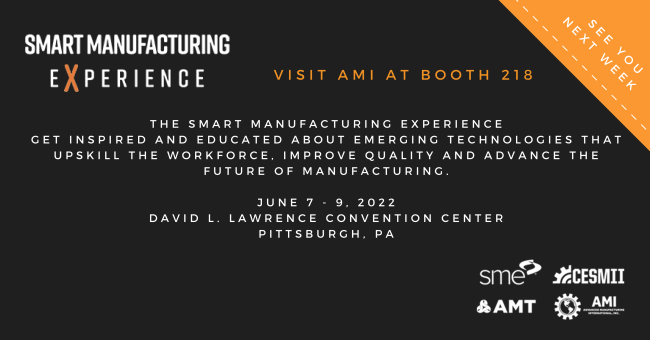
The Smart Manufacturing Experience (SMX) 2022 - June 7 - 9, 2022 - Pittsburgh, PA
The Smart Manufacturing Experience (SMX) enables manufacturers to get inspired and educated about emerging technologies that upskill the workforce, improve quality and advance the future of manufacturing.
IME South June 14-16, 2022 - Charlotte Convention Center. Come explore this six-in-one advanced design and manufacturing expo, designed to give you a comprehensive view of the product lifecycle—from prototype to production. Your FREE expo pass gives you access to top manufacturing exhibitors, 20+ free education sessions, and discounted admission to the Welcome Reception at the NASCAR Hall of Fame. Register here to get a free expo pass.
18th Aerospace and Defense Manufacturing and R&D Summit - June 23-24, 2022 | Caesar’s Palace | Las Vegas, NV - Dr. Stephan Biller to Deliver Keynote Address. Digital Transformation of Small- and Medium-Size Manufacturers (SMM) and their Impact on Supply Chain Resiliency.
A resilient supply chain must have the capability to avoid, resist and adapt to the impact of disruptions and have the ability to quickly recover. Visibility into the supply chain is a critical requirement to manage disruptions, but often Small- and Medium-sized Manufacturers (SMM) do not have to enable technologies in place. Since most supply chains are comprised of SMMs that cannot integrate advanced technologies on their own, OEMs ought to consider a larger role in the suppliers’ digital transformation. This session will discuss these challenges and reveal an easy-to-integrate, low-cost, fully integrated, and secure solution for OEMs and supply chain partners.
Rethink Summit - June 27-29, 2022 - Marco Island, FL -The Council’s premier event for manufacturing executives offers a unique blend of senior-level content, interactive discussions, and networking with industry peers.
With a focus on real-world concepts and best practices necessary for manufacturers to succeed in their journey to M4.0, Rethink brings together technology, organization, and leadership so manufacturers can create winning strategies to succeed. Learn more here
MMX Members Meeting & Exchange 2022 - August 17-18, 2022 - Youngstown, OH
The Members Meeting and Exchange is America Makes' premier gathering of members and industry leaders to network, plan, and exchange ideas.
International Manufacturing Technology Show - September 12 - 17, 2022 - McCormick Place, Chicago IL. _ IMTS – The International Manufacturing Technology Show is the leading global marketplace to connect buyers and sellers of manufacturing equipment, products, and software through exhibitions, events and partnerships to advance the industry and its businesses. More information here.
| |
Share The Manufacturing News Consolidator with your network | |
|
Why Some CFOs Make Better M&A Deals
Despite the tremendous uncertainty and disruption caused by the persistent COVID-19 pandemic, global M&A volume exceeded $5 trillion for the first time in 2021, with many experts predicting that this current wave is only the beginning of a merger frenzy that could last for several years.1 The abundance of capital and the ever-increasing pressures to grow more quickly, become larger, and digitalize are driving companies to close deals with over-the-top premiums. Overpriced acquisitions are hardly a new phenomenon: In the past two decades, U.S. public companies have paid, on average, a 36% premium in excess of the prevailing market value of the target company prior to the news of the takeover. But in the current hot market for acquisitions, the risk of overpayment is significantly heightened — and, according to our research, that’s a risk organizations might be able to mitigate by examining and changing power dynamics in the C-suite. Read more at Sloan Review
| |
|
Declare ‘Calendar Bankruptcy’ to Move Beyond Meeting-Driven Culture
It’s a ubiquitous complaint in corporate culture: Practically everyone is overwhelmed by meetings. And there are real questions about whether meetings are necessary to get things done, or if they are getting in our way far too often. In a survey of managers across a wide range of industries, researchers Leslie Perlow, Constance Hadley, and Eunice Eun found that more than 70% of people believed meetings were unproductive and inefficient, and 65% said meetings keep them from completing their work.1 It’s time to rethink the meeting. At Slack, our executives led by example on this by declaring “calendar bankruptcy.” They removed all recurring meetings and one-on-ones from their calendars so that they could consider each one and add back only what was truly necessary. Read more at Sloan Review
| |
|
State of the CIO, 2022: Focus turns to IT fundamentals
If there’s one thing Jamie Holcombe has learned from his decades-long career as a public and private sector IT leader, it’s how to be a good salesman. Staying razor-focused on business benefits and communicating in a language everyone understands is central to successful IT initiatives, whether the project involves state-of-the-art technology like robotic process automation (RPA) or is a bit more mundane, like upgrading an aging data center. Now, fresh off a pandemic-fueled cycle of accelerated innovation, Holcombe is channeling his vaunted sales skills to drive an upcoming IT agenda centered on foundational areas like optimization, security, and enterprise resiliency. Jamie Holcombe, CIO, U.S. Patent and Trademark Office Jamie Holcombe U.S. Patent and Trademark Office Holcombe, CIO for the United States Patent and Trademark Office (USPTO), is not the least bit concerned that this year’s focus on the practical, not the trend-setting, will cause any setback to IT’s standing in the business. Unlike years past, he believes the CIO is well situated to weather a back-to-basics IT deployment cycle without undermining status or ceding any leadership ground. “Everyone realizes that technology is significant—we’ve earned the seat at the table and have everyone’s ear,” he explains. “You lose it by talking geek speak or focusing on pet projects that have nothing to do with the business mission. Make sure you talk to colleagues in business terms so they understand how you’re delivering for them.” Read more at CIO
| |
|
Ransomware Costs City of Quincy, Illinois, $650,000
In response, the city council passed a resolution authorizing emergency payment of more than $145,000 for cybersecurity consulting services and an unspecified amount, which is less than $500,000 for paying the ransom. "The entire package which includes the fees of the three cybersecurity consulting firms and the payment towards getting a specific decryption key is $650,000," Troup stated in the press conference. The ransomware attack affected the administrative office emails and phones, the communication systems of the police and fire departments along with the Quincy Public Library as the library services are hosted on the City Hall servers, Troup says. Troup says that it doesn't appear that any data was exfiltrated. He says: "It's remarkable how we are still able to function our critical services with the city like water, recycling, thrash [sewage plants], police and fire departments, through the entire [cyber incident] situation." Read more at Gov Info Security
| |
|
How SaaS and MaaS Impact Industry
A little more than a year ago in another Take Five video, I highlighted how the as-a-service model was beginning to change how automation technologies are being offered. So now, I want to update this story by highlighting two start-up companies that have been able to develop very quickly due to the availability of software as a service. I learned about these companies at Siemens recent media and analyst day in Detroit. One of these companies is Saildrone, a company that designs, manufactures, and operates a fleet of uncrewed surface vehicles for maritime security, ocean mapping, and ocean data collection. Saildrone’s customers don’t purchase the drones they build, instead they pay for the data collected by them. Saildrone is using Siemens Xcelerator cloud-based portfolio as a service to improve design collaboration across the organization without the need for traditional IT infrastructure to support it. Andrew Schultz, chief technology officer at Saildrone, says: Manufacturing uses the software for purchasing and building the components in the drones, and the finance teams use it to track inventory. He says software as a service is key to them because Saildrone’s primary focus is on engineering new products and making their drones and services better—not having to manage and update an on-premises server. Read more at Automation World
| |
|
SASE or SSE? Don’t let hype distract from enterprise needs
Secure access service edge (SASE) has generated a buzz over the last couple of years, particularly in light of the pandemic and its associated surge in remote employees. But SASE hasn’t quite materialized in the way Gartner – which first coined the term in a 2019 white paper – initially expected. In particular, there’s been pushback around the idea that SASE should be delivered by a single vendor, as a single integrated cloud service at the network edge. The SASE model combines network security functions with WAN capabilities, delivering the security elements in the cloud and using SD-WAN at the edge or in the cloud. Key security functions include secure web gateway (SWG), zero trust network access (ZTNA), firewall as a service (FWaaS), and cloud access security broker (CASB). Read more at Network World
| |
|
New Linux-based ransomware targets VMware servers
Researchers at Trend Micro have discovered some new Linux-based ransomware that's being used to attack VMware ESXi servers, a bare-metal hypervisor for creating and running several virtual machines (VMs) that share the same hard drive storage. Called Cheerscrypt, the bad app is following in the footsteps of other ransomware programs—such as LockBit, Hive and RansomEXX—that have found ESXi an efficient way to infect many computers at once with malicious payloads. Roger Grimes, a defense evangelist with security awareness training provider KnowBe4, explains that most of the world's organizations operate using VMware virtual machines. "It makes the job of ransomware attackers far easier because they can encrypt one server—the VMware server—and then encrypt every guest VM it contains. One compromise and encryption command can easily encrypt dozens to hundreds of other virtually run computers all at once." Read more at CS Online
| |
|
New Submarine Designed for Deep-sea Entertainment
U-Boat Worx is combining nautical craft with the entertainment business. The submarine company announced its submerged creation, the UWEP, which stands for Under Water Entertainment Platform. The company offers two models, the UWEP 2700 and the larger UWEP 3500. The 3500 weighs 1,050 tons and can hold 120 guests plus a full crew and catering staff on board. Additionally, it features over 1,600-square feet of configurable space that can be tailored to an operator’s requirements. The 2700 weighs 810 tons and can carry 80 passengers plus a crew and staff. Both models can descend to a depth of 650 feet and possess an endurance of up to 18 hours. During emergencies, life support systems can last for 96 hours. Read More at Thomas
| |
|
A Look at How Manufacturers Are Surviving
Larger manufacturers ($1 billion+) remain concerned with shipping and logistics bottlenecks with about half expecting scarce shipping container availability throughout 2022. Access to capital isn’t a major concern, despite rate increases. No large companies expressed worries about access to capital, and only 10% of smaller manufacturers did. The vast majority (72%) of manufacturers expect to have the staff to meet 2022 production demand, thanks to alternative work schedules and more training. Only one-third said they were raising wages, with those increases concentrated in mid-sized companies. Manufacturers remain dedicated to lean principles (68% haven’t cancelled or delayed projects), yet 44% stockpiled supplies, and companies elevated supply chain issues from the shop floor to the executive suite. Read more at Industry Week
| |
|
Building Cyber Resilience Before the Next Attack Occurs
Before the tensions between Russia and Ukraine escalated into full-blown war, cyber activity in both countries surged. As Ukraine was bracing for an invasion, cyberattacks targeted the country’s banks and government agencies, and Russian hackers attempted to bring down the power grid. Russia, in turn, found itself a target of Anonymous, a “hacktivist” collective, which in the first days of the invasion played the Ukrainian national anthem on Russian state TV along with footage from the war. The surge in cyber activity surrounding the invasion of Ukraine, documented in a Microsoft report, stoked concerns among governments and enterprises fearful of getting caught in the digital crossfire. In 2017, a cyberattack on a Ukrainian tax preparation program led to disabled airports, railways, and banks within Ukraine and spread to a host of global companies, eventually causing more than $10 billion in economic damage). Read more at Sloan Review
| |
|
Russian Forums Sell Higher Education Credentials
The FBI's Cyber Division sent a "private industry alert" to organizations around the U.S. on Thursday warning that threat actors are continuing to attack US colleges and universities leading to the exposure of user information on these underground forums. "This exposure of sensitive credential and network access information, especially privileged user accounts, could lead to subsequent cyberattacks against individual users or affiliated organizations," the bureau says. "Credential harvesting against an organization is often a byproduct of spear-phishing, ransomware, or other cyber intrusion tactics." Using an example from 2017, the bureau says that the cybercriminals targeted universities to hack .edu accounts by “cloning university login pages and embedding a credential harvester link in phishing emails.” The FBI says this helped them harvest credentials and send them to cybercriminals in an automated email from their server. Read more at Gov Info Security
| |
|
VPNs can complement SASE
The pandemic has accelerated the development of better ways to serve and secure remote workers, which make it a good time to rexamine VPNS. Recently VPNs have received technical boosts with the addition of protocol options that improve functionality far ahead of where they were when first invented. At the same time, new security architectures zero trust network access (ZTNA), secure access service edge (SASE), and security service edge (SSE) are making inroads into what had been the domain of remote-access VPNs. Read more at Network World
| |
|
Intel Selects Diverse Ohio-Based Team to Lead Early Excavation Work for Ohio Fabs
Intel Corporation has selected a diverse Ohio-based team led by Gilbane Building Company, with partners McDaniel’s Construction Corp., Northstar Contracting Inc., and GTSA Construction Consulting, to manage the early excavation work for its two new leading-edge chip factories in Ohio. The factories, known in the industry as fabs, will help boost chip production to meet the surging demand for advanced semiconductors, powering a new generation of innovative products from Intel and serving the needs of foundry customers as part of the company’s IDM 2.0 strategy. The selection of Gilbane and partners marks the first of Intel’s hiring of construction suppliers for an anticipated 7,000 construction jobs over the course of the build. The project will also generate tens of thousands of additional indirect and support jobs, including contracted positions, electricians and engineers, and jobs in restaurants, healthcare, housing, entertainment and other businesses. For example, in Arizona, where Intel has operated high-volume manufacturing for more than four decades, Intel depends on a local network of more than 1,000 businesses to directly supply its operations. In January, several of Intel’s top suppliers announced they would make investments in Ohio to support Intel’s planned operations. Read more at SemiConductor Digest
| |
|
Castor Oil Delivers Eco-Friendly 3D Printed Orthosis
Does anybody out there remember taking castor oil as a health remedy? My mom used to give us a tablespoon of the oily liquid when we had an upset stomach. Tasted nasty. It taught me not to tell Mom about stomach troubles. Apparently, there are plenty of other uses for the castor bean. Turns out this vegetable oil that comes from pressed castor beans is a 100% bio-sourced, renewable polymer that can be used as a material in additive manufacturing. Read more at Plastics Today
| |
|
5 Technology Trends in the U.S. Military
The United States military is adopting new technologies with blistering frequency in order to maintain its status as one of the most sophisticated fighting forces in the world. Here are some of the most noteworthy technology trends in the U.S. military. 1. Hypersonic Missiles According to the Department of Defense, the U.S. military expects to have battle-ready hypersonic missiles by 2023. Hypersonic missiles are projectiles that can reach or exceed Mach 5. Projectiles that can travel this fast are moving at five times the speed of sound. Currently, there are no defense systems capable of stopping hypersonic missile systems once they are in flight. 2. Internet of Military Things (IoMT) The term “Internet of Military Things” refers to a variety of internet-connected devices that can be used by soldiers on the front lines. These advanced pieces of equipment can collect important biometric data, analyze battlefield conditions, and facilitate the strategic deployment of military assets. IoMT devices will allow for seamless data sharing across the entire fighting force. Read more at Thomas
| |
|
The AI-powered Robots Addressing Current, Future Industry Challenges
When I first saw a video of the humanoid robot Sophia, I thought, “What other AI-powered programs are out there?” Turns out, there are quite a few. In 2021, more bills related to artificial intelligence (AI) passed into law than ever before. These bills both suggested regulations to manage potential risks that come with AI and promoted public funding for the technology. With ongoing development in AI tech — and experts agreeing that COVID-19 accelerated the shift to Industry 5.0 — here are a few very complex, cool, and useful AI-powered robots designed to address both current and future challenges. Strawberry-picking Robot V7 Labs, a London-based startup specialized in training AI companies to automate training-date processes, helped a strawberry-picking robot learn which fruit was ready to be pulled. The startup FruitCast went to V7 with images and videos of what their AI model needed to learn. From there, the system detected boundaries and internal measurements and labeled them accordingly using a “continual learning” approach. Read more at Thomas
| |
|
Ransomware Gang Demands $5M From Austrian State Carinthia
In an initial briefing given on May 24, immediately after the attack was detected, Kurath described the issue as an "IT system failure" due to a "hacker attack" that paralyzed the entire state administration. This forced them to shut down nearly 3,700 administrative systems as a preventive measure, Kurath adds. This made its email services inoperable as well as some phone lines of the state and administrative departments, including Carinthia's district authorities, the state administrative court and the court of auditors, among others. COVID-19 contact tracing services in Austria were not spared, and Kurath says "Currently, no suspected case tests can be carried out," and that those who suspect symptoms should self-prescribe and get a PCR test done from a pharmacy. The government of Carinthia also informed the country's data protection officer, who in turn notified the data protection authority of Austria, a legal requirement that should be done within 72 hours of the discovery of any cyber incident, Kurath says. Read more at Gov Info Security
| |
This newsletter is brought to you by Advanced Manufacturing International, Inc.
Please contact us if you would like to add your news to "The Consolidator."
| |
Advanced Manufacturing International is an SMM-first non-profit organization striving to accelerate the digital transformation of small to medium-sized manufacturers with simple, secure, and ultra-low-cost solutions. If you are interested in accelerating the digital transformation of small-to-medium-sized manufacturers please contact us and subscribe to our newsletter. Learn more about AMI.
| | | | | |