September 2022 Newsletter |
|
Dear Friend,
We’re now nearly two weeks past the long-awaited yet, in the end, deeply disappointing 10th NPT Review Conference. The RevCon ended without a substantive outcome document due to Russia's blocking consensus. You can read an excerpt of LCNP’s commentary on the conference's conclusion below.
Post-RevCon, without the benefit of new commitments by nuclear weapon states to disarm in a measurable or time-bound way and reaffirmation of past commitments, the world continues to grapple with increasing nuclear risk, including that related to the Zaporizhzhia nuclear power plant. Amidst Russian occupation of the plant and reports of shelling damaging the plant’s nuclear safety, the IAEA, which conducted an on-site inspection last week, reports an "increasingly alarming situation…with potentially catastrophic consequences."
The newly-released report states, among other concerns, that:
"While the ongoing shelling has not yet triggered a nuclear emergency, it continues to represent a constant threat to nuclear safety and security with potential impact on critical safety functions that may lead to radiological consequences with great safety significance."
While international law establishes a framework for nuclear weapons abolition, the right to nuclear energy is conversely entrenched in treaty law, both in the 1968 Nuclear Non-Proliferation Treaty (NPT) and the new Treaty on the Prohibition of Nuclear Weapons (TPNW). Despite this dichotomy, the untenable situation at Zaporizhzhia serves to underscore the undeniable risk of nuclear energy, its capacity to be weaponized, and the disastrous danger of radiological accidents.
Disarmament work presses on. While there was no substantive outcome from the 10th Review Conference, states parties did agree on a forthcoming RevCon schedule that will move right into the next Preparatory Committee in Vienna in 2023, with subsequent PrepComs in Geneva in 2024, New York in 2025, and the 11th Review Conference again in New York in 2026.
Ariana Smith
Executive Director
|
|
10th NPT RevCon in Review |
|
Reflecting on the Review Conference as a whole, LCNP Senior Analyst John Burroughs writes:
Due to a “Nyet” from Russia, states parties to the Nuclear Non-Proliferation Treaty (NPT) did not reach consensus on an outcome document for the 10th Review Conference of the treaty, held 1-26 August 2022 at the United Nations in New York City. Though the point was not plainly stated, clearly Russia could not accept provisions in the draft relating to the Zaporizhzhia nuclear power plant, one of which stresses the need to ensure control of the facility by competent Ukrainian authorities. While the draft outcome document was not adopted, it is worth examining it in some detail, both because it will serve as an important, albeit informal, reference point for future NPT discussions and because of what it reveals about the state of things in the wider world....
On balance, and even putting aside the fact that an outcome document was not adopted due to the Russian position, the 10th NPT Review Conference did very little to advance the cause of achieving a world free of nuclear weapons, a world promised by the NPT. There will need to be a change of course toward nuclear abolition if humanity is not to be condemned to living for still more decades with the very real risk of social and environmental catastrophe, even catastrophe so devastating that it renders unviable human society in its current form.
Read the full commentary on our website here.
While the 10th RevCon ended without consensus on a substantive document and with, overall, a grim tone with the lack of disarmament progress and even regression on some commitments made by nuclear weapon states, LCNP staff, Board members, and advisors all had the opportunity to speak to states parties in several useful ways.
-
We made an NGO statement to NPT states parties during the August 5 plenary session of the RevCon discussing the illegality of nuclear threats and how threats of nuclear force weaken already-tenuous commitments made by NPT states parties in RevCons prior. LCNP's statement also discussed the incompatibility of nuclear sharing—arrangements like the new one discussed this year between Putin and Lukashenko as well as those pre-existing the NPT among NATO states—with the NPT regime.
-
In addition, LCNP Board member and Global Security Institute President Jonathan Granoff made another NGO presentation at the August 5 session emphasizing the importance of diplomacy in establishing a human security paradigm for disarmament among nations. "Ignoring past pledges puts the very fabric of civilization at risk. Pacta Sunt Servanda, promises must be kept, is the foundation of peace amongst nations."
-
LCNP advisor Jackie Cabasso, on behalf of the Abolition 2000 Working Group on the UN Disarmament Agenda and a Nuclear Weapons Convention, delivered another statement during the August 5 NGO plenary, describing the main points of the Abolition 2000 working paper, "NWC Reset: Frameworks for a Nuclear-Weapon-Free World," including the suggestion of "a range of modalities and approaches to achieve and maintain a nuclear-weapon-free world."
-
LCNP held a side event, Nuclear Threats & Nuclear Sharing Versus the Non-Proliferation Regime, to further discuss the themes of our statement and paper, with Francesca Giovannini, Executive Director of the Project on Managing the Atom at Harvard Kennedy School's Belfer Center, speaking alongside LCNP's Executive Director Ariana Smith and Senior Analyst John Burroughs.
|
|
A Closer Look: TPNW Positive Obligations |
|
This summer, we shared a short series of educational posts about the positive obligations of the Treaty on the Prohibition of Nuclear Weapons. Click through our Twitter thread or Instagram post to read about the Article 6 obligation to provide age- and gender-sensitive victim assistance to those who've survived nuclear testing and use.
|
|
|
|
|
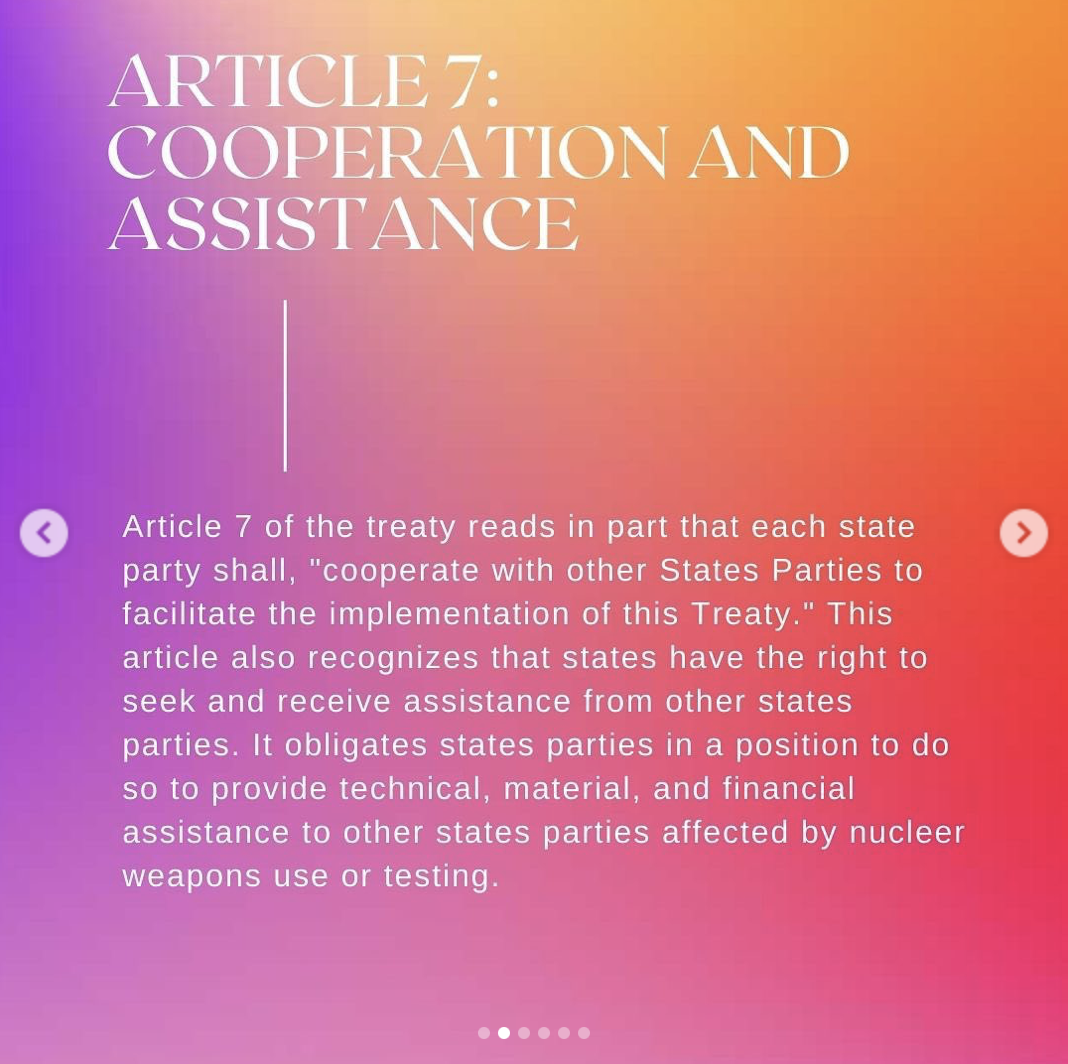
This second post in the series takes a closer look at the Article 7 obligation to cooperate with and assist other states parties with implementation of the treaty, including providing technical, material, and financial assistance to states parties affected by nuclear testing or use.
|
|
-
"For the IAEA to intervene directly in the delivery of safety and security [to the Zaporizhzhia plant] would be unprecedented, and legally and practically very challenging," in The Conversation
-
"It was significant to see states highlight efforts to address ongoing harm from nuclear weapons use and testing at the Nuclear Non-Proliferation Treaty Review Conference last month," says Elizabeth Minor for Rethinking Security.
-
"How the U.S. Lost Russia—and How We Can Restore Relations: Former Secretary of Defense William J. Perry looks back at the US relationship with Russia and charts a way forward for peace," in Outrider.
|
|
|
|
|
|
|