The voice for pharmacy compounding | April 23, 2021

From APC’s President
Not all heroes wear capes
Dear A4PC,

Michael Blaire, RPh, FIACP
APC President
holding the APC
Sword of Office
While cleaning out my garage recently, I came across a box containing several hundred comic books, most more than 50 years old. Memories! As a middle school student, I didn’t enjoy reading books very much — only grudgingly delving into those assigned in class, and not much more. But I devoured comic books, especially the Marvel superheroes. I eagerly anticipated the arrival every month of Iron Man, The Hulk, The Fantastic Four, and, of course, Spider-Man, and I would read each title over and over again. Looking at them now, I wish I had taken better care of them.
Stan Lee, the creator of so many of those Marvel comics, broke with tradition and introduced a different kind of superhero to the world. Where most superheroes had been idealistically perfect people with no serious, lasting problems, Lee introduced complex, naturalistic characters who could have bad tempers, fits of melancholy, vanity and insecurity. They sometimes became physically ill, worried about paying their bills and stressed over impressing their girlfriends. But they were all basically good people.
Lee's formula for writing a good story was simple: Have a good person trying to do something, often facing insurmountable odds, who keeps getting into trouble or encounters obstacles along the way, until finally, after a good deal of suffering, there is a victory of sorts. Sometimes that victory is achieved by brute force, but more often it is the result of innovation and ingenuity.
Pharmacy compounders can easily assume the mantle of one of Lee's superheroes. We are good people trying to help our patients, facing seemingly insurmountable challenges thrown at us by an overreaching Food and Drug Administration.
Well, this week, we have achieved some vindication of sorts. Several months ago our sister organization, the Pharmacy Compounding Foundation, engaged the Berkeley Research Group to conduct an independent review of the FDA sponsored NASEM Report The Clinical Utility of Compounded Bioidentical Hormone Therapy: A Review of Safety, Effectiveness, [and Use].
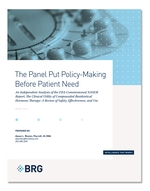
The results of this review were published in a white paper written by Dr. Alyson Wooten: The Panel Put Policy-Making Before Patient Need. As you can guess, the white paper identifies several areas of potential bias that almost certainly influenced NASEM's conclusions. Armed with this white paper, pharmacy compounders can pre-emptively educate federal legislators and patients about the flaws in the NASEM study well in advance of any action by FDA. Thank you to the Pharmacy Compounding Foundation for providing the resources to make this white paper possible.
While we can feel good about the results of the white paper, this is only the first salvo in what is likely to be a protracted conflict. Our big guns have yet to be rolled out in the guise of the CBHT Media Campaign. This coming week we'll be rolling out videos and store-level resources that have been developed for the campaign — watch your email. But right now we need to begin strategically placing ads, and that requires money. If you have not yet given to the cBHT Media Campaign I strongly urge you to do so. If you have already given, give again! Maybe give a little bit to the Pharmacy Compounding Foundation while you're at it.
Fight to save your profession. There is a superhero in all of us, we just need the courage to take up the mantle.
Michael Blaire is APC’s president, but his day job is vice president for government and regulatory affairs at Wedgewood Pharmacy in Scottsdale, Arizona. You can reach him at mblaire@wedgewoodpharmacy.com.
This Week
FDA-funded report on compounded hormones is tainted, analysis shows
A 2020 FDA-funded report published by the National Academies of Science, Engineering, and Medicine on the safety and utility of compounded hormones is compromised by potential bias, conflicts of interest and bad science — so says an independent, third-party analysis.
FDA touted the NASEM report, which recommended restrictions on compounded hormone therapy, as “independent” and “comprehensive,” but in fact it was neither. That’s one of the key findings in the white paper by Dr. Alyson Wooten, a director at the nonpartisan Berkeley Research Group (BRG).
The paper, The Panel Put Policy-Making Before Patient Need: An Independent Analysis of the FDA-Commissioned NASEM Report was commissioned by the Pharmacy Compounding Foundation.
(The 42-page paper is available at A4PC.org/BRGwhitepaper; a two-page synopsis is available on A4PC.org/cbht.)

“Given the strong potential bias influencing the committee’s recommendations and the omission from the final report of key data supporting the safety and efficacy of cBHT, we recommend that FDA not rely on or consider the NASEM report,” the white paper advises.
Background
FDA commissioned NASEM in 2019 to undertake what it said would be an objective review of the safety and effectiveness of compounded hormones. After NASEM released the final report on July 1, 2020 — which included a recommendation for across-the-board restrictions on compounded hormones — FDA issued a public statement saying the agency would base its next steps on compounded hormones on that report.
What FDA did not say — but which the BRG paper demonstrates — was that the agency exerted inappropriate influence and bias in almost every phase of the commissioned report, even recommending appointees to the study committee who had no expertise in prescribing or compounding hormones.
“This BRG paper shows how FDA inappropriately meddled in the composition of the NASEM committee, fed the committee selective research for its consideration, and even advised the committee on its final recommendations for restricting compounded hormones,” said Pharmacy Compounding Foundation CEO Scott Brunner. “All so FDA could have a report that reflected its existing negative view of compounded hormone therapy. The white paper reveals an FDA much more interested documenting its own biases than in actual objective science. And it was apparently willing to spend $1.3 million in taxpayer dollars to do it.”
“So thoroughly compromised as to be useless”
Dr. Wooten’s review is a stunning repudiation of an FDA staff that manipulated the process, and of NASEM committee members who lacked expertise in the subject matter they were engaged to study.
The white paper scrupulously documents how bias may have influenced the conclusions and recommendations of the committee:
- The committee and its review team included individuals who may have been biased against compounded hormones. For example...
- Jane Axelrad, former FDA official and outspoken critic of compounded hormones, played multiple key roles in the development of the NASEM report.
- The committee did not include any prescribers or pharmacists with substantive, patient-facing experience with compounded hormones.
- The definition of “clinical utility” developed and relied upon by the committee does not reflect an accurate or complete representation of the term.
- The studies relied upon by the committee do not reflect an accurate or complete representation of compounded hormones.
- The standards for evaluating the safety and efficacy of FDA-approved drugs cannot be reasonably applied to highly individualized compounded medications.
- The committee relied upon the discredited 2002 Women’s Health Initiative study in developing its conclusions.
- The committee ignored the body of evidence demonstrating the safety and efficacy of compounded hormones.
“These numerous flaws render the NASEM report so thoroughly compromised," said Brunner, "as to be useless in any discussion of compounded hormone therapy.

Introducing Compounding.com
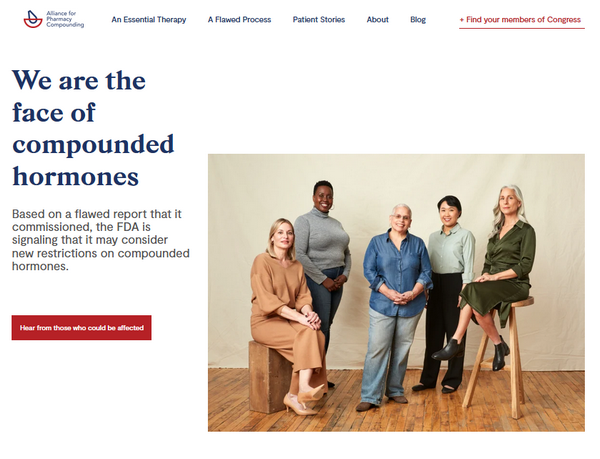
APC has launched Compounding.com, a new website dedicated to sharing the value of compounded hormone therapy — and the place to direct patients to share their compounded hormone stories.
The site is aimed at consumers, legislators, and anyone who needs to get the facts about cBHT ... and how important it is for so many people.
Compounding.com showcases patient testimonials (collected via A4PC.org/cbhtandme), explains the benefits of cBHT, details the flaws in the now-debunked NASEM study (see the previous story), and makes it clear: This is a therapy that is critical for millions of people.
Just as important, it will serve as the home page for our big cBHT Media campaign — and a clearinghouse for information and resources on cBHT.
We'll be updating the site and adding more to it over the coming days, so be sure to check it out and share it with your patients, prescribers, and legislators.
By the way, we're still about $600,000 short of the funds we'll need to launch the media campaign, which means all the photos, video, and print materials are sitting until we have the money to begin placing ads. If you haven't already, please:
BRIEFING FOR OWNERS:
The MOU, reporting shipments, and you
We reported to you last week that we've asked FDA for a postponement of the enforcement deadline for the MOU on interstate shipments of compounded medication (see "Short Takes" below if you missed that bit in last week's Compounding Connections), but for now, October 26, 2021 is the deadline for states to sign.
If your state does sign, there’s the question of how reporting of inordinate shipments will be handled by your state board of pharmacy — and what may be required of you.
So APC is offering a free one-hour, members-only webinar briefing for owners: "NABP’s Data Collection Tool for MOU Compliance: What Will It Mean for You?" on May 6, 2021 at 3:00pm EDT. You'll hear from NABP staff about the information sharing network they’re creating to facilitate that reporting, and how your pharmacy will access it.
It's free, but registration is required. Click here to sign up.
Scott 'casts about compounding's priorities
APC CEO Scott Brunner was the featured guest on the April 14 edition of Medisca's PhLAG 2021 pod/video cast. Hosted by Medisca's Philip Smyth and Aaron Lopez, as well as attorney Stephen Snow, the discussion covered many of the challenges facing compounding, but particularly the FDA's MOU and the threat to restrict compounded hormones ... and APC’s campaign to confront that threat.
You can check it out on YouTube, Spotify, Apple Podcasts, or Google Podcasts.

Coming Up
May 6, 2021 — NABP’s Data Collection Tool for MOU Compliance: What Will It Mean for You? (a free briefing for compounding pharmacy owners)
June 10–11 — PCCA ACT Conference (virtual)
June 16–17 — Compounding Pharmacy Compliance Virtual (APC members: Use code APC10 for 10% off registration!)
July 13 — APC CE: Reading a Certificate of Analysis: Calculations Based on C of A Data
September 14–15 — Compounders on Capitol Hill (mark your calendars!)
September 22–24 — Compounding Pharmacy Compliance East
Short Takes
Don't skip the survey. Please don't forget to take the APC/University of Mary Washington Compounding Profile Survey — we need your help to pain the the first comprehensive picture of the breadth and depth of compounding in the U.S. Go to A4PC.org/2021survey, and it should take less than 10 minutes. If you're a member of the compounding community, take the survey now!
ICYMI: Associations ask FDA to delay MOU enforcement. APC, APhA, the National Alliance of State Pharmacy Associations, and NCPA, have submitted a joint letter to FDA asking that it delay enforcement of the final MOU until at least October 26, 2023, in large part because a number of states can't sign the MOU without changes to their state laws.
Pretty good vaccine news. Of the 75 million or so Americans who have been fully vaccinated against Covid-19 so far, the CDC has received 5,814 reports of vaccine breakthroughs. That’s 0.0078%. In other words, current data says the vaccine is 99.2% effective. Even better, “Most of those have been mildly symptomatic or asymptomatic.”