Weekly Digest Number 48 - November 29th, 2022 |
|
Welcome to the RWU Rail & Labor News! This news bulletin is produced and emailed out each Tuesday morning. We hope you find each week's news and information useful. If so, please share with co-workers, friends, and colleagues. If you like, you can sign them up to get all the news from RWU HERE. Or forward them the link. Note: If you read over this news bulletin each week, you will be sure to never miss the important news of what is going on in the railroad world from a worker's perspective!
|
|
(Editor's Note: He could have called on Congress to stay out of it. Or even better, he could have called on Congress to legislate a contract more favorable to the rail workers. Instead, the "most labor friendly president" opted to break the rail workers strike before it could happen, on terms that the industry is quite happy about. One can imagine the Democrats now joining with Republicans in the coming days, goaded on by their sponsors - the Class One carriers and Big Business - in crafting legislation to put an end to this round of "bargaining," while the rail union "leadership" sits quietly on the sidelines.) |
|
Biden Calls On Congress To Head Off Potential Rail Strike
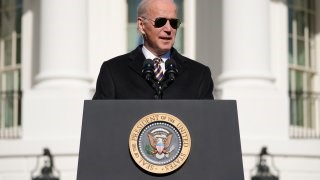
President Joe Biden is calling on Congress to pass legislation to intervene and block a railroad strike before next month’s deadline in the stalled contract talks.
|
|
Biden said a tentative agreement approved in September provided a pay raise for workers, health care benefits and a better leave policy.
But talks have since stalled. Four rail unions are back at the table after rejecting their deals with the railroads, trying to work out new agreements before the Dec. 9 deadline. Eight other rail unions have ratified their deals that include 24% raises and $5,000 in bonuses.
Labor leaders have asked Congress to step in. Lawmakers have the power to impose contract terms on the workers, but it’s not clear what they might include if they do that. They could also force the negotiations to continue into the new year.
“Let me be clear: a rail shutdown would devastate our economy,” Biden said in a statement. “Without freight rail, many U.S. industries would shut down.”
|
|
(Editor's Note: Bernie Sanders has emerged as one of the few in Congress who are championing the rail workers cause, proclaiming they have the right to strike. But now that the Chief Democrat has come out in favor of stopping potential strike action - see article above - it will be an uphill battle to thwart the pro-business momentum that is building in the House and Senate. Just like 30 years ago, we will probably see a very lopsided "bi-partisan" bill legislate a national rail contract in the coming days.) |
|
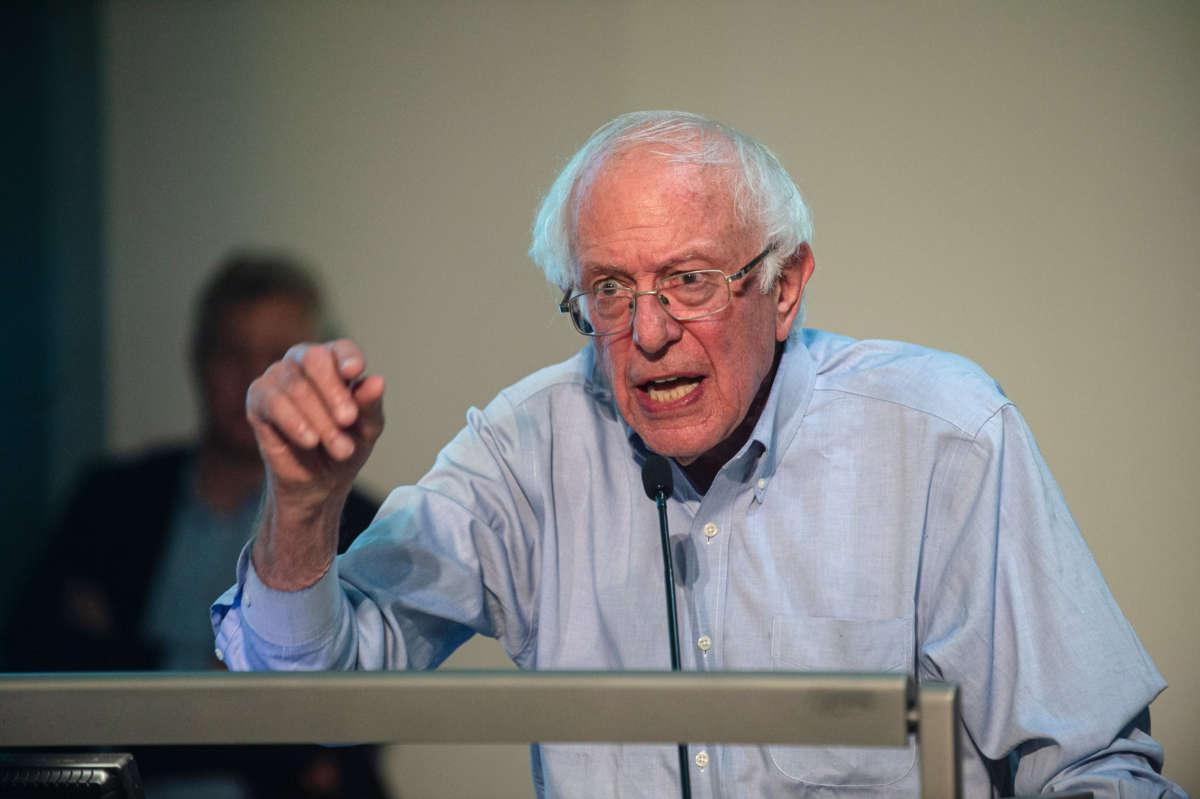
“Congress Must Stand With Rail Workers,” Sanders Says Ahead of Potential Strike |
|
House Republican from Pennsylvania said Sunday that Congress will intervene to stop a nationwide strike if rail companies and unions don’t reach a contract agreement soon, a step that would likely force workers to accept a deal without any paid sick days.
Acknowledging that rail workers “have a very reasonable ask” for better benefits and wages as they continue to labor under a punishing scheduling system, Rep. Brian Kevin Fitzpatrick said in a Fox News appearance Sunday that “Congress will not let this strike happen, that’s for sure.”
“It would be devastating for our economy” Fitzpatrick added. “We’ll get to a resolution one way or another.”
Powerful industry groups including the U.S. Chamber of Commerce and the Association of American Railroads have been pressuring Congress to step in after members of the largest rail union in the United States voted to reject a White House-brokered contract deal that rebuffed workers’ push for at least 15 days of paid sick leave. The deal, touted by the Biden White House as a victory for workers and profitable rail companies, does not include a single paid sick day.
The prospect of congressional intervention ahead of a potential strike on December 9 has angered rail workers who say it would let giant companies off the hook, allowing them to continue abusing their employees while raking in record profits. Rail workers are often forced to be on call 24/7 — with minimal rest between long shifts — and are penalized for taking days off for doctor’s appointments or health emergencies. ...
“When railroads refuse to give us sick time, what they are saying is their profits are worth more than their workers and the national economy,” Ross Grooters, co-chair of Railroad Workers United, tweeted over the weekend. “Hold the railroads accountable. Tell your elected leaders to give railroad workers the sick time they need or let them strike.”
Progressive lawmakers have also placed blame for the looming strike with large railroad companies, which have been gorging on their own stock, reporting huge profits, and enriching shareholders and executives while refusing to budge on workers’ longstanding demands for basic quality-of-life benefits.
|
|
(Editor's Note: The spotlight is being shined on the antics of the rail industry like never before. We have broad public support out there. The rail industry has alienated practically everyone. Railroad workers must use this golden opportunity to build our alliances in order to more effectively challenge the industry. ) |
|
'Greedy Behavior' of Profit-Hungry Rail Industry Blamed for Looming Strike
"The same wealthy rail industry executives that say they can't afford to pay their workers fair wages all had banner years in net revenue and shareholder giveaways."
|
|
A new analysis shines fresh light on U.S. railroad giants' "greedy behavior" - from gorging on their own stock to ramping up fees to pad their bottom lines - as workers struggle for basic rights and benefits in ongoing contract negotiations that could result in the first national rail strike in decades.
Updated figures compiled by the watchdog group Accountable.US and released Tuesday show that BNSF, a subsidiary of billionaire Warren Buffett's Berkshire Hathaway that operates one of North America's largest railroad networks, saw its net income rise 4% to $4.4 billion during the first three quarters of 2022. Union Pacific, meanwhile, saw its profits jump 11% to $5.36 billion during that period.
"Big Rail has opted to impose record fees and shortchange their workers while continuing to enrich a small group of investors."
In those nine months, Union Pacific spent nearly $8 billion on stock buybacks and dividend payouts to shareholders, Accountable.US notes.
The rail transportation giant CSX reported a 37% surge in Fiscal Year 2021 net income, the watchdog added, and the company repurchased $3.7 billion worth of its own shares during the first three quarters of this year.
Rail workers haven't fared nearly as well as industry giants and their wealthy executives and shareholders. For the past three years, many rail employees have worked under increasingly grueling conditions without a raise as management continues to resist demands for changes to draconian attendance policies, better pay, and foundational quality-of-life benefits such as paid sick leave.
"The same wealthy rail industry executives that say they can't afford to pay their workers fair wages all had banner years in net revenue and shareholder giveaways," said Liz Zelnick, a spokesperson for Accountable.US. "The big rail industry's own earnings reports show they didn't need to cut corners on safety and gouge businesses with excessive fees that get passed onto consumers. It only adds up to one thing: greed."
"For years the industry gutted investments in maintenance and equipment, and when those decisions inevitably led to supply chain bottlenecks, the industry now refuses to take any responsibility," Zelnick added. "Instead, Big Rail has opted to impose record fees and shortchange their workers while continuing to enrich a small group of investors. If Congress has to intervene, it would make no sense to reinforce greedy industry behavior that would lead to a supply chain crisis right before the holiday season."
The new analysis was published a day after the largest railroad workers union in the U.S. announced that its members voted to reject a tentative five-year contract deal negotiated with the help of the White House. While President Joe Biden hailed the proposed agreement as a victory for both the rail industry and workers, many union members reacted with outrage to the specifics of the deal, which does not include a single day of paid sick leave.
"It is beyond belief that in the year 2022 rail workers in America have zero guaranteed paid sick days. Zero," Sen. Bernie Sanders (I-Vt.) tweeted Monday. "The rail industry, which made a record-breaking $20 billion in profits last year, must come to the table and negotiate a contract which treats their workers with respect."
Railroad Workers United (RWU), an inter-union alliance that supports public ownership of the U.S. rail system, noted in a statement Monday that "with votes now tabulated from every rail union, unions representing over half of rail labor have rejected their proposed contracts."
"Without a better contract for all railroad crafts, service will continue to suffer as rail carriers extract wealth and buy back their shares at the expense of the economy as a whole," RWU said. "Their systems, which were primarily built on public investment, no longer work for the benefit of the people. If rail carriers are fixated on paying out more for stock buybacks than they are for worker benefits, we will continue to see attrition as a once-stable career turns into a revolving-door job."
|
|
Tell Congress: Railroad Workers Deserve Fair Pay and Time Off
|
|
Railroad workers have rejected a tentative agreement that continues to put the profits of the railroad industry ahead of the rights and wages of its workers.
More Perfect Union’s exclusive reporting shows just what would happen if 115,000 railroad workers across the country went on strike this year. Grocery store shelves could empty again and the US economy would grind to a halt.
Click the button below to send a message to Congress. Demand they act immediately to improve the tentative agreement by giving railroad workers more paid time off.
Workers currently get no sick leave and are on-call 7 days per week, year round. We’re fighting back against corporate greed and demanding Congress act to put the needs of working people first.
Thank you for taking action today.
|
|
Major Strike Looms as Largest Rail Union in US Rejects White House-Brokered Contract
"It's about attendance policies, sick time, fatigue, and the lack of family time," said one union official. "A lot of these things that cannot be seen but are felt by our membership. It's destroying their livelihoods."
|
|
The largest railroad workers union in the United States announced Monday that its members voted to reject a contract negotiated with the help of the Biden White House, once again raising the prospect of a major strike or lockout as employees revolt over profitable rail giants' refusal to provide adequate paid sick leave.
The Transportation Division of the International Association of Sheet Metal, Air, Rail, and Transportation Workers (SMART-TD) said in a statement that just over 50% of its members voted to reject the proposed contract. Members of the Brotherhood of Locomotive Engineers and Trainmen (BLET)—the second-largest rail union in the U.S.—voted to ratify the contract, the union said Monday.
If any of the rail unions decide to strike, the others have vowed to honor their picket lines. SMART-TD said a strike or lockout could begin as soon as December 9.
"SMART-TD members with their votes have spoken, it's now back to the bargaining table for our operating craft members," said Jeremy Ferguson, the union's president. "This can all be settled through negotiations and without a strike. A settlement would be in the best interests of the workers, the railroads, shippers, and the American people."
"The ball is now in the railroads' court. Let's see what they do. They can settle this at the bargaining table," Ferguson added. "But, the railroad executives who constantly complain about government interference and regularly bad-mouth regulators and Congress now want Congress to do the bargaining for them."
The tentative contract agreement was reached in September after marathon negotiations between the Biden White House, rail unions, and rail company representatives.
As the details of the proposed deal began reaching union members, it became increasingly clear that many were furious at how little the agreement would do to alter rail companies' punitive attendance system, under which workers can be penalized or fired for taking a day off to see the doctor.
"Press reports made it sound like the deal would create three sick days for railroad workers," Jonah Furman of Labor Notes reported last month after the Brotherhood of Maintenance of Way Employees—the nation's third-largest rail union—voted to reject the proposed contract.
"Once the actual language came out, what was created turned out to be something less than sick time: heavily circumscribed, unpaid time off for routine or preventative medical appointments, on a Tuesday, Wednesday, or Thursday with at least 30 days notice, plus no attendance penalties for hospitalization or surgery," Furman added.
|
|
(Editor's Note: It is shocking to see just how much wealth the "billionaire class" actually owns, and what a better world we would have if even a fraction of it were distributed to working people.) |
|
One Day of Warren Buffett Wealth Gains Could Fund 15 Days of Paid Sick Leave for Rail Workers
"Buffett could avert a rail strike today by giving workers what they need: paid sick days," said Sen. Bernie Sanders' staff director. "That's how you give thanks."
|
|
Billionaire Warren Buffett, one of the wealthiest men in the world and the CEO of BNSF Railway's parent company, saw his wealth jump by nearly $1.4 billion in a single day earlier this week, a sum that could easily fund 15 days of paid sick leave for every rail worker in the United States.
BNSF is one of the major railroad giants refusing to budge in contract negotiations with rail unions as they fight for 15 days of paid sick leave. Under a White House-brokered contract that major rail unions have recently voted to reject, rail workers would not receive a single paid sick day.
A nationwide rail strike or lockout with major implications for the U.S. economy could begin as soon as December 9 if rail companies and unions don't reach a contract deal.
"In one day, Mr. Buffett made twice as much money as it would cost to guarantee 15 paid sick days a year to every rail worker in America," Sen. Bernie Sanders (I-Vt.) tweeted Wednesday. "The greed of the rail industry must end."
Warren Gunnels, Sanders' staff director, reiterated that message Thursday, writing, "Can't stop thinking about how Warren Buffett, the owner of BNSF Rail, made more money in one day than it would cost to guarantee 15 paid sick days to rail workers."
"Buffett could avert a rail strike today by giving workers what they need: paid sick days," Gunnels added. "That's how you give thanks."
Rail companies have estimated that it would cost roughly $688 million a year to provide 15 days of paid sick leave to rail employees, who work long and erratic hours and are often expected to be on call 24 hours a day. To make matters worse, rail companies' attendance policies punish workers for calling out sick or taking a day off to see the doctor.
"Buffett's BNSF, for example, has started using a convoluted system called 'Hi-Viz' under which workers start with a point balance then lose points if they're unavailable to work because they're sick, have a family emergency, or other reasons," Mother Jones reported in September. "If their balance hits zero, they get a 10-day suspension, and a 20-day suspension if it happens again. Reaching zero for the third time in a two-year period means getting fired."
BNSF has urged Congress to intervene and force rail workers to accept a contract with no paid sick days, something Senate Republicans tried to do via the unanimous consent process in mid-September. Sanders, the chair of the Senate Budget Committee, blocked the GOP legislation, allowing the collective bargaining process to continue.
|
|
(Editor's Note: The Surface Transportation Board has called UP executives in to explain why the Class One carrier is refusing to accept carloads not just from new customers, but from its existing and loyal ones as well. Rail workers know the answer - complete and total mismanagement. Now is your chance to tell the STB your story! See article below...) |
|
STB to UP: Explain Embargo Escalation |
|
The Surface Transportation Board (STB) is ordering Union Pacific (UP) President and CEO Lance Fritz and other top UP executives to appear at a Dec. 13-14 public hearing on what it’s calling a “substantial increase” in the Class I railroad’s use of embargoes as a method of reducing rail traffic congestion. UP responds.
STB on Nov. 22 reported that UP embargoes have increased from a total of 27 in 2017 to more than 1,000 to date (as of Nov. 17, 2002). See chart below (through October 2022).
An embargo suspends a shipper’s right to common carriage by restricting freight movements. Issued by a railroad when weather, congestion, labor strife, natural disasters or track conditions prevent fluid operations, embargoes may not be used as an alternative to seeking regulatory approval for line abandonments, to avoid handling unprofitable or undesired traffic, or to influence routing. Shippers may ask the STB to cancel an embargo.
STB said it has “received numerous reports that shippers are suffering supply chain problems as a result of the embargoes that are hampering their operations.”
Since UP carries approximately 26.8% of freight served by rail and about 10.7% of all long-distance freight volume, “disruptions in UP’s service levels have a significant detrimental impact on the supply chain and the nation’s economy,” STB reported. “As such, the Board has been closely monitoring UP’s recent use of embargoes.”
According to STB, between Nov. 1, 2022, and Nov. 17, 2022, UP issued 126 embargoes with congestion as the stated cause. Of those, 89 were issued on Nov. 16; as of Nov. 17, UP had 128 active embargoes in place and, for all, congestion was the stated cause, the agency wrote in its Nov. 22 decision to hold the hearing (scroll down to download). “The Board understands that embargoes may vary in scope and that all carriers do not report and use embargoes in the same way,” STB reported. “Nevertheless, the use of embargoes by all other Class I carriers, combined, pales in comparison to the number of embargoes issued by UP. Given UP’s sizeable role in freight rail, its increased use of embargoes in recent years, and the considerable increase just this month, it is imperative that the Board hear from UP directly about this matter and how UP plans to reduce, if not eliminate, the use of embargoes to control congestion.”
At the December hearing, STB said it expects “testimony on topics including, but not limited to, the railroad’s decision-making process in determining whether to issue an embargo, data inputs, its consideration of shippers’ operational needs, and explanations for the dramatic increase in embargoes since 2017.” STB has also invited testimony from shippers and other stakeholders, “who can contribute to the Board’s understanding of the cause and/or impact of the embargoes.”
|
|
(Editor's Note: Great to see Doug Riddell joining the chorus of voices that are critical of PSR and the rail industry's modern day operation. Hopefully soon, there will be no one left apologizing for the rail industry's bullshit, except perhaps Frank Wilner.) |
|
Not My Grandfather’s Railroad |
|
Aside from having been a locomotive engineer for 35 years, preceded by a decade in broadcasting, I have offered my insight into the ground pounder’s life on the railroad in books, magazines, and even on network television for the past 30 years. I hear regularly from readers of my first book, “From The Cab: Stories From A Locomotive Engineer,” even though it’s been out of print since shortly after its 1999 publishing. Folks tell me that they pass around old copies or purchase them on line. The most frequent response is, “I wanted to work for the railroad until I read your book and realized I wasn’t willing to sacrifice my personal life, my marriage, and my family—for whatever I was going to be paid.”
I was, I did, but I survived. My son has followed me up the grab irons into the cab of a locomotive, and he faces the same challenges—only worse. I don’t think my grandsons will become railroaders, although they initially had a fixation with trains. Times are changing, the industry has too, and if we don’t come to grips with and understand what’s causing this wave of climate change on the rails, we’re going to find ourselves up to our neck in a rising sea of problems that’s already knee deep.
My first day as a yard brakeman, I worked alongside a man who could neither read nor write. He switched freight cars with the best of them, but on payday, someone had to accompany him to the bank to witness him endorsing the back of his paycheck with an “X,” and to help count the money that was stuffed into his pay envelope. I personally was subject to much scrutiny, at first. “You’ve got a college education, and you’re going to be our boss one of these days. We don’t know if we can trust you.” They did, thankfully. I learned a lot, and I’m very grateful.
I quickly discovered from an angry old conductor that every minute counts when you are being paid by the hour—especially when you’re on overtime. We had a “toe to toe” confrontation over our release time once when our watches disagreed by a few seconds. “That was ninety-five cents you were about to throw away. And don’t forget to put in for the eighty-five cents arbitrary we’re owed for coupling an air hose.”
These men of the Greatest Generation—who scavenged for food during the Great Depression—scoured their weekly statement of earnings, checking it line-by-line for any minuscule errors or omissions. Certain that they were purposely being cheated, they immediately ran to their union rep, upon finding any discrepancy. One brakeman even insisted there was a conspiracy afoot: “Think of how much money they [the railroad] saves if they short every employee out of a single minute. It adds up to a fortune.”
Most accepted the fact, that with their level of education, even after having served in the military during World War II, they were reasonably well compensated. They coveted the free healthcare that railroad employment (at the time) provided them. To that end, their families simply had to understand that the privilege of “marking off” amounted to a voluntarily pay cut since they weren’t compensated whenever they didn’t work. Holidays were observed only when they happened to fit into a railroader’s work schedule. Neighbors had to accept that any social plans were temporary, and subject to sudden unannounced cancelation. When able to attend a high school play or sporting event, the railroader was excitedly introduced to his children’s friends as the dad they’d alluded to from time to time, just to prove that he actually existed. When the coal miners went on vacation, or the Florida tourist season ended during the summer, a drop in business meant that railroaders were furloughed—cut off. Thus, the rule of thumb for the older generation of railroaders was to make as much as they could while they could.
I began to notice the hastening evolution in the grand scheme of things as my career progressed...
|
|
(Editor's Note: Rail is currently the cleanest most environmentally sensitive form of transportation. But we know it can be so much better! We need to move in the direction of cleaner locomotives, ultimately to electric propulsion, the direction that most of the world's railways are moving in.) |
|
EPA Responds to Petitions to Address Harmful Emissions from Locomotives |
|
WASHINGTON — The U.S. Environmental Protection Agency or EPA Nov. 9 announced it is responding to petitions from the California Air Resources Board, the San Joaquin Valley Air Pollution Control District, and the California Air Pollution Control Officers Association to address harmful nitrogen oxide or NOx and particulate matter or PM emissions from locomotives. As part of EPA’s response to these petitions, the agency is taking immediate steps to develop options and recommendations to address pollution from new locomotives as well as those already operating in communities nationwide.
Additionally, EPA plans to propose revisions to existing locomotive preemption regulations to ensure they don’t inappropriately limit California’s and other states’ authorities under the Clean Air Act to address their air quality issues.
Further, EPA has formed a rail study team to evaluate how best to address air pollutant emissions from the locomotive sector.
In the coming months, this team will collect information and evaluate the following:
- a range of technologies that may be available to further reduce locomotive emissions;
- policy options to accelerate locomotive fleet turnover to newer, cleaner technology;
- policy options to ensure that remanufactured locomotives are as clean as possible;
- engagement with partners, such as state, non-governmental organizations, environmental justice organizations, and industry stakeholders, to gather input as needed to inform the required evaluations.
The passing of the Inflation Reduction Act provides an enormous opportunity in the locomotive space, accelerating the transition to a zero emissions future by providing funding opportunities in many subsectors of transportation.
|
|
(Editor's Note: After intentionally decimating the workforce the last few years, the Class Ones cannot move their freight. The recent hiring numbers hardly constitute a "binge" when one considers what actually needs to be done, and probably will not solve the problem, as many new hires are gone in the first few months of employment, particularly in train and engine service, a whole lot of "old heads" may soon be "pulling the pin as well.") |
|
Class Is' Hiring Binge Continued in October |
|
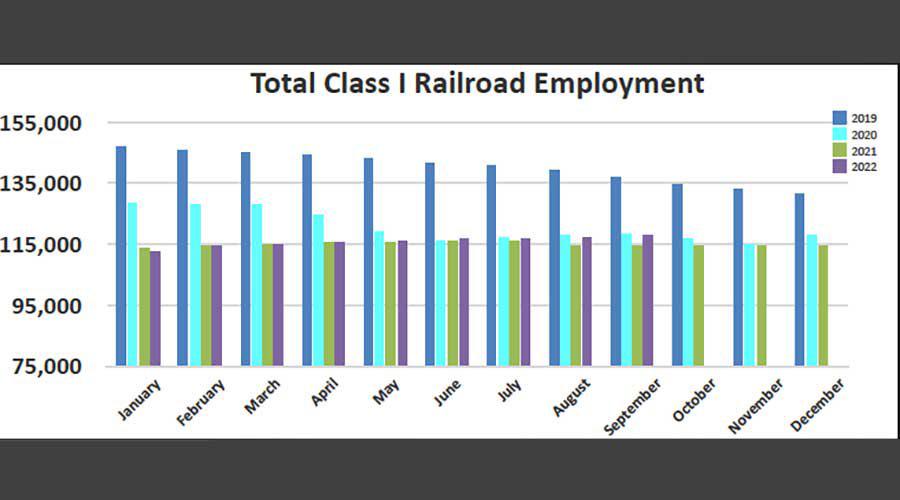
Class Is employed 118,208 people as of mid-October, a 0.53% increase from mid-September employment levels and a 3.53% increase year over year, according to Surface Transportation Board data.
Five of six employment categories registered employment increases between September and October. They were: transportation (train and engine), up 0.81% to 49,569 employees; professional and administrative, up 0.8% to 9,888; maintenance of equipment and stores, up 0.47% to 17,639; executives, officials and staff assistants, up 0.44% to 7,954; and maintenance of way and structures, up 0.13% to 28,442.
The only category to log a decrease between September and October was transportation (other than train and engine), which inched down 0.04% to 4,716 employees.
Year over year, all categories posted increases: executives, officials and staff assistants, up 9.97%; transportation (train and engine), up 5.47%; maintenance of equipment and stores, up 2.11%; professional and administrative, up 1.45%; transportation (other than train and engine), up 0.9%; and maintenance of way and structures, up 0.67%.
|
|
(Editor's Note: While the parties have not released any details, this might signal the beginning of a new era of less antagonistic relations between Amtrak and the "host" railroads. As more is learned about the deal - and if the freight carriers actually stick to it - we will have a better picture going forward. In order for Amtrak's grandiose expansion plans to come to fruition, the carrier needs a victory in this long drawn out battle with NS/CSX in the Gulf.) |
|
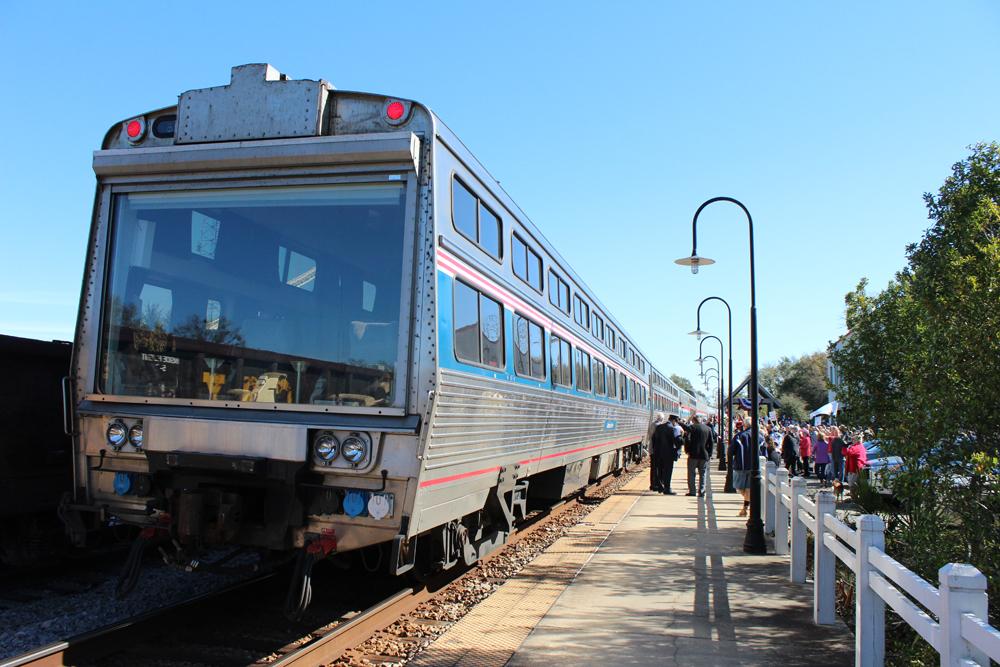
Amtrak, Freight Railroads Say They Have a Deal on Gulf Coast Service |
|
WASHINGTON — The parties involved in the long-running dispute over Amtrak’s effort to launch Gulf Coast passenger service say they have reached an agreement, but at least initially are offering no details on the nature of that deal
In a joint statement Tuesday, Amtrak, CSX Transportation, Norfolk Southern, and the Alabama State Port Authority say they have “collectively reached an agreement to support passenger and freight service in the Gulf Coast Corridor. … Due to the confidential nature of the settlement agreement, the parties are not able to provide further comment on its terms at this time.”
The four parties asked the STB to hold in abeyance further proceedings involving the case, a request the board granted in a decision issued Tuesday afternoon, cancelling hearings set for Nov. 30 and Dec. 1, as well as a Dec. 7 conference to vote on a decision in the case.
“With the assistance of Board-sponsored mediators, the Parties have agreed upon a settlement that will — after several conditions are met in the coming weeks and months — completely resolve this dispute,” the filing says. “Some of these conditions are not entirely within the Parties’ control, however. Therefore, each Party has reserved its right to reinstate this proceeding in the event certain of those conditions are not met.”
The parties will provide the board with an update on the status of the agreement by June 30, 2023, if the agreement is not completed before then.
When the board announced its decision, STB Chairman Martin J. Oberman issued a statement saying the board “appreciates the successful efforts of Amtrak, CSX, NS, and the Port to settle this important case. I particularly want to acknowledge the significant progress that has been made in achieving a settlement under the new leadership of CSX and NS, which I expect brought a fresh constructive approach to resolving the matter.”
Noting that the board “has stated many times our strong preference for private parties to operate in good faith and to amicably resolve disputes on their own whenever possible to obviate the need for Board action,” Oberman said the settlement, by hastening the return of passenger operations on the route, “will result in a substantial public benefit” for residents and visitors to the region and have a positive impact on the economy.
“I look forward to the parties informing us of the specific infrastructure improvements that will be made to the rail network as a result of the settlement,” Oberman said.
|
|
(Editor's Note: Rail workers, unions, environmental groups and the citizenry in general should oppose this sale of public infrastructure to NS or ANY Class One railroad at this point. We need to move towards public ownership of transportation infrastructure, not away from it! See the RWU Resolution in Support of Public Ownership of the Railroads. This important rail artery is one of the few mainlines in this country not owned by a Class One railroad. We urge the citizens and elected leaders of the Queen City to keep hold of this railroad!)
|
|
NS to Acquire Cincinnati Southern for $1.62B |
|
NS said that CSR is owned by the city of Cincinnati and operated by NS subsidiary Cincinnati, New Orleans and Texas Pacific (CNO&TP) under a lease agreement expiring in 2026. Funds from the $20 million-per-year lease are dedicated to city infrastructure projects, according to the city of Cincinnati.
“The [acquisition] agreement provides the company ownership of approximately 9,500 acres of land that sits under infrastructure maintained and operated by Norfolk Southern,” according to the Class I railroad. “Further, it ensures Norfolk Southern will own the line in perpetuity, while eliminating uncertainty around future lease costs. The line is one of the highest-density segments of the company’s network, with as many as 30 trains a day traveling the route.”
The city of Cincinnati will receive cash consideration of approximately $1.62 billion, said NS, which intends to finance the transaction “through a combination of internal and external sources.” The city plans to use the proceeds “to form an infrastructure fund” for the rehabilitation, modernization or replacement of existing infrastructure such as streets, bridges, municipal buildings, parks, and green space, NS added.
The transaction’s closing is subject to certain conditions, including approval by the voters of Cincinnati and the Surface Transportation Board, according to NS.
“This agreement sets the framework for Norfolk Southern to own a core line in our network in perpetuity, allowing us to advance our strategic objectives of improving service, enhancing productivity, and creating an even stronger platform for accelerated growth, all while eliminating uncertainty around future control of the line and lease costs,” NS President and CEO Alan H. Shaw said.
CSR History
“Before the Civil War, Cincinnati was a major destination for steamboats,” according to the city of Cincinnati. “After the war, it was more economical to ship to the south via Louisville instead of Cincinnati because of the newly built L&N Railroad. Since no rail line existed connecting Cincinnati to the deep south, the city fathers decided to build one” and expand the Cincinnati economy. An Ohio law enabling the creation of CSR was enacted on May 4, 1869, with a resolution adopted a month later designating Chattanooga as the southern terminus.
|
|
(Editor's Note: This is the kind of infrastructure projects that are sorely needed by the rail industry in order to increase capacity and move more freight more efficiently. In an ironic twist, in a previous era of railroad shortsightedness, the BN abandoned its former Great Northern mainline from Sandpoint to Spokane in favor of routing all traffic this way, via the old NP. Had they not, this second bridge might not have even been necessary.) |
|
BNSF’s New Sandpoint Bridge Opens for Business |
|
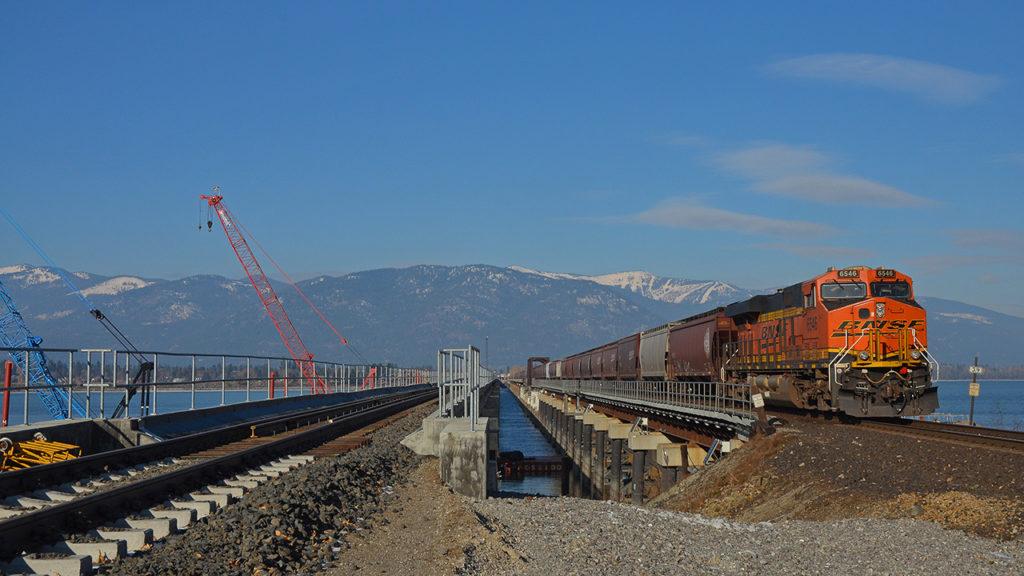
Fifty years after Burlington Northern consolidated the traffic of two predecessor routes onto a single line featuring a nearly mile-long bridge near Sandpoint, Idaho, successor BNSF has opened its long-anticipated second bridge. The first train to officially cross the new structure was an empty coal train at 9:00 p.m. on Nov. 20, 2022.
At 4,873 feet in length, BNSF’s new bridge across Lake Pend Oreille parallels an existing bridge that has been in service since 1904, and will help eliminate a single-track bottleneck that had become increasingly detrimental to traffic flow on BNSF’s Northern Corridor. The new bridge is comprised of 49 spans, 224 precast concrete girders and 6-pile bents totaling approximately 55,000 feet of 36-inch pipe pile.
Despite the new bridge being operational, it will be months before trains are seen passing each other side-by-side on a regular basis over Lake Pend Oreille. BNSF has taken the older bridge out of service in order to resume renovations that were started more than a decade ago. Lena Kent, General Director Public Affairs at BNSF, says, “The maintenance will consist of replacing all 59 of the remaining original 1904 bridge spans, including the no-longer-operational swing span. A number of spans, as well as all of the piers outside the navigation channel, were replaced in previous projects. The few remaining piers will be getting some minor reinforcement above the low-water line.”
Some might say that BNSF’s second bridge across Lake Pend Oreille and the extension of double track to Sandpoint Junction have been a half century in the making. Following the 1970 merger that formed Burlington Northern, various route segments from the Midwest to the Pacific Coast that were deemed redundant were either sold off, leased (in the case of MRL) or abandoned. Between Spokane and Sandpoint, BN phased out use of the former Great Northern main line as a through route, leaving portions of it in place only for branch line service. In 1972, BN completed major bridge and track projects in Spokane and Sandpoint that channeled all through traffic from either direction onto one line between those two cities: the former Northern Pacific, which earned the nickname of “The Funnel.”
|
|
(Editor's Note: Once again, US rail workers can learn a lot from our fellow rail workers in the UK. Note the parallels that exist in our respective struggles.) |
|
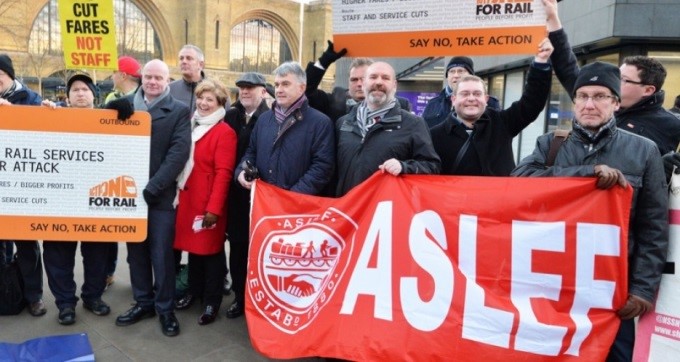
Enough is Enough: UK Train Drivers Speak Out
Mick Whelan, general secretary of ASLEF, the train drivers’ union, explains why his members have been on strike this summer
|
|
Train drivers in ASLEF, which represents 96% of the train drivers in England, Scotland and Wales, have taken four days of strike action so far this year. Not, as some commentators have suggested, a ‘summer of discontent’ but in what we see as a ‘summer of solidarity’, as workers in many different sectors take industrial action and offer each other support on picket lines up and down this country.
Our drivers have been on strike – on Saturday 30th July, Saturday 13th August, Saturday 1st October and Wednesday 5th October – at those privatised train companies which have refused to give our members, who have not had an increase since 2019, a pay rise.
We would, of course, much rather not be in this position. We don’t want to go on strike; withdrawing your labour, although a fundamental human right, is always a last resort. We don’t want to inconvenience passengers, and we don’t want our members to lose money.
But the companies – and we can see the Tory government leading them on this – appear determined to force our hand. Because they are telling train drivers to take a real-terms pay cut. With inflation now running at 12.3% – and set, economists say, to go higher – they are, in effect, telling us that train drivers should be prepared to work just as hard, for just as long, but for considerably less, in real terms, in their pay packets. And that’s not on.
The companies with whom we are in dispute have not offered us a penny. It’s outrageous that they expect us to put up with a real-terms pay cut for a third year in a row. That’s why we have been on strike: to persuade the companies to be sensible, to do the right thing, and to come and negotiate properly with us, rather than claiming ‘We don’t have the money’ (which they do) or blaming the Government for ‘not allowing us to pay you what you’re worth’ – which might well be true.
|
|
|
|
|
|
|