Native American Heritage
Month photo challenge
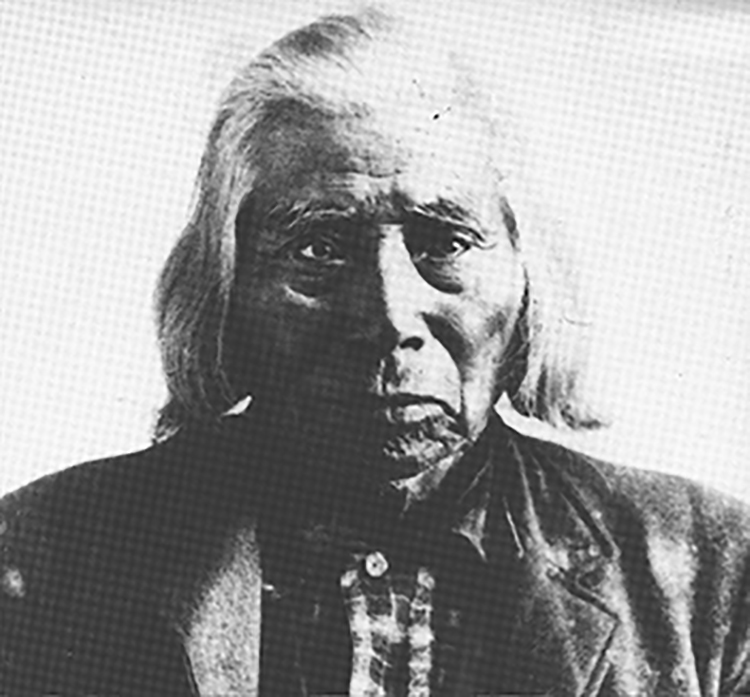
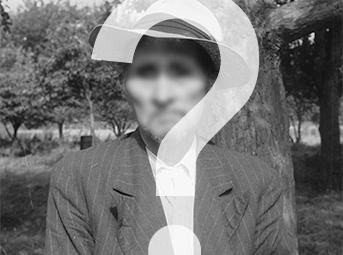
November is National Native American Heritage Month. Help us honor American Indians with this photo challenge. Tell us who is in this picture.

Bonus points if you can tell us a little bit about him. Click the photo to view a larger version.

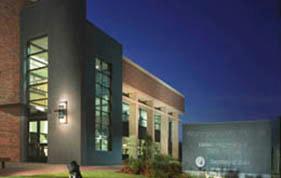
Last month’s photo challenge celebrated Archives Month. This one was pretty easy, even though the sign in the picture is illegible.

Readers readily recognized the Eastern Region Branch and Digital Archives building.

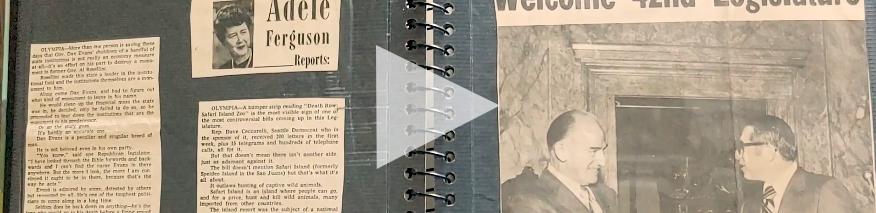
On Nov. 6, Washington State Archives' Digital Projects and Preservation Archivist Mary Hammer hosted a public webinar called "Preserving historical scrapbooks and creating new ones that last."

Do you have a scrapbook you would like to preserve? Do you want some professional tips on how to create a scrapbook that will last for generations? Watch the full webinar online now!
The Washington State Archives - Digital Archives Electronic Records Archivist Debbie Bahn is transcribing and researching a series of recordings from the Hanford Health Information Archives, Oral History Collection, 1996-2000. The oral histories are interviews with "Hanford Downwinders," the citizens exposed to radiation from the Hanford Nuclear Reservation from 1944 to 1972. Five interview transcriptions are already posted on the Digital Archives, with several more to come. Audio recordings will eventually be available as well.

The project led Bahn to host a panel called "Bodies of evidence using archives to give voice to the Hanford Downwinders" at the Pacific Northwest History Conference Oct. 21. The panel was co-presented by Eastern Washington University Professor of History Ann Le Bar, Ph.D., and students Brianna Humphreys, Anika Martin, Alex Mikinaak, and Miles Ormsby, all of whom currently work with the Hanford Health Information Archives (HHIA).

The panel explored a few of the stories uncovered during their research. The bodies of Hanford Downwinders bear witness, in the form of myriad debilitating diseases, to the U.S. Government's malfeasance, deception, and skewing of scientific research on Hanford radiation emissions, perpetrated across decades in the name of national security.

After finally learning about the emissions and the coverup in 1986, hundreds of Downwinders recorded their oral histories to be part of the HHIA. They illustrate the accounts of otherwise healthy people suddenly beset with extreme, mysterious symptoms for which doctors could find no cause and often misdiagnosed. Some Downwinders lost parents early to cancers and heart attacks, or had siblings who were stillborn or congenitally disabled.

Interpreting these oral histories has expanded our students' notions of what constitutes historical accuracy, how to account for the narrator's subjectivity, and how to represent each Downwinder's anger, distrust, and sadness.

View the webinar here. The compelling presentation highlights the importance of the new collection and affirms the State Archives and EWU's strong partnership.
Who said
that?
For the 20th time, the Washington State Archives - Digital Archives and the Washington State Library's Rural Heritage site have been named by Family Tree Magazine as two of the "75 Best U.S. Genealogy Websites." The world-class staffs at the Archives and Library have a consistent track record of making this list year after year.

Congrats for the recognition yet again! It's an honor to have all that hard work nationally acknowledged.
With consideration for the safety of the public and our staff, and to help prevent the spread of COVID-19, the Olympia and Ellensburg branches of the State Archives are available by appointment only.

All other branches remain closed, but still allow state and local government agency staff to research records on an emergency basis.

The Tumwater Records Center continues to operate at its usual capacity.

Go here for more information.
"Take nothing but memories, leave nothing but footprints!"

Who said that?

Hint: The person in the photo above has nothing to do with this quote.

Last month's quote is from country music legend Loretta Lynn. Lynn started her music career while she lived in Custer, Washington, where she learned to play guitar and started a band.
Out of the Archives, November 2020 banner photo: Pendleton round-up. State Library Photograph Collection, 1851-1990. 1955.