Whatever logical conundrums riddlers may pose, the fact remains that every egg at every grocery store, food co-op, or farmer's market came from a hen. In this newsletter, you'll meet the first egg factory refugees to come to our sanctuary. Then, you'll learn how you can help seize the day for hens by spreading the word about egg alternatives right now, while high egg prices have led many cooks to be more open to other options. | | |
In the autumn of 2000, when our sanctuary (then called the Eastern Shore Chicken Sanctuary) was still less than a year old, Kay Evans suggested that we begin offering refuge to egg factory survivors. Karen Davis taught us everything we needed to know to get set to welcome "spent" hens who were scheduled to be killed after enduring sentences of eighteen months or more in battery cages so cramped that they could not stand up straight or stretch their wings.
Here's how pattrice remembers the day that those hens came to the sanctuary:
| | |
Finally, the appointed day arrived. Kay visited the egg factory and then drove north to United Poultry Concerns in Virginia. Miriam and I drove south to meet her and the birds there. The Isley Brothers sang "Caravan of Love" on the radio, and I swayed in my seat to that sweetly appropriate tune.
We drove up just in time to see Kay and Karen unload and open the carriers containing the hens who would be staying at UPC. Our upbeat mood evaporated as we watched the first few birds gingerly step out into the grass. They didn't know how to walk! Having spent their entire adult lives perched on the wires of their cages, many had crippled feet and none of them knew exactly what to do with their legs. After a lifetime caged in dim, grim buildings, the birds seemed both stimulated and disoriented by fresh air, bright colors, and physical freedom. Some stayed still, hesitating between curiosity and confusion. Others careened into the greenery, eager to explore their new surroundings but not yet capable of controlling their frail bodies with their atrophied muscles.
They were so pale! Their combs and legs were almost as white as the sickly skin showing through their patchy feathers. Some were nearly naked. None had enough feathers to cover their wings, which looked like stumps rather than limbs. They didn't look like birds at all! It was as if their essential 'bird-ness' had been stolen from them along with their eggs. "They look like monsters," I thought, then felt immediately ashamed of that reaction.
As I watched those estranged animals from an increasingly dissociated distance, high school film-strip images dragged themselves out of my memory and ran like a newsreel before my eyes. Jerky black-and-white pictures of concentration camp survivors at the moment of liberation superimposed themselves over the scene before me. I'd always rejected facile comparisons between animal exploitation and events in human history, but those images of stunned survivors of concentrated cruelty must have been the only match my brain could find for the unspeakable sight of those limping, naked, scrawny survivors of concentrated suffering.
Stunned into silence, I focused on the concrete project of getting the hens home safely. As Miriam chatted with Karen and Kay, I wordlessly loaded carriers into our truck, tied them down, and covered the carriers with a tarp to shade the birds from the wind and sun.
Back at home, I struggled with a queasy mix of sympathy and revulsion as we carried the birds, one by one, from the truck to the foraging yard. I didn't want to touch these birds! Their naked skin felt cold and clammy under my fingers. Suddenly I understood, with visceral clarity, how it is that degradation facilitates further degradation. Catching myself recoiling from these debased creatures, I felt a sickness in the pit of my stomach. Shocked and shamed by my reactions, I fought back against the archaic impulse to flee from suffering. Cradling each hen even more closely and tenderly, I focused on seeing each one as the bird she was born to be.
| | |
Miriam and pattrice gently carried the hens into the coop, where they clustered together in a heap for the evening. The next morning, Miriam and pattrice placed water very near them and food a few steps away, setting additional food bowls along what would be their route to the outdoors. First one and then another hen found her way outside and stood blinking in the sunshine. Over time, some of these hens became the wildest birds at the sanctuary, literally flying from their perches as soon as the coop door was opened each morning, eager to see what surprises were in store for them that day.
From an essay published first in Satya Magazine and then reprinted in Bird's-Eye Views, here's what pattrice learned from those hens:
| | |
Where can you find the hope to do this? You already have it in your muscles.
Here is what I learned from the birds: Hope is something you do. "
Spent" hens arrive from egg factories in a state of abject shock, half-starved and barely able to walk. Nothing in their lives has taught them to expect anything other than constricted movement and misery. They huddle, shoulders slumped, in a corner of the barn. But then they take a step. And then they take another step. They discover freedom and their own abilities. They learn to use their wings.
Hope is something you do. We create hope by acting. As our actions create change, our hopes are realized. When it comes to climate change, action is our only hope.
How can we start? Follow the birds. Take a step. Then another step. Then...
| | |
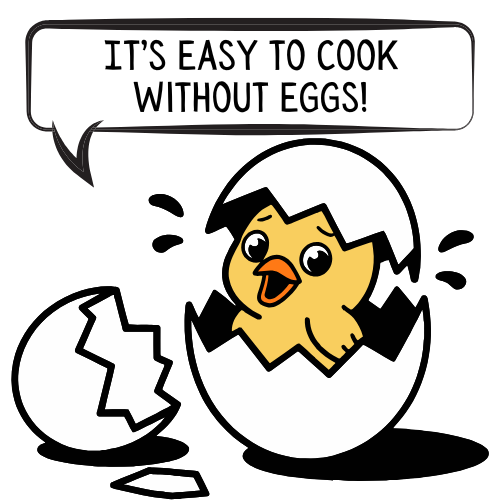
Let's be strategic and use the high price of eggs these days to inspire cooks to forgo eggs altogether! Download a black-and-white brochure that you can print out and share with not-yet-vegan friends and family.
The brochure includes information about 26 egg alternatives as well as tips for baking and making breakfast scrambles.
| | |
Go the extra mile for hens by printing out a stack of brochures to leave at a food co-op, public library, laundromat, bus station, or other place where people might be bored and looking for something to read!
The QR code on the brochure leads to the Instead of Eggs webpage, which gives more detailed information about the 26 alternatives as well as further tips on replacing eggs in baking, breakfast, and creative cooking.
| | |
Small increases in costs can also add up. Like everybody else, the sanctuary has had to cope with increased inflation in recent years. But, this year, the problem has reached a crisis point.
The first group of egg factory survivors to come to what has become VINE Sanctuary included many notable personalities. Scout was the most curious and intrepid of the group. Simone was the most thoughtful and empathic. Diamonda was the most feral. But nobody had a bigger personality than Fanny.
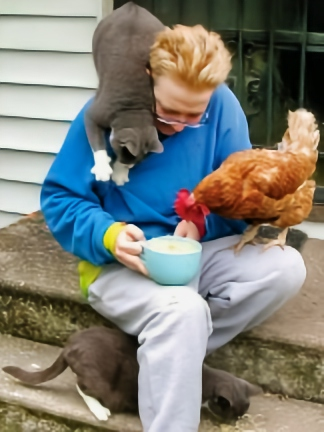
| | | | Seen here with pattrice and cats Pearl and Pajama and below accepting a donation from a sanctuary visitor, Fanny was as bold and gregarious as a person can be. She demanded to be hand-fed and also to be given a bit of whatever anyone else was eating. Unlike many of the birds, whose feathers got ruffled by any departure from their favored routines, Fanny liked excitement and changes of pace. Fanny walked right up to any sanctuary visitors, thus becoming the first of a long line of self-appointed ambassadors and tour guides. | | |
Like all hens from egg factories and ostensibly "humane" egg farms who purchase chicks from hatcheries, Fanny had been subjected to the painful operation known as "debeaking." Chicks who will later be confined to egg factories have the tips of their beaks burned off with a hot blade. This prevents the bored and hungry hens, who are crowded into cages so small that they cannot spread their wings or even lie down comfortably, from pecking themselves or each other to death in frustration. Fanny's mutilated beak gave her face a blunted look that always reminded us of what she had been through.
In her later years, Fanny greeted visitors from the front yard, where she spent her days once she got too old to deal with the hustle and bustle and randy roosters of the main chicken yard. She was joined by Carmen, who had been with her in the egg factory, a younger hen called Darwin, who had lost a wing in a freak accident, and a delicate but tenacious half-blind hen called Felicia.
Felicia was a remarkable bird who had several times been so sick that we were sure she would die but recovered and went on to enjoy more times around the seasons. But when the cold weather came again, her little body finally gave out. That was very sad for Fanny, who had lived to see all of her closest friends die.
Fanny kept up her usual routine but just didn't seem herself anymore. Sometimes we would see her standing out in the yard alone. She spent some time with the elderly roosters and a juvenile rooster named Dizzy, but didn't seem to have the same bond with them as she had had with her hen friends. "We've got to get Fanny a new friend," pattrice and Miriam said, but she didn't hit it off with any of the other red hens with whom we encouraged her to spend time. Luckily, a red hen named Rosalita moved in from Washington, DC and she and Fanny hit it off right away. Fanny's mood improved overnight.
But nobody lives forever. On the morning of what would be her last day, Fanny had a slow start but came running when sanctuary cofounder Miriam Jones mixed up her favorite treat for breakfast. Later in the day, pattrice noticed Fanny drooping and brought her some mulberries. She ate one berry eagerly but dropped the next and couldn't find the rest. Seeing that she was slipping into a stupor, pattrice gathered Fanny into her arms and sat down under a tree with the little hen held close to her chest. Fanny fell asleep within that embrace as the life ebbed from her body.
The little red hen we called "Fanny" was one in a million—literally and figuratively. Fanny was just one of millions of hens crowded into tiny cages in egg factories. And, like every one of them, she was unique in the sense of having her own characteristics, her own likes and dislikes, and her own way of looking at the world. If, by speaking and writing about Fanny, we can help people to see hens as individuals and stop treating them like objects, then Fanny really will live forever.
If Fanny were with us today, she'd undoubtedly be looking for a handout, so we feel no shame in asking for a donation in her honor.
| | |
In Multispecies Assemblies, philosopher Eva Meijer offers a new and more inclusive way of doing doing democracy. Join members of the VINE Book Club to discuss this brief, accessible, and thought-provoking new book with its author.
Buy the paperback for just $10 from directly from the printer, from the nonprofit Bookshop.org, Buy the e-book for just $5 directly from VINE.
Register for the meeting here. Find the date and time in your own zone here.
| |
If you prefer to donate by mail, you can send a check to the address below:
VINE Sanctuary, 158 Massey Road, Springfield, VT 05156
| | | | |