|
For nearly seven decades, NELSON has designed some of the most complex offshore infrastructure in the world. But our commitment to the industries we serve extends beyond engineering and design services. We actively support the development of industry codes, standards and recommended practices (RPs) that improve safety, reliability and efficiency across the energy sector.
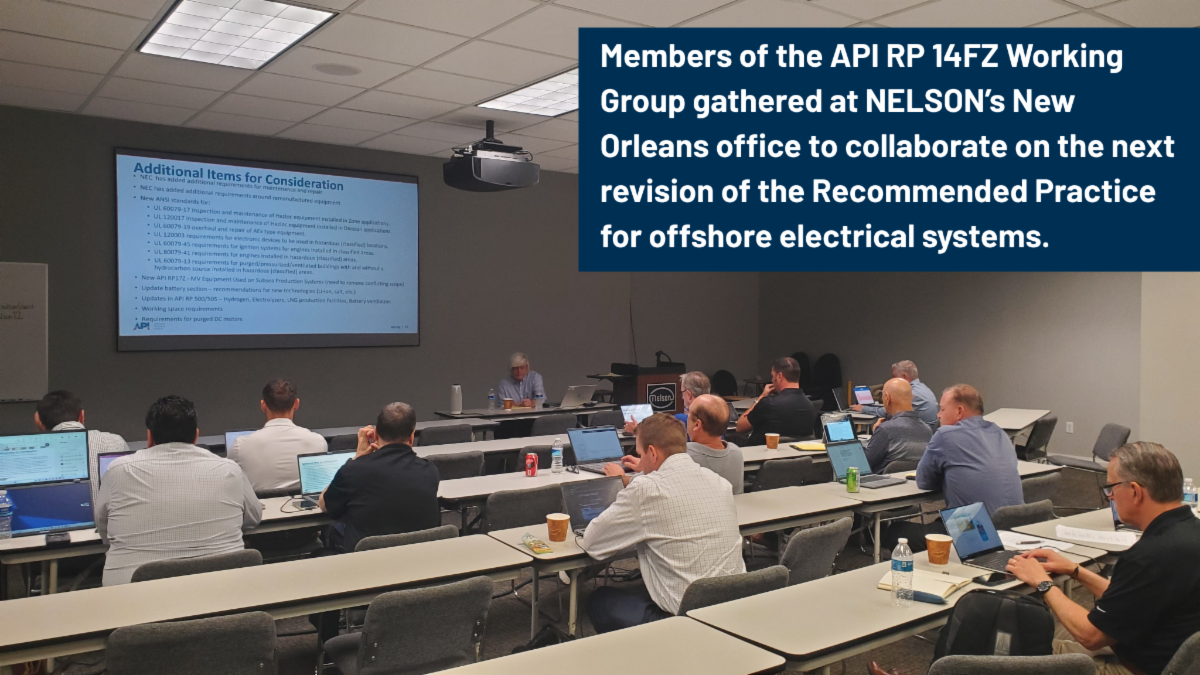
Recently, NELSON Senior VP Jack Neelis II hosted the American Petroleum Institute’s RP 14FZ Working Group at our New Orleans office, where he heads our electrical engineering practice. API RP 14FZ is the Recommended Practice for Design and Installation of Electrical Systems for Fixed and Floating Offshore Petroleum Facilities for Unclassified and Class I, Zone 0, Zone 1 and Zone 2 Locations. It is one of the most consequential documents governing offshore electrical infrastructure. The meeting was convened to initiate the next revision of the RP, ensuring it continues to address the evolving needs of the offshore industry.
The API RP 14FZ Working Group meeting brought together a diverse group of stakeholders: operators, producers, equipment manufacturers, engineering consultants and representatives from the Bureau of Safety and Environmental Enforcement. Discussions focused on incorporating advances in electrical technology, addressing changes introduced by recent editions of the National Electrical Code, evaluating lessons learned from industry experience and considering emerging operational and regulatory challenges. By uniting experts from across the industry, the Working Group helps ensure future revisions remain technically sound, practical and aligned with current industry needs.
Active participation in the RP’s development allows NELSON to contribute technical expertise drawn directly from decades of field experience. This ensures that the standards we help write are grounded in real-world application.
A legacy built before the code existed
In 1956, NELSON began designing what was then the largest offshore platform complex in the world. Located in the Gulf of Mexico, this milestone came 13 years before the American Petroleum Institute published its first edition of the recommended practice for offshore platform design, RP-2A. Our engineers were not waiting for the standards to catch up. They were setting the benchmark.
Since the founding of the API code writing committee for offshore electrical standards, NELSON has maintained an active seat at the table. That commitment to shaping industry best practices continues today.
Our engineers regularly participate in technical committees and working groups across multiple organizations. These include:
- API: Offshore platform design and electrical systems (see above).
- IEEE: Electrical and electronics engineering standards.
- International Council on Large Electric Systems (CIGRE): High-voltage systems and power engineering.
- National Fire Protection Association (NFPA): Fire protection and electrical safety codes.
This breadth of engagement means our team brings a comprehensive, multi-disciplinary perspective to every project and every standard we help develop. It keeps us engaged with emerging technologies, evolving regulations and industry best practices so we can provide clients with solutions that are both innovative and grounded in the latest engineering standards.
We are proud to support these collaborative efforts and contribute to the standards that shape our industry.
Offshore electrical expertise at all depths
NELSON's offshore electrical experience spans the full range of operating environments. We work from shallow-water fixed platforms at 50 feet to deepwater and ultra-deepwater facilities at 9,500 feet. Whether the project involves a legacy Gulf of Mexico structure or a new deepwater development, our team has the technical depth and historical precedent to deliver on time and within budget.
Our capabilities include electrical system design, hazardous area classification, grounding and bonding, power distribution and instrumentation. All work is executed in accordance with the strict codes and standards our engineers help shape.
To learn more about our services or to discuss your next project, please reach out to our experts. Contact Tom Wells at tom.wells@wsnelson.com or Marcel Danos at marcel.danos@wsnelson.com.
We look forward to hearing from you!
|