|
Dear Community:
Tomorrow marks the beginning of August, a month carrying profound significance for our physical and economic well-being.
August is National Minority Donor Awareness Month, an opportunity to highlight the urgent need for organ and tissue donation within multicultural communities. By stepping up, we can directly address transplant waitlist disparities and combat systemic inequities in healthcare access.
It is also National Black Business Month, an opportunity to celebrate the achievements, resilience, and economic impact of Black-owned businesses in Cincinnati. We're especially excited to spotlight the incredible local entrepreneurs who partner with and support the Health Gap. After all, economic empowerment and health equity are inextricably linked.
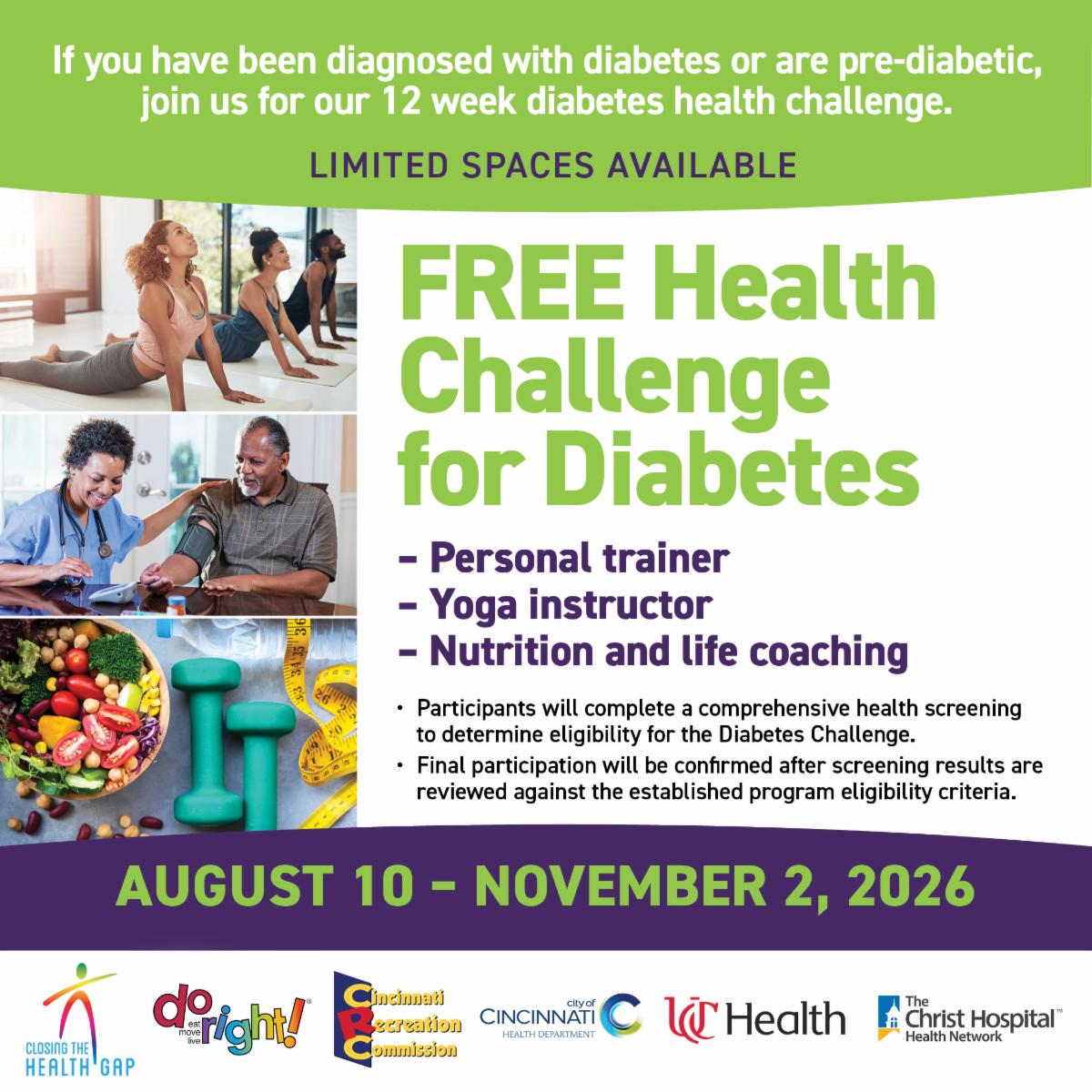
As we close out July, we are in the final stages of registration for our Diabetes Health Challenge. This completely free program begins August 10, offering the tools you need to thrive. Check out the details below and secure your spot today!
As we build healthier lives and stronger communities together, please remember our core truth: We Must Save Us. Blessings to all of you for a safe and healthy week ahead.
Renee Mahaffey Harris
President & CEO
| |
House and Senate Introduce Bill Aimed at Reducing Health Disparities and Combatting Chronic Disease
The U.S. House of Representatives and the U.S. Senate today introduced legislation aimed at eliminating health disparities. Sponsored by Rep. Raul Ruiz (D-CA) and Sen. Alex Padilla (D-CA), the Health Equity and Accountability Act of 2026 offers a comprehensive policy framework that will help address health inequities that intersect with race and ethnicity as well as geography, immigration status, age, disability, sex, gender, sexual orientation, gender identity and expression, language and socioeconomic status. The bill includes policy solutions that will help bolster cancer research and improve access to cancer prevention, early detection and care.
| |
Preeclampsia rates in minority communities shed light on the social roots of maternal health disparities
Elevated stress, exposure to environmental toxins, COVID-19 infection during pregnancy and extreme heat are among the factors that have the potential to unleash a chain of physiological responses that can lead to preeclampsia.
While an estimated 4.4% of pregnancies result in preeclampsia globally, the rates are typically higher in low- and middle-income countries compared to wealthier nations. Sub-Saharan Africa has the highest regional prevalence rate, at 13%. In the U.S., the preeclampsia rate rose from 4.5% in 2008 to 8% in 2021, during the height of the COVID-19 pandemic. But racial and ethnic minorities in the U.S. experience higher prevalence rates.
|
Risk accumulation, not care delivery, linked to increased disparities in CVD outcomes, study finds
Despite higher baseline risk, the United States health system achieved comparable or better performance than English and South Korea health systems in managing cardiovascular disease (CVD) risk factors. Accumulated risks attributable to social determinants of health, rather than care delivery, were linked to increasing disparities in CVD outcomes, according to a July study published in JAMA Network Open.
The study analyzed data on 120,678 adults 50 years or older from 1998 to 2020. A total of 27,327 participants were from the US, 41,986 were from England and 51,365 were from South Korea. Researchers compared three biomarkers, cholesterol levels, blood pressure and HbA1c levels, of each participant and determined CVD risk levels. The results showed that the US had the highest proportion of all three biomarkers across the study period.
|
New clues about whether genes or environment influence our health more
It’s been clear for some time that social determinants of health (SDoH) play a massive role in shaping our health, well-being and overall quality of life. While healthcare access is vital, research shows that medical care only accounts for about 10-20% of modifiable health outcomes. The remaining 80-90% is driven by these social, economic and environmental factors.
A recent study analyzed data from the National Institutes of Health’s All of Us Research Program, which included genetic information, electronic health records and survey responses from participants across the country. The results suggest that SDoH may play an equally important, or even more important, role than genetics in predicting our risk of developing asthma, chronic kidney disease, coronary heart disease, high cholesterol, breast cancer and prostate cancer.
Why? Because when social and systemic factors are inequitable, they create health disparities — preventable differences in health burdens. Addressing SDoH isn’t just about encouraging individuals to make healthy choices — it’s about shifting policies and systems to ensure everyone has the foundational environment required to thrive. It’s about addressing risk factors like smoking, but also loneliness.
|
Not as divided as we think? Ahead of midterms, don’t overlook where Americans agree on health
Despite the political polarization dominating headlines, recent research from the Johns Hopkins Institute for Policy Solutions shows that Americans may share more common ground on health inequities than many may assume. The findings suggest reconsidering how inequities are framed in news coverage and whether stories may amplify division while overlooking areas of public consensus.
The research, based on a nationally representative survey of U.S. adults, found that many Americans view inequities in health care as evidence of broader system failures rather than isolated problems affecting only certain communities. While disagreements are often more newsworthy, news coverage should reflect public opinion as accurately as it reflects conflict. Consensus reporting could change how reporters frame stories about health inequities and help audiences better understand where they share common concerns.
|
How Community Safety is Grounded in Access to Mental Healthcare
Every person deserves access to compassionate and culturally responsive mental healthcare. Yet for far too many people in the United States, a mental health crisis becomes a point of contact with law enforcement instead of an opportunity to receive treatment and care.
This Minority Mental Health Month, the Center for Policing Equity examines how inequities in mental healthcare and community safety intersect. Mental health outcomes are shaped not only by individual circumstances, but also by the systems people rely on when they need help. Healthcare systems, housing, transportation, community-based services, crisis response infrastructure, and other available social supports all play a role in whether someone receives care or experiences harm. For many communities, those systems are failing to deliver holistic and responsive support.
People living with mental illness are no more likely than anyone else to engage in violent behavior. Yet, they are disproportionately represented in fatal police encounters. Just this month, NPR reported on a story in which Jonah Neal, a young man suffering a mental health crisis, was killed by members of the Memphis Safe Task Force who were responding to his mother’s 911 call. Since 2015, approximately 21% of people killed by police in the United States had a known mental illness. These outcomes underscore a broader challenge: when communities lack accessible mental and behavioral health services and alternative response options, law enforcement often becomes the default response to situations that require care, not enforcement.
These gaps do not affect everyone equally. Black and Brown communities, LGBTQ+ people, people living in poverty, and other historically underserved populations continue to face significant barriers to accessing quality mental and behavioral healthcare.
| | |
More Articles of Interest
HealthTech, July 28, 2026
Science Magazine, July 24, 2026
BlackPressUSA, July 25, 2026
| | | | |