Rail Workers Weekly News Digest
Number 24 - June 16th, 2020
|
|
Below is a series of articles compiled over the previous week.
They are of interest to railroad workers and activists.
|
|
ARTICLE 1 - PASSENGER RAIL NEWS
|
|
Support $58 Billion Investment in Passenger Trains and Key Amtrak Reforms Today!
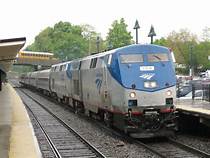
The U.S. House Committee on Transportation & Infrastructure has scheduled a June 17 markup for the INVEST in America Act, which would invest more than $58 billion in America’s rail network over the next five years. The bill also includes several key Amtrak reforms: enshrining Amtrak’s duty to run a National Network, improvements to Amtrak food and beverage service, providing protections for on-time service for passengers,
and more!
We need every American passenger and every railroad worker to contact their Representative to generate support for this bill. Passing the INVEST in America Act will result in meaningful investments in passenger trains and reforms to Amtrak that will greatly benefit passengers, rail workers and the nation.
The bill includes a section called the Transforming Rail by Accelerating Investment Nationwide (TRAIN) Act, crucial for rail workers and passengers and all supporters of rail transportation.
Specifically, the Act would do the following: (note especially the last three points)
-- Provide $29.3 billion over five years in grants to support Amtrak’s intercity passenger rail service on the Northeast Corridor (NEC) and the National Network
-- Reauthorize the FRA’s discretionary grant program, CRISI, at $7 billion over five years.
-- Authorizes grant funding of $19 billion over five years for state of good repair projects, service improvement projects, and rail expansion projects.
-- Mandate that Amtrak must provide reliable national intercity passenger rail service now and, in the future, reflect the needs of all passengers, and support the U.S. workforce.
-- Clarify that Amtrak serves the public interest in providing reliable passenger rail service.
-- Realign the makeup of Amtrak’s board of directors to better reflect the interests of passengers and Amtrak-served states.
-- Provide a means for Amtrak to enforce its statutory right of preference directly in Federal court without intermediaries.
-- Revise the Surface Transportation Board provisions that govern when Amtrak seeks to operate additional trains over rail lines owned by another carrier by establishing a process for the Board to determine whether the additional trains unreasonably impair freight transportation and initiate a proceeding to evaluate what additional investments are required.
--
Require that any individual onboard a train who prepares onboard food and beverage service is an Amtrak employee.
-- Amends current Amtrak contracting limitations to clarify that Amtrak cannot contract out the work performed by an employee if such employee has been laid off and has not been recalled to perform such work. It also clarifies that Amtrak is not authorized to contract out work if prohibited in a collective bargaining agreement.
-- Prevents Amtrak from contracting out work performed at Amtrak call centers. The section also requires an Amtrak ticket agent to staff each station where there was more than an average of 40 Amtrak passengers boarding or deboarding per day in FY 2019.
|
|
More Passenger Rail News and Info
|
|
ARTICLE 2 - CORONAVIRUS NEWS
|
|
Congressional Hearing Highlights COVID-19 Impact on Transportation Workers
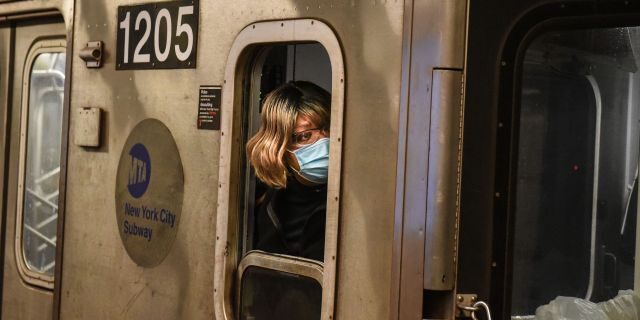
In his opening statement, T&I Chairman Peter DeFazio (D-Ore.) noted that few industries have been hit harder by the pandemic than transportation.
"Providing an essential service, transportation workers have continued to show up to work driving buses and trains, caring for passengers on airplanes, moving freight and repairing roads and bridges," DeFazio said.
He lamented that federal agencies, including those in the U.S. Department of Transportation, have "refused to issue mandatory guidance protecting workers and the general public, instead relying on voluntary recommendations that offer little practical guidance other than suggesting that agencies develop rules to keep their employees safe without even collecting best practices from different sectors."
Many transit workers have continued to do their jobs without the necessary personal protective equipment, DeFazio noted.
Meanwhile, U.S. Rep. Sam Graves (R-Mo.), the committee's ranking member, said in his opening statement that it's important to understand how the pandemic has affected frontline transportation workers.
|
|
ARTICLE 3 - RAIL SAFETY NEWS
|
|
Safety Board Recommendation Aims to Reduce Frequency of Uncontrolled Movements in Rail Yards
(Editor's Note: The TSB of Canada finds that such uncontrolled movement incidents have nearly doubled in the last decade, due to a combination of factors: the pairing of inexperienced personnel on crews; and the increasing frequency of uncontrolled movements. In addition, the investigation revealed the CN practice of routinely kicking cars uphill, and the large number of deficient handbrakes on rail cars.)
Gatineau, Quebec, 10 June 2020 — The Transportation Safety Board of Canada (TSB) is recommending that Transport Canada (TC), railway companies, and their labour representatives work together to reduce the number of uncontrolled movements in rail yards, specifically those caused by rail cars being moved without using air brakes – a routine task known as “switching without air.” This recommendation stems from the TSB’s investigation (R17W0267) into a 2017 employee fatality following the uncontrolled movement of a rail car at Melville Yard in Saskatchewan.
On 22 December 2017, two Canadian National (CN) employees, a foreman and a helper, were operating a yard assignment and performing switching operations at a rail yard in Melville, Saskatchewan. The switching was done by shoving the cars with a remote-controlled locomotive, releasing the cars and then letting the cars roll under their own momentum to their intended track, without the use of air brakes on any of the cars. This is an industry operation known as “kicking cars.” After an attempt to kick a group of three loaded cars up a short ascending grade with insufficient speed, the cars lost momentum and began rolling back downhill, uncontrolled. The foreman, who was operating the assignment, ran toward the cars, climbed on the lead car, and attempted to apply the hand brake, but the braking efficiency of the hand brake was compromised. As a result, the cars did not stop or slow down, but continued to roll back down the track, colliding corner-to-corner with the stationary group of cars, pinning the foreman between them. As a result of the collision, the foreman sustained fatal injuries.
The investigation found that the crew’s limited experience likely contributed to a decision to kick three loaded cars at insufficient speed up an ascending grade. It was also determined that there was a lack of communication between the two employees. If crew members do not receive enhanced crew resource management training to develop skills in crew coordination and communication, there is an increased risk that inadequate crew communication will lead to unsafe operations. In this case, neither crew member had received formal crew resource management training. They also had not discussed kicking the cars uphill or expectations of how this task would be performed.
“Switching cars without use of air brakes in rail yards is a routine railway industry practice, but one that requires a certain degree of skill, experience and judgment to do safely”, says TSB Chair Kathy Fox. “Since 2009 there have been 185 occurrences involving switching without air, and these are on an upward trend. This tells us that current defenses are not sufficient to reduce the number of uncontrolled movements”.
|
|
ARTICLE 4 - RAIL UNEMPLOYMENT NEWS
|
|
Rail Unions Unite to Demand a Full Restoration of Unemployment Benefits
(Editor's Note: This info went out last week as an dedicated RWU Action Alert. If you have not yet taken action, please see below and act NOW!)
As a result of the Budget Control Act of 2011, rail workers are the only workers in the US who are subjected to so-called "sequestration" that limits the full amount that these brothers and sisters should be receiving. No state laws governing unemployment of other workers are encumbered by this act.
As a result, all U.S. rail unions have come together to push for an end to this unjust practice of sequestration of
Railroad Unemployment Insurance Act (RUIA) benefits
. With tens of thousands of rail workers in furlough status, it is imperative that the law be amended to allow unemployed and sick/disabled rail workers to receive what is rightfully theirs.
According to Teamsters Rail Conference President Dennis R. Pierce and TTD President Larry Willis: “Unlike the average U.S. worker, railroad employees do not receive unemployment benefits through state-administered unemployment insurance programs. Instead, unemployed railroaders receive these benefits through the RUIA program, which is administered by the United States Railroad Retirement Board (RRB). As a result of the Budget Control Act of 2011, RUIA are subject to sequestration. No state unemployment insurance benefits in the country are subject to this unfair treatment.”
|
|
ARTICLE 5 - UPRISING NEWS
|
|
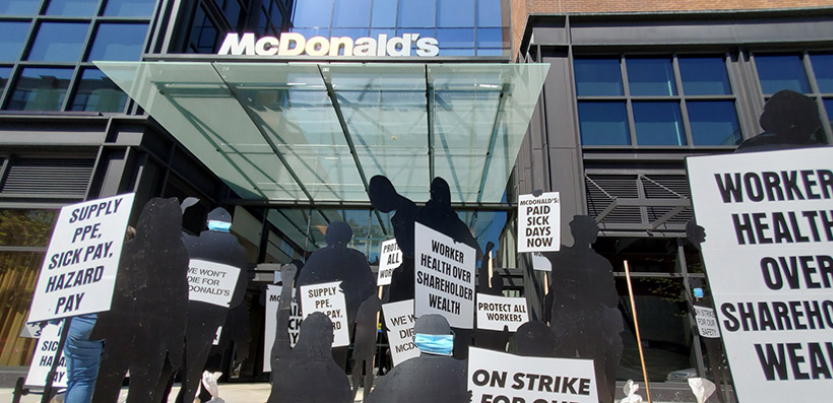
Corporations Now Love 'Black Lives'- But What About Their Own Black Workers?
Never underestimate the American business community's capacity for hypocrisy.
That’s one of the lessons to be drawn from the explosive reaction to George Floyd’s murder. As demonstrators began flooding streets, corporate PR departments flew into rapid response mode, issuing a flurry of agonized, apologetic pledges to do more to combat racism and inequality.
Such statements may, on a personal level, be sincere: the depth of righteous pain and anger expressed by African Americans has induced widespread soul-searching, even in executive suites. Yet this high-profile hand-wringing is used to uncouple the outpouring of outrage from capitalist practices that are now, and always have been, at the intertwined roots of racial and economic injustice.
As they nimbly co-opted the language of the protests, moreover, corporate leaders offered up “solutions” to structural racism that won’t diminish managerial control or redistribute power in the workplace, meaning their proposals won’t promote actual structural change of any sort. With a few well-publicized contributions and some new rounds of diversity training, business elites hope to emerge from the present crisis with their privilege, and their profits, intact.
“Tragic, painful and unacceptable,” so Walmart CEO Doug McMillon described George Floyd’s death. “The inequitable and brutal treatment of Black people in our country must stop,” an Amazon tweet proclaimed. “We do not tolerate inequity, injustice or racism,” McDonald’s announced, with
CEO Joe Erlinger insisting
, “when any member of our McFamily hurts, we all hurt."
|
|
ARTICLE 6 - RAIL FREIGHT NEWS
|
|
Trans-Pacific Rates Surge as Volume Rebounds
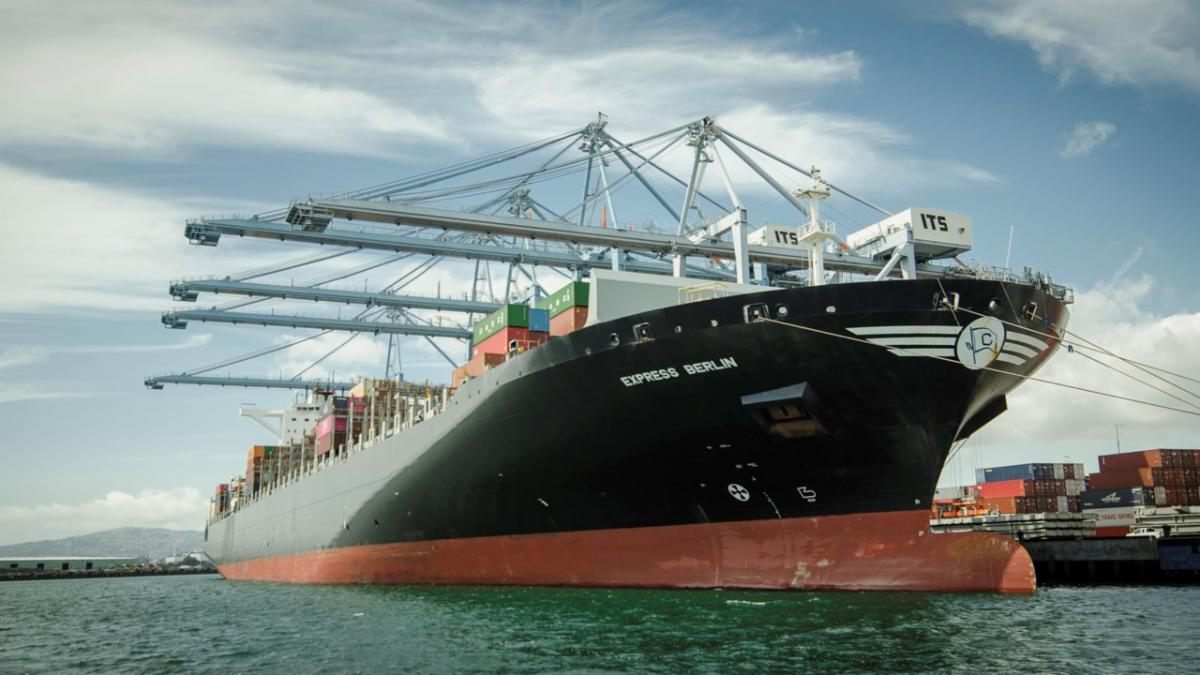
Politically, the U.S. and China are barely on speaking terms. Trade-wise, they’re still very much in bed together. Cargo from China is accounting for an even greater share of inbound container volumes than before the coronavirus crisis, according to the latest U.S. Customs data.
China flows have helped blunt volume fallout along the U.S. West Coast. In fact, the Port of Long Beach disclosed on June 9 that it had handled 312,590 loaded inbound twenty-foot equivalent unit (TEU) containers in May, up 7.6% year-on-year and up 23.3% from April.
Mediterranean Shipping Company, which majority owns Terminal T in Long Beach, announced that it handled more containers at that facility on June 8 than it has on any single day at any of its North American terminals ever before.
Demand for Chinese goods has also caused rates to surge – an unusual occurrence in the midst of a global pandemic.
According to Freightos Chief Marketing Officer Eytan Buchman, “It has been a tough few weeks … unless you’re an ocean liner on the China-U.S. West Coast, where rates just shot up” due to an “unexpected spike in demand combined with tight capacity.”
|
|
ARTICLE 7 - DERAILMENT NEWS
|
|
Authorities Investigate Train Derailment and Explosion in Wyoming
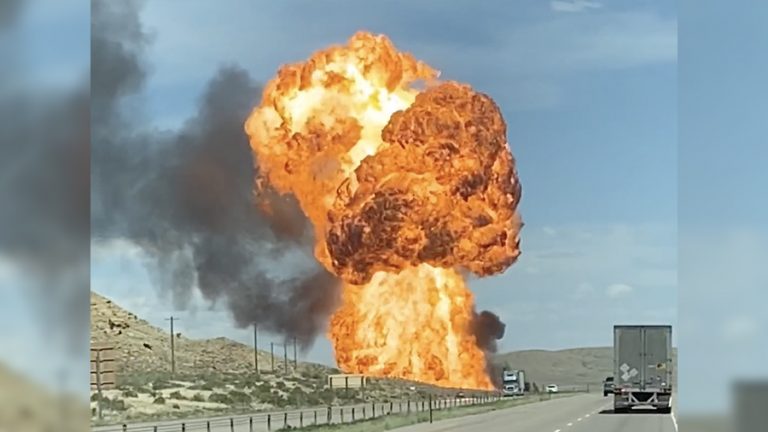
Plumes of smoke and flames shot upwards of 100 feet in the air Saturday afternoon moments after a train operated by Union Pacific Railroad derailed roughly four miles east of Rock Springs, causing several rail cars to catch on fire and explode, according to details provided by the company and first responders.
Local crews extinguished the dangerous fire by 3:30 a.m. Sunday.
The mixed freight was hauling 116 rail cars of alcohol and other materials when it derailed at 2:54 p.m Saturday. Nine cars sustained damage, though the exact cause of the incident remains unknown and is under investigation by Union Pacific and the Federal Railroad Administration.
Though some responders initially suspected the rail cars may have contained liquefied natural gas, only two HAZMAT products were being transported: liquefied petroleum gas/butane and ethanol, Union Pacific confirmed.
"When we first arrived on the scene, we saw huge, thick black smoke," Sweetwater County Fire District No. 1 Fire Chief Scott Kitchner told the Star-Tribune Monday. "This is pretty unusual," he added. "This is the second time in the 28 years I've been here that we've had a train derailment catch on fire."
He estimated about 20 to 30 trains were flipped over on their sides when he arrived, with the freight's long line of cars fractured into multiple sections from the derailment. Over a half dozen rail cars were engulfed in flames. Kitchner suspects the ethanol catalyzed the fireball explosion.
|
|
ARTICLE 8 - INTERNATIONAL RAIL NEWS
|
|
European Rail Freight Association Calls for New Rights for Freight Post Covid-19
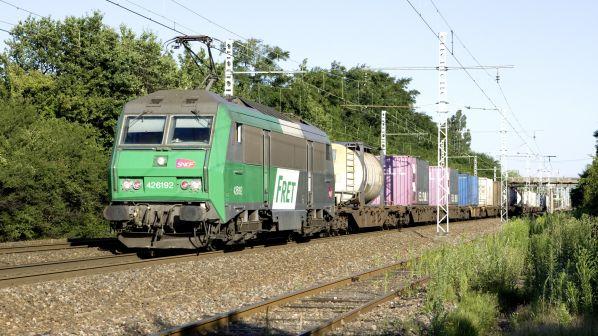
The European Rail Freight Association (ERFA) has called on the European Union to enshrine clear and well-defined rights for rail freight in a new European legislative framework which establishes a new normal upon exiting the current coronavirus crisis.
ERFA says the punctuality of international freight trains in Europe has improved from around 60% to 80-90% in recent months because of increased capacity on the network due to a sharp reduction in passenger traffic.
While passenger traffic will return, the association says it is essential for policy makers to learn lessons from the current crisis to the benefit of rail freight. It says that without improving rail freight punctuality and reliability, it will not be possible for Europe to reach its modal shift and decarbonisation targets.
ERFA secretary general, Mr Conor Feighan, says one of the key lessons from the Covid-19 crisis is that there is not yet a good framework for rail freight to operate.
“These lessons need to be taken into account in the Commission’s upcoming Strategy on Sustainable and Smart Mobility and, in particular, the revision of the Rail Freight Corridors Regulation,” Feighan says. “Continued and sustainable growth in rail freight can only be achieved through granting rail freight clear and well-defined rights.”
ERFA adds that the need to define these rights confirms the appropriateness of proposals from February 14 concerning the upcoming revision of Regulation 913/2010, a European rail network for competitive freight. The proposals are:
|
|
|
|
|
|
|