E-Newsletter | December 4, 2020 |
|
A Cow Named Tiger
Adventures in Puritan Animal Husbandry
By Bethany Groff Dorau
The 19th century almost ruined 17th century Newbury for me. Picture the scene – Godly Puritans, dressed in various earth tones, covered from head to toe, going silently about their business. They were never noisy, bright, funny, profane, joyful, vulgar, petty, sentimental, you know, human.
Most of us were not brought up to consider where we learned about these killjoy sourpusses with no Christmas (true, at least by law), dull sex lives (decidedly untrue) and admirable emotional restraint (well, sometimes).
The short version is that faced with new immigrants, many of them Catholic, from cultures stereotyped as overly emotional, loud, sexually dangerous, etc., there was a concerted effort in 19th century America to portray the Puritans as the opposite of all that, and therefore models for new Americans to emulate.
There is plenty of evidence in the record to support this view of Puritan Newbury. Mandatory church attendance, whippings for swearing and fines for shelling peas on the Sabbath are all in the record.
I have been an animal lover since birth, and now dedicate a significant amount of time and treasure to caring for farm animals, many of them rescued from neglect and abuse. The way a culture treats its working and food animals has perhaps outsize meaning for me.
In a romp through the Essex County Quarterly Court Records, I met Newbury’s own “Wild Rascal/Matt/Tiger-the-cow” and had to rethink another assumption I had made about early Newbury.
Let’s set the time machine to 1657.
|
|
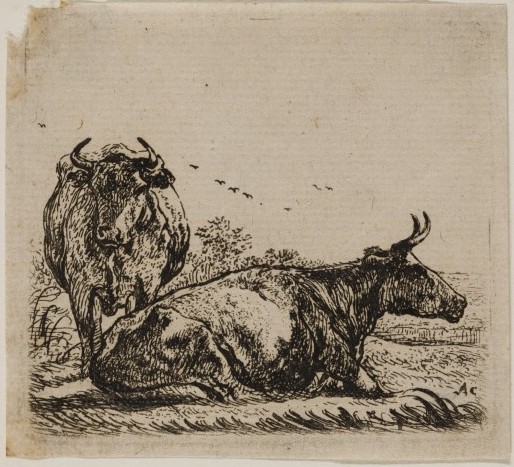
17th century bovines. From the collections of the Detroit Institute of Arts. |
|
Peter Godfrey is working as a herdsman for Mr. Noyes. Godfrey goes looking for a steer that was lost and finds it in John Chater’s herd, but with “new earmarks,” notches used to identify the ownership of animals kept in common areas. As with many of these cases, everyone in town seems to have had an opinion on whether the steer in question had been filched from Noyes.
John Chater’s two children offered, to me, the most interesting bit of evidence. “John Chater's two children deposed that the steer Mrs. Noyes had was one of five cattle brought from Rowley and at first they called him ‘Wild Rascal’ but after he was marked, they called him ‘Matt.’ The beast John Poore [another Newbury farmer] had was called ‘Tiger.’ ”
Think about this for a minute. There are two bovines wandering around Newbury in 1657 called “Wild Rascal,” who became “Matt” and “Tiger.” Matt? I laughed aloud.
What does a young steer have to do to be called “Tiger?” Who in Newbury in 1657 had ever seen a picture of a tiger? Turns out there are tigers aplenty in the Bible. Who knew? The Puritans, that’s who. Naming an animal is often the first indication of a sentimental attachment, I find. If Newbury farmers routinely named their cattle, perhaps there was more to learn about how they related to animals in general.
Further evidence from Newbury itself is fragmentary, but a thorough examination of the Essex County Quarterly Court records offers examples of prosecutions for the mistreatment of animals.
It would be easy enough to dismiss these cases as property crimes, after all, livestock was a valuable commodity, but in several instances, the owners of the animal were the accused.
In 1649, Ann Hagget was fined for “beating her child and a calf with an axe in a cruel manner.”
In 1666, Abraham Fitts of Ipswich was convicted of cruelty to his ox. This case is described in detail and is worth quoting at length.
“Thomas Burnham deposed that he saw Fitts with his sled near Mr. Hubert's barn and he noticed that the bullock was very white with frost, the weather being very cold and the bullock being in a great sweat. Deponent told him he should put the bullock in a warm place as soon as he could.”
“Samuel Ayers of Ipswich deposed that he saw Abraham Fitts come with a load of wood upon a sled by his house, a reasonable load for two cattle. Going over the gutter near his barn, the off [sick] bullock slipped upon the ice and he could not get him up… (his) dog shook the bullock by the ear. After the bullock was dead, Fitts desired deponent to help him draw him to Deacon Pingree’s, but the latter refused it, and he went to three men to take the hide but could get none to do it.”
This sad case offers the picture of a community coming together to condemn the mistreatment of an ox, not a pet or a fine horse, but a workaday animal.
Members of the community admonished Fitts on the suffering of the animal and advised him to let the animal rest “in a warm place.”
Further, the community refused to participate in the animal’s slaughter after death, neither hauling it out of the road nor taking the offered hide, a valuable piece of leather.
Puritans as never being sentimental, indeed.
I will leave you with this…the image of a young man in Bradford with a pet deer who wears a red bow around its neck. The court case that brought this vision to light, however, is a story for another time.
Bethany Groff Dorau is a historian, writer and Regional Site Administrator for Historic New England, based at the Spencer-Peirce-Little Farm in Newbury. Some of the material used in this story is taken from Dorau's book, A Brief History of Old Newbury (History Press).
|
|
Going Once, Going Twice!
Auction of Merman Replica Underway
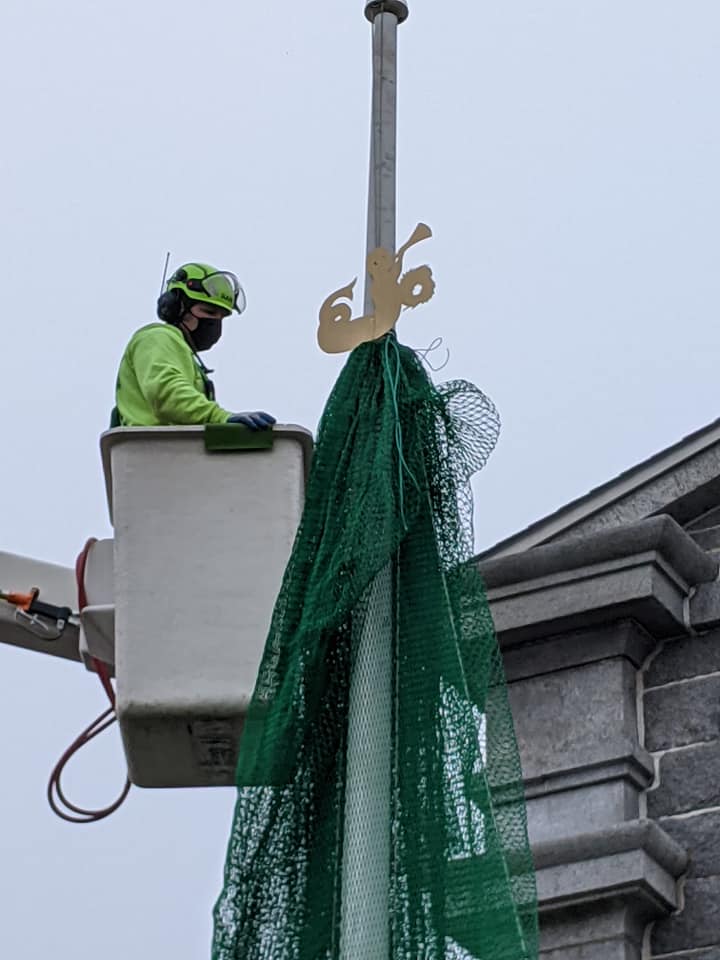
A gilded steel replica of the Merman* will be featured high atop the Custom House Maritime Museum's "Maritime Tree" and is up for auction. Worker installs the topper via "the bucket!" Tree lighting is today at 4:30 p.m.
This hand cut and crafted Triton with Horn, also known as the Merman, is similar to the one on the Museum of Old Newbury's sign and was made by museum Co-President, David Mack. It can be used as a tree topper or garden ornament. The piece measures 15"H x 18"W and is mounted on a 3' steel pole.
|
|
Join us Today @ Noon for "Yeat Yeat, Don't Tell Me!"
Watch and play along on Newburyport's fastest half-hour trivia show of all things Newbury and history related. Laugh and learn with your hosts, Jack Santos, Custom House Maritime Museum, and Colleen Turner Secino, Museum of Old Newbury, today, December 4, 2020, for "Yeat Yeat, Don't Tell Me!" (Zoom in here).
And save the date for Friday, December 18, 2020's show, featuring special guest, Alex Cain ( get link here), author, academic dean and one of the founding partners of Untapped History, a historical walking tour company based in Newburyport, Massachusetts.
Season 2 of "Yeat Yeat, Don't Tell Me!" starts Friday, January 8, 2021.
|
|
|
|
Coming to a desktop near you!
A Colonial Christmas
The Museum of Old Newbury is proud to present a holiday program to watch at your leisure. Board Member, Historian and Re-enactor Mike Welch will take you back in time and explain what holidays were like in the late 1700s through 1800.
He explains where words like "Christmas," "yuletide" and "wassail" originated or when mistletoe went from being a parasite on trees to a symbol of the holiday (and an opportunity to grab a kiss). Interspersed through the production, Mike will perform traditional carols, complete with lyrics so viewers can sing-a-long.
Gather 'round the computer screen and enjoy this cozy Colonial Christmas show, premiering on Friday, December 18, 2020; link available in that day's e-Newsletter.
|
|
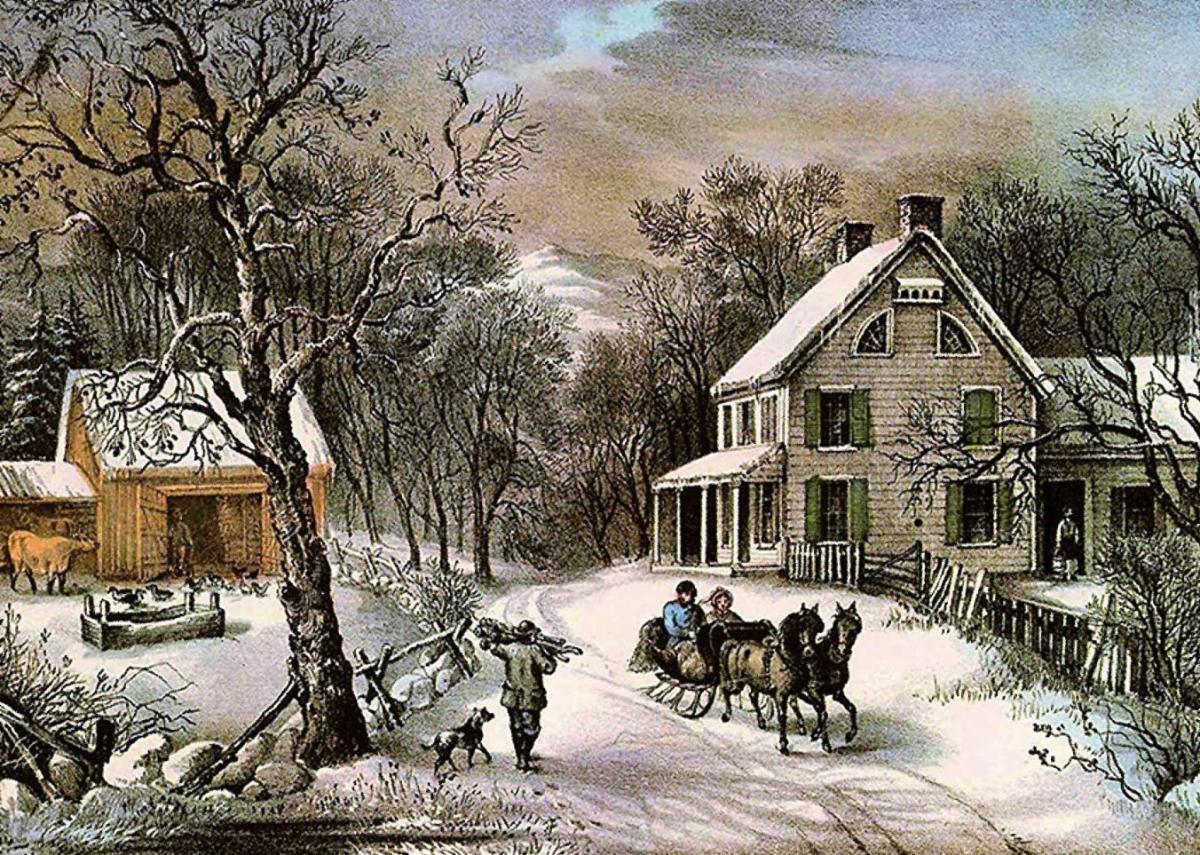
Presenter Mike Welch (above) and a classic Currier & Ives Christmas Sleigh Ride image. |
|
2021 MOON Programs Kick Off with Pirates and Part 2 of an Armchair Tour Across the Pond
Two virtual events will set the stage for the Museum of Old Newbury's Program of Events for 2021.
Jack Santos' A Newburyport Travelogue: Part 2 is set for Tuesday, January 5, 2021 @ 7:00 p.m. and Eric Jay Dolin's presentation of Black Flags, Blue Waters: The Epic History of America's Most Notorious Pirates will shove off on Thursday, January 14, 2021 @ 7:00 p.m.
Dolin, a celebrated author whose history books often focus on maritime topics, will take you through the Golden Age of American piracy when lawless pirates plied the coastal waters of North America and beyond. Register here (there is an $8 fee per household).
|
|
Puzzle Me This...If you have the time... |
|
...we have the puzzle!
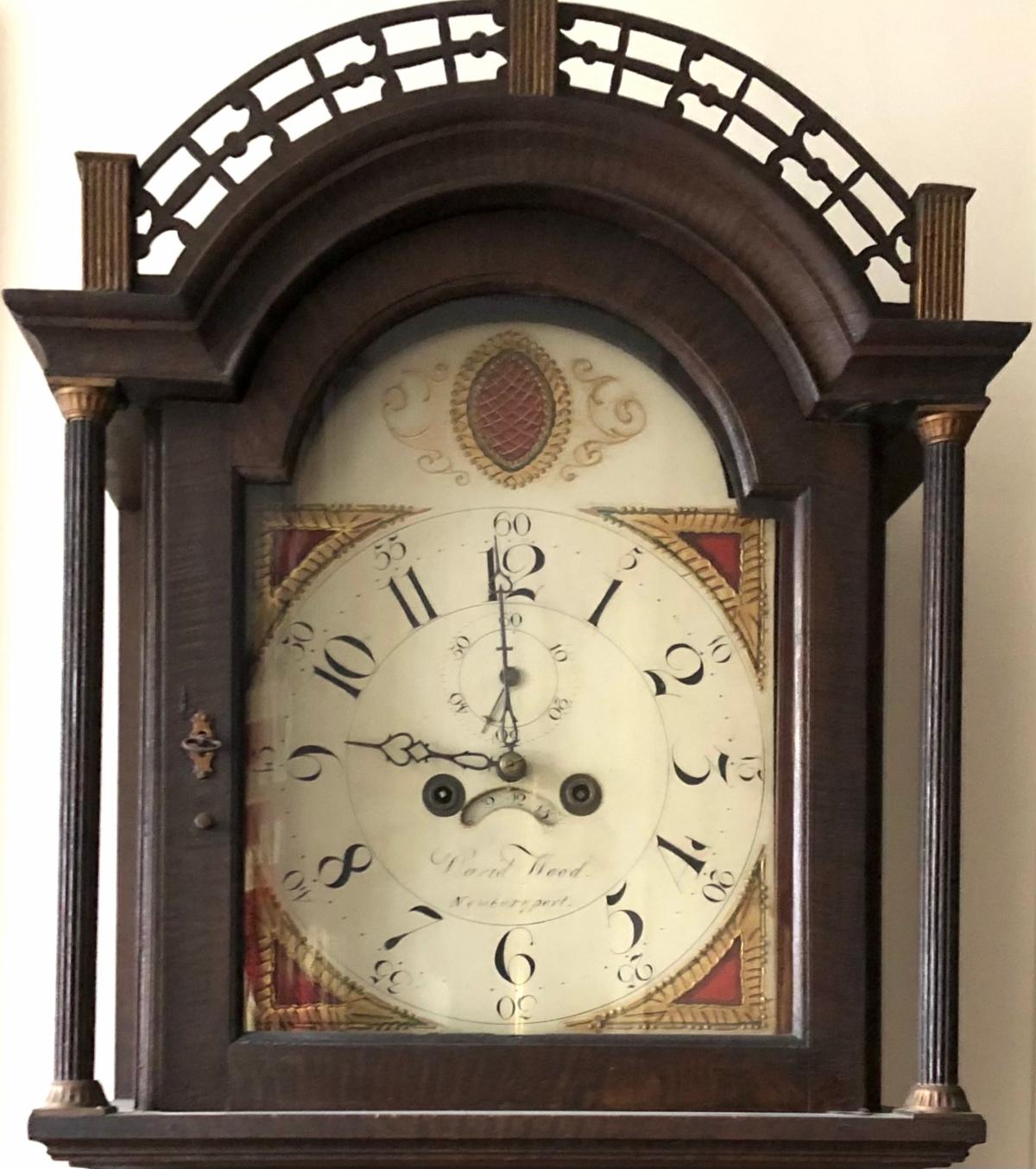
Close-up of the hand painted face on a tall case clock, featuring movement by David Wood.
The clock sports a paint grained pine case in imitation of mahogany veneer.
It is perhaps the only one of its kind with a Wood movement.
Newburyport, 1810-1820. From the collections of the Museum of Old Newbury.
Click on the image to begin.
|
|
Something is Always Cooking at the Museum
As the temperatures start to drop in earnest, nothing warms stomach and soul better than a hot bowl of chicken soup. Lynn Fiore's addition of meatballs takes it to a whole new level.
Chicken Soup with Meatballs
3-4 skinless chicken breasts
8 cups water
2 cloves garlic, chopped
1 teaspoon basil
1 teaspoon salt
1/2 teaspoon pepper
1 (15-ounce) can tomato sauce
32 ounces chicken broth
1 small bag petite carrots
1 cup orzo
Parmesan cheese
In a large pot, combine chicken, water, garlic, basil, salt, pepper and tomatoes. Bring to a boil. Reduce heat to simmer and cook 30-45 minutes. Remove chicken and let cool. Add chicken broth to liquid in pot. Add carrots and let simmer on low until carrots are tender.
Meatballs:
1 pound hamburg
3/4 cups fresh bread crumbs
1 egg, slightly beaten
Salt, pepper and basil to taste
Mix all together. Roll small meatballs (makes approximately 50) and add to simmering soup. Shred cooled chicken and add to soup. Let simmer, uncovered, 1 hour. If preparing ahead of time, one hour prior to serving, add orzo. Simmer 45 minutes. Top each bowl with parmesan cheese. Serves 8.
|
|
It's not too late! Order the 2021 Cushing House Calendar and your holiday gift giving worries are history.
You can stop by the Brown Chapel (Oak Hill Cemetery, 4 Brown Street, Newburyport), Saturday and Sundays through Christmas, 10:00 - 11:30 a.m., and purchase your 2021 calendar from Newburyport native and historian, Ghlee Woodworth.
COVID-19 safety protocols will be in place; masks and social distancing required.
$16.50 per calendar.
|
|
During this difficult period of COVID-19, we rely on your support more than ever. We are working to reschedule many of the programs that we have had to postpone, as well as develop new, online programs for you to enjoy and keep us connected. We hope, if you are able, that you will consider a donation to the museum. Thank you for your continued support.
|
|
Museum e-Newsletter made possible through the
generosity of our sponsors:
|
|
|
Museum of Old Newbury
98 High Street
Newburyport, MA 01950
978-462-2681
|
|
|
|
|
|
|
|