The American Society of Le Souvenir Français Inc.
Monthly Bulletin - Vol. III. No 3 - March 2023
|
|
French Forts of the Midwest |
|
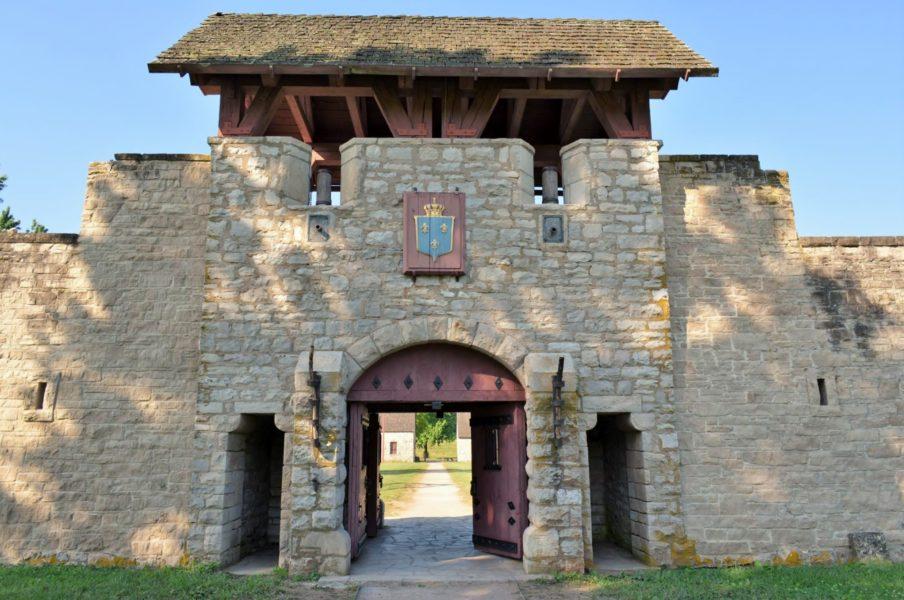
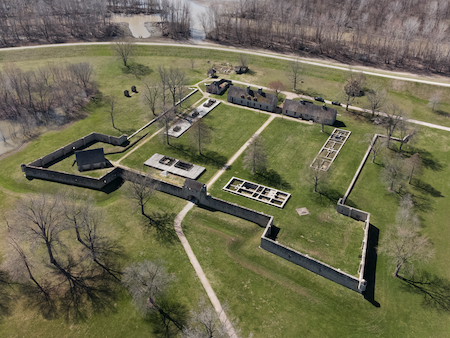
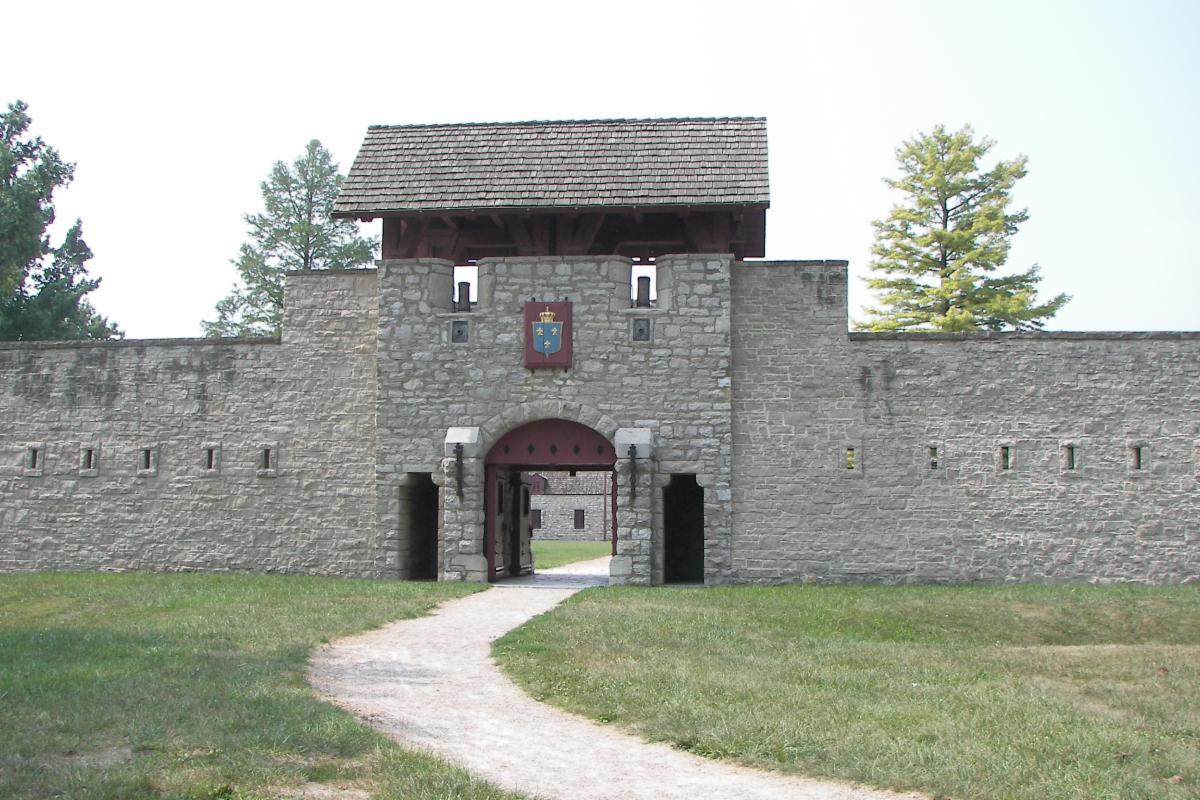
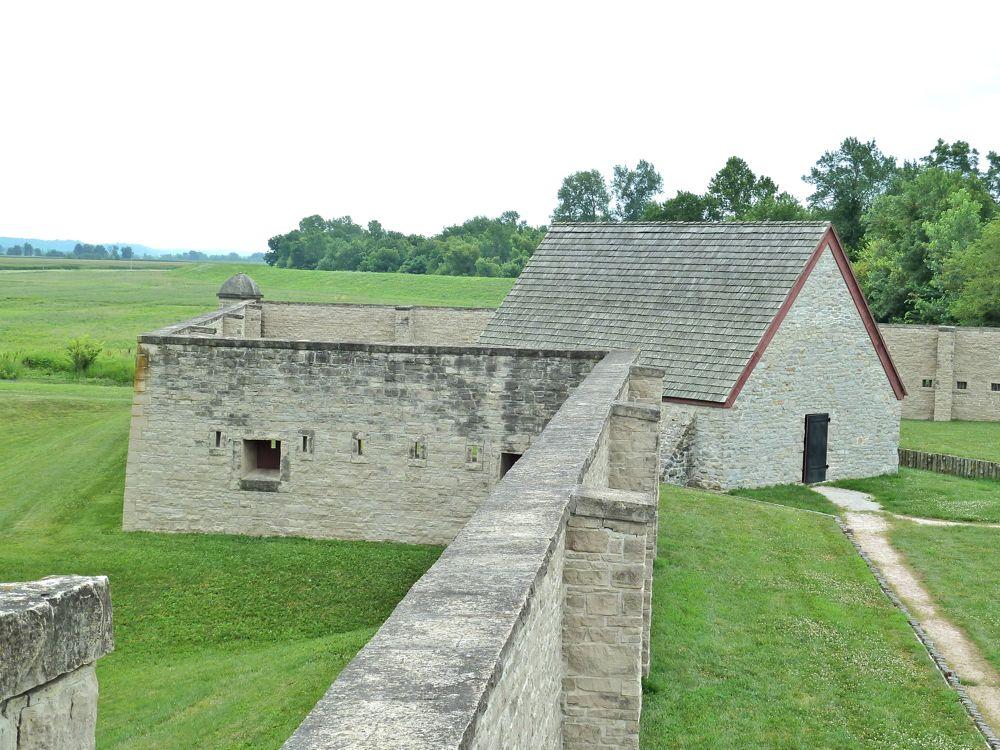
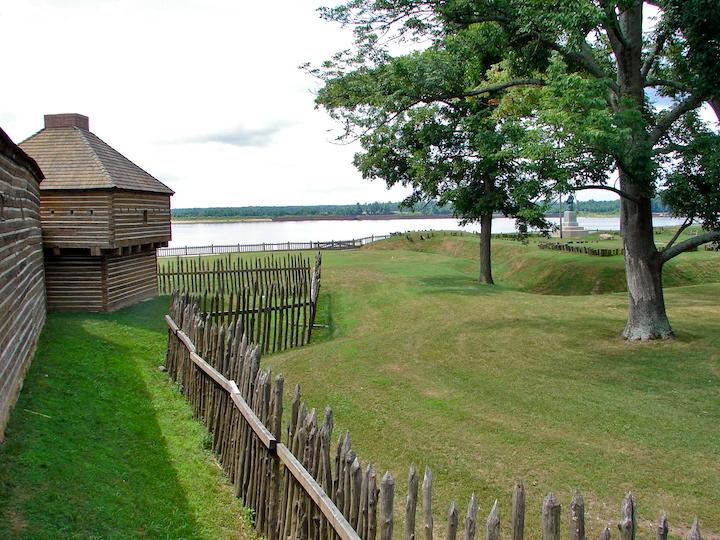
Cover photo, courtesy of Les Amis du Fort de Chartres: the Fort de Chartres, seat of civil and military government in the Illinois country for half a century, was first completed in 1720.
Located near Prairie du Rocher in the state of Illinois, Fort de Chartres is the only stone fort constructed by the French in the Mississippi basin, the heart of the North American continent. Three forts were built in succession between 1720 and 1755. Abandoned for several decades, the State of Illinois partially restored it to keep alive the testimony of the French presence in the region.
|
|
EDITORIAL
Spring is almost in the air, and hopefully soon, the mountains of snow that buried so many communities throughout the continent will melt. How did our ancestors survive brutal winter conditions? It is always a subject of amazement to think that not only they traveled vast distances in hostile terrain, but that they built settlements and fortifications armed only with faith and rudimentary toolings.
As is often the case, we go about our daily lives without realizing that right where we stand, walk, or drive, there are untold stories of men and women who labored and fought to build this continent. Fortunately, there are also many sites that are preserved or restored for the edification of the public. Such is the case with several of the French Forts that connected a vast empire, stretching from Canada to the Gulf of Mexico, called then La Nouvelle France, (New France), and which can be visited today.
This Bulletin will introduce some of these forts, in the states of Michigan, Indiana,Illinois, Wisconsin, Minnesota, which constitute today what was called then Upper Louisiana. In a future Bulletin, we will explore forts located in the states of Mississippi, Missouri, Alabama, Florida, Louisiana, spanning several decades. While it is outside the scope of our Bulletins to describe in depth each and every one of them, we do introduce some of the valiant explorers who claimed vast territories for the king of France. We also pay our respects to all the officers and soldiers who marched for days and months, toiling under most adverse conditions, most of whom are buried in anonymous locations.
Fast forward to today: our association is expanding its territorial coverage. We are honored and pleased to announce the appointment earlier this month of Mr. Alain Leca of Washington, D.C. and Mr. Bruno Cateni of Houston, as Regional Delegates for the District of Columbia and the Southern States respectively. You will read more about them in the pages below.
We wish a warm welcome to both!
We are also proud to be active participants in the Bicentennial Committee of the triumphal farewell tour of General Lafayette, led by the American Friends of Lafayette, as part of America250 celebrations ordained by the US Congress. In this Bulletin, we will continue to follow this most illustrious Frenchman on some of his footsteps during the month of March 1825. The upcoming Centennial promises to be a momentous series of celebrations, stretching 24 States over 13 months. We will duly inform you as these celebrations are finalized.
Already, you may mark your calendar for the official kick-off welcome parade in Lower Manhattan on August 16, 2024!
Finally, as always, we will announce some upcoming events from like-minded sister organizations that are of great interest to our members and sympathizers.
We thank all of you who have recently renewed your 2023 membership, and if you haven't done so yet, please consider doing so. No contribution is too small, and your support is gratefully appreciated. You will find the instructions at the end of this Bulletin.
In closing, feel free to share this e-Bulletin with the education community. Honoring our forebears who contributed to the exploration, expansion, and freedom of the United States is important. A vital part of our mission is to educate the younger generations so that they understand the sacrifices which were made, and develop a renewed appreciation for the long and rich history of America the Beautiful. And, hopefully, visit some of these forts!
Thank you as always for your remarks, suggestions and support.
On behalf of the Board of Directors.
Thierry Chaunu, President,
American Society of Le Souvenir Français, Inc.
|
|
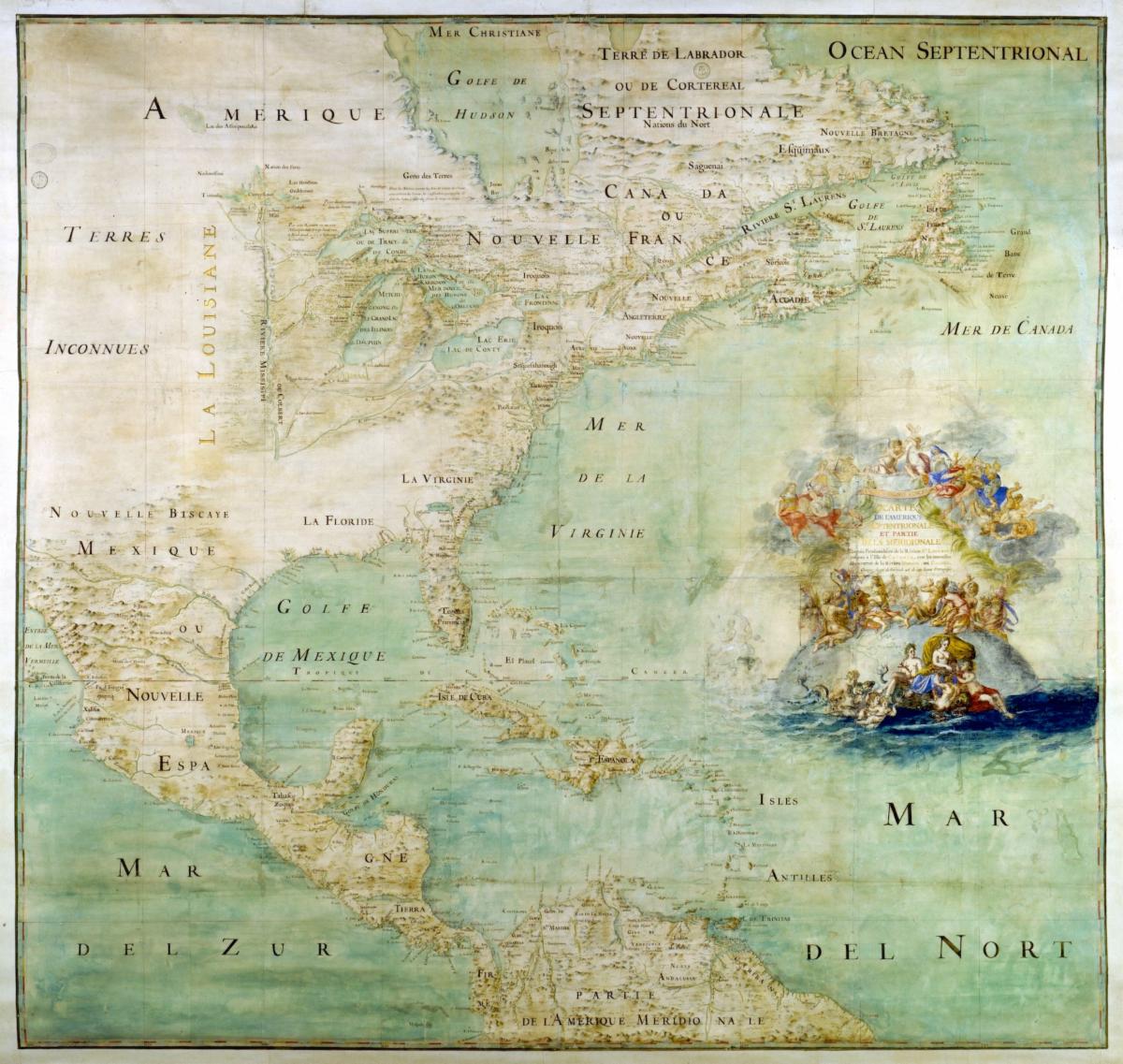
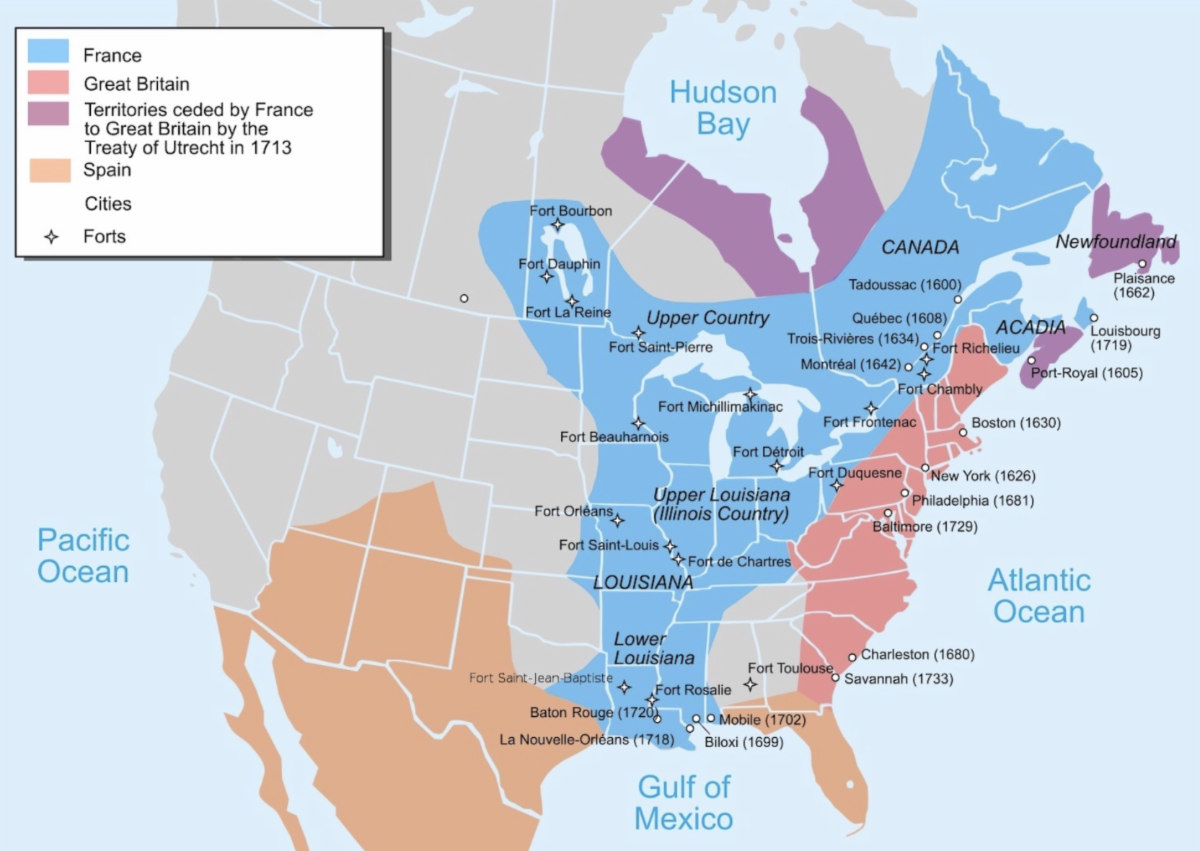
MAP OF THE NOUVELLE FRANCE |
|
France built a vast empire in America over two centuries, from 1534 until 1763. Sparsely populated, this vast empire was impossible to defend with a military constantly engaged in wars in continental Europe. Today, vestiges of this presence in the United States are found in a few fortifications throughout the Mississippi basin, and dozens of cities with French names.
In this Bulletin we will visit the forts of the northern part of New France, also called Upper Louisiana, primarily in present-day Michigan, Illinois, Minnesota, Wisconsin, Indiana. In a future Bulletin we will explore the forts of Lower Louisiana, and tell their story in Mississippi, Missouri, Alabama, Florida, Louisiana.
It is impossible to talk about these forts without introducing first some of the most prominent soldiers-explorers who tirelessly canvassed these vast regions from North to South, and built forts in both.
|
|
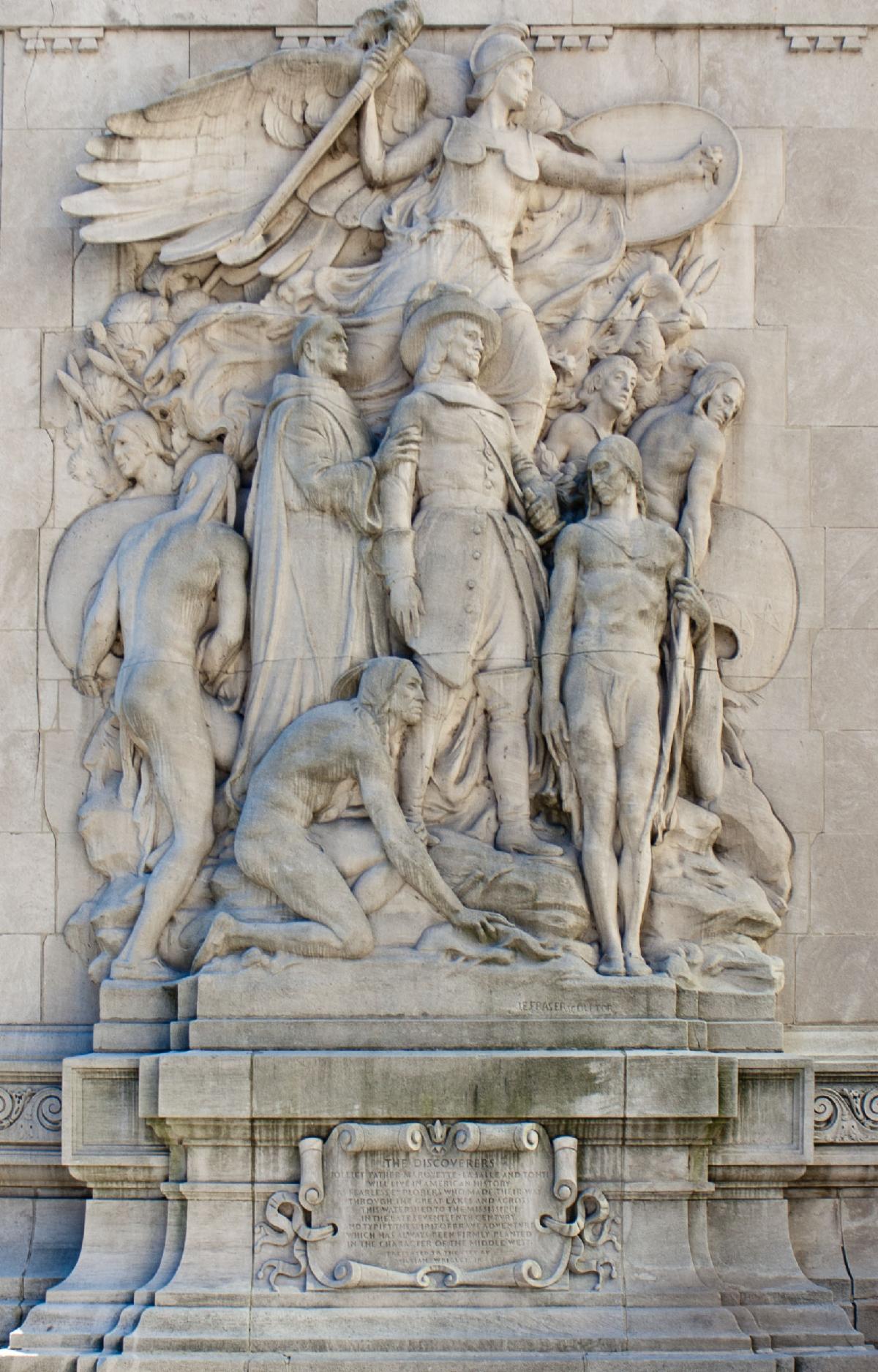
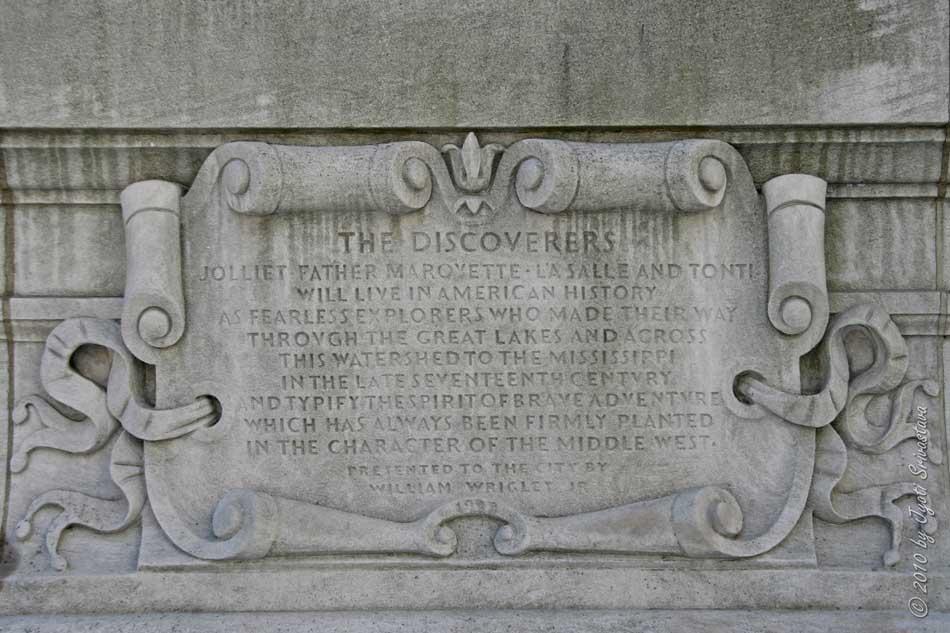
Monument, "The Discoverers”
DuSable Bridge (on formerly Michigan Avenue), Chicago IL 60611
The Discoverers by James Earle Fraser, 1928. This sculpture adorns the wall of the north eastern bridge tender's house on DuSable bridge in Chicago, Illinois.
|
|
• The bridge is situated in a historically significant area. The northern end of the bridge covers part of the Jean Baptiste Point Du Sable Homesite, which is commemorated by a National Historic plaque in Pioneer Court. In 1928, sculptures depicting scenes from Chicago's history were added to the outward-facing walls of the four bridgehouses.
• "This relief portrays French explorers Louis Joliet and Jacques Marquette, who determined in 1678 that Chicago was the site of the passage between the Great Lakes and the Mississippi River system, and René Robert Cavelier, Sieur de La Salle, and his lieutenant, Henri de Tonti, who explored the entire Mississippi River area between 1679 and 1682. Although Marquette was a Jesuit priest, he is depicted in the robes of a Franciscan monk. There is a profile of a kneeling native American in the foreground. An allegorical female figure floats above the more boldly carved, Beaux-Arts figure group” (Smithsonian Institution Research Information System)
• Inscription:
“Jolliet, Father Marquette, La Salle and Tonti will live in American history as fearless explorers who made their way through the Great Lakes and across this watershed to the Mississippi in the late seventeenth century and typify the spirit of brave adventure which has always been firmly planted in the character of the middle west. Presented to the city by William Wrigley Jr. 1928
Erected 1928 by William Wrigley Jr."
|
|
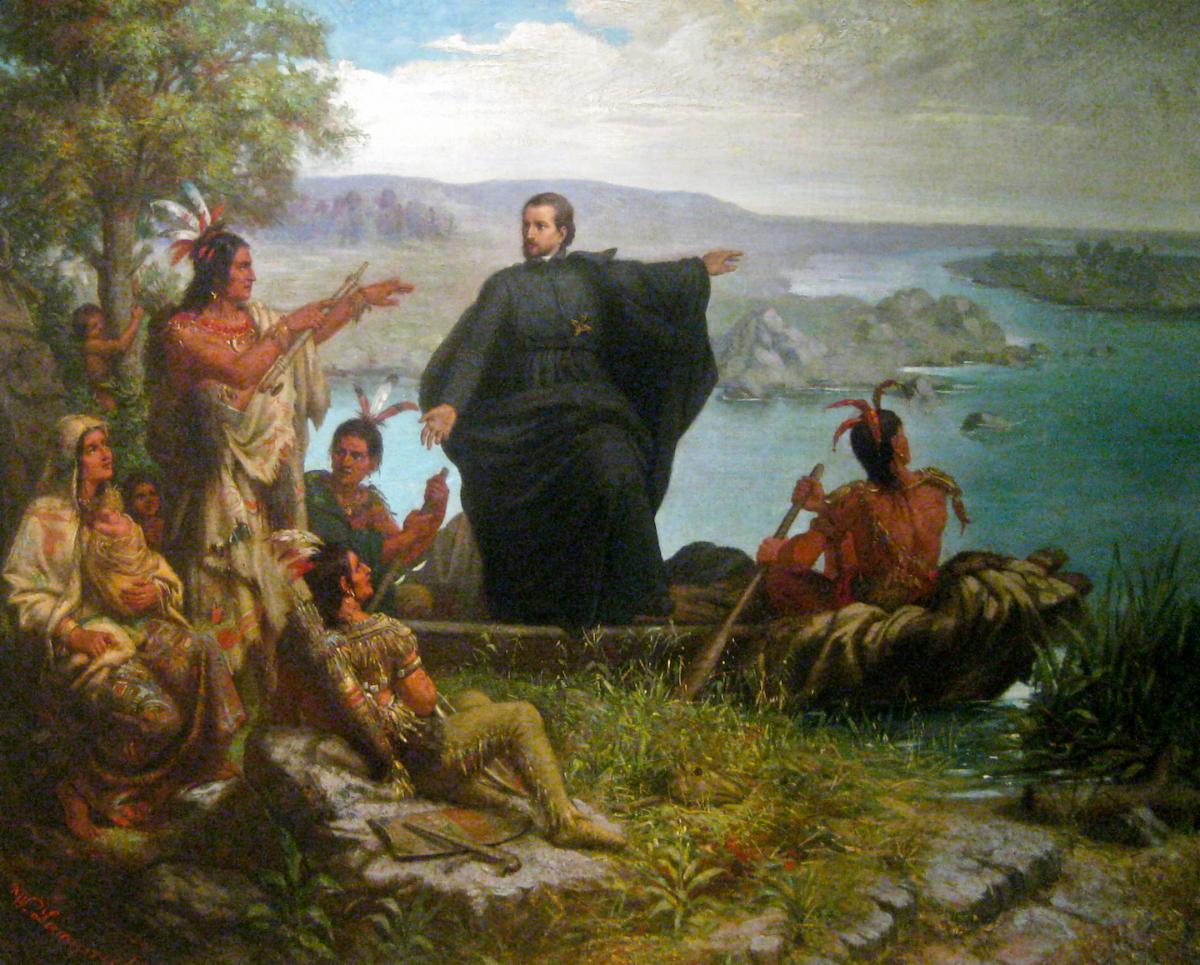
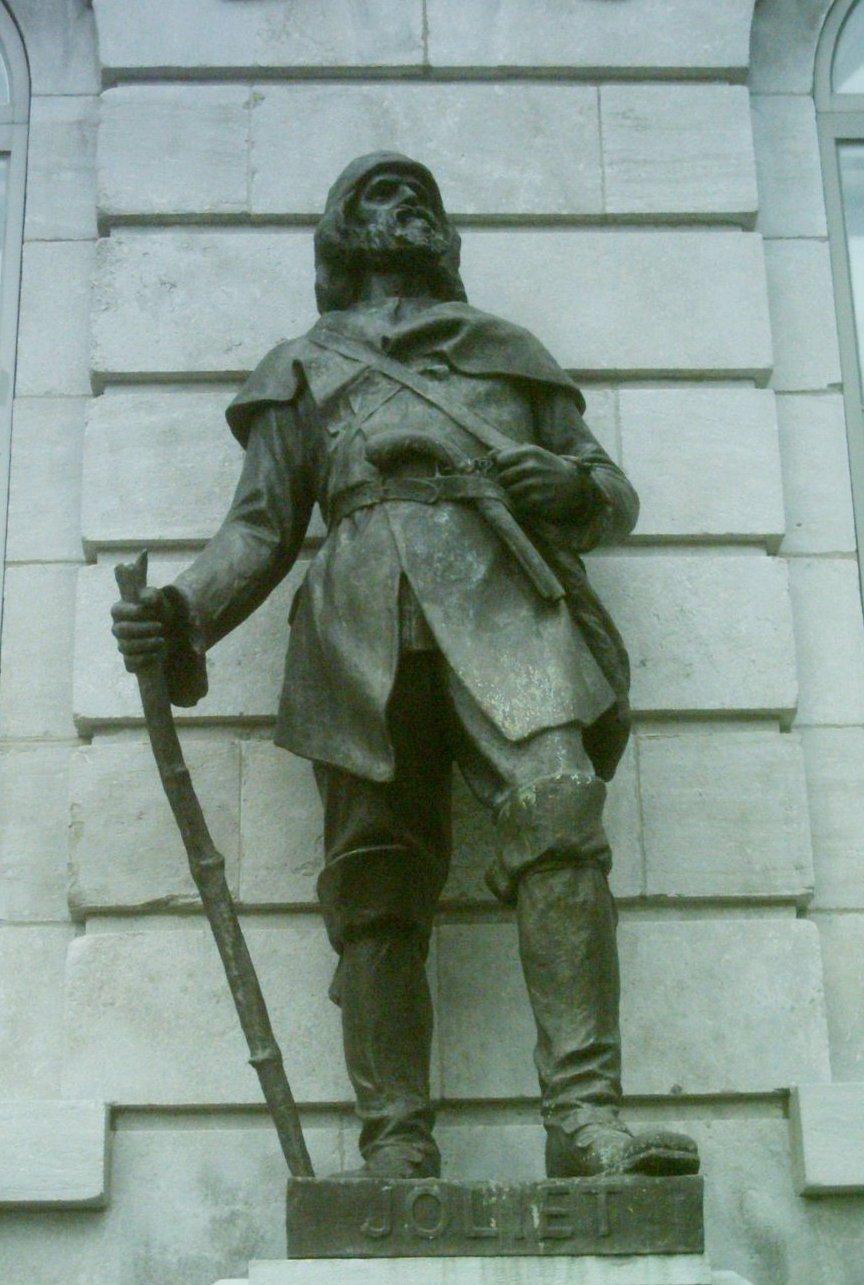
Father Marquette & Louis Joliet |
|
Bottom: Alfred Laliberté’s sculpture of Louis Joliet in front of l'Hôtel du Parlement de Québec photo by Jean Gagnon, via Wikimedia Commons
|
|
• Jacques Marquette, French Jesuit missionary and explorer, was born in Laon, France, on June 1, 1637. After years of preparatory study and teaching, he arrived in Quebec in 1666, studied Indian language and culture, and was sent in 1668 to Sault Ste. Marie, a mission among the Ottawa Indians, and to La Pointe de St. Esprit.
• While he was at St. Ignace on Mackinac Island in December 1672, an old friend, the trader Louis Joliet, arrived with orders for Marquette to accompany him on a journey to explore the Mississippi. Embarking in May 1673, they reached the confluence of the Mississippi and Missouri rivers. Indians told them that the Mississippi (which Marquette named Riviere de la Conception) emptied into the Gulf of Mexico and warned them of Spanish settlers farther downstream. They turned back to avoid being captured with their information on geography and Indian culture. By May 1674 Marquette was very ill; while recovering his health he prepared notes for publication in Jesuit Relations, since the official record had been lost.
• In October 1674, Marquette fulfilled his wish to establish a mission at Kaskaskia, where he and Jolliet had spent time. Marquette's poor health forced their return to Sault Ste. Marie. Marquette died en route and was buried on May 18, 1675. His remains were returned to St. Ignace by Indian converts and placed in a chapel, which was destroyed by fire in 1706. In 1877 the grave was discovered, and a monument was erected in 1882.
• Louis Joliet (also spelt Jolliet) (September 21, 1645 – after May 1700) was a French-Canadian explorer known for his discoveries in North America. In 1673, Jolliet and Jesuit Father Jacques Marquette were the first non-Natives to explore and map the Upper Mississippi River.
• On May 17, 1673, Jolliet and Marquette departed from St. Ignace, Michigan, with two canoes and five other voyageurs of French-Indian ancestry.
The Jolliet-Marquette expedition traveled down the Mississippi to within 435 miles (700 km) of the Gulf of Mexico. They turned back north at the mouth of the Arkansas River. The voyageurs then followed the Mississippi back to the mouth of the Illinois River, which friendly natives told them was a shorter route back to the Great Lakes. Following the Illinois river upstream, they then turned up its tributary the Des Plaines River near modern-day Joliet, Illinois. They then continued up the Des Plaines River and portaged their canoes and gear at the Chicago Portage. They then followed the Chicago River downstream until they reached Lake Michigan near the location of modern-day Chicago.
• Father Marquette stayed at the mission of St. Francis Xavier at the southern end of Green Bay, which they reached in August. Joliet returned to Quebec to relate the news of their discoveries.
|
|
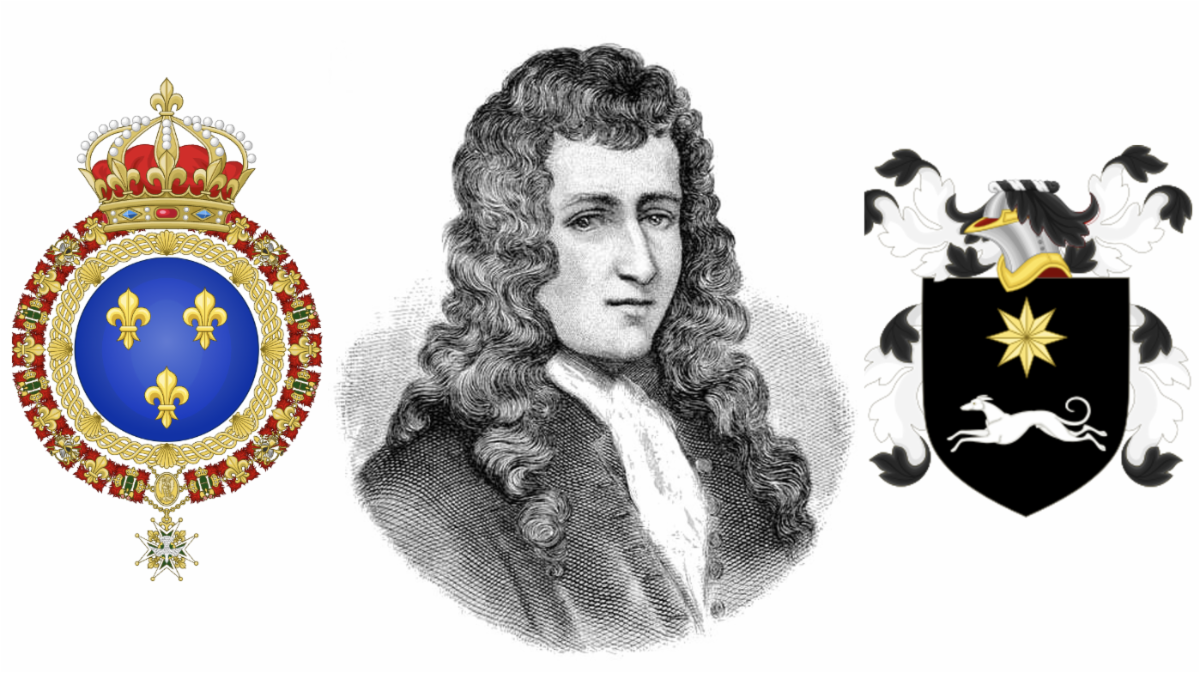
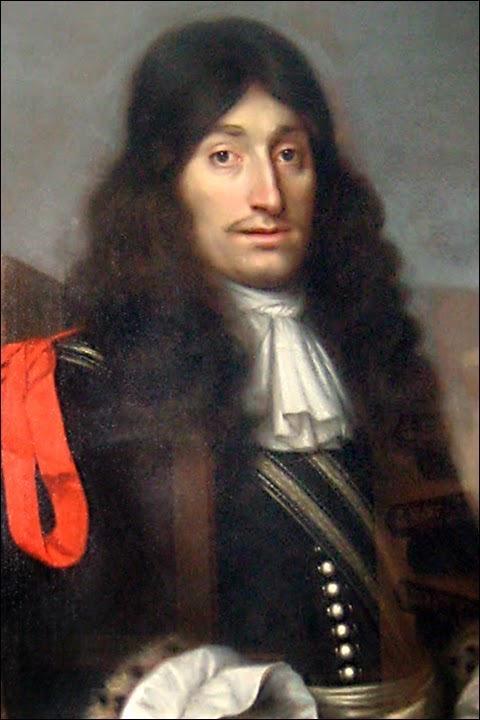
René-Robert Cavelier, Sieur de La Salle (1643-1687)
|
|
Right: Coat of arms of René-Robert Cavelier, Sieur de La Salle - via Wikimedia Commons
|
|
• Robert Cavelier was born on November 22, 1643, into a well-off family in Rouen, Normandy. He became a Jesuit and sailed for New France in the spring of 1666 but was soon released from the Society of Jesus after citing "moral weaknesses”. He received the title Sieur de La Salle with his seigneurial purchase of Lachine near Montréal.
• He learned several native languages, such as the Iroquois and Seneca, and began to plan for expeditions to find a western passage to China. He built ships such as the Griffon to navigate the Great Lakes and build forts such as Fort Conti (later rebuilt and renamed Fort Denonville, and then Fort Niagara in Youngstown, NY, as narrated in our January 2023 Bulletin) and Fort Miami in Michigan (presented further below).
• In 1679, with a party of 40 men, he went on to explore the Mississippi River, taking him to today’s Peoria, IL, (Fort Crevecoeur) Memphis, TN, (Fort Prudhomme), reaching the Gulf of Mexico in 1682 where he named the basin Louisiana in honor of King Louis XIV.
• In 1684 he went on an ill-fated mission to Texas (see further down the expedition of La Belle shipwreck) and after wandering for two years lost in the marshes of the Mississippi delta, he was killed during a mutiny near Navasota, TX on March 19, 1687.
• Dozens of sites, streets, parks, buildings throughout the United States bear the name of La Salle, with monuments, markers in several States:
Counties, towns and parks:
LaSalle County, Illinois, La Salle County, Texas, the city of LaSalle in Illinois, LaSalle Parish, Louisiana, La Salles Landing Park on Irondequoit Creek in Penfield, NY, Robert LaSalle County Park, Door County, Wisconsin.
Dozens of avenues, streets, highways, buildings are named La Salle, such as:
The LaSalle Street, a north–south thoroughfare in Chicago, leads directly to the Board of Trade, and is the center of Chicago's financial district, or La Salle Avenue in downtown Minneapolis, La Salle Street in Navasota, Texas.
Our society plans to honor with a wreath-laying ceremony the great explorer at the site of his statue in Port Lavaca, Texas, which was erected in 1936 by the local Robert Raines Chapter of the National Society Daughters of the American Revolution and the Texas Society Daughters of the American Revolution.
|
|
Henri de Tonty « The Father of Arkansas » |
|
• Henri de Tonti (né Henrico Tonty (c. 1649 – 1704), was born in Gaeta, Italy. His family was forced to seek political asylum and moved to Paris, France around the time of Henri’s birth. He became a French military officer, explorer, and voyageur who assisted René-Robert Cavelier, Sieur de La Salle, with North American exploration and colonization from 1678 to 1686.
• In 1668, at the age of 18 or 19, Henri joined the French Army. He also later served in the French Navy
• With La Salle, de Tonti was one of the first explorers to navigate and sail the upper Great Lakes. They also sailed the Illinois and the Mississippi, which they traveled to its mouth and claimed for King Louis XIV, the "Sun King".
• De Tonti established the first permanent European settlement in the lower Mississippi valley, known as Poste de Arkansea, making him "The Father of Arkansas." In this trading post in Arkansas, he left six Frenchman to secure a permanent French settlement in which trade with the Quapaw tribe became possible, and to hinder English invasion in the east by establishing a presence in the middle of North America.
• Henri's brother Alphonse was born in 1659, and later became one of the founders of what is now Detroit.
|
|
106 W Straits Ave, Mackinaw City, MI 49701
Fort Michilimackinac is located in today's Mackinac County. This area between Lake Huron and Lake Michigan was known to the Odawa tribe as Michilimackinac, meaning "Big Turtle".
Marker, "France at Mackinack"
251 South State Street, Saint Ignace MI 49781
|
|
• Fort Michilimackinac was built by the French around 1715, and abandoned in 1783, it was located along the Straits, which connect Lake Huron and Lake Michigan. The primary purpose of the fort was as part of the French-Canadian trading post system, which stretched from the Atlantic Coast and the St. Lawrence River to the Great Lakes, and south to the Mississippi River through the Illinois Country. The fort served as a supply depot for traders in the western Great Lakes
• During the French and Indian War, joint Native American and French forces from Michilimackinac traveled south to battle British and colonial American troops. On July 9, 1755 those forces, led by Michilimackinac's Charles de Langlade participated in the defeat of General Edward Braddock and a young George Washington at the Battle of Monongahela River in Pennsylvania.
• Each Memorial Day Weekend since the 200th anniversary of the Indian attack of 1763, the residents of Mackinaw City reenact the history of the 18th Century British, French, and Native American community. Originally called the Massacre at Michilimackinac, the free event was renamed the Fort Michilimackinac Pageant as the region grew more socially conscious and aware of Native American contributions and treatment.
• The French surrender scene re-enacted regularly at the Fort Michilimackinac Pageant never took place in real life, since the French military left the year before the arrival of the British garrison...
• Excerpts of Marker:
“Fort Michilimackinac:
Around 1715 Constant Le Marchand de Lignery established Fort Michilimackinac for the French at the site of a Jesuit mission. During the next fifty years as France and Great Britain struggled for control of the fur trade in the Great Lakes region, the fort expanded as a trading settlement and a military post. Soon after hostilities of the French and Indian War ceased, the British took control of the fort in the fall of 1761. Two years later local Chippewa (Ojibwa), angered by British policies, captured the fort as part of Pontiac’s Uprising. The British regained control in 1764. Between 1779 and 1781, during the American Revolution, the British built Fort Mackinac on nearby Mackinac Island and abandoned Fort Michilimackinac.
Erected 2009 by Michigan Historical Commission - Michigan Historical Center and Mackinac Island State Park Commission”
• Excerpts of second marker "France at Mackinac":
“... French Explorers: In the 1620s French explorer Etienne Brûlé became the first European to set eyes on the Great Lakes. In 1634 Jean Nicolet passed through the Straits of Mackinac searching for a water route to China. By 1658 traders led by Médard Chouart des Groseilliers and Pierre Esprit Radisson plied these waters in search of furs in Michigan and Wisconsin...”
“French Missions: In the 1640s French missionary priests brought the Christian gospel to the people of the upper Great Lakes. In 1671 Father Jacques Marquette established a mission on Mackinac Island. After a few months Marquette moved the mission to the north side of the Straits and named it St. Ignace in honor of the founder of his Jesuit order St. Ignatius Loyola. Father Marquette was eager to take his message to distant tribes. In 1673 he accompanied Louis Jolliet on an exploratory trip that led to the European discovery of the Mississippi River. “
“French Culture and Indian Ways: French men often married Native women. An Indian wife provided an important connection between the European trader and the Native peoples. Her family ties were essential because Indian people wanted to trade with merchants they could trust. Their children bridged both cultures and were known as metis. Metis were the major population of the Straits of Mackinac into the early 19th century. Today French descendants remain in the Straits area.”
“French Marines at Mackinac: Soldiers of the Compagnies Franches de la Marines (Independent Company of Marines) served at the Straits of Mackinac beginning in the late 1600s. In 1715 French Marines began a 45-year period of service at Fort Michilimackinac. Here they protected the community and supervised the fur trade. French officers also recruited Native American warriors at Michilimackinac to fight against British forces as far away as Ohio and New York.”
|
|
396 North State Street, Saint Ignace MI 49781
Fort de Buade Depiction from Town Marker, photo by John Stanton 28 Aug 2013, FortWiki
|
|
• Fort de Buade was built in the present U.S. state of Michigan's Upper Peninsula across the Straits of Mackinac. It was garrisoned between 1683 and 1701. The city of St. Ignace developed at the site, which also had the historic St. Ignace Mission founded by Jesuits. The fort was named after New France's governor at the time, Louis de Buade de Frontenac.
• Inscription:
“This fort was built by the French near here within a decade after Marquette had established his mission in 1671. Its name was that of the family of Frontenac, the French Governor for North America. Until Detroit was founded in 1701, this was the most important French post west of Montreal. The fort's commandant had charge of all other French forts in the West. Also known as Fort Michilimackinac, it was the first of three forts which were to bear this name in the Straits area.
Erected by Michigan Historical Commission”
|
|
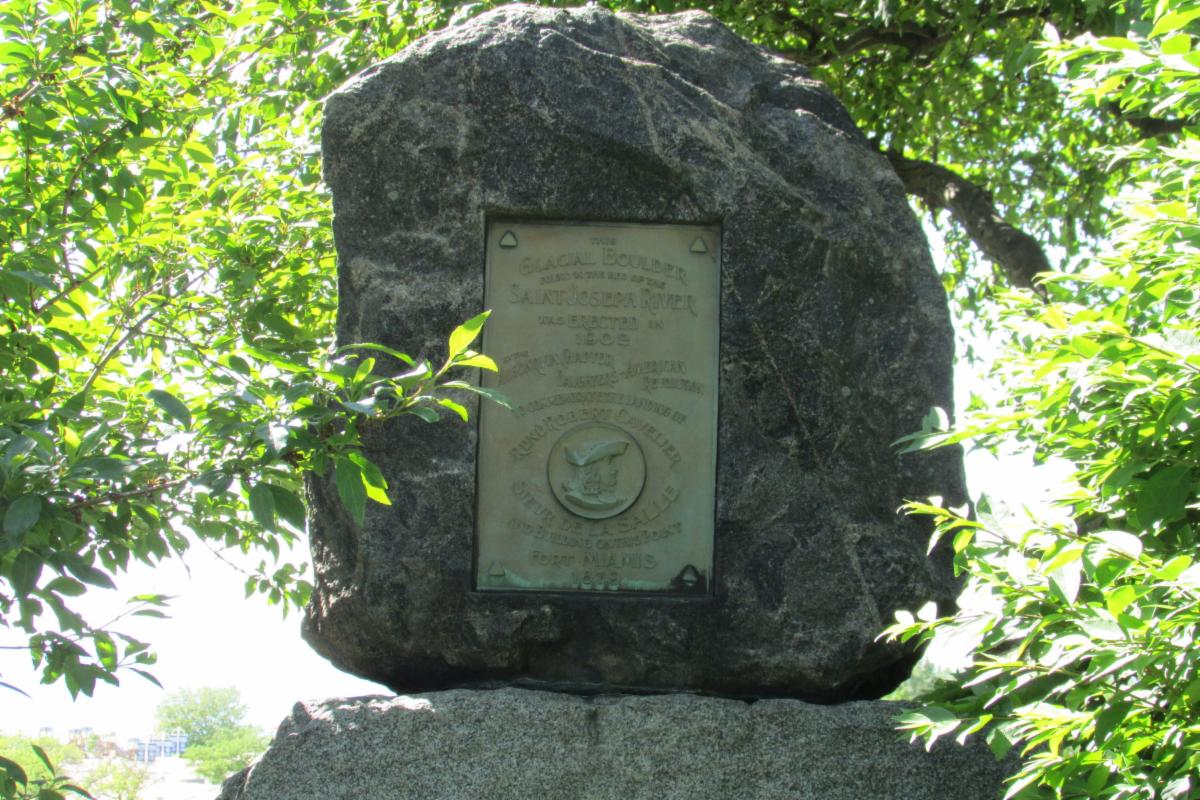
200 Lake Street, Saint Joseph MI 49085
|
|
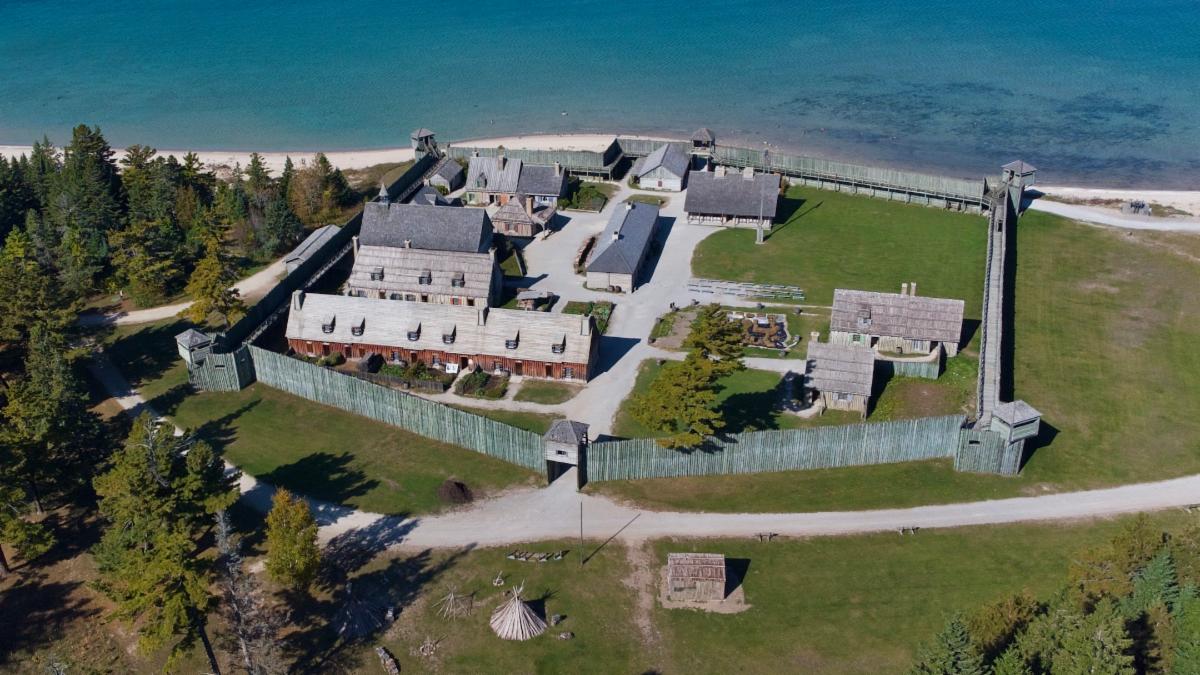
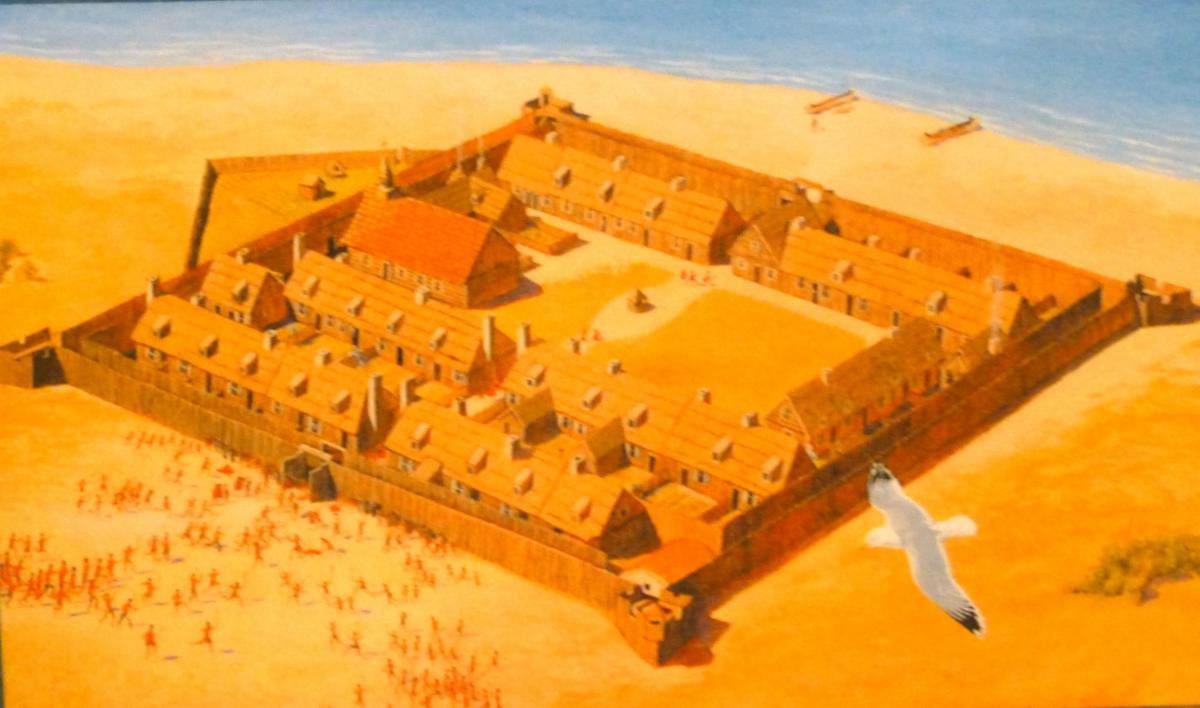
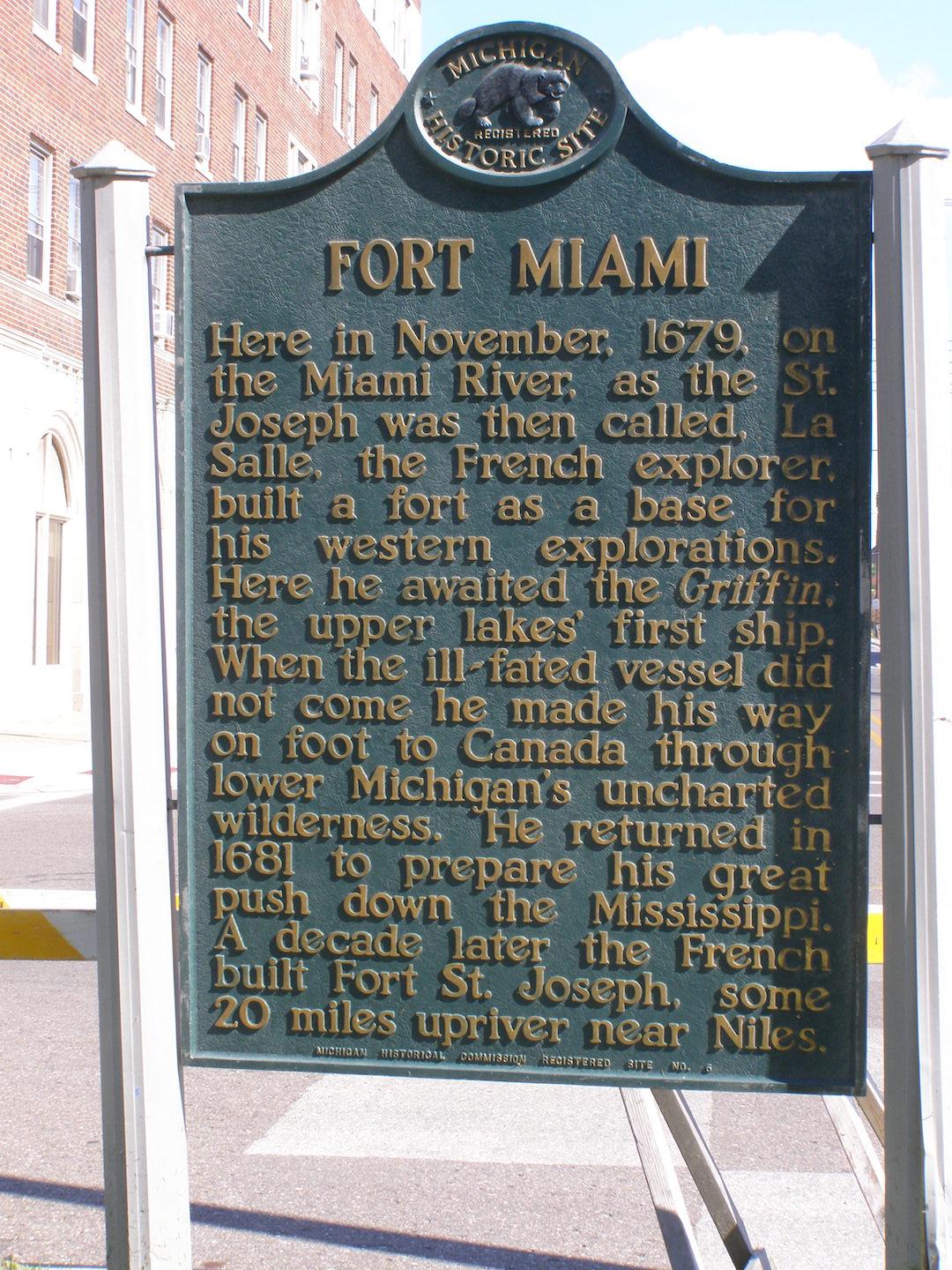
• Fort Miami was a fort on the bank of the St. Joseph River at the site of the present-day city of St. Joseph, Michigan.
•It was established in November 1679 by a band of French explorers led by René Robert Cavelier, Sieur de La Salle on the banks of what was then called the River Miami as a mission and Indian trading outpost. His soldiers destroyed it the next year. It was rebuilt in winter 1680-81.
• In 1700, a second fort was erected by a visiting Jesuit mission and remained in French possession until the French and Indian War (1754-1763), at which point it was conquered by the British.
• Inscription on marker:
“Here in November 1679, on the Miami River, as the St. Joseph was then called, La Salle, the French explorer built a fort as a base for his western explorations. Here he awaited the Griffin, the upper lakes' first ship. When the ill-fated vessel did not come he made his way on foot to Canada through lower Michigan's uncharted wilderness. He returned in 1681 to prepare his great push down the Mississippi. A decade later the French built Fort St. Joseph, some 20 miles upriver near Niles.
Erected by Michigan Historical Commission.”
|
|
Marker “Fort Saint Joseph”
Saint Joseph River Park, Bond St, Niles, MI 49120
|
|
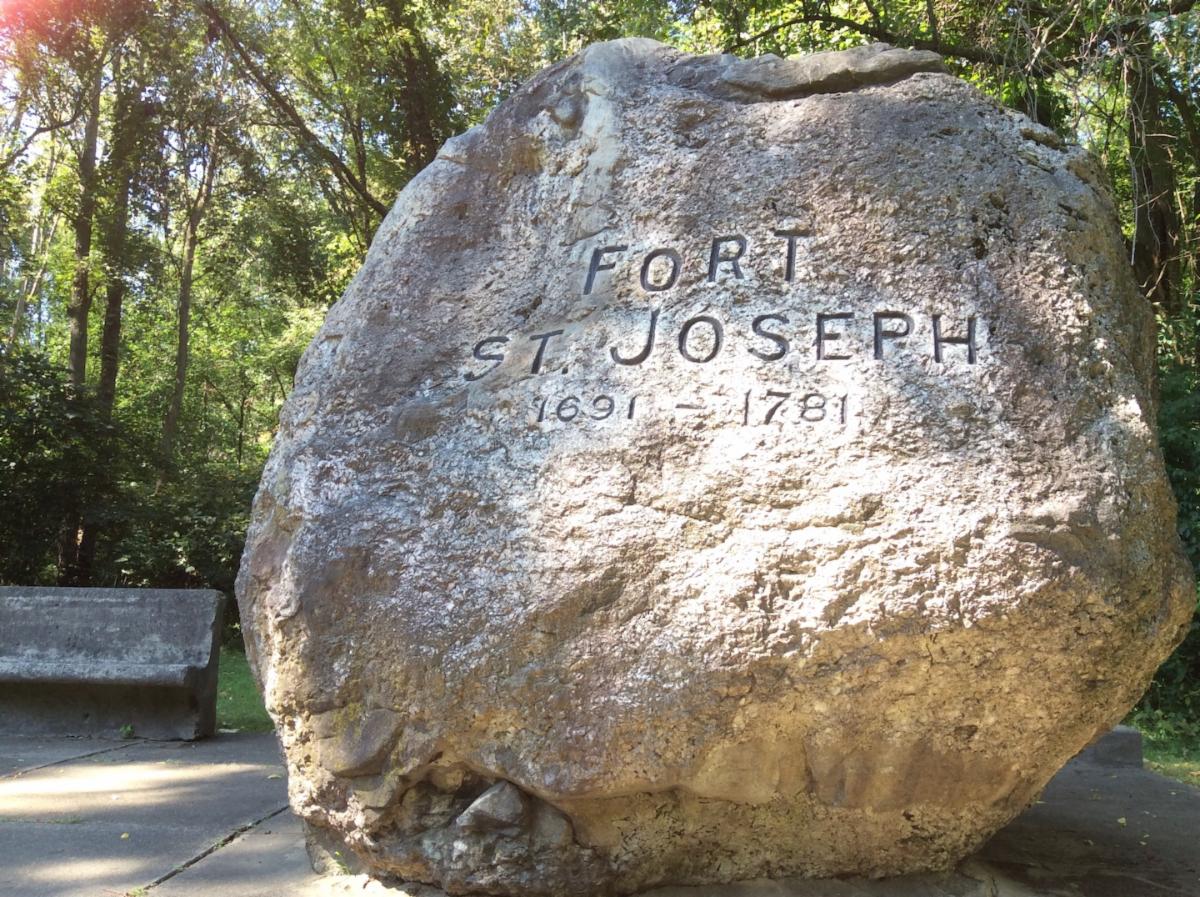
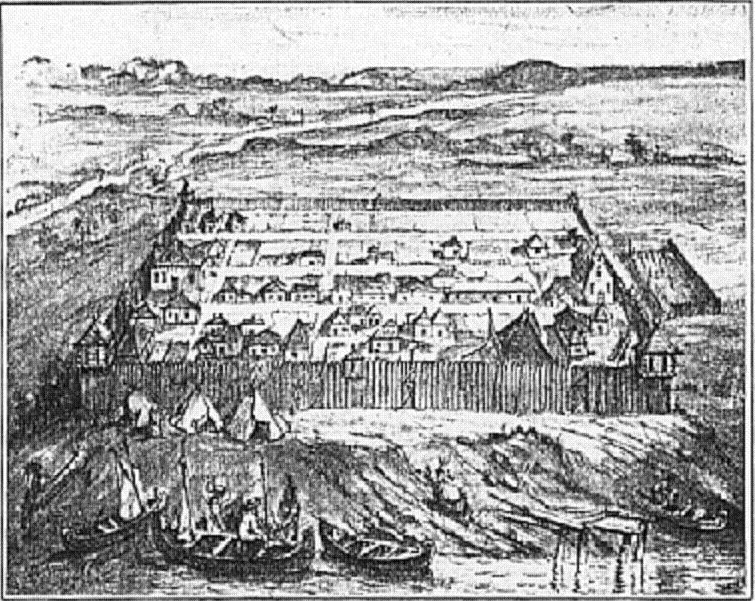
• Fort Saint Joseph was a fort established on land granted to the Jesuits by King Louis XIV; it was located on what is now the south side of the present-day town of Niles, Michigan.
• Père Claude-Jean Allouez established the Mission de Saint-Joseph in the 1680s. Allouez ministered to the local Native Americans, who were primarily Odawa and Ojibwe.
• Built in 1691, the fort was a significant stronghold of the fur trade at the southern end of Lake Michigan. Prior to the French and Indian War (the North American front of the Seven Years' War in Europe), the post had a French garrison of 10 soldiers, a commandant, blacksmith, Catholic priest, interpreter, and 15 additional households.
• The fort site was not rediscovered until 1998. An archeology excavation has been underway since 2002. Among the rare artifacts discovered is an intact Jesuit religious medallion from the 1730s, one of only two found in North America. In December 2010, the team revealed a foundation wall and corner posts of one of the original buildings. The site is listed on the National Register of Historic Places and is a state-registered site as well.
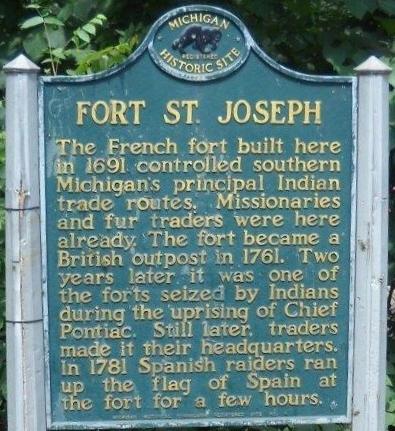
• Inscription:
“The French Fort built here in 1691 controlled southern Michigan’s principal Indian trade routes. Missionaries and fur traders were here already. The fort became a British outpost in 1761. Tow years later it was one of the forts seized by Indians during the uprising of Chief Pontiac. Still later, traders made it their headquarters. In 1781 Spanish raiders ran up the flag of Spain at the fort for a few hours. Erected by Michigan Historical Commission.”
|
|
Fort Pontchartrain du Détroit
(Detroit, Michigan)
|
|
Marker “Fort Pontchartrain”
Southwest corner of the Crown Plaza Hotel, 2 Washington Blvd, Detroit, MI 48226
|
|
• In 1701, Antoine de la Mothe Cadillac founded Fort Pontchartrain du Détroit, the future city of Detroit.
• Inscription:
“The first permanent French settlement in the Detroit region was built on this site in 1701. The location was recommended by Antoine de la Mothe Cadillac, who wished to move the fur trade center south from Michilimackinac. Cadillac's plan was approved by Count Jerome de Pontchartrain, Minister of Marine, for whom the fort was named. The term le detroit (the strait) was applied to the fort and surrounding area; after 1751 the post was known as Fort Detroit. In 1760, as a result of the French and Indian War, the British gained control of Detroit and other posts in the Great Lakes region. British troops enlarged Fort Detroit, but during the American Revolution they moved to nearby Fort Lernoult, built in 1778-79. The Americans occupied Fort Lernoult in 1796 and renamed it Fort Shelby. Erected 1967 by Michigan Historical Commission.”
|
|
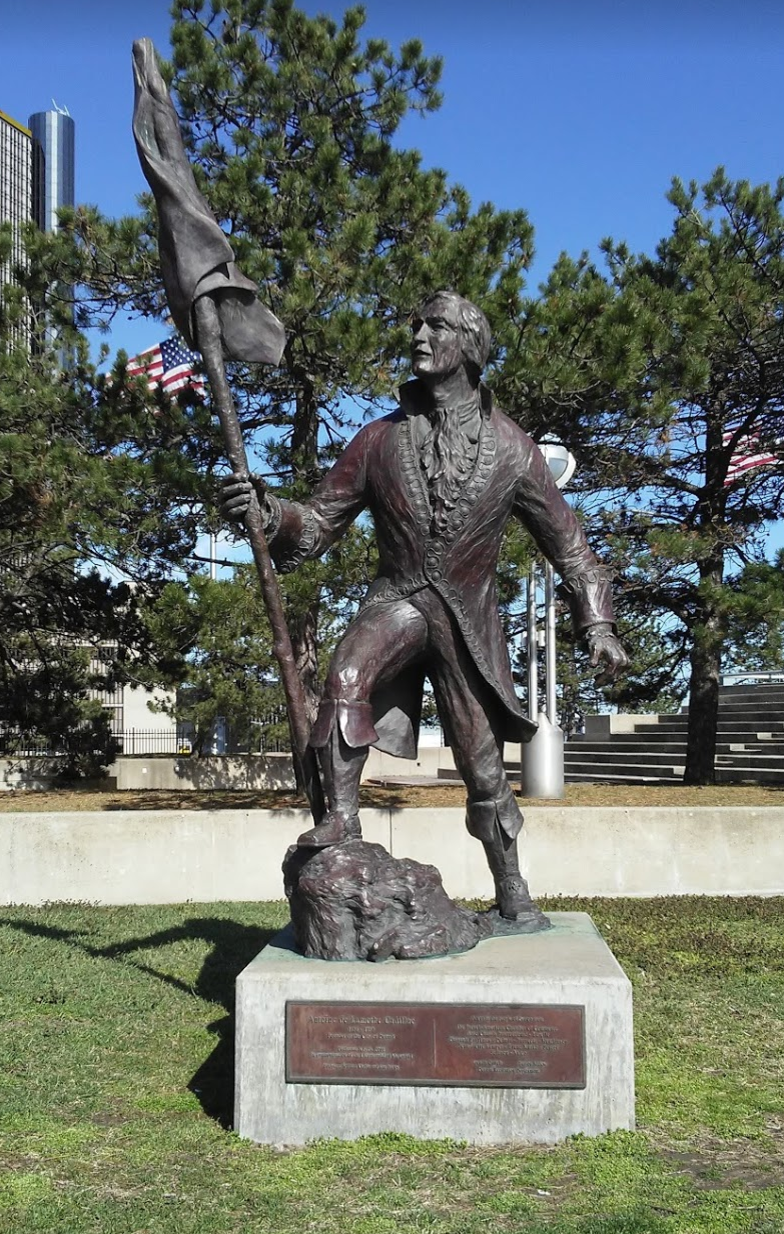
Statue Antoine de la Mothe, sieur de Cadillac |
|
One Hart Plaza, Detroit MI 48226
|
|
• Antoine de la Mothe, sieur de Cadillac (March 5, 1658 – October 16, 1730), born Antoine Laumet, was a French explorer and adventurer in New France, which stretched from Eastern Canada to Louisiana on the Gulf of Mexico.
• He rose from a modest beginning in Acadia in 1683 as an explorer, trapper, and a trader of alcohol and furs, achieving various positions of political importance in the colony.
• In 1701, he founded Fort Pontchartrain du Détroit (which became the city of Detroit); he was commandant of the fort until 1710. Between 1710 and 1716, he was the governor of Louisiana, although he did not arrive in that territory until 1713.
• His knowledge of the coasts of New England and the Great Lakes area was appreciated by Frontenac, governor of New France, and Pontchartrain, Secretary of State for the Navy. This earned him various favors, including the Order of Saint Louis from King Louis XIV. The Jesuits in Canada, however, accused him of perverting the Indians with his alcohol trading, and he was imprisoned for a few months in Quebec in 1704, and again in the Bastille on his return to France in 1717.
• Upon his arrival in America, La Mothe adopted his title after the town of Cadillac, Gironde in southwestern France. William H. Murphy and Henry M. Leland founded the Cadillac auto company and paid homage to him by using his name for their company and his armorial bearings as its logo in 1902. Various places bear his name in America, in particular Cadillac Mountain in Maine and the town of Cadillac, Michigan.
|
|
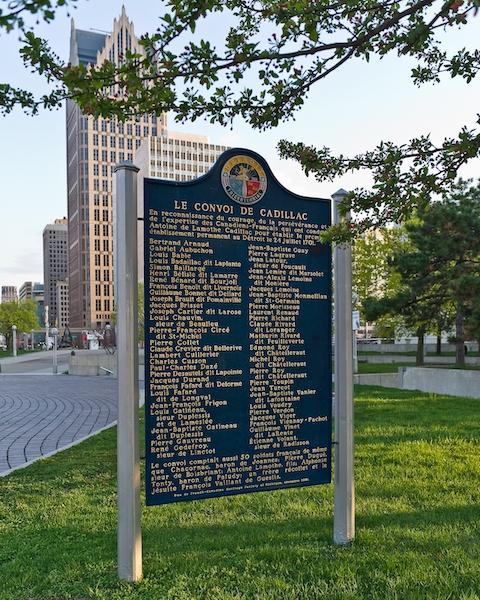
Marker “The Cadillac Convoy / Le Convoi de Cadillac” |
|
One Hart Plaza, Detroit MI 48226
Photo: google maps
|
|
• Inscription:
“In recognition of the courage, perseverance and expertise of the French-Canadians who brought Antoine de Lamothe Cadillac to establish the first permanent settlement at Le Détroit du Lac Érié.”
[Bertrand Arnaud Gabriel Aubuchon Louis Babie Louis Badaillac dit Laplante Simon Baillargé Henri Bélisle dit Lamarre René Bénard dit Bourjoli François Benoît dit Livernois Guillaume Bonnet dit Deliard Joseph Brault dit Pomainville Jacques Brisset Joseph Cartier dit Larose Louis Chauvin, sieur de Beaulieu Pierre-François Circé dit St-Michel Pierre Collet Claude Crevier dit Bellerive Lambert Cuillerier Charles Cusson Paul-Charles Dazé Pierre Desautels dit Lapointe Jacques Durand François Fafard dit Delorme Louis Fafard dit de Longval Jean-François Frigon Louis Gatineau, sieur Duplessis et de Lameslée Jean-Baptiste Gatineau dit Duplessis Pierre Gauvreau René Godefroy, sieur de Linctot Jean-Baptiste Guay Pierre Lagrave Jean Latour, sieur de Foucault Jean Lemire dit Marsolet Jean-Alexis Lemoine dit Monière Jacques Lemoine Jean-Baptiste Monmellian dit StGermain Pierre Morisseau Laurent Renaud Pierre Richard Claude Rivard dit Loranger Mathurin Rivard dit Feuilleverte Edmond Roy dit Châtelleraut Michel Roy dit Châtelleraut Pierre Roy dit Châtelleraut Pierre Toupin Jean Turcot Jean-Baptiste Vanier dit Lafontaine Louis Vaudry Pierre Verdon Jacques Viger François Viennay-Pachot Guillaume Vinet dit LaRente Étienne Volant, sieur de Radisson
The convoy also included fifty French soldiers and Chacornac, sieur de Joannès; Pierre Dugué, sieur de Boisbriant; Antoine Lamothe, fils; Alphonse Tonty, baron de Paludy; a Récollet priest and François Vaillant de Gueslis, S.J.
Erected 2001 by The French Canadian Heritage Society of Michigan"
|
|
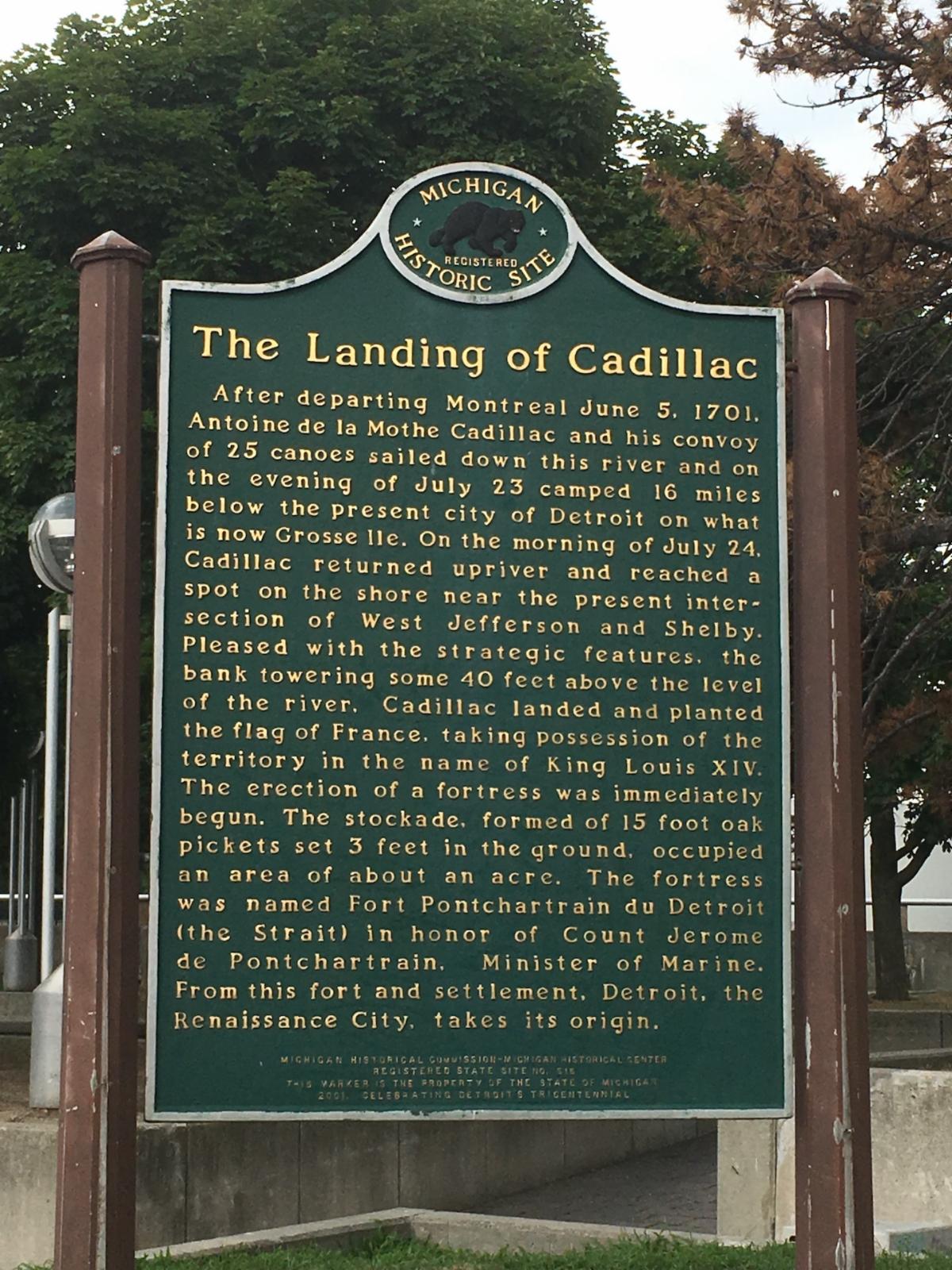
Marker, “The landing of Cadillac" |
|
..."The erection of a fortress was immediately begun..."
One Hart Plaza, Detroit MI 48226
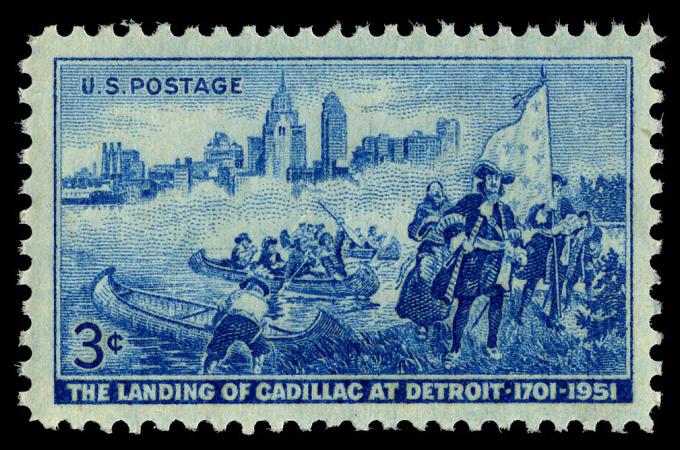
Top: The Department issued this 3-cent stamp through the Detroit, Michigan, post office on July 24, 1951, to commemorate the 250th anniversary of the landing of Antoine de la Mothe Cadillac at Detroit in 1701. Cadillac founded the city of Detroit. His namesake is the Cadillac motor vehicle company.
The stamp's central design depicts Detroit's skyline as it appeared in 1951 and the landing of Cadillac at Detroit in 1701.
Bureau of Engraving and Printing, Public domain, via Wikimedia Commons
Antoine de Lamothe Cadillac (1658–1730) founder of the City of Detroit
|
|
• Inscription, marker "The Landing of Cadillac"
(one side is in English, the other side in French)
“After departing Montreal June 5, 1701, Antoine de la Mothe Cadillac and his convoy of 25 canoes sailed down this river and on the evening of July 23 camped 16 miles below the present city of Detroit on what is now Grosse Ile. On the morning of July 24, Cadillac returned upriver and reached a spot on the shore near the present intersection of West Jefferson and Shelby. Pleased with the strategic features, the bank towering some 40 feet above the level of the river, Cadillac landed and planted the flag of France, taking possession of the territory in the name of King Louis XIV. The erection of a fortress was immediately begun. The stockade, formed of 15 foot oak pickets set 3 feet in the ground, occupied an area of about an acre. The fortress was named Fort Pontchartrain du Detroit (the Strait) in honor of Count Jerome de Pontchartrain, Minister of Marine. From this fort and settlement, Detroit, the Renaissance City, takes its origin.
Erected 2001 by Michigan Historical Commission-Michigan Historical Center.
|
|
301 Lawnridge Dr, Creve Coeur, IL 61610
|
|
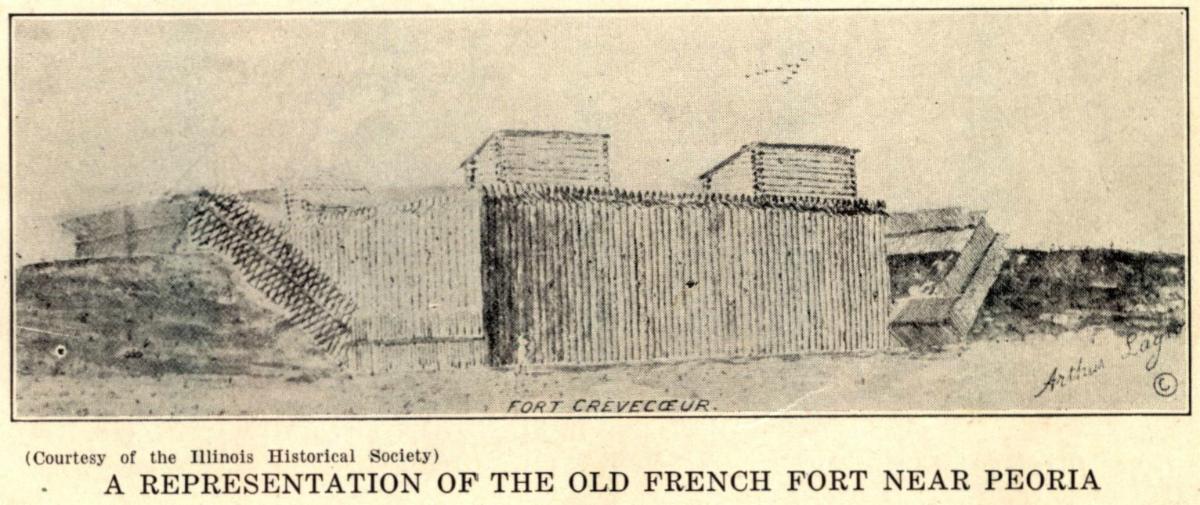
• Fort Crèvecoeur was the first public building erected by Europeans within the boundaries of the modern state of Illinois and the first fort built in the West by the French.
• On January 15, 1680, French explorers René-Robert Cavelier, Sieur de La Salle, and Henri de Tonti began construction of a stockade they would call Fort Crèvecoeur most likely named after a noble family with villages in France, and not because they were heart-broken (crèvecoeur = “coeur brisé) as some historians suggest.
• While on his return trip up the Illinois River, La Salle concluded that Le Rocher (nowadays called Starved Rock), would be a better location for a fortification and sent word downriver to Tonti regarding this idea. Following La Salle’s instructions, Henri de Tonti left Fort Crèvecoeur on April 15, 1680 to begin fortifying the settlement and Fort St. Louis at Le Rocher. The next day, the remaining seven men, pillaged Fort Crèvecoeur of all provisions and ammunition, destroyed the fort, and headed back to Canada.
|
|
Fort Saint-Louis-des-Illinois
and
Fort Saint Louis de Pimiteoui
(present-day Peoria, Illinois)
|
|
301 Lawnridge Dr, Creve Coeur, IL 61610
|
|
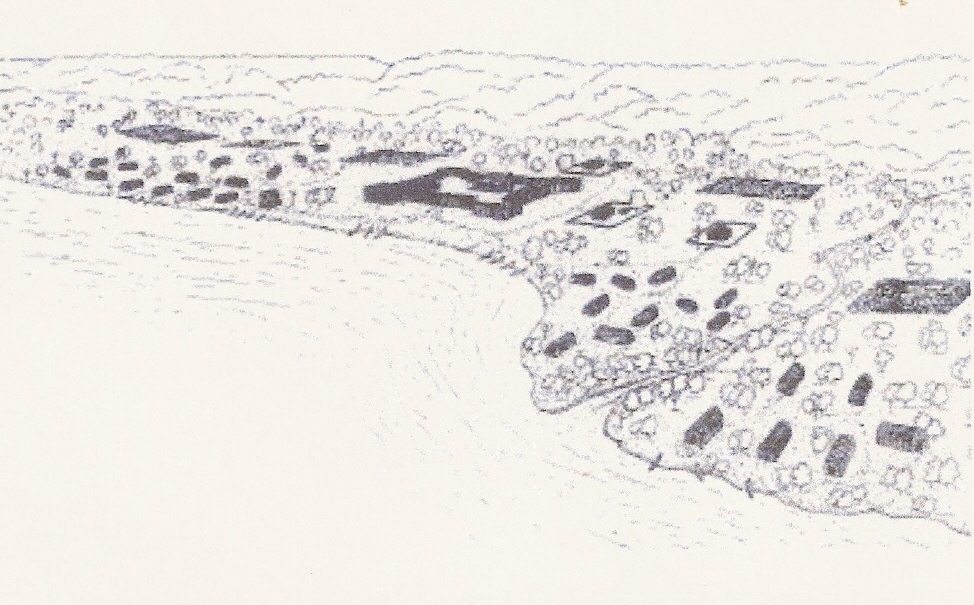
• After establishing Fort Crèvecœur in January 1680 at Lake Peoria , La Salle left it under the command of his loyal lieutenant Henri de Tonti as he returned north for additional supplies. En route up the Illinois River, he noted on its south bank a natural abutment rising perpendicularly to an elevation of 126 meters and accessible on only one of its sides. La Salle immediately recognized that it was a real fortress and did not forget the site.
• La Salle put his men to work on a warehouse of stunted pines, which he surrounded with a strong wooden palisade, the elements of which had to be laboriously dragged during the ascent of the cliff. The fort was completed during the winter. In honor of his king, La Salle named this fortified place Fort Saint-Louis, variously also called Fort Saint-Louis du Rocher and Fort Saint-Louis des Illinois. By law of its royal patent or license, the explorer ruled the fort and its surroundings as a lordship.
• During the inter-colonial wars , the French used the fort as a refuge from attacks by the Iroquois who were allied with the British. The Iroquois forced the settlers, then commanded by Henri de Tonti, to abandon the fort in 1691. De Tonti reorganized the settlers at Fort Pimiteoui, now Peoria.
• In 1691, Tonti returned to the area and founded another fort. This fort is known variously as Fort St. Louis du Pimiteoui, Fort Pimiteoui, and Old Fort Peoria (Pimiteoui – English: Fat Lake – was the name of what is now called, Peoria Lake, a stretch where the Illinois River significantly widens). It was intermittently a center of trade, particularly fur trade, and sometimes settlement throughout the colonial period, when control of it shifted from the French to the British in 1763 after the French and Indian War.
• The fort that Tonti and his men built in the winter of 1691-1692 at Lake Pimiteoui was surrounded by 1,800 pickets. It enclosed two large log buildings - one was a lodging and the other was a warehouse - and two houses built of uprights for the soldiers. This event is generally recognized as the origin of the city of Peoria, and Henri de Tonti became known as “The Father of Peoria”
|
|
Fort de Chartres, 1350 State Rte 155, Prairie du Rocher IL 62277
Bottom: Fort De Chartres East Bastion, photo by John Stanton 27 Jun 2010
|
|
• Inscription bronze plaque at the entrance:
“Fort de Chartres, seat of civil and military government in the Illinois country for half a century, was first completed in 1720. In 1753-56 it was rebuilt of stone at a cost of 200,000 livres and became one of the strongest forts in North America and the key to the French defenses in what is now the United States. By the Treaty of Paris, 1763, France ceded the greater part of her North American possessions to Great Britain, but Fort de Chartres, the last post to be surrendered was occupied by a French garrison until 1765. Renamed Fort Cavendish, the fort was the seat of British government in the Illinois country. Until 1772. When it was abandoned and destroyed.”
The State of Illinois purchased the site of Fort de Chartres and made it a state park in 1913.”
• Inscription marker "Welcome to Fort de Chartres":
“Before you stands the partially reconstructed Fort de Chartres, built by the French government between 1753 and 1755.
The stone fort replaced earlier wooden forts by the same name. From 1720 to 1763, these forts served France as the military, economic, and governmental center of the Illinois Country, which was part of the Louisiana colony. Most of France's possessions in North America, including Fort de Chartres, passed to Great Britain in 1763 with the Treaty of Paris, which brought an end to the French and Indian War.
British troops occupied the fort on October 10, 1765, renaming it Fort Cavendish.
The fort was abandoned around 1771 as the Mississippi River's channel moved near closer, ending the fort's use as a military post.
Erected by Save Illinois History.
|
|
Fort Massac State Park, 1308 E 5th St, Metropolis IL 62960
|
|
• Excerpts of Marker:
“The monument, cannons and fountain are erected on this site of Old Fort Massac. Here on the twentieth of June, 1757, a fort called Fort Ascension, later known as Fort Massac, was completed by the French under Charles Phillippe Aubry. It was destroyed by the French themselves in 1764 before this territory passed into the hands of the British.”...
” At some unknown place between this site and the mouth of the Ohio River, Charles Juchereau de St. Denis built a trading post, and tannery in the Autumn of 1702, and to this first settlement of Europeans in the Ohio Valley, Father Jean Mermet came to preach to the Indians the Word of God”...
” As a memorial to these and other great events for which Fort Massac may rightly stand as reminder and symbol, this park and monument have been dedicated by the people of Illinois to bring to the remembrance of their children and children's children forever the deeds of their predecessors who won for us and our posterity this noble heritage. Let us cherish their memory with pride and affection unto the remotest generations.”
|
|
FRENCH FORTS IN MINNESOTA |
|
East River Parkway, Champlin MN 55316
|
|
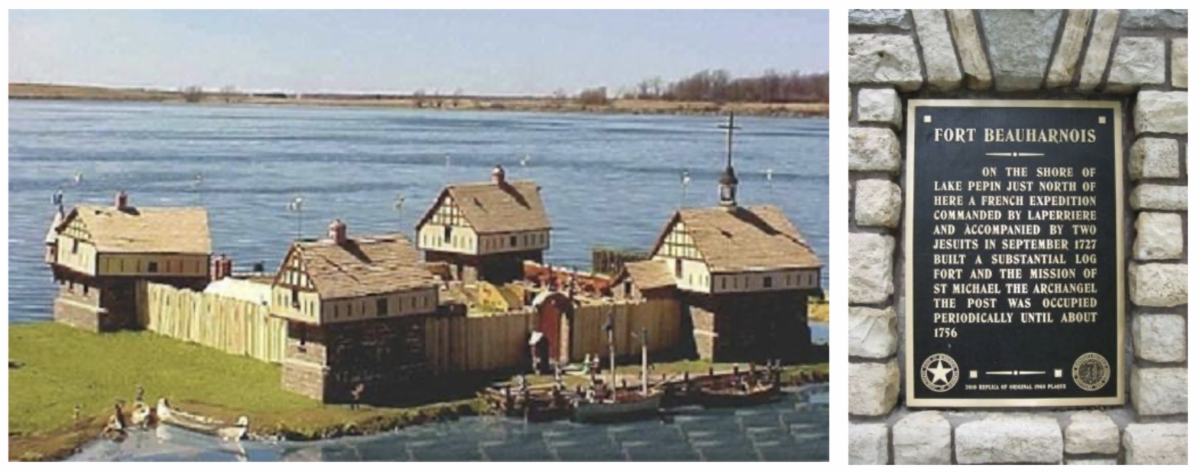
• Fort Beauharnois was a French fort (or fur post) built on the shores of Lake Pepin, a wide section of the upper Mississippi River, in 1727. It was the site of the first Roman Catholic chapel in Minnesota, which was dedicated to St. Michael the Archangel. The fort was named after the Governor of New France at the time, Charles de Beauharnois.
• Inscription:
“On the shore of Lake Pepin just north of here a French expedition commanded by LaPerriere and accompanied by two Jesuits in September 1727 built a substantial log fort and the mission of St. Michael the Archangel. The post was occupied periodically until about 1756.
[seals of the Minnesota Department of Highways and Minnesota Historical Society] 2010 Replica of Original 1940 Plaque
Erected 1940 by the Minnesota Department of Highways and Minnesota Historical Society.”
|
|
Marker, “Fort Saint Charles“
By the lake, a few steps behind 1109 MacKenzie St NE, Warroad, MN 56763
|
|
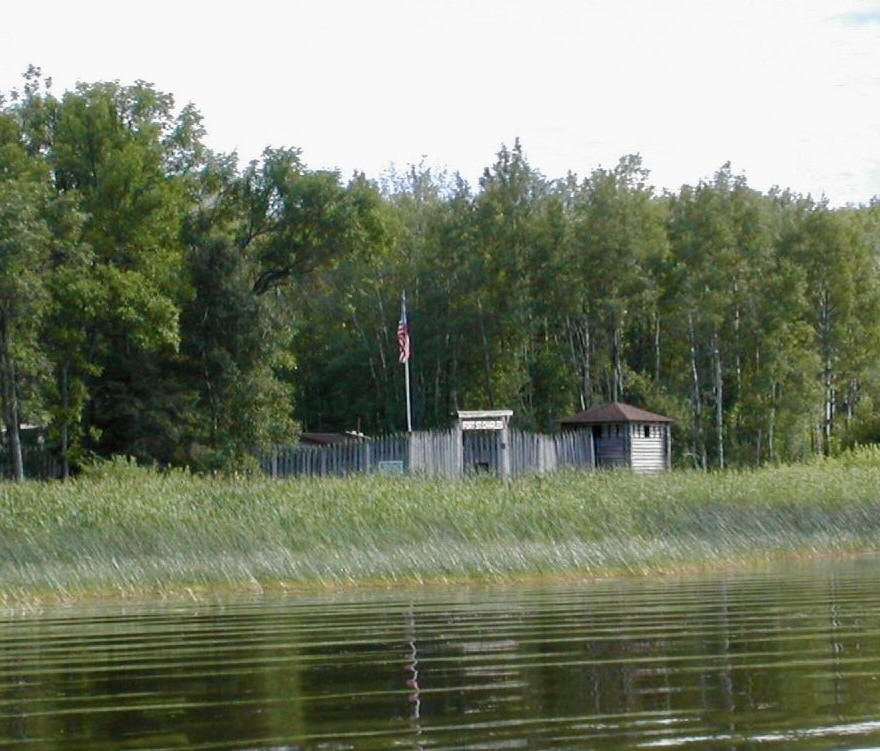
• Fort Saint Charles (1732) on Lake of the Woods was the second post built by La Vérendrye during his expansion of trade and exploration west of Lake Superior. Unfortunately, his son Jean-Baptiste, and a party of 20 were massacred by Sioux Indians in what is called today Massacre Island. The fort was abandoned in 1749.
• Inscription:
“Pierre Gaultier de Varennes, Sieur de La Verendrye, established Fort St. Charles on Lake of the Woods in 1732. A daring soldier, fur trader, and explorer, La Verendrye had the ambitious dream of finding the fabled "Western Sea" and sought to establish French outposts along the way. On Magnuson's Island (then connected with the mainland) he built a palisaded fort which he named in honor of Charles de Beauharnois, governor of New France.
Fort St. Charles became the western capital of the French empire in the Northwest. From it expeditions were launched and supplies dispatched to newer posts around Lake Winnipeg. Indians brought furs to trade for white men's goods, and these pelts were sent by canoe to Montreal. The scarcity of food and Indian warfare made life precarious. In 1736 La Verendrye's oldest son, Jean-Baptiste, nineteen voyageurs, and Father Jean-Pierre Aulneau, a Jesuit priest, were sent on an expedition to the east for supplies. They were massacred by a Sioux war party on a nearby island. Abandoned after 1760, the fort was rediscovered and marked by a group of Jesuit fathers in 1908. The site was acquired and the buildings reconstructed by the 4th Degree Knights of Columbus some forty years later. Erected 1968 by Minnesota Historical Society & the Warroad Chamber of Commerce.”
|
|
FRENCH FORTS IN WISCONSIN |
|
118 S Adams St, Green Bay, WI 54301
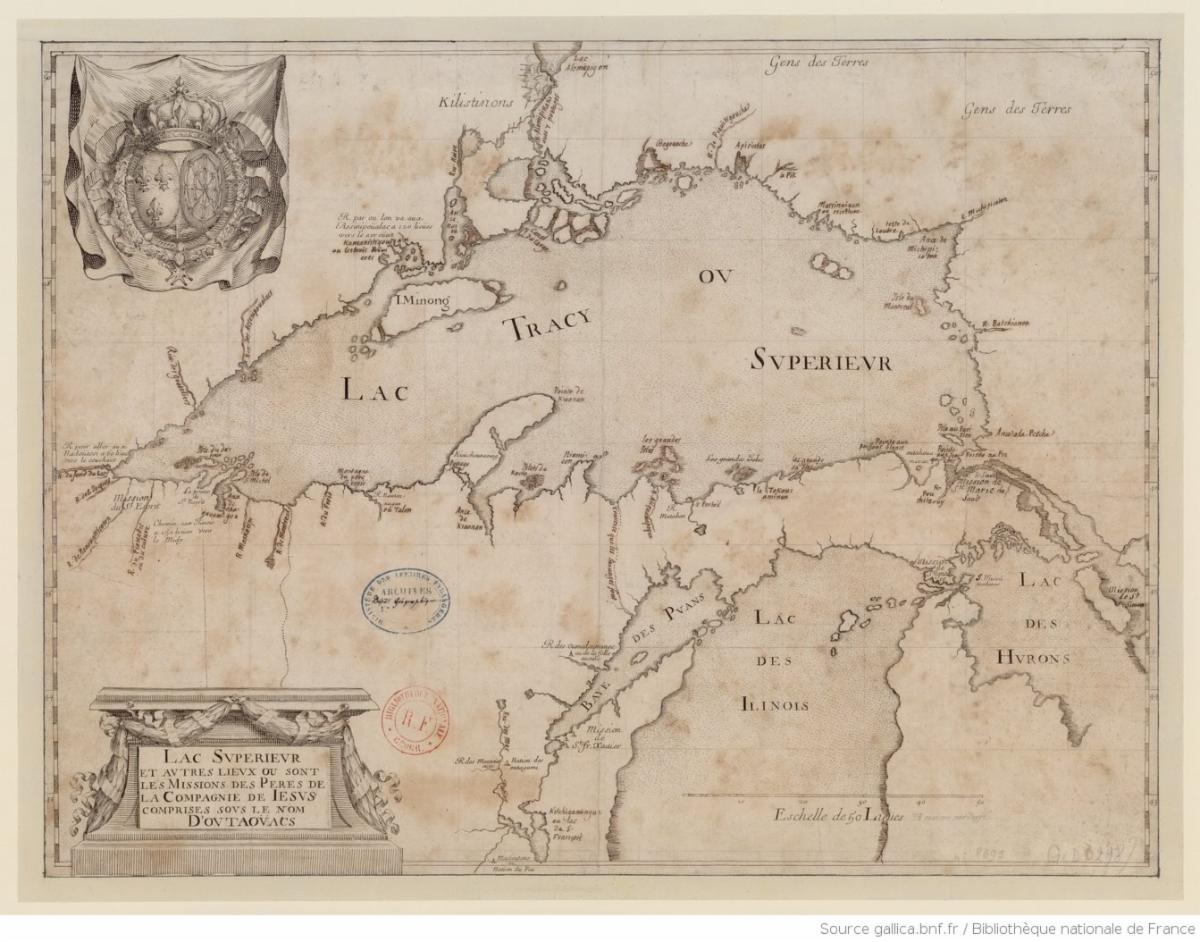
Illustraion: Map "Lac Supérieur et autres lieux où sont les missions des pères de la Compagnie de Jésus comprises sous le nom d'Outaoüacs" (Lake Superior and other places where are the missions of the fathers of the Society of Jesus included under the name of Outaoüacs, by Jean-Baptiste Bourguignon d' Anville, (1697-1782). Notes éditoriales 1700-1799
Bibliothèque nationale de France, département Cartes et plans, GE DD-2987 (8695), Public Domain
|
|
• La Baye was a small trading post established on the Baie des Puants in 1634 by Jean Nicolet, is today Green Bay, Wisconsin. Fort La Baye, a French military post, was eventually built in 1717, and occupied until 1760.
• One Commandant of the Fort was the famous Chevalier Jacques Testard de Montigny, Knight of the Order of St. Louis. By 1718, there were a number of French Canadian families living in the area near the fort. Other families from the Mackinac area settled across the river from the fort, in an area which was called Munnomonee, because of the Menominee native people that lived there.
• In 1733 the Sauks, allied to the Meskwaki (Fox), attacked the French at Fort La Baye. When a French force went out after them, the sons of De Villiers and Repentigny were killed. In 1737 Claude-Antoine de Bermen de La Martinière was appointed commander of the fort. Pierre-Paul Marin became the leader of a French force against the Meskwaki and Sauks. His prevailed and in 1739 the Marquis de Beauharnois, Governor of Canada, wrote "Sieur Marin has re-established peace and quietness”.
• It was not until 1763 that concerted civilian settlement really started. The first settlement in that year was led by Charles de Langlade, who was the son of a French-Canadian father and an Odawa mother.
|
|
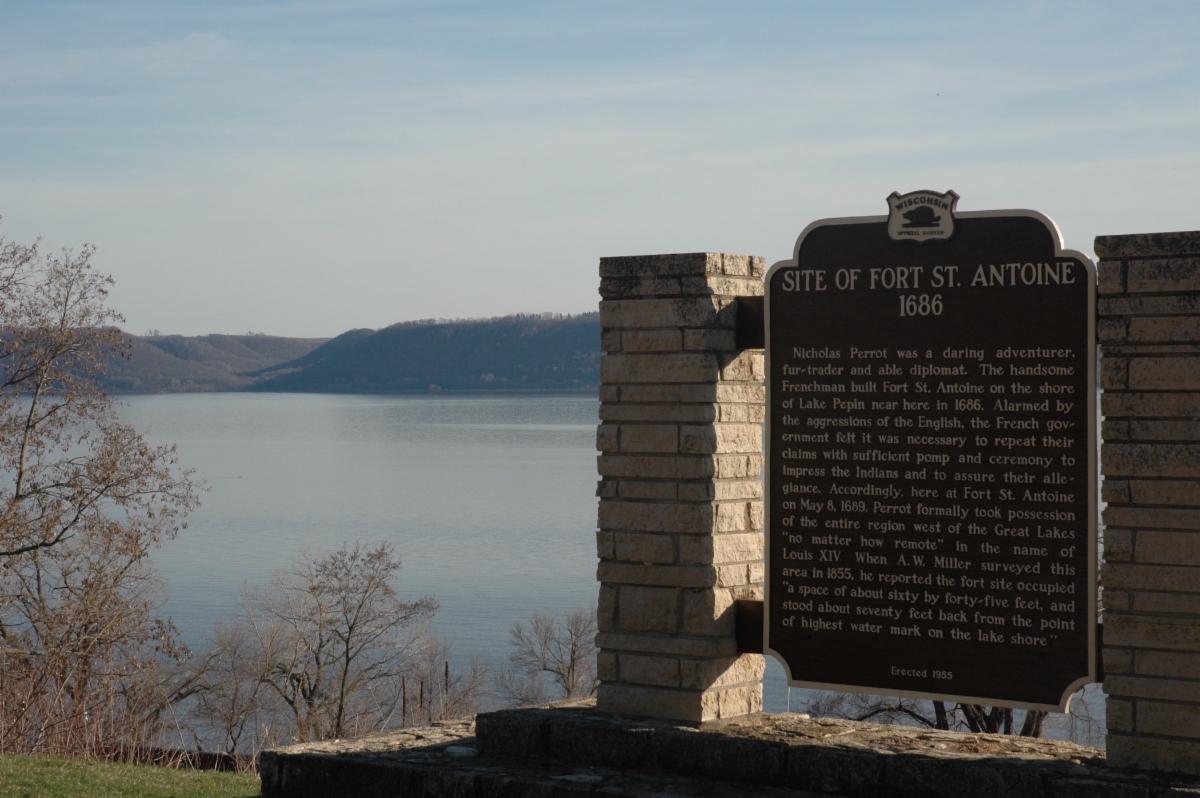
Marker, “site of Fort St Antoine 1686”
11585 3rd St, Stockholm, WI 54769
Public domain. Photo by A. E. Crane
|
|
• Fort Saint Antoine was a French fort on Lake Pepin in present-day Wisconsin founded in 1686 by explorer and fur trader Nicolas Perrot and his expedition of Canadiens. They had come to the region to begin trading with Native American tribes of the area. Their purpose was to establish alliances with the Ioway and Dakota Indians in order to expand French interests in the fur trade market
• Inscription:
«Nicholas Perrot was a daring adventurer, fur-trader and able diplomat. The handsome Frenchman built Fort St. Antoine on the shore of Lake Pepin near here in 1686. Alarmed by the aggressions of the English, the French government felt it was necessary to repeat their claims with sufficient pomp and ceremony to impress the Indians and to assure their allegiance. Accordingly, here at Fort St. Antoine on May 8, 1689, Perrot formally took possession of the entire region west of the Great Lakes "no matter how remote" in the name of Louis XIV. When A.W. Miller surveyed this area in 1855, he reported the fort site occupied "a space of about sixty by forty-five feet, and stood about seventy feet back from the point of highest water mark on the lake shore". Erected 1955 by the Wisconsin Historical Society”
|
|
Marker, “site of Fort Trampealeau”
S Park Rd, Trempealeau, WI 54661
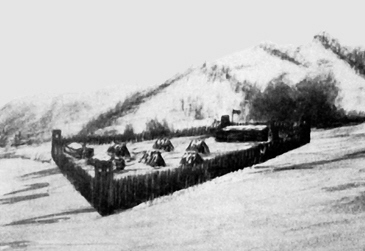
"Vue cavalière" de Fort Trempealeau situé en Nouvelle-France en 1732 par Inconnu, dessin crayon réalisée en 1732, Archives nationales d'outre-mer (France) - (view of Fort Trempealeau located in New France in 1732) by Charles Morse Stotz ?, Public Domain, https://commons.wikimedia.org/w/index.php?curid=26270002
|
|
• Fort Trempealeau was founded in 1685 by Nicolas Perrot and a groupe of Canadiens. The Winnebagos called this mountain, Hay-nee-ah-cheh, or the mountain in the water. That is why Perrot called it in French, la montagne qui trempe à l'eau, or Trempealeau mountain
• Nicolas Perrot (c. 1644–1717), a French explorer, fur trader, and diplomat, was one of the first European men to travel in the Upper Mississippi Valley, in what is now Wisconsin and Minnesota.
•Perrot traveled to New France around 1660 with Jesuit missionaries. He earned the friendship of the natives by swapping furs for guns, allowing the group to defend themselves on an equal footing against their enemies. He was nicknamed the "trafficker of iron", or "iron legs”.
•In the spring of 1685 he was appointed Commandant-in-Chief of Bais Des Puants (present-day Green Bay, Wisconsin) . He managed to broker peace treaties with the 5- Nations Indian tribes. He wielded considerable influence among the Indian nations of these regions and on a number of occasions was able to enlist their support in defence of New France against the Iroquois.
• Perrot State Park, near the confluence of the Trempealeau and Mississippi Rivers in Wisconsin, is named after him.
• Inscription:
«One of the leading early French traders and diplomats among the Indians of the upper Mississippi region was dark and handsome Nicholas Perrot. After building Fort St. Nicholas at Prairie du Chien in the summer of 1685, Perrot moved north and spent the winter here "at the foot of the mountain behind which was a great prairie abounding in wild beasts." These "wild beasts" were buffalo, elk, deer, bear, cougar and lynx. Today, only deer are still common to this area. From here Perrot continued up the Mississippi to establish another fortified post on Lake Pepin and named it Fort St. Antoine. There on May 6, 1689, he formally took possession of the entire region west of the Great Lakes "no matter how remote" in the name of his king, Louis XIV.
In 1731 Godefroy de Linctot built a small fort among the Sioux at "the mountain whose foot is bathed by water", sometimes written "La Montagne Qui Trempe a Leau" and now referred to as Mount Trempealeau. De Linctot's fort existed until 1736 and when its ruins were uncovered on this site in 1887, below them was found a hearthstone probably used by Perrot during the winter of 1685-1686. Erected 1964 by the Wisconsin Historical Society”.
|
|
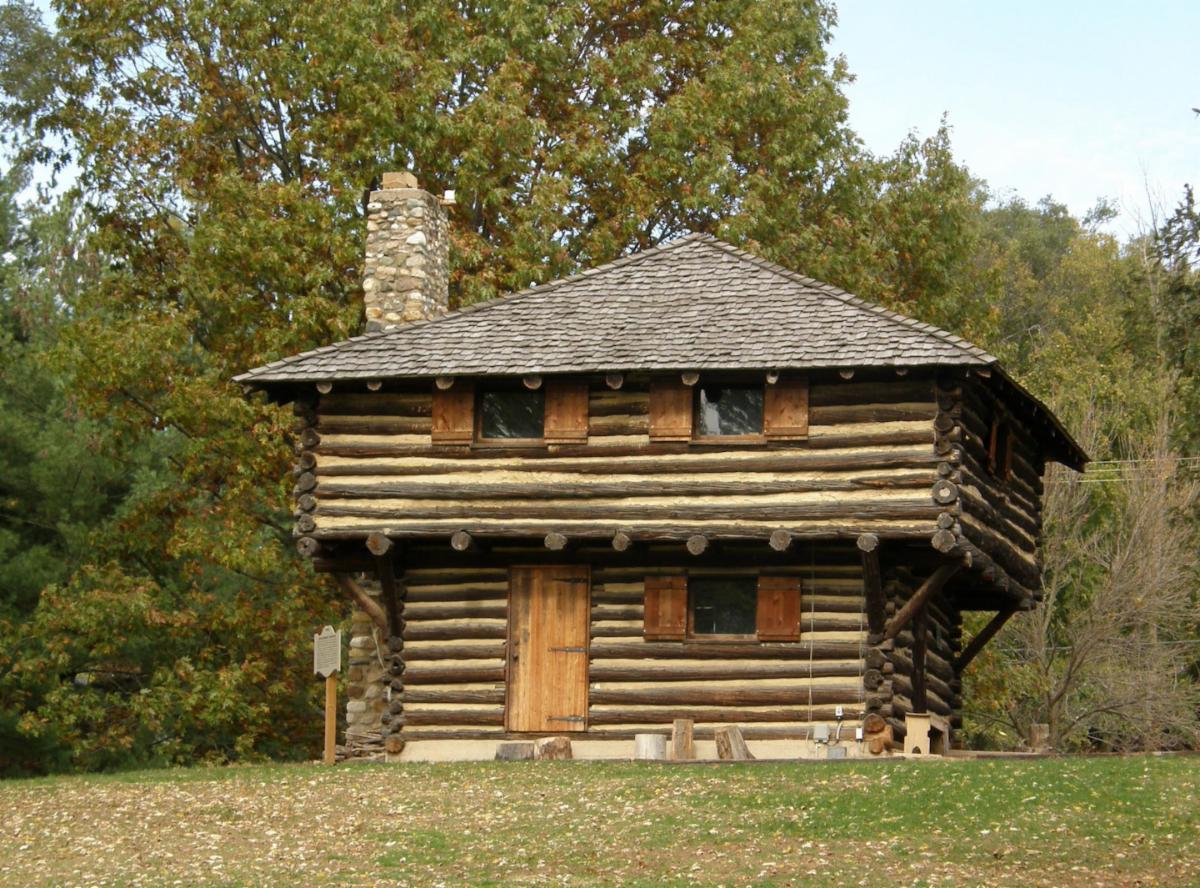
Fort Ouiatenon, 3129 S River Rd, West Lafayette IN 47906
|
|
• Fort Ouiatenon, built in 1717, was the first fortified European settlement in what is now called Indiana. It was a palisade stockade with log blockhouse used as a French trading post on the Wabash River located approximately three miles southwest of modern-day West Lafayette.
• The name 'Ouiatenon' is a French rendering of the name in the Wea language, waayaahtanonki, meaning 'place of the whirlpool’.
• It was one of three French forts built during the 18th century in what was then New France, later the Northwest Territory and today the state of Indiana, the other two being Fort Miami and Fort Vincennes.
• A substantial French settlement grew up around the fort in the mid-18th century. It was ceded to the British and abandoned after the French and Indian war.
• Inscription:
“First post in Indiana area built nearby in 1717 by French Canada to counter British expansion in valleys of Wabash and Ohio rivers. Served as trade and communication post. French surrendered fort to British in 1761 during the French and Indian War. Fort was occupied by Native Americans after 1763 and destroyed by American soldiers 1791. Erected 1976 by Indiana Bicentennial Commission"
|
|
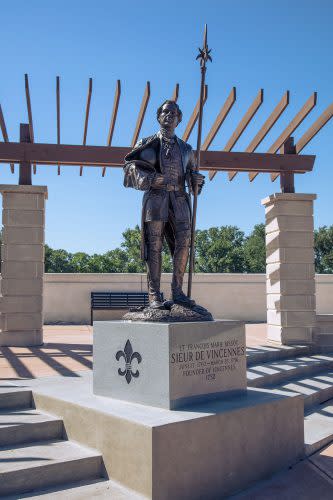
Statue François-Marie Bissot, Sieur de Vincennes,
Vincennes Riverwalk, Vincennes, IN 47591
Photo: by Bill Wolfe of Terre-Haute, Indiana
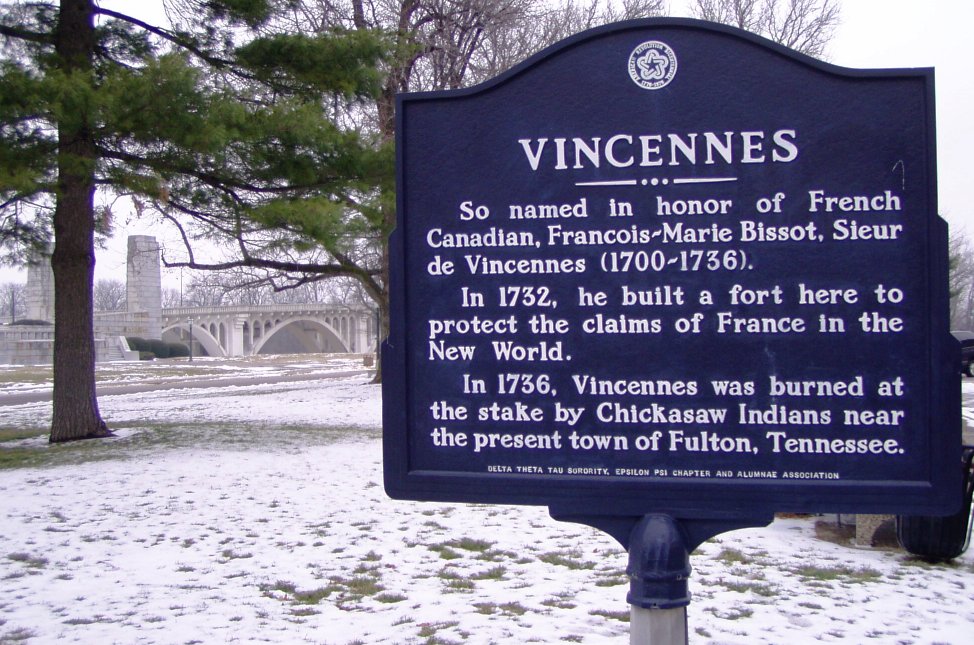
Marker, located at 12 S 2nd St, Vincennes, IN 47591
|
|
• Vincennes is a city in and the county seat of Knox County, Indiana . Founded in 1732 by French fur traders, notably François-Marie Bissot, Sieur de Vincennes, for whom the Fort was named.
• Vincennes is the oldest continually inhabited European settlement in Indiana and one of the oldest settlements west of the Appalachians. The first European settlers were French, when Vincennes was founded as part of the French colony of New France. Later on, it would be transferred to the colony of Louisiana. The boundary between the French colonies of Louisiana and Canada, although inexact in the first years of the settlement, was decreed in 1745 to run between Fort Ouiatenon (below the site of modern-day Lafayette, Indiana) and Vincennes.
• François-Marie Bissot, Sieur de Vincennes (17 June 1700 – 25 March 1736) was a French explorer and soldier who established several forts in what is now the U.S. state of Indiana. In May 1722, Vincennes was commissioned an Ensign and took control of Fort Ouiatenon near present-day Lafayette, Indiana. He was promoted to Lieutenant in 1730 and was made commandant in what is now southern Indiana. He was commissioned to build a trading post on the Wabash River and established Fort Vincennes where the modern city of Vincennes, Indiana is located.
• On 25 March 1736, he was burnt alive at the stake by the Chickasaw Indians along with other captive French at the village of Ogoula Tchetoka, near the present site of Fulton, Mississippi, though a historical marker in Vincennes gives the location as Fulton, Tennessee.
• Inscription (front of statue):
“Lt. Francois Marie Bissot
Sieur De Vincennes
June 17 1700 - March 25 1736
Founder of Vincennes
1732”
Erected 2018 by The Friends of Vincennes Heritage & The Vincennes Historical and Antiquarian Society"
• Inscription of marker:
"So named in honor of French Canadian, Francois-Marie Bissot, Sieur de Vincennes (1700–1736).In 1732, he built a fort here to protect the claims of France in the New World. In 1736, Vincennes was burned at the stake by Chickasaw Indians near the present town of Fulton, Tennessee. Erected by Delta Theta Tau Sorority, Epsilon Psi Chapter and Alumnae Association."
|
|
Fort des Miamis
(present-day Fort Wayne, IN)
|
|
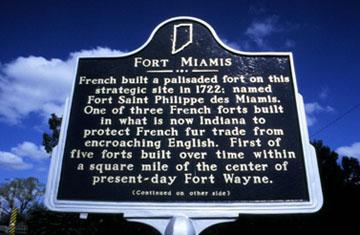
Marker, « The First French Fort ”, Fort Miami, Indiana
Sherman Boulevard Bridge, Fort Wayne, IN 46802
Photo Indiana Historical Bureau
|
|
• Fort Miami, originally called Fort St. Philippe or Fort des Miamis, was the name of a pair of French palisade forts built at Kekionga, a large Miami Indian village. In 1715, the French had located a trading post in the Miami capital village of Kekionga. The Miami refused to abandon their village and move farther West, away from encroaching British traders, so Governor Philippe de Rigaud Vaudreuil authorized Jean Baptiste Bissot to build a strong fort to protect the trade routes of New France. The first fort was built in 1722.
• Inscription "The First French Fort":
“[Left side of marker]:
"The French lived among the Miami at the Three Rivers as early as 1697 when Jean Baptiste Bissot, Sieur de Vincennes (d. 1719), and Francois Marie Bissot de Vincennes, the son of Jean Baptiste (d. 1736), served as royal agents to the Miamis.
The first fort was built in 1722 on this site by Capt. Dubuisson upon the orders of the French governor in Quebec. The fortification was called Fort St. Philippe or Fort Miamis, was garrisoned by as many as thirty men, and commanded the fur trade in the area and the portage between the St. Mary’s and Wabash rivers.
In 1747, the Wyandot chief Sanosket (known also as Old Britain or La Damoiselle), encouraged by the British, attacked and burnt the fort. A new French commandant, Capt. Charles DeRaimond, repaired the fort and used it for three years until a new fort could be completed on the St. Joseph.”
• Inscription:
[Marker Front]:
"French built a palisaded fort on this strategic site in 1722; named Fort Saint Philippe des Miamis. One of three French forts built in what is now Indiana to protect French fur trade from encroaching English. First of five forts built over time within a square mile of the center of present-day Fort Wayne."
[Marker Reverse]:
"Nearby confluence of St. Mary's and St. Joseph's Rivers forms Maumee River, a strategic central part of the waterways system connecting Great Lakes regions with Mississippi River Valley. Using a portage between Maumee and Wabash rivers, travelers could journey nearly 2,500 miles by water from French Canada to Louisiana. Erected 2000 by Indiana Historical Bureau and Society of Colonial Wars in the State of Indiana"
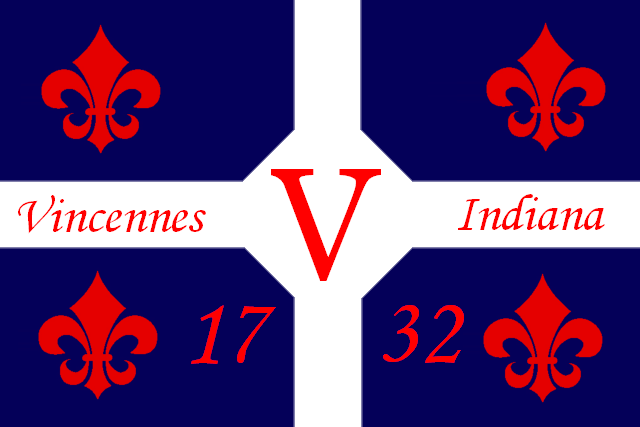
Illustration below: Flag of the City of Vincennes, Indiana
|
|
PART EIGHT OF THE SERIES
"LAFAYETTE, GUEST OF THE NATION"
If you missed the episodes from our past Bulletins...
• President James Monroe invited Lafayette, the last surviving major general of the American Revolutionary War, to tour the United States, officially to celebrate the nation's 50th anniversary but also to instill the "spirit of 1776" in the next generation of Americans at a time of great political divide. His tour drew large crowds and sparked a renewal of patriotism.
• From July 1824 to September 1825, Lafayette made a tour of all 24 States in the United States. He was received with a hero's welcome everywhere he stopped. Immense crowds, children, old veterans would come from miles away and wait hours to have a chance to see him, approach him, touch him. Many honors and monuments were presented to commemorate and memorialize the visit.
• The 24 states visited were: Alabama, Connecticut, Delaware, Georgia, Illinois, Indiana, Kentucky, Louisiana, Maine (ex-Massachusetts / North part), Maryland, Massachusetts, Mississippi, Missouri, New Hampshire, New Jersey, New York, North Carolina, Ohio, Pennsylvania, Rhode Island, South Carolina, Tennessee, Vermont, Virginia, Washington D.C.
• The main means of transportation were stagecoach, horseback, canal barge, and steamboat.
• Throughout the years 2024 and 2025 each city will celebrate this most illustrious Frenchman, ranked alongside the Founding Fathers, practically on a par with George Washington. If anyone harbors any doubt about it, one only needs to read some of the hundreds of local newspaper articles and the accounts or memoirs of contemporary witnesses accounts.
|
|
• Several of his stops are memorialized with markers and plaques, some decades-old, and an increasing number of brand new ones, thanks to the energy and enthusiasm deployed by Julien Icher, president of the LafayetteTrail.org, whose goal is to dedicate all 175 markers by 2024.
• These new markers from the LafayetteTrail.org are all made in the same distinctive blue and red cast metal and signed by the William C. Pomeroy Foundation which is generously funding this gigantic project.
• The American Society of Le Souvenir Français Inc. is honored to partner with these two like-minded organizations, as well as all other American patriotic associations and volunteers who are participating in these celebrations, under the umbrella of America250.
|
|
As we started with the August 2022 Bulletin, we will narrate every month some of the most salient episodes of this remarkable journey of the corresponding month 199 years ago, while keeping you abreast of the many celebrations planned by the local committees of the American Friends of Lafayette in 2024 and in 2025.
For this series we will also borrow from the testimonies of a privileged close witness, Auguste Levasseur, Lafayette’s personal secretary, who traveled along with the Marquis and his son, George Washington Lafayette, and who published his extensive daily journal: “Lafayette en Amérique 1824-1825, ou Journal d'un voyage aux Etats-Unis" (Published by the Librairie Baudoin, Paris, in 1829), as well as other well-documented sources, such as Samuel Lorenzo Knapp. “Memoirs of General Lafayette : with an Account of His Visit to America and His Reception By the People of the United States; From His Arrival, August 15th, to the Celebration at Yorktown, October 19th, 1824”(Published in November, 1824)
|
|
-
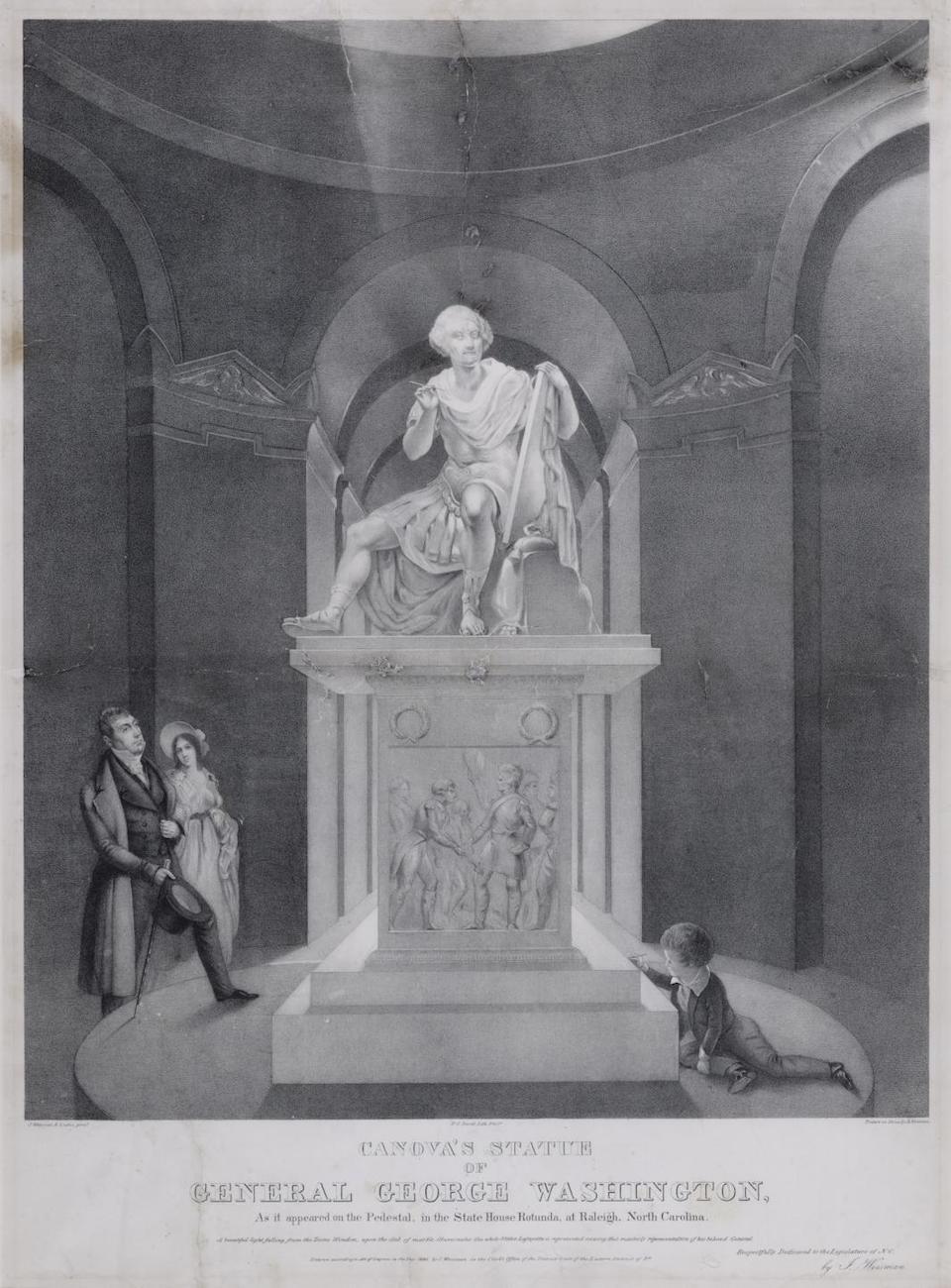
March 1 — Viewed Canova's statue, George Washington, at the North Carolina State House. Traveled from Raleigh to his namesake town Fayetteville, North Carolina
-
March 2–3 – Stays in Raleigh, where he is reunited with Colonel William Polk who fought beside him at the Battle of Brandywine where both were wounded
- March 15 – Arrived in Charleston, South Carolina, and enjoys three days of balls, fireworks, and reunions; is reunited with Francis Kinloch Huger, who is the son of his comrade Benjamin Huger and who tried to free Lafayette from an Austrian prison around 1795
-
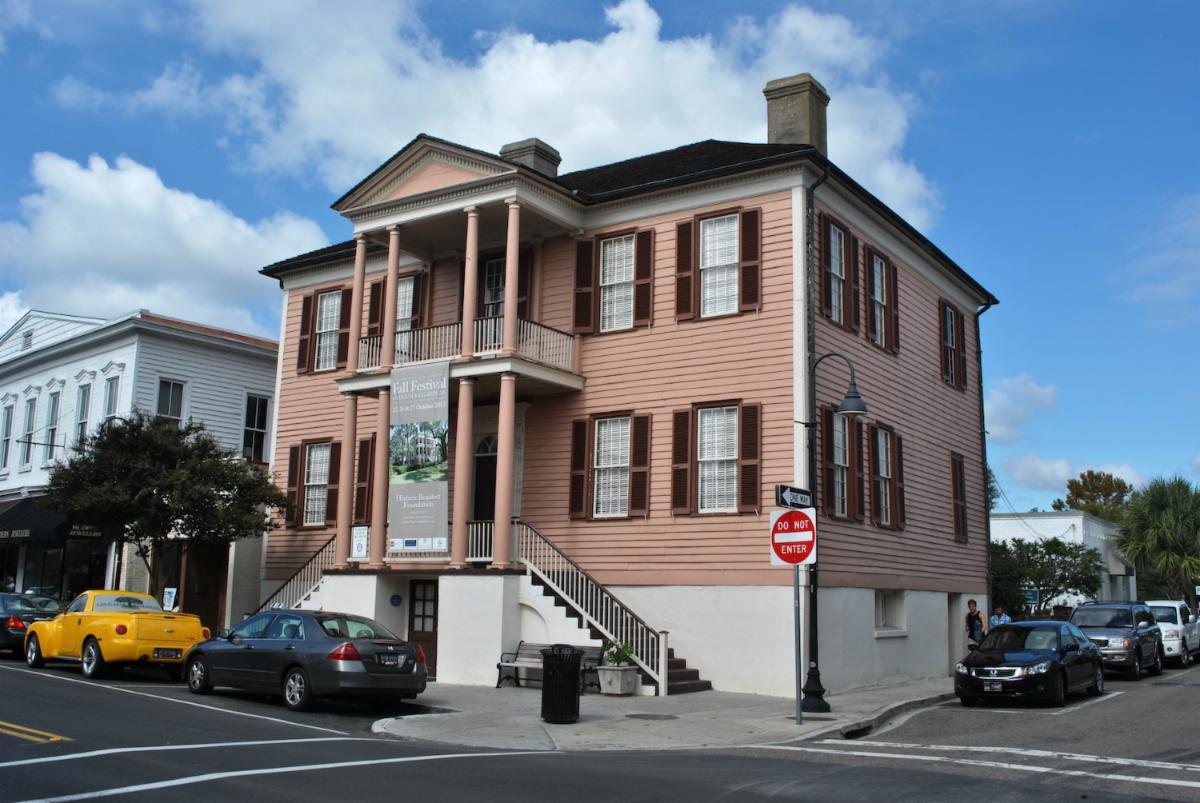
March 18 – Arrived in Beaufort, South Carolina, to a 13-gun salute and speaks to citizens from the John Mark Verdier House
-
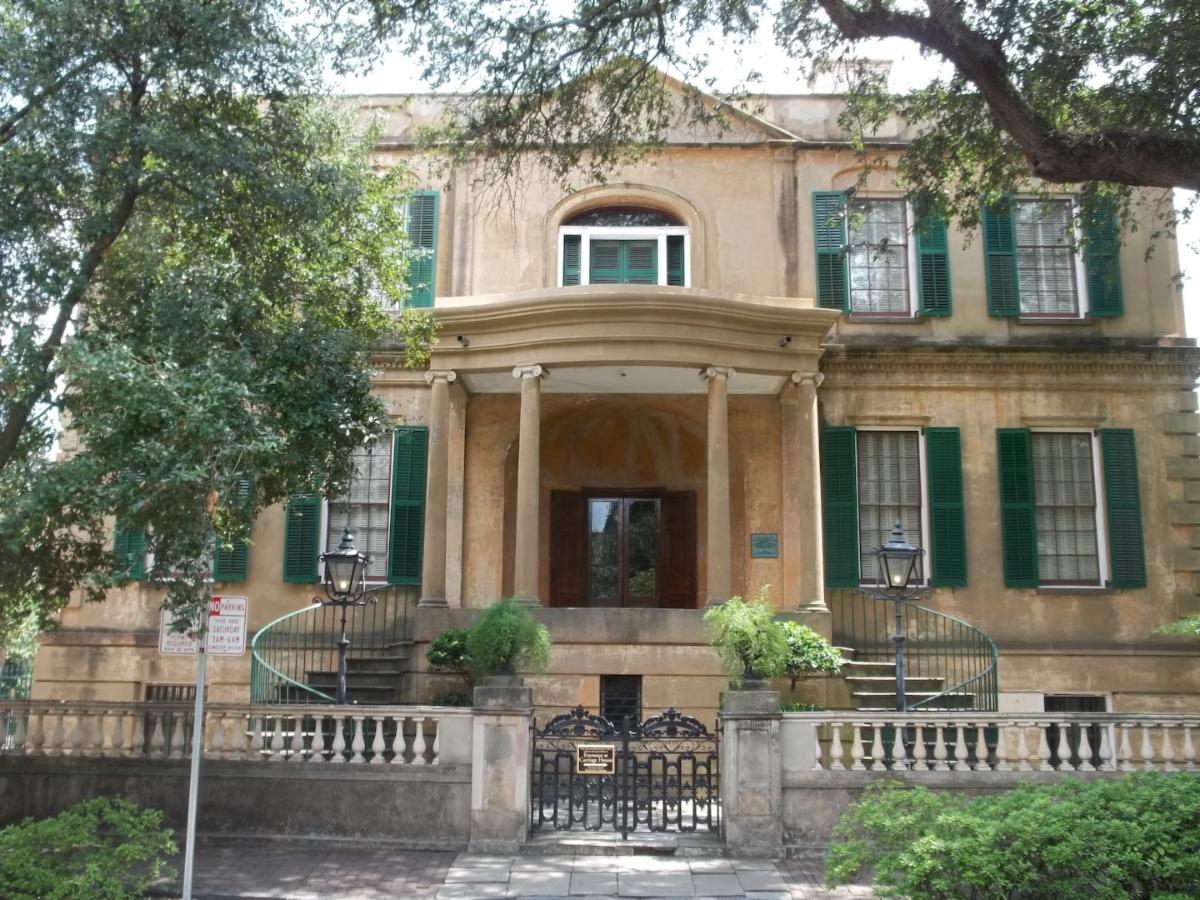
March 19 – Arrived in Savannah, Georgia, and speaks to citizens from the Owens–Thomas House
-
March 21 – Lays the cornerstone for a memorial to General Nathanael Greene
- March 23 – Traveled up the Savannah River by steamboat to Augusta, Georgia
-
March 25 – Traveled along the Milledgeville Stage Road to Warrenton, Georgia
- March 26 – Continued on to Sparta, Georgia
-
March 27 – Arrived in Milledgeville, Georgia where he meets with the Governor George Troup in an elaborate reception and feast at the Capitol grounds
-
March 29 – Travels to Macon, Georgia, and visits the Old Creek Indian agency in Crawford County, Georgia March 30 – Spends the night in a bark-covered log cabin in Chattahoochee County, Georgia
- March 31 – Crosses the Chattahoochee River into Alabama and stays in Fort Mitchell, they begin their route west to Montgomery via military escort through Creek territory
|
|
Lafayette at Raleigh, NC
March 2, 1824
|
|
March 2, 1825
118 E. South Street (Shaw University Yancy Building, Room 234, Raleigh, NC 27601
Illustration above: “The Marquis de Lafayette Visiting the State Capitol in Raleigh in March 1825”, 1840s Lithograph on paper done after the disappearance of the statue. North Carolina Museum of History, Raleigh
Click on the illustration above to view a video of "Follow the Frenchmen", Episode 4, posted on YouTube, by Julien Icher, president of the Lafayette Trail, Inc.
|
|
• “...[Raleigh] is the seat of government for North Carolina, and contains about two thousand seven hundred inhabitants, of which about fifteen hundred are blacks, both free and slaves. One of the most precious monuments of this town, is the superb statue of Washington, executed in marble by Canova. It is preserved, with the greatest care, in one of the halls of the capitol.” (Auguste Levasseur. “Lafayette in America in 1824 and 1825, Vol. II. p.75)
• Lafayette was almost the adopted son of George Washington, and an eyewitness at the time stated that the marquis thought that “the likeness was so much better than he expected to see". Unfortunately, the statue was accidentally destroyed in 1831 during work done to the roof of the Capitol.
• Inscription of marker:
“On March 2, 1825, general
Lafayette, an outspoken
abolitionist, was received
near this spot by gov. Burton
at the government house.
William G. Pomeroy foundation 2020"
|
|
Lafayette in Fayetteville, North Carolina
March 4, 1825
|
|
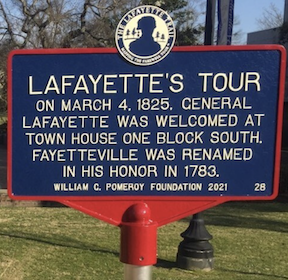
Marker, “Lafayette’s tour”, Fayetteville, NC
March 4, 1825
211 Green St, Fayetteville, NC 28301
Photo: Lafayette Trail, Inc.
Click on the illustration above to view a video of "Follow the Frenchmen", Episode 5, posted on YouTube, by Julien Icher, president of the Lafayette Trail, Inc.
|
|
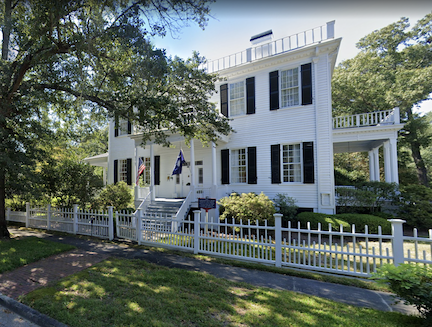
• “After General Lafayette had expressed his gratitude for the reception given him by the citizens of Fayetteville, and his sympathy for the sentiments of the orator, we were conducted to the residence of Mr. Duncan M‘Rae, where, by the attentions of Mrs. Duncan, our lodgings had been prepared in an elegant and commodious manner. The general was there received by the committee, appointed to supply all his wants. “You are here in your own town,” said the chairman of the committee to him, “in your own house, surrounded by your children. Dispose of all—everything is yours.” Every moment of our short stay at Fayetteville was occupied by festivals of gratitude and friendship.” (Auguste Levasseur “Lafayette in America in 1824 and 1825, Vol. II., p.79)
• Inscription of marker:
Lafayette's tour
On March 4, 1825, General
Lafayette was welcomed at
town house one block south.
Fayetteville was renamed
in his honor in 1783.
William G. Pomeroy foundation 2021
|
|
Lafayette in Cheraw, North Carolina
March 6, 1825
|
|
Marker, Lafayette’s tour, Cheraw, SC
March 6, 1825
235 Third Street, Cheraw, SC 29520
This Federal-style home built in 1820 hosted Lafayette. A reception was held here in his honor, and legend holds that he enjoyed himself to the point of dancing on the roof. Image capture Sept 2020 (c) Google 2022
|
|
• “At half past 11 o’clock, P.M. the General arrived at the Bridge, where he was met by the Committee appointed for the purpose on the part of the town, and a large concourse of citizens, and was conducted to the House expressly prepared for his reception. As the procession passed through the streets some of the houses were spontaneously illuminated, and the shouts of “Welcome Lafayette” were heard in every direction, while a salute of fifteen guns roared forth the joy which animated the heart of every citizen. The House which was appropriated for his quarters while here, was elegantly fitted up by five or six ladies of the town, in conjunction with the General Committee, to whom too much praise for their taste and indefatigable exertions, cannot be given." “Cheraw Intelligencer , March 11, 1825
• Inscription:
“On March 6, 1825, general
Lafayette visited Cheraw
where he spent the night.
The next morning, he
departed for Charleston”.
William G. Pomeroy foundation 2020
|
|
Lafayette in Charleston, South Carolina
March 15, 1825
|
|
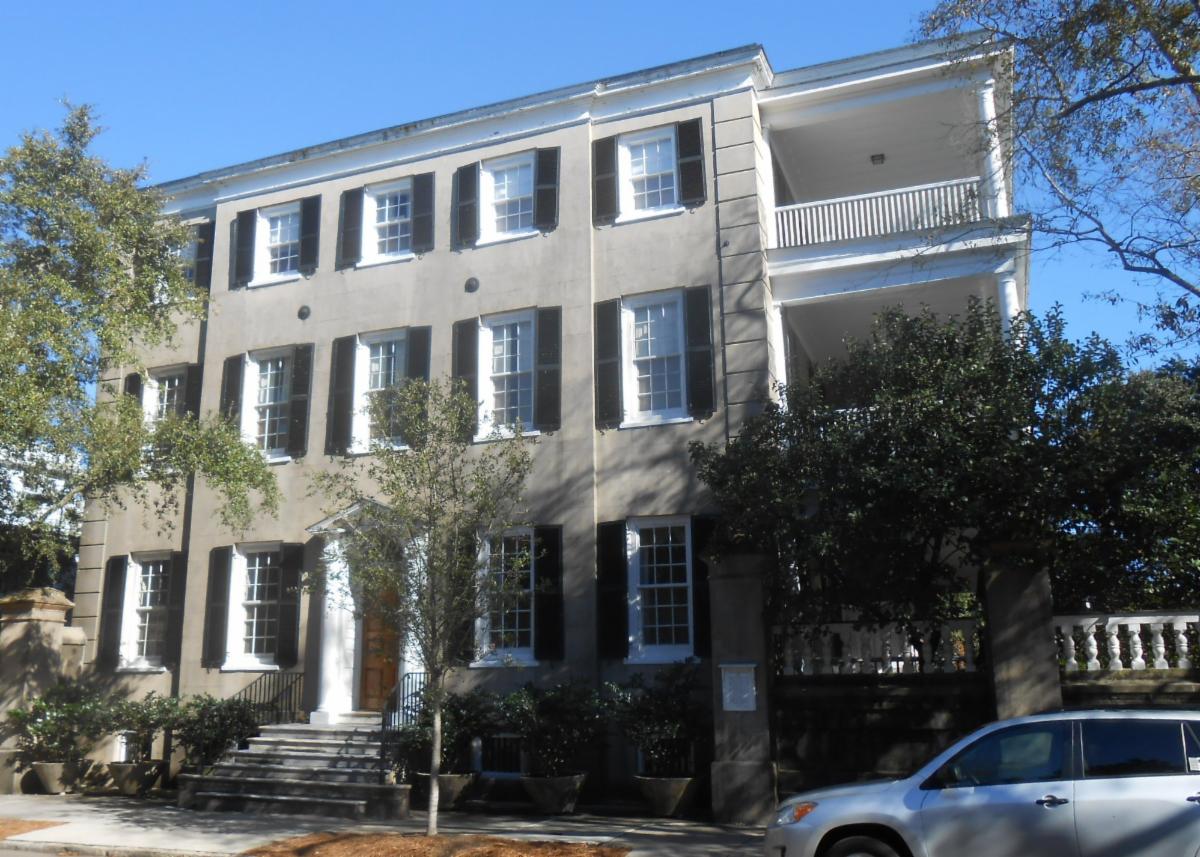
Marker, Lafayette at Daniel Huger House, Charleston SC
March 15, 1825
34 Meeting St, Charleston, SC 29401
By ProfReader - Own work, CC BY-SA 3.0, https://commons.wikimedia.org/w/index.php?curid=30599364
|
|
• The Daniel Elliott Huger House was the home of the last Royal governor in South Carolina, Lord Campbell. The common name for the house was assumed when Daniel Elliott Huger bought the house in 1818. The Hugers were a very prominent French Huguenot family in S.C., counting several politicians, soldiers, businessmen.
• Benjamin Huger hosted Lafayette when he first came to America in 1777. His son Francis, a little boy then, admired so much Lafayette that when he studied medicine in Austria he tried to organize the escape of the illustrious prisoner there in Nov. 1794. He eventually became a surgeon and an artillery colonel in the War of 1812, and hosted Lafayette again in 1825.
• Inscription:
“Handsome Georgian "Double House" constructed of brick but covered by stucco after 1886 earthquake. Drawing room has handsome ceiling plaster work decorations and carved overmantel with ionic pilasters. Residence of last Royal Governor Lord William Campbell, whose flight ended era of Royal rule. Daniel Elliot Huger acquired the house from his uncle in 1818, and it has ever since remained property of Huger family. LaFayette was entertained here in 1825. Erected by Preservation Society of Charleston.”
|
|
Lafayette in Edisto Island, SC
March 18, 1825
|
|
William Seabrook House, County Road 768, Edisto Island (Charleston County, South Carolina) (cropped)
8123 Chisolm Plantation Ln, Edisto Island, SC 29438
According to local lore, when it was discovered it would be low tide at the time of his arrival and the general would have to step off the boat into mud to reach the estate, a red velvet carpet was made to cover the mud.
|
|
• “We afterwards continued our navigation between the continent and the islands which border it and extend as far as Savannah. We landed on one of these, called Edisto, where General Lafayette was expected; but, as it was impossible for him to remain there more than two or three hours, the inhabitants, who were collected at one of the principal proprietor’s, decided to offer him at once all the festivals they had prepared for several days. We had, at the same time, the harangue, the public dinner, the ball, and even the baptism of a charming little infant, to which the name of Lafayette was given. We then rapidly traversed the island in a carriage, to join our steam-boat, which awaited us on the side next the ocean. What we saw of the island, in this short ride, appeared to us enchanting” (Auguste Levasseur. “Lafayette in America in 1824 and 1825, Vol. II. p126-127”)
• “Immediately after breakfast the Rev. Mr. William S. Lee performed the ceremony of baptism on Mr. William Seabrook’s infant, who received the name of Carolina Lafayette. The General was much affected and appeared as if he were unable fully to display his thanks and gratitude to the parents of the child”. Charleston Mercury, March 25, 1825
• Inscription:
“On March 18, 1825, general
Lafayette visited William
Seabrook and witnessed
the baptism of Carolina
Lafayette Seabrook.”
William G. Pomeroy foundation 2021
|
|
Lafayette in Beaufort, SC
March 18, 1825
|
|
801 Bay Street, Beaufort SC 29902
By Elisa.rolle - Own work, CC BY-SA 4.0,
|
|
• “It was nearly midnight when we passed Beaufort, and all on board were asleep; but we were soon awakened by the acclamations of citizens, who were waiting on the shore, and General Lafayette having arisen, yielded with readiness to their desire that he would land for some moments among them.” Excerpt From: Auguste Levasseur. “Lafayette in America in 1824 and 1825, p. 128 Vol. II.”
• The house was built in 1804 by John Mark Verdier. He was a son of a French Huguenot emigrant and was a wealthy planter and merchant. The house is on the Register of National Landmarks.
• Inscription:
"John Mark Verdier
1759-1826
Builder Of This House
1795-1800
General Lafayette Spoke To The People
Of Beaufort From This Portico
March 18, 1825
Erected by Beaufort County Historical Society"
|
|
Lafayette in Savannah, GA
March 19, 1825
|
|
By Ebyabe - Own work, CC BY-SA 3.0, https://commons.wikimedia.org/w/index.php?curid=16197669
|
|
• Inscription:
“This residence is the outstanding monument to the architectural genius of William Jay who completed his designs for its construction prior to his twenty-first birthday. Supervision of the work brought Jay to America in 1817. Its period is English Regency. Its style is known as Greek Revival. Its interiors are particularly notable and, in many features, unique. Of its style and period it is Savannah's finest and among the nation's best.
The mansion was built 1816-1819 for Richard Richardson, a Savannah merchant. The basement, of "tabby" construction, is of much earlier date, and contains the original trim of the de Brahm house which once occupied the site.
General LaFayette was quartered here as a guest of the City when he visited Savannah in 1825. He addressed the populace from the south balcony.
The mansion was left in trust to the Telfair Academy of Arts and Sciences in 1951 by Margaret Gray Thomas whose grandfather, George W. Owens, distinguished lawyer and Member of Congress, acquired the property from the Bank of the United States. It is now a historic house museum. Erected 1954 by Georgia Historical Commission. (Marker Number 025-26.)"
|
|
Lafayette in Augusta, GA
March 23, 1825
|
|
109 Macartan St, Augusta, GA 30901
Image Capture August 2019 (c) Google 2022
|
|
• Inscription:
“This is the site of the old Planter's Hotel, which was burned in 1839. There the Marquis de LaFayette was entertained during his visit to Augusta in March 1825. LaFayette landed at Savannah on March 19th and traveled to Augusta with Governor Troup a few days later. Arriving on the steamboat "Altamaha", LaFayette was greeted by a great procession of musicians, soldiers, clergymen, and citizens, who accompanied him into the city and to the Planter`s Hotel, where apartments had been prepared for him. The next day, Mayor William Holt formally welcomed the Marquis at the City Hall. The festivities planned in honor of LaFayette were even more lavish than those enjoyed by General Washington when he visited the city in 1791. An elaborate banquet and ball climaxed his visit. LaFayette left Augusta on Friday, March 25th, and with Governor Troup journeyed on to Milledgeville. The reverence which the people of Augusta felt for this most beloved American ally is reflected in a toast proposed at the banquet: "A man whose sovereignty is above that of kings - LaFayette who reigns in the hearts of the whole people." Erected 1962 by Georgia Historical Commission. (Marker Number 121-42.)"
|
|
Lafayette in Warrenton, GA
March 25, 1825
|
|
Warren County Clerk’s office, 650 Main St, Warrenton, GA 30828
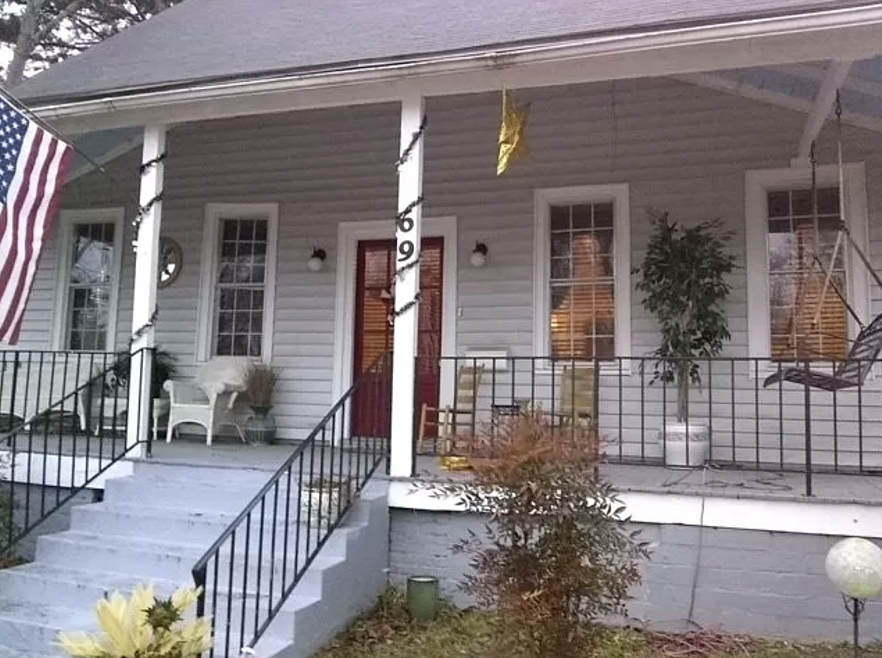
The Old Burkhalter Home at 69 Davis Street was the house of the Revolutionary War Solider Jacob Burkhalter. It is the first colonial house in Warren County, with the columns of the porch being the square type used in that day. General Lafayette reportedly stayed here during recovery. It is a private residence.
|
|
• Lafayette’s party traveled inland from Augusta on the Milledgeville Stage Road. The road was so treacherous with potholes and ruts that the four-horse carriage nearly broke down, and the general became ill from the jolts. After resting overnight in Warrenton, Lafayette continued on to Sparta and then to the capital, Milledgeville, where he arrived on March 27. He stayed at the Burkhalter House while traveling by stage from Augusta to Milledgeville. During his stay in Warrenton, a ball was held in his honor at the Allen House (later Fair Havens), which has since been moved to Arnoldsville in Oglethorpe County.
• “He [Lafayette] left Augusta on Friday morning, in a carriage and four, escorted by a detachment of cavalry, which would accompany him to Warrenton. Preparations have been made at that place and Sparta, for his reception.” Charleston Courier, March 30, 1825
• Inscription:
“On March 25, 1825, general
Lafayette spent the night in
Warrenton on his way from
Augusta to Milledgeville.
He departed the next morning.”
William G. Pomeroy foundation 2022
|
|
Lafayette in Milledgeville, GA
March 27, 1825
|
|
201 East Greene Street, Milledgeville GA 31061
Photo by Daughters of the American Revolution
|
|
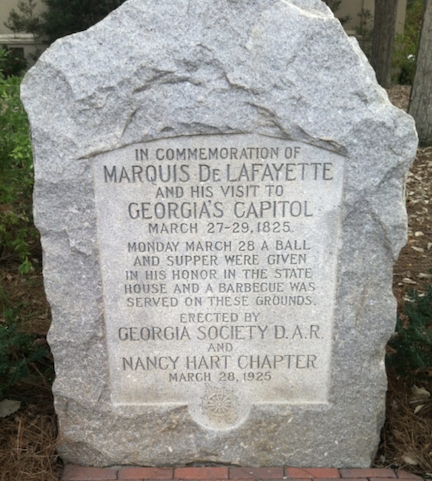
• On March 27, 1825 General Lafayette arrived in Milledgeville from Sparta, where he spent the next couple days until his departure on March 29 for Macon. At the time, Milledgeville was Georgia’s state capital and General Lafayette lodged at the government house.
The April 1, 1825 edition of The Georgian details his visit: “General Lafayette arrived in Milledgeville on Sunday last, at noon. It is needless to say he received a hearty and enthusiastic welcome. We learn from the Patriot, that he was met by the Cavalry of Baldwin County, who escorted him into the town, and that his approach was announced by the firing of cannon, ringing of bells, &e. The General rode in an open carriage, accompanied by the Governor, and followed by the military and civil procession, as previously arranged. In the evening he attended service at the Methodist Chapel- the town was illuminated, and on Monday he was to dine with the citizens, in an extensive arbor prepared in the State House square. A splendid Ball and supper were to be given him in Monday evening- the Senate Chamber and Hall of representatives having been tastefully prepared for the occasion. Several volunteer companies from the neighboring counties had arrived to assist in paying honor to the Guest of the Nation.”
• Inscription:
“In Commemoration of Marquis De Lafayette and his visit to Georgia's Capitol March 27-29, 1825. Monday March 28 a ball and supper were given in his honor in the State House and a barbecue was served on these grounds.
Erected 1925 by Georgia Society D.A.R. and Nancy Hart Chapter.”
|
|
Lafayette in Fort Benning, GA
March 31, 1825
|
|
Fort Benning (US Army base, restricted access) 1st Division Rd, Fort Benning, GA 31905
Photo: U.S. Army Fort Benning and The Maneuver Center of Excellence
|
|
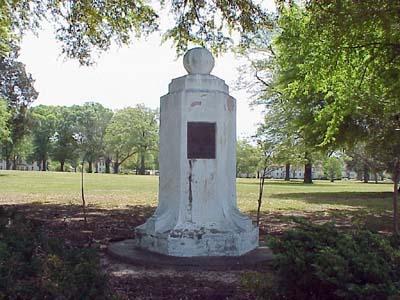
• The Lafayette Monument (formerly known as the “DAR Monument”) was built in 1926. It consists of three bronze plaques mounted on a concrete pedestal. This is the oldest monument on Fort Benning.
• Inscription of the plaque (excerpts):
"Along the Federal Road
built in 1811
east and west through
this place
there passed in 1825
Lafayette
Soldier of France and
volunteer in the cause
of American Liberty
“At the first news my heart was enrolled”
"Tablet erected in 1926 by the Georgia Daughters of the American Revolution"
|
|
Lafayette at Fort Mitchell, AL
March 31, 1825
|
|
561 AL-165, Fort Mitchell, AL 36856
|
|
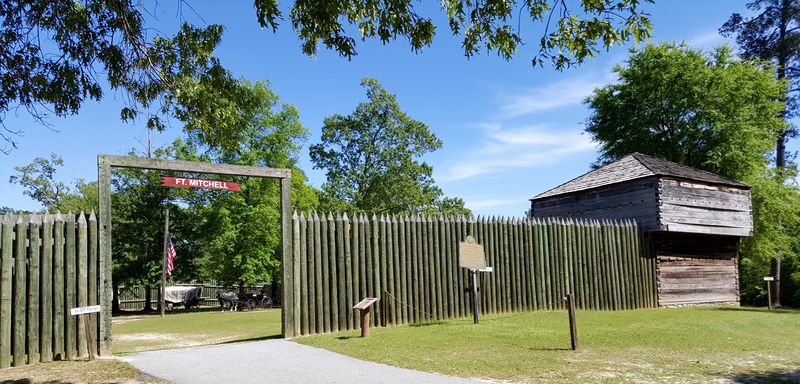
•...“It was on the banks of the Chatahouche that we met with the first assemblage of Indians, in honour of the general. A great number of women and children were to be seen in the woods on the opposite bank, who uttered cries of joy on perceiving us” - Excerpt From: Auguste Levasseur. “Lafayette in America in 1824 and 1825, Vol. II p 168.”
•Inscription (excerpts):
Fort Mitchell
“Fort Mitchell is located on the Federal Road on the West bank overlooking the Chattahoochee River [...]
In 1825, a second fort was built on the same site. It was a smaller, square fort 100' x 100'. The most honored guest of Alabama at this time was French General Lafayette who came to Fort Mitchell and was welcomed by Indian agent John Crowell and the Creek Indians”...
• Inscription of Lafayette Trail marker:
“On March 31, 1825,
Creek Indians welcomed
Lafayette by Chattahoochee
river near this settlement
as he traveled Federal Rd”.
"William G. Pomeroy foundation 2020"
|
|
WE WILL CONTINUE TO TRAVEL WITH LAFAYETTE
OVER THE NEXT 7 MONTHS!...
|
|
PAST MONTHLY BULLETINS
OUR GOAL: turn the spotlight on a famous, or less famous, episode or historical figure during the long shared history between France and the United States, with illustrations and anecdotes.
You can have access to all our past Monthly Bulletin
since February 2021 by visiting our website:
You can click on the photos throughout our bulletins and also on the links indicated in blue for more information and direct access to sources.
|
|
Next month we will devote our Bulletin to the great explorer Jehan de Verrazane, who was the first to sail to New York, which he named La Nouvelle-Angoulême on behalf of French King François Ier.
|
|
We are honored and pleased to announce the nomination of two Regional Delegates:
Mr. Alain LECA, Deputy General Delegate, Regional Delegate in Washington, district of columbia
Alain LECA's father was a veteran and a survivor of the Mauthausen extermination camp. Therefore he is a "Pupil of the French Nation" and a member of the "Amicale de Mauthausen".
He spent 7 years in the French armed forces:
- 3 years at the Army technical school (74/77) . He is a member of the association of the 12th promotion of the EETAT.
- followed by a year at the ground-air artillery school and 3 years at the 402nd ground-air regiment, hence his membership in the Hawk alumni association
His civilian professional career includes positions in Libya, Saudi Arabia to name a few.
Alain Leca is a Dual French-American national, working for a company managing US federal projects.
Alain Leca is currently:
- President of the Association des Anciens Combattants Francais (Washington DC region), and their flag bearer. This is also part of the "Tricolor committee"
- Member of the association of former students of the 12th promotion of the EETAT military school in issoire
- Member of the association of veterans of the hawk system (anti-aircraft system of the French army - hawk missile)
- Permanent member of the company of the 3rd American infantry division
- Permanent member of the association of the 15th American infantry regiment
- Member of the association of children of deportees from the Mauthausen extermination camp
Alain is a well known figure in the Washington DC French and American communities. Our association is proud to be represented by this French-American Patriot in the Federal Capital.
Mr. Bruno CATENI, residing in Houston, TX, is Deputy General Delegate, Regional Delegate for the Southern States of Texas, Louisiana, Arkansas, Oklahoma.
Bruno CATENI is a Cadet of the Corniche Lyautey of Aix en Provence (MSU)1989-90, and served as a PMP 1990 and PMP Instructor 1991.
He is a Naval air student pilot, petty officer second master "Maistrancier" 1991-1992
He is an engineer with diplomas from DEUG SSM 1992-94, ENSIA engineering degree 1994-97, Renewable Energy Research Engineer (employed by Oklahoma State University 1998-2007) and earned his
PhD from Oklahoma State University 2007.
He is a Chemical, natural gas and petroleum process engineer and an hydrogen and ammonia specialist, a father of two 8 year-old children.
Note:
Bruno Cateni participated in the repatriation of Lieutenant Ottaway Cornwell, MIA reconnaissance pilot shot over France, whose remains were discovered recently and who was buried in Houston almost 80 years after his death on January 27, 1944.
He is a Member and Flag Bearer of the French Veterans of Texas.
Our association is proud to be represented by Bruno CATENI who will oversee several noteworthy sites of French presence - - including the grave site of the oldest French sailor buried in the United States, at the Texas National Cemetery in Austin, who died while serving king Louis XVI in 1685, and whose remains were discovered in 1996.
|
|
ANNOUNCEMENT FROM
THE NATIONAL ARTS CLUB
INVITATION TO A RECEPTION FOR
MARCEL MARCEAU'S FRIENDS AND ADMIRERS
March 20, 2023
|
|
You are cordially invited to a reception
for Marcel Marceau’s
friends and admirers
on March 20, 2023 at 6.30 pm
The National Arts Club (NAC) hosts
"Marcel Marceau: Master of Mime",
a special exhibit ( March 9 - April 28, 2023)
celebrating the legendary mime on his 100th birthday.
The exhibition features photographs by Ben Martin, a Time photographer who produced them in close collaboration with the famed pantomime artist. A revised edition of the 1978 photographic portrait of the artist will be released in March 2023 to coincide with the exhibit. His widow Anne Sicco will be in attendance representing the Marceau family.
There is no charge for the reception, and the exhibit is open to the public.
The cost of the dinner is $90, payable by cash or check.
For more information please call: Francis Dubois at 917 880 2274
|
|
Frédéric Vigneron was a longstanding member of the ACREFEU (Association of French Reserve Officers in the United States), of the American Society of Le Souvenir Français and a Friend of the Federation of French War Veterans. He was also a Board Member of the Lower Manhattan Historical Association, where he was in charge of French military & community liaison and serving as Web Master as well. He died in New York on February 18, 2021, and is sorely missed by his many friends. We will gather next Friday, March 24th, for a very special tribute in his honor.
|
|
Refreshments & welcome
Tribute:
Ambrose Richardson, past president
Sons of the Revolution in the State of New York
James Kaplan, Esq., Founder & Chairman
Lower Manhattan Historical Association
Peter C. Hein, president,
Sons of the Revolution in the State of New York
Remarks:
Alain Dupuis, president
Federation of French War Veterans
Patrick du Tertre, president
French Reserve Officers in the USA
National Anthems:
La Marseillaise
The Star-Spangled Banner
Moment of Silence:
In Memory of Frédéric P. Vigneron
Closure:
Thierry Chaunu, Ling Yu
Musical Pot-Pourri:
David Anderson, Patrick Derivaz, Pablo Martin, Patti Rothberg, and Arthur Stevenson
End of tribute at 4:00PM
|
|
ANNOUNCEMENT FROM
WILLIAMSBURG YORKTOWN AMERICAN REVOLUTION ROUND TABLE
SAVE THE DATE
APRIL 6, 2023
|
|
At the American Revolution Museum at Yorktown (200 Water St, Yorktown)
APRIL 6, 2023 AT 6:30PM
Dr Robert A. Selig
will be presenting:
Of Skulls and Skeletons: Battlefield Clean-Up
With the recent findings at Red Banks, Colonial Williamsburg and Camden this topic will be extremely timely and critical to understanding the remarkable nature of these discoveries.
You are encouraged to bring a friend.
|
|
ANNOUNCEMENTS FROM THE WASHINGTON -ROCHAMBEAU REVOLUTIONARY ROUTE |
|
W3R-DE will host the Annual Meeting of W3R-US
April 14-16
|
|
Annual Meeting Weekend in Delaware to Include Ship Tour, Socials
W3R-DE will host the Annual Meeting of W3R-US and has developed several activities around the April 15 business session. Here are the highlights of the two-day gathering in Wilmington; please watch your email for additional information:
Friday, April 14
4 p.m. Check-in begins at the Staybridge Hotel with a special group rate of $129 per night until March 24 and parking discounted to $14 a day. Full breakfast is included. The Staybridge is at 13th and Market Streets, directly across the street from the Chancery Market in the Hercules Building, and centrally located for all events.
6 p.m. Pop-up gathering in the Chancery Market. Special prices for drinks and food. Mix and have fun! The Market has a large outdoor fireplace with comfortable seating if weather cooperates; indoor ambience includes fireplaces.
Saturday, April 15
9 a.m.-12 noon. Annual Meeting at the Junior League Building, 18th and Market Streets. Box lunch ($15) will be served.
1 p.m. Free time. Welcome bags, distributed at the meeting, will include information on all proximate heritage and cultural sites. Options include the Delaware History Museum and African American Museum for $8.
4:30-5:30 p.m. Delaware’s Tall Ship, Kalmar Nyckel, open for touring.
4:30-8:30 p.m. Heavy hors d’oeuvres and drinks in the Kalmar Nyckel Building, 1124 E. 7th Street, a fascinating facility rich in Delaware maritime heritage. Archaeologist Wade Catts of South River Heritage Consulting will speak.
Sunday, April 16
11 a.m. Staybridge checkout time.
For more information about Trail events, please visit:
|
|
Support the Carpenters’ Hall Recovery Fund! |
|
It is with great sadness we inform you the Carpenters' Hall in Philadelphia was damaged by fire on Christmas Eve this year. Being a major part of the trail, and the site of the 1st Continental Congress, it is imperative the restoration is completed before the 250th anniversary of the First Continental Congress.
A comment from the Carpenters’ Company, “As we look towards the 250th anniversary of the First Continental Congress in just over a year, it is more vital than ever that we reopen the Hall as it was intended: as a meeting place for the community, a civic forum, and a building for the people.”
Please click the link below to contribute to the effort to rebuild.
All contributions are appreciated!
|
|
SAVE THE DATE!
MAY 20TH, 2023
"Follow the French: Rochambeau Festival"
|
|
Three Encampment Site Tour / Event:
Audio digital tour overlay and customized individual site events:
Yorktown Site, 99 Moseman Road, Yorktown, NY (one of five 1781 encampment locations, AKA Yorktown Grange Fairgrounds)
Hartsdale, NY: Odell House - Rochambeau Headquarters
North Castle, Smith’s Tavern
Yorktown Site, Yorktown Grange Fairgrounds
99 Moseman Road, Yorktown, NY 10598
Free, Open to the general public
(Program in formation)
10:00am Grounds Open
-Exhibits, animals and food and beverage (Education Building/ Field)-map
10:15am Encampment Reenactment (Field)-map
12:00pm Kick Off Ceremony (Stage) with officials
2:00pm Encampment Reenactment (Field)-map
3:00pm Indispensable Allies Presentation (Main building)-map
4:00pm Close and Breakdown
Odell House - Rochambeau Headquarters
425 Ridge Rd, Hartsdale, NY 10530
Free, Open to the general public
On May 20 the Friends of Odell House Rochambeau Headquarters will welcome the public to our site as part of the Follow the French tour of three important places where the French forces encamped in Westchester in 1781. The French arrived first in North Castle/Armonk, then came to OHRH and then marched to present-day Yorktown (New York) on their way to Yorktown, Virginia. Each location will be part of the May 20 event, from 10 a.m. to 4 p.m.
More details will be announced soon in our Bulletin next month!
|
|
The Annual Meeting of the American Friends of Lafayette
June 8 to June 11, 2023 in LaGrange, Georgia
|
|
A message from Chuck Schwam, COO, American Friends of Lafayette
The Lafayette Alliance, led by Dr. Richard Ingram, is ready to roll out the red carpet for AFL members. Richard, his lovely wife Janice, along with a cast of many have planned a very entertaining weekend. Their excitement was palpable, as was their pride in the charming city of LaGrange. AFL members are going to fall in love with LaGrange and its Lafayette Fountain.
This could also be our most economical annual meeting ever. We will be staying at the Courtyard Marriott at the center of town, directly across from the famous Lafayette Fountain on the main square for only $129 per night (double) or $139 per night (king) plus taxes. Quaint shops and restaurants surround the hotel. More on booking rooms below.
REGISTRATION DEADLINE IS SUNDAY, APRIL 30th
This year’s registration fee is only $200 which includes all meals from Thursday night through Sunday morning and all transportation within the itinerary. Your registration fee also includes a weekend PACKED with scholarly and fun activities. We will see Lafayette artifacts and places he visited. We will see art devoted to Lafayette, including paintings, sculptures, architecture, drama, music, and dance. It could be the most unique itinerary we’ve ever seen.
The closest airport is in Atlanta (Hartsfield-Jackson Atlanta International Airport). If you plan on flying to this meeting, you will not have to rent a car if you do not want to. There is a shuttle that operates 24/7 that will take you from the Airport to LaGrange for $44pp each way. Once in LaGrange, all of our activities are either within walking distance of the venues or transportation is provided (motor coach or trolley). Full details regarding the shuttle service (Groome) between the airport and LaGrange will be shared with registrants in May.
Here is what you need to do (read carefully)...
-
Book your hotel stay now. Please call the Marriott Courtyard in LaGrange at 706-668-5600 and mention that you are with the Lafayette Alliance group to get your discounted rate.
- If you are flying, book your flight now. PLEASE NOTE: If using the airport shuttle to get to and from the meeting…
-
On Thursday, June 8th, please arrive at Atlanta’s airport (ATL) no later than 2:00pm. That will give you plenty of time to catch the shuttle (every hour on the half hour), check into your room, freshen up and be at our first event which is the welcome reception which starts at 6:30pm (doors open at 5:30pm). Details regarding the shuttle service will be emailed in May.
-
On Sunday, June 11th, please book a flight that leaves Atlanta’s airport (ATL) at 3:00pm or later. Although the shuttle runs every hour (at quarter past the hour) we want to get you to the airport in plenty of time and in a relaxed state. Our last event on June 11th is breakfast and tours, starting at 9:00am and ends whenever you are finished. Feel free to leave this venue after breakfast (10am) or after the program (about noon). I would budget two hours to get from the Sunday venue to the Atlanta Airport. Then budget more time to check bags and go through security. Again… Details regarding the shuttle service will be emailed in May.
- If you plan on driving, parking is FREE.
-
PLEASE: Register for the upcoming annual meeting (and pay your $200pp), by clicking here: REGISTER
REGISTRATION DEADLINE IS SUNDAY, APRIL 30th
|
|
ANNONCEMENT FROM THE BATTLE OF RHODE ISLAND ASSOCIATION:
Ambassador George Krol joins the Battle of Rhode Island Association as a Director
|
|
The Battle of Rhode Island Association (BoRIA) recently announced the addition of retired U.S. Ambassador George Krol as a Director representing the Middletown Historical Society. Fellow Director Joe Studlick remarked “we’re very excited to have the Ambassador and his unique global knowledge to help us in our endeavors to expand the understanding of Rhode Island’s role in the war for independence. He will strengthen our relationships with our French partners much like the Patriots experienced during the Revolutionary War.”
Prior to retiring to Middletown, Rhode Island, George Krol served 36 years in the U.S. Foreign Service, during which he held foreign assignments in Poland, India, Russia, the Baltic republics, Ukraine and as U.S. Ambassador to Belarus, Uzbekistan, and Kazakhstan. In Washington he served as Deputy Assistant Secretary of State for Central Asia Affairs and as Director of the U.S. State Department’s Office of Russian Affairs. Krol teaches as an Adjunct Professor at the U.S. Naval War College and lectures frequently on foreign policy issues and the states of the former Soviet Union and Warsaw Pact. He is also an Associate of Harvard University's Davis Center for Russian and Eurasian Studies. A graduate of Harvard College and Oxford University, and a lifelong lover of history, Krol currently enjoys learning the unique history, customs and languages of his now permanent assignment - Rhode Island.
Ambassador Krol remarked “I am honored to represent the Middletown Historical Society on the Board of the Battle of Rhode Island Association. The more I learned about this battle and the preceding siege of Newport that involved Middletown directly, the more I came to appreciate the importance of these events – and of Rhode Islanders of all colors and creeds, and our own Aquidneck Island communities -- in the history of the American Revolution. This battle was the precursor to the ultimately successful Battle of Yorktown where again the First Rhode Island Regiment fought bravely and brilliantly. The Battle of Rhode Island deserves wide recognition and commemoration. I look forward to helping achieve that worthy goal.”
The Battle of Rhode Island Association is a 501(c)(3) non-profit committed to raising awareness of Rhode Island’s role in the War for Independence. Donations may be made payable to “BoRIA” at PO Box 626, Portsmouth, RI 02871 or by visiting:
We extend a respectful welcome to Ambassador Krol. We look forward to working with him and members of the association in the coming months to help promote Fort Butts Hill.
|
|
OUR MISSIONS:
• To preserve the memory of the French soldiers, sailors and airmen who gave their lives for freedom, and who are buried in the United States.
• To honor French Citizens who did great deeds in the United States, or with a strong connection with the United States,
• To promote the appreciation for French culture and heritage in the United States, and the ideals that unite our two nations, in order to pass the torch of memory to younger generations.
• To strengthen the long-standing traditional bonds of friendship between the American and French peoples, and to this end: erect or maintain memorials and monuments and encourage historical research, public presentations and publications in the media.
We are looking to complete our geographic coverage with Regional Delegates for the SouthWest in cities such as Austin, or Houston, and Louisiana, in cities such as New Orleans or Baton Rouge.
The American Society of Le Souvenir Français, Inc. is an independent American corporation, apolitical, established in 1993 in NY, with 501 (c) 3 non-profit status.
|
|
Board of Directors
American Society of Le Souvenir Français, Inc.
Members (2023):
Françoise Cestac, Honorary President • Thierry Chaunu, President • Yves de Ternay, Treasurer • Patrick du Tertre, 1st Vice President • Henri Dubarry • Francis Dubois • Alain Dupuis, 2nd Vice President • Daniel Falgerho, General Secretary • Pierre Gervois • Caroline Lareuse • Clément Mbom, Education Advisor • Jean-Hugues Monier, Auditor • Harriet Saxon • Nicole Yancey
Regional Delegates:
Jacques Baisnenou, Great Lakes and Midwest • Bruno Cateni, South
Prof. Norman Desmarais, New England • Alain Leca, Washington D.C. •
Marc Onetto, West Coast • Brigitte Van den Hove – Smith, Southeast • Nicole Yancey, Yorktown & Virginia, former Honorary Consul of France in Virginia
|
|
Help us implement several historic commemorative projects celebrating the 245-year-old Franco-American friendship and alliance! |
|
The American Society of Le Souvenir Français, Inc. is a registered NY State non-profit corporation and has full IRS tax exempt 501(c)3 status. All donations are tax deductible.
Copyright © 2023 The American Society of Le Souvenir Français, Inc.
All Rights Reserved
Merci de nous contacter si vous souhaitez recevoir ce bulletin dans sa version traduite en français.
Contact: Thierry Chaunu, President
697 Third Avenue #341 New York, NY 10017
|
|
|
|
|
|
|