Weekly News From Los Alamos County
February 3, 2022
|
|
Inside this newsletter you will find...
A Message from Dr. McAtee, Article: Becoming an Endemic, This Week's Survey, Healthcare Resilience, COVID-19 Data, Vaccine Updates and more.
|
|
|
|
A message from Dr. Elena McAtee -
Let's Talk Outpatient Treatment Options...
|
"Because the main goal of treatment is to reduce hospitalization and/or death from COVID 19, the oral therapies are being
prioritized to those who are high risk."
|
|
As you may be aware, two oral treatments (Paxlovid and Molnupiravir) were recently approved by the FDA for emergency use for the treatment of COVID-19. Alas, significant headway to prevent hospitalizations and severe disease! The supply of the two oral medications is limited and will be for several months, but the goal is to make the medications accessible to those who are considered highest risk for hospitalization and/or death. The state of New Mexico is further prioritizing availability of oral therapeutics to counties with poor access to monoclonal antibody infusions. Los Alamos County will be part of the second group, Phase 1B. Current eligibility for oral therapeutics is underway in Phase 1A counties which includes several nearby counties.
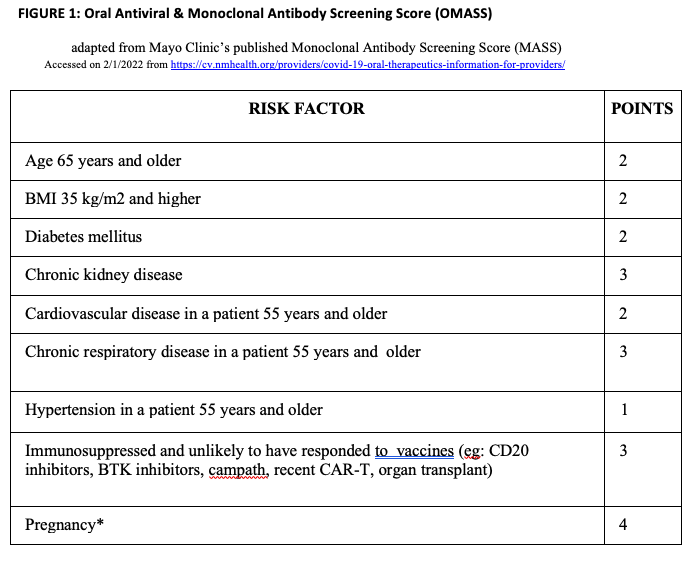
The New Mexico Department of Health is using the oral antiviral and monoclonal antibody screening score (OMASS) (see Figure 1) to objectively risk-stratify individuals with COVID-19 and determine who meets the threshold for treatment.
|
|
There are multiple factors to consider when weighing the option of treatment with Paxlovid or Molnupiravir. The effectiveness of Paxlovid at reducing the risk of hospitalization in 88% when taken within 5 days of symptom onset; Molnupiravir reduces the risk of hospitalization by 30%. Paxlovid is in shorter supply and therefore not as available. More medical and medication contraindications exist with Paxlovid. Molnupiravir is potentially harmful to a fetus and individuals who receive this medication are advised to prevent pregnancy for 90 days after receiving it. Both medications must be started within 5 days of symptom onset and consist of a 5 days course.
It is important to remember that different therapies exist and information regarding COVID-19 is constantly evolving. Speak to your doctor to help to clarify your options and for the most current information.
Elena McAtee, MD
Family Medicine
Medical Associates of Northern New Mexico
|
|
Endemic, ‘New Normal’ Chatter Intensifies as U.S. Coronavirus Cases Start to Decline
Experts are striking a noticeably more hopeful tone as the Omicron coronavirus variant’s wave in the U.S. appears to be turning the corner. With increased levels of immunity due to vaccines and the massive number of infections caused by Omicron, talks of whether the U.S. is approaching a “new normal” are intensifying. But the shift to endemic – or a state when the presence of the coronavirus is constant but predictable – is a ways away.
Coronavirus cases and hospitalizations in the U.S. are decreasing but remain at overall very high levels. With several states yet to see their peaks, Omicron’s damage is far from over. Despite the statistics, more political figures and health officials are shifting their language to an optimistic tone.
What Does Endemic Mean?
Experts generally agree that the coronavirus will not be eradicated, but they also note that every previous pandemic has ended. The expectation for COVID-19 is that it will eventually shift from a pandemic, when unpredictable infections affect multiple countries, to endemic, when illness is consistently present but limited to certain areas.
One change in tracking the virus that some experts are already considering is watching the number of coronavirus-related hospitalizations more closely than cases. Nicholas Reich, a professor of biostatistics at the University of Massachusetts Amherst School of Public Health and Health Sciences who helps curate an ensemble coronavirus model, said he has almost entirely stopped looking at cases.
“To me, this is part of the new normal, is that the hospitalizations are going to continue to be the key indicator,” Reich said on a call with reporters on Wednesday. “I really think we as a society need to start focusing our emphasis on the hospitalization data.”
What The Near Future Could Bring
With so many people infected by the Omicron variant, levels of immunity across the U.S. have undoubtedly increased.
But WHO Director General Tedros Adhanom Ghebreyesus said this month at a press briefing that the “pandemic is nowhere near over” despite some countries moving past their omicron peaks.
“There are different scenarios for how the pandemic could play out and how the acute phase could end, but it is dangerous to assume that Omicron will be the last variant – or that we are in the endgame,” Tedros said. “On the contrary, globally the conditions are ideal for more variants to emerge.”
If Omicron is any indicator, the situation can still change quickly and dramatically. Many countries are still seeing high levels of transmission of the virus with little vaccine coverage. The more opportunity the virus has to spread, the higher the chance it will mutate. More than 3 billion people in the world have yet to receive a single dose of coronavirus vaccine, and experts have continually warned that the pandemic won’t end anywhere until it ends everywhere.
|
|
|
Do you still find National and International COVID-19 information valuable?
|
|
Yes - The more the better!
|
|
|
|
|
|
|
The latest Covid variant is 1.5 times more contagious than Omicron and already circulating in almost half of U.S. states
Nearly half of U.S. states have confirmed the presence of BA.2 with at least 127 known cases nationwide as of Friday, according to a global data base that tracks Covid variants. The Centers for Disease Control and Prevention, in a statement Friday, said although BA.2 has increased in proportion to the original omicron strain in some countries, it is currently circulating at a low level in the U.S.
The subvariant is 1.5 times more transmissible than the original omicron strain, referred to by scientists as BA.1, according to Statens Serum Institut, which conducts infectious disease surveillance for Denmark.
The BA.2 variant has five unique mutations on a key part of the spike protein the virus uses to attach to human cells and invade them, Lillebaek told CNBC. Mutations on this part of the spike, known as the receptor binding domain, are often associated with higher transmissibility.
The U.K. Health Security Agency on Friday said BA.2 has a “substantial” growth advantage over the original omicron. The sister variant spread faster than the original omicron in all regions of England where there were enough cases to conduct an analysis, according to the agency.
However, a preliminary assessment found that BA.2 doesn’t appear to reduce the effectiveness of vaccines any more than the original omicron. A booster dose was 70% effective at preventing symptomatic illness from BA.2 two weeks after receiving the shot, compared with 63% effectiveness for the original omicron strain.
The World Health Organization has not labeled BA.2 a separate variant of concern from omicron. However, WHO officials have repeatedly warned that new variants will arise as omicron spreads across the world at an unprecedented rate. Maria Van Kerkhove, the WHO’s Covid-19 technical lead warned that the next Covid will variant be more transmissible.
|
|
Q&A: COLLECTING DATA ON HEALTHCARE RESILIENCE
Healthcare organizations have been stretched thin throughout the pandemic, but frontline workers continue to show up and save lives. The ability of these organizations to perform well despite unprecedented pressures should be analyzed through the lens of ‘high-reliability organizing’ to determine what changes could help prepare for future crises.
Resilience is not just the ability to recover; it’s also the ability to withstand strain during adversity. Nurses and hospitals are unusually resilient. There have been many studies of nurses and their abilities to improvise because their work is challenging every single day.
So, where haven’t our healthcare organizations been resilient and need improvement?
Some culture surveys show a decline in organizational culture, particularly safety culture, and there are some data surfacing suggesting that patient safety has declined too. Some research, suggests that one reason for this decline in patient safety relates to the fact that the requisite variability of the system was compromised because visitors couldn’t be by the bedside anymore. Patients’ families are a big input to sense-making and decision-making in healthcare, providing variety to the process. Providers couldn’t get insight from patients’ families during the pandemic. That meant that oftentimes healthcare providers didn’t have as much information because they didn’t have other people to draw on. That is an important gap we need to address.
|
|
Have a question? Email us. |
|
Harvard Health FAQs
Harvard Health has an FAQs page for your reference. Find answers to questions like "When am I no longer contageous?" and "I had COVID-19. Am I at risk for future health risks?". Click HERE for those answers and more.
|
|
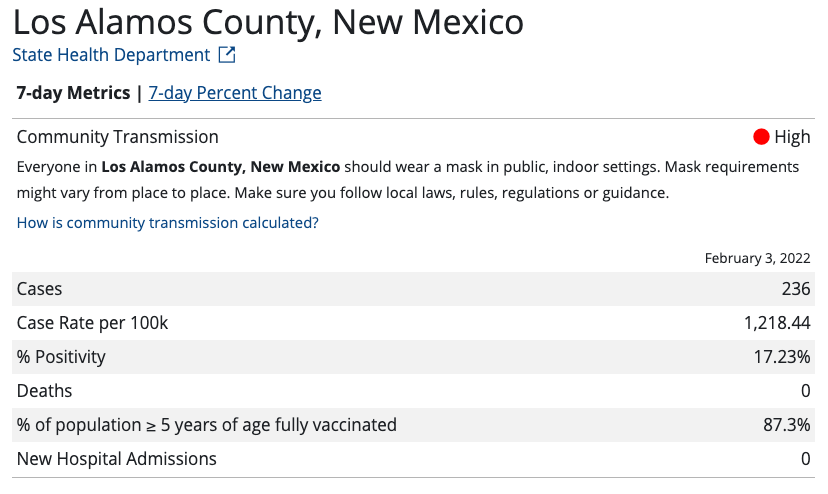
CDC COVID Data Tracker - February 3, 2022
To get today's break down of positive case data, demographics information, vaccine status and more for Los Alamos County or other counties across the United States, click HERE
|
|
Stay Up to Date - Interpretive Summary for January 28, 2022
Get weekly updates to CDC journals, publications, articles, and more, right in your email box. Subscribe for free and stay up-to-date with the latest information.
|
|
LAC Emergency Manager's Report to Council click HERE
|
|
Johns Hopkins
COVID-19 Status Report Dashboard for
|
|
Mayo Clinic Vaccine Tracker
To see how many people are vaccinated and compare progress across states, click HERE
|
|
NMDOH Epidemiology Reports Updated January 31, 2022
View data showing the percentage of new cases each week by race/ethnicity, as well as by age groups and gender. You will also find in-depth epidemiology reports - click HERE
|
|
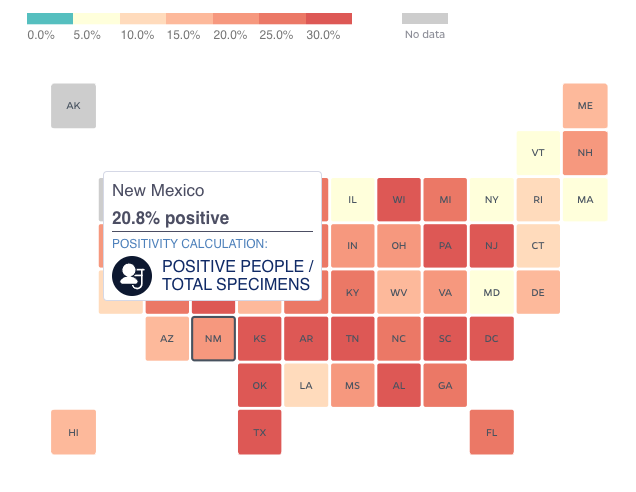
The charts available with this TOOL layout the key metrics for understanding the reach and severity of COVID-19 in a given area.
The chart below shows the Percent Positive by state.
|
|
|
|
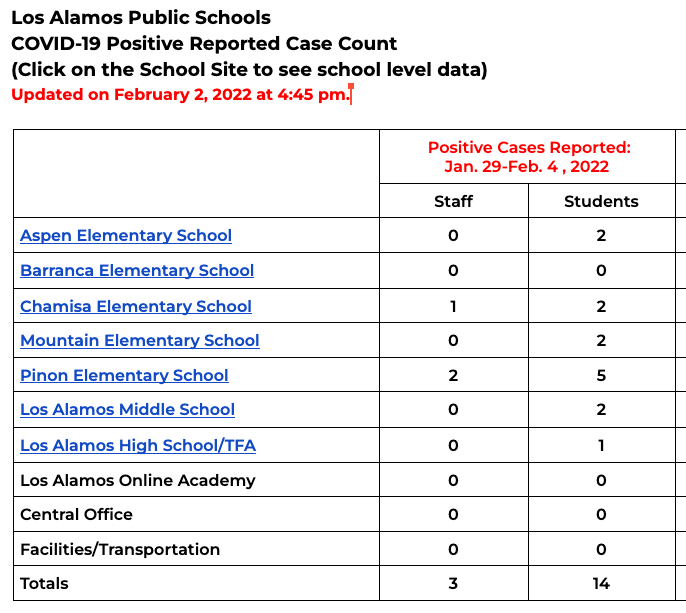
LAPS COVID-19 Positive Reported Case Count
Cases Reported between
Jan. 29-Feb. 2
Total: 17
|
To learn more about reported COVID-19 cases in the individual LAPS schools, click HERE.
|
|
Vaccine/Booster Information |
|
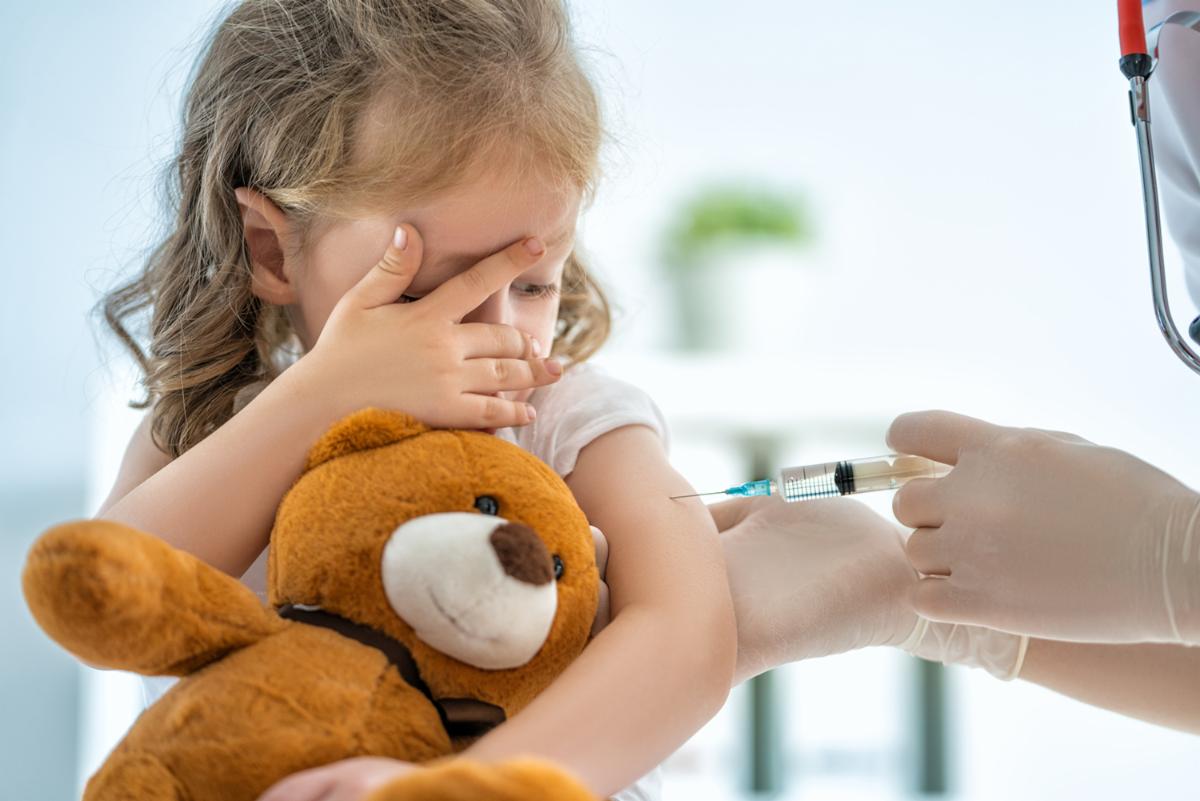
Pfizer and BioNTech Initiate Rolling Submission for Emergency Use Authorization of Their COVID-19 Vaccine in Children 6 Months Through 4 Years of Age Following Request From U.S. FDA
Pfizer Inc. and BioNTech SE today announced that following a request from the U.S. Food and Drug Administration (FDA) the companies have initiated a rolling submission seeking to amend the Emergency Use Authorization (EUA) of the Pfizer-BioNTech COVID-19 Vaccine to include children 6 months through 4 years of age, in response to the urgent public health need in this population. The companies expect to complete the EUA submission in the coming days. This application is for authorization of the first two 3 µg doses of a planned three-dose primary series in this age group. Data on a third dose given at least 8 weeks after completion of the second dose are expected in the coming months and will be submitted to the FDA to support a potential expansion of this requested EUA.
Since the pandemic began, more than 10.6 million children have tested positive for COVID-19 in the U.S.,1 with children under 4 accounting for more than 1.6 million of those cases.2 Further, reported COVID-19 cases and related hospitalization among children have spiked dramatically across the United States during the Omicron variant surge. For the week ending January 22, children under 4 accounted for 3.2% of the total hospitalizations due to COVID-19.2 If authorization is granted, the Pfizer-BioNTech COVID-19 Vaccine would be the first vaccine available to help protect children under 5 years of age from this disease, potentially including future emerging variants of concern.
|
|
Los Alamos County Vaccine/Booster Resources
Visit the County COVID Page for information regarding vaccinations/boosters, click below:
|
|
Testing Resources for Los Alamos County |
|
Additional Los Alamos County Testing Resources
Visit the County COVID Page for information regarding testing, click below:
|
|
What else would you like to see in this newsletter?
Click below to email us your feedback and questions!
|
|
|
|
|
|
|