|
Dear Presidents’ Alliance Member,
In this week’s Member Update:
- Latest on H-1B: The $100K Fee, Proposed Weighted Lottery Rule, and What’s Coming Next
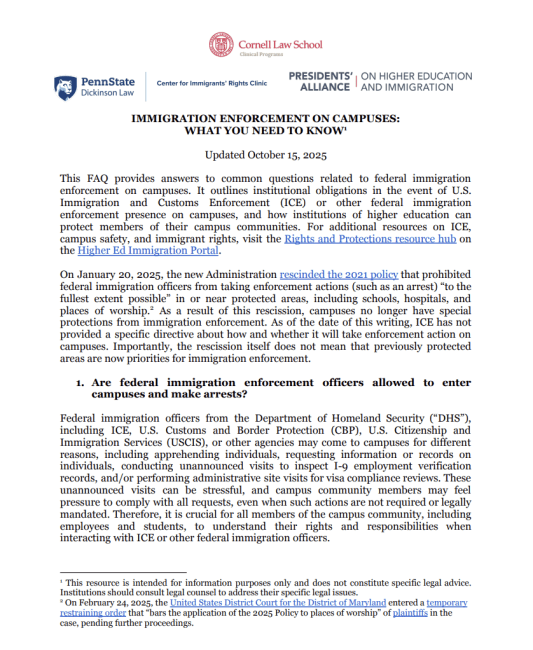
- Updated FAQ! Immigration Enforcement on Campuses
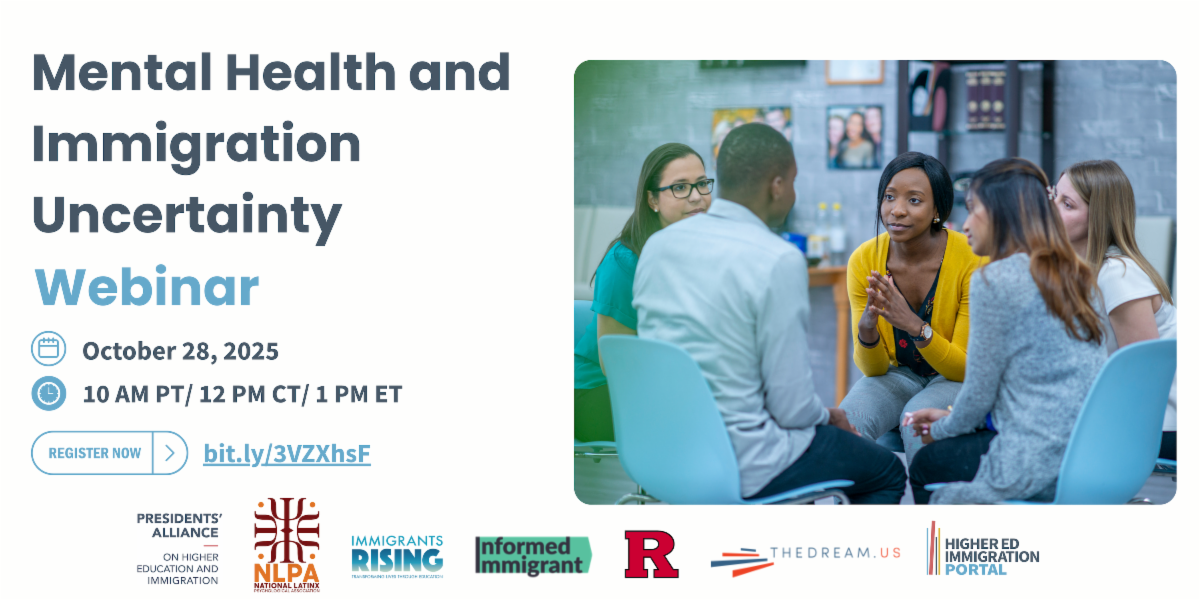
- Next Week! Webinar and New Guide on Mental Health and Immigration Uncertainty
- Explainer and Webinar Recording: Policy Impacts & Ways to Support Refugee and Displaced Students on Campus
- Deadline Extended: Join Our Amicus Brief in Defense of Texas’ In-State Tuition Policy
- New Resource! Free Legal Consultations for Students & Graduates in Precarious Statuses Residing in Texas
- Join Our Upcoming Undocumented Community of Practice & Action (UndocuCoPA) Community Check-In
- Immigration in Brief
- Calendar of Events
- Top Reads
| | |
Latest on H-1B: The $100K Fee, Proposed Weighted Lottery Rule, and What’s Coming Next
New Guidance on the $100k H-1B Fee. The U.S. Citizenship and Immigration Services (USCIS) issued guidance this week on the implementation of the September 19 presidential proclamation establishing a new $100,000 fee on H-1B visa applications. The guidance details who must pay the fee, potential exceptions, and payment instructions. The fee applies only to new petitions filed for individuals outside the United States – applicants such as international students, graduates, and scholars who are already in the country and requesting “change of status” should not be subject to the fee, though further clarifications are still needed. The guidance also outlines how to make the payment and sets “extraordinarily rare” standards for possible exceptions limited to cases deemed in the national interest. The rollout has generated confusion among employers, and two lawsuits have already been filed challenging the fee.
Comments on H-1B Weighed Lottery Rule. The public comment period on the recently proposed H-1B Weighted Lottery rule closes on October 24. While the proposed rule does not impact cap-exempt higher education institutions as employers, it would directly harm our international graduates seeking to launch careers in the U.S. By prioritizing applicants with higher wage levels, the rule would favor mid-career professionals and disadvantage recent graduates, whose positions are typically classified at the lowest wage levels. Institutions and organizations may want to consider signing onto a comment letter led by the Institute for Progress (IFP) in response to the proposed rule. The Presidents’ Alliance has signed on.
Sign on to the letter here. The sign-on deadline is Friday, October 24, at 12 PM ET.
What's Next? We also published a post summarizing everything campus leaders need to know about the proposed rule and other planned changes to the H-1B visas, as well as other programs such as practical training and O visas.
| | Updated FAQ! Immigration Enforcement on Campuses | | |
We have updated our Immigration Enforcement on Campuses FAQ to include new guidance following USCIS’s Operation Twin Shield, a recent enforcement initiative that involved contact with international students, including those with pending OPT applications. The update addresses what Operation Twin Shield was, how students and campuses may be affected by similar actions, and how institutions should prepare. New questions also clarify students’ rights if approached by DHS at their residences, the potential consequences of declining to engage with officers, and ensuring that student and employee information is current.
| | Next Week! Webinar and New Guide on Mental Health and Immigration Uncertainty | | |
Join the Presidents’ Alliance, TheDream.US, Immigrants Rising, Informed Immigrant, NLPA, and the Immigrant Mental Health Lab at Rutgers University on Tuesday, October 28, at 1 PM ET / 10 AM PT for the launch of a new guide, Supporting Mental Health Amid Uncertain Immigration Status: A Higher Education Guide.
This webinar will explore how colleges and universities can better support the mental health of students, scholars, and educators navigating immigration-related uncertainty. The event will feature an overview of the new guide, a panel discussion, and an audience Q&A.
Speakers include:
-
Luz Bertadillo, Director of Campus Engagement, Presidents’ Alliance
-
Dr. Germán A. Cadenas, Associate Professor of Clinical Psychology, Rutgers University
-
Dr. Elizabeth Hernandez, Assistant Training Director, UCLA CAPS
-
Dr. Diana Peña, Mental Health Coordinator & Licensed Psychologist
-
Jody-Ann Thomas, Student, John Jay College of Criminal Justice
-
Caishu, Student, University of California, Santa Cruz
-
Dr. Felecia Russell, Director of the Higher Ed Immigration Portal, Presidents’ Alliance (Moderator)
| |
|
Explainer and Webinar Recording: Policy Impacts & Ways to Support Refugee and Displaced Students on Campus
On October 15, the Presidents’ Alliance hosted a webinar on the latest “Updates on Policies & Programs for Refugee and Displaced Students.” Policy experts shared the latest information on humanitarian protections and their implications for campus communities. The discussion also highlighted opportunities for institutions to support refugee and displaced students through two recent initiatives: the higher education access program for refugees, led by CSH, and the Legal Pathways that Work Initiative of the Presidents’ Alliance.
You can now access the webinar recording, slides, and an explainer detailing the different humanitarian immigration statuses students may hold, and the challenges they face amid shifting protections.
| | |
Deadline Extended: Join Our Amicus Brief in Defense of Texas’ In-State Tuition Policy
The Presidents’ Alliance invites higher education institutions and organizations to join an amicus brief in support of motions filed by the Austin Community College District Board of Trustees and the Mexican American Legal Defense and Education Fund (MALDEF) to intervene in the Department of Justice’s lawsuit challenging Texas’ longstanding tuition equity policy. This amicus brief is relevant to both public and private institutions, and addresses the importance of eligibility to in-state tuition and/or state financial aid policies in expanding higher education access, strengthening the economy, and supporting state and national workforce needs.
The deadline for signing on in support of this amicus brief has been extended to November 3, 2025.
To review the full outline of the amicus brief and/or indicate interest in signing on, please reach out to us at info@presidentsalliance.org. If you are an Alliance member institution or partner organization, your leadership should have received a direct invitation with all the relevant information. Please contact us with any questions.
| | |
New Resource! Free Legal Consultations for Students & Graduates in Precarious Statuses Residing in Texas
As uncertainty surrounding the future of DACA continues, especially for individuals in Texas, our Legal Pathways that Work (LPTW) initiative is expanding its free virtual legal consultations.
Eligible individuals must:
- Reside in Texas;
-
Be a Dreamer (with or without DACA), Temporary Protected Status (TPS) recipient, or Humanitarian Parolee; AND
-
Hold an associate degree or higher, OR be currently enrolled as a junior or senior in an undergraduate program.
| | |
Consultations focus on employment-based visa options and include screening for all potential pathways to lawful status.
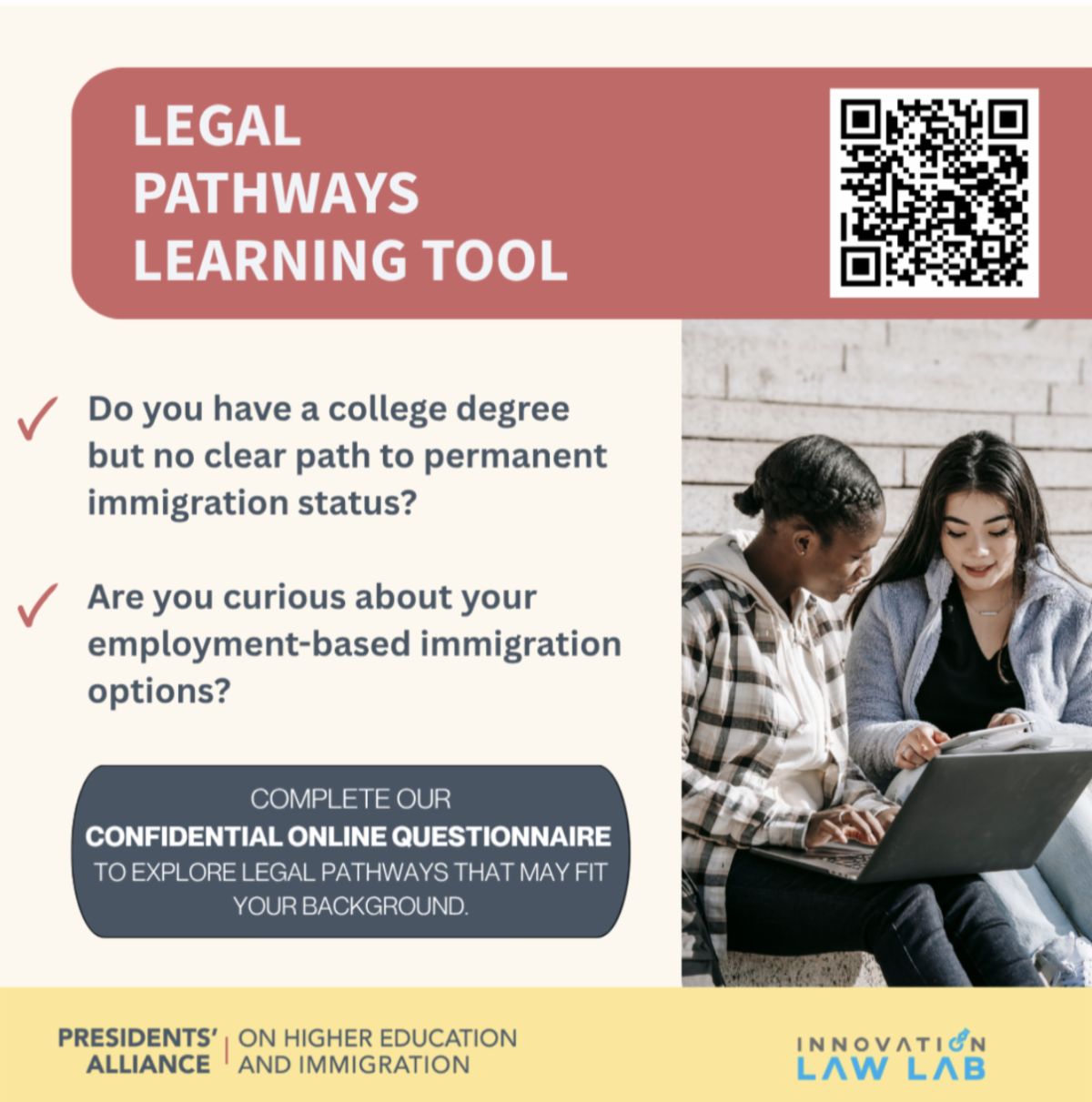
How It Works: Eligible students and graduates should first complete our Legal Pathways Learning Tool – a confidential online questionnaire developed by immigration legal experts. It helps users explore possible employment-based pathways and determine next steps. Those who meet our program criteria will then have access to the legal consultation request form.
| | |
Please Note: The Presidents’ Alliance continues to offer free legal consultations nationwide for Dreamers (with or without DACA), TPS recipients, or Humanitarian Parolees who hold a bachelor’s degree or higher. Eligible individuals can request a consultation by first completing the Legal Pathways Learning Tool.
Due to our program’s limited capacity, we are currently unable to offer free legal consultations to enrolled undergraduate students outside of Texas, international students, those with pending or approved green cards, or individuals seeking advice outside of employment-based immigration.
We hope to continue expanding access in the future. For more information, visit our Legal Pathways that Work resource hub or email Caitlin Johnson at caitlin@presidentsalliance.org.
| Join Our Upcoming Undocumented Community of Practice & Action (UndocuCoPA) Community Check-In | |
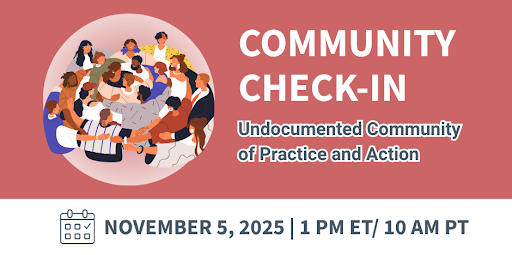
If you are a practitioner or advocate working with undocumented students, we invite you to join our upcoming Undocumented Community of Practice & Action (UndocuCoPA) Community Check-In on Wednesday, November 5, at 1 PM ET / 10 AM PT. This session will provide an opportunity to connect with colleagues across the country and discuss recent changes, challenges, and emerging needs in your work this semester. Our goal is to provide a space for meaningful conversation, collaborative problem-solving, and relationship-building.
| | |
Immigration in Brief
-
Last Thursday, the U.S. Chamber of Commerce filed a lawsuit challenging the $100K H-1B visa fee; the complaint laid out several reasons why the imposition of the fee was unlawful.
-
A new NFAP study estimates that the current administration’s immigration and immigration enforcement policies targeting undocumented, lawfully immigrant, and international populations in the U.S. would reduce the number of workers in the U.S. by 6.8M by 2028 and 15.7M by 2035, lowering the annual rate of economic growth by almost one-third.
-
This week, the Migration Policy Institute released new estimates of the undocumented population in the U.S. According to MPI, the undocumented population grew from 10.7M in 2019 to 13.7M in 2023, and accounted for 26% of the overall immigrant population in the U.S. in 2023. While the increase was the largest since the early 2000s, it was still the case that 80% of all undocumented immigrants had been in the U.S. for at least 5 years, with 45% living in the U.S. for 20 or more years. Among the undocumented population, approximately 4M held a liminal status granting temporary relief from deportation and work authorization, including DACA, TPS, humanitarian parole, or pending asylum applications.
| | |
Calendar of Events
-
October 28, 2025 | Webinar – Mental Health and Uncertain Immigrant Rights: A Guide for Higher Education | Register Here
-
November 5, 2025 | Undocumented Community of Practice & Action (UndocuCoPA) Community Check-In | Register Here
| | |
Thank you for your support and engagement.
The Presidents’ Alliance Team
| | | | |