Hearing The Word


A weekly newsletter delivering context and insight into the Sunday Gospels.


August 2, 2026

Eighteenth Sunday in Ordinary Time

Matthew 14:13-21


When Jesus heard of the death of John the Baptist,

he withdrew in a boat to a deserted place by himself.

The crowds heard of this and followed him on foot from their towns.

When he disembarked and saw the vast crowd,

his heart was moved with pity for them, and he cured their sick.

When it was evening, the disciples approached him and said,

“This is a deserted place and it is already late;

dismiss the crowds so that they can go to the villages

and buy food for themselves.”

Jesus said to them, “There is no need for them to go away;

give them some food yourselves.”

But they said to him,

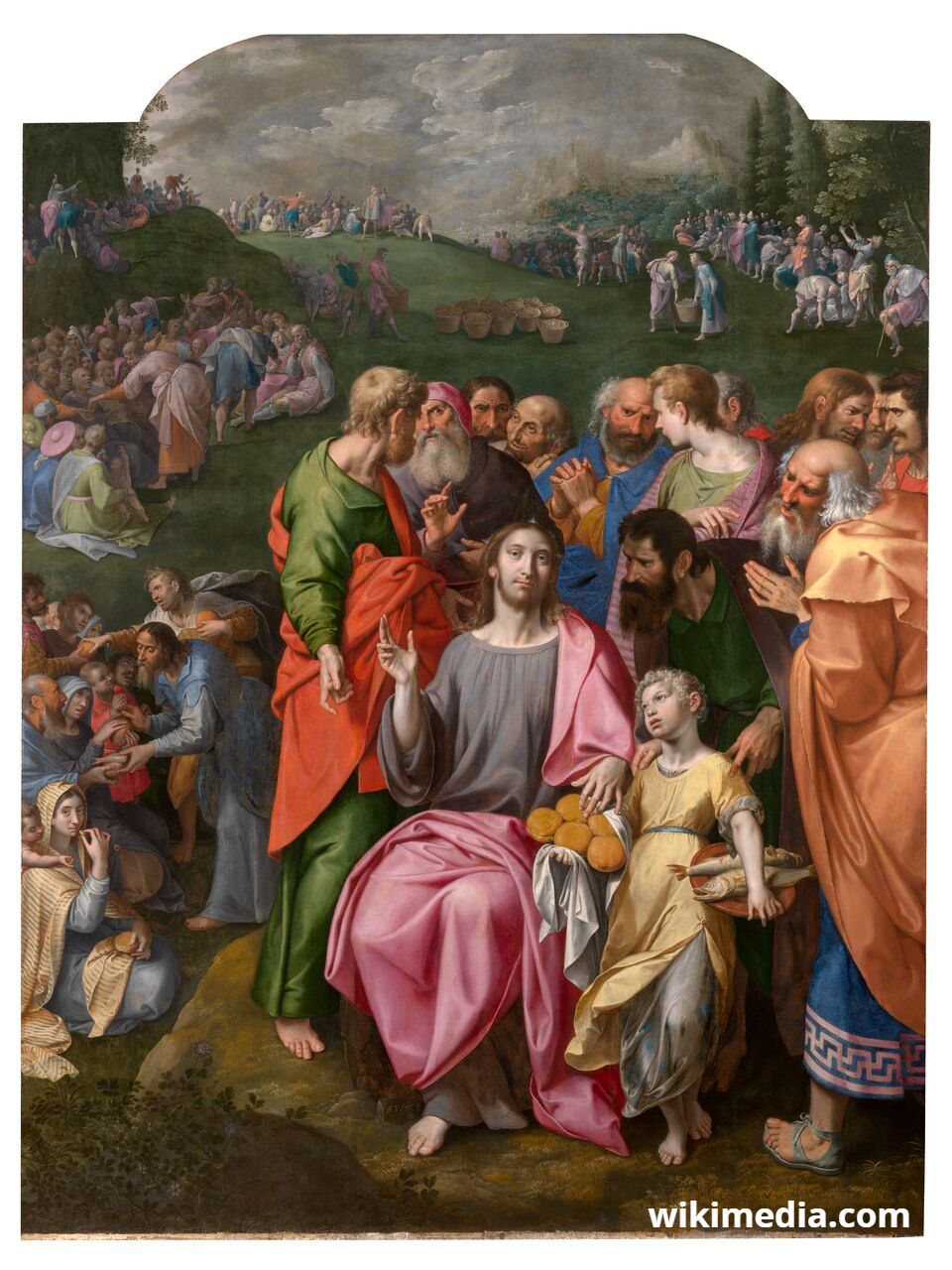
“Five loaves and two fish are all we have here.”

Then he said, “Bring them here to me,”

and he ordered the crowds to sit down on the grass.

Taking the five loaves and the two fish, and looking up to heaven,

he said the blessing, broke the loaves,

and gave them to the disciples,

who in turn gave them to the crowds.

They all ate and were satisfied,

and they picked up the fragments left over—

twelve wicker baskets full.

Those who ate were about five thousand men, not counting women and children.


A VIEW FROM THE PULPIT ...

providing insight into the Gospel's meaning


Two Banquets, One King


Rev. Patrick Brady

Pastor, Saint Stanislaus + Lansdale, Pa.


Matthew presents this pericope with deliberate echoes of the Old Testament while interweaving themes from across his Gospel, forming a rich tapestry of Eucharistic theology. The immediate context contrasts sharply with Herod’s banquet. Herod’s feast is marked by power, fear, and fragile honor, ending in the death of John the Baptist. Jesus’ banquet occurs in a “deserted place” (erēmos topos), instead of a palace, and results in life and abundance. We are shown two different kinds of kingship: one that takes life, and one that gives it in abundance. 


After hearing of John’s death, Jesus withdraws. et the crowds follow on foot, and rather than protecting his solitude, he responds with compassion (splanchnizomai) the same visceral term Matthew uses for a shepherd moved by sheep without a shepherd (9:36). In the face of grief, Jesus turns outward in mercy. The setting itself recalls Israel in the wilderness, where God fed his people with manna (Exod 16). In this erēmos topos, Jesus again provides bread for a hungry people. 


Matthew directs us toward the Eucharist through the four verbs in verse 19: he “took” (elaben), “blessed” (eulogēsen), “broke” (eklasen), and “gave” (edōken). This same sequence appears at the Last Supper (26:26), inviting the reader to see this feeding as a sign that anticipates the Church’s ongoing participation in Christ’s self-gift. 


The twelve baskets of fragments, one for each apostle and tribe of Israel, signify abundance. God’s provision is not merely sufficient but overflowing. Read alongside Exodus and 2 Kings 4, where Elisha feeds a hundred men with twenty loaves and has food left over, Matthew shows that Jesus does more than surpass Moses and Elisha. He brings to fulfillment every prior pattern of divine nourishment, revealing himself as the definitive source of life for God’s people. 


A VIEW FROM THE PEW ...

offering testimonies on how the Gospel is meaningful


Priests: They Are People Too!


~Jeffrey Faneck

Saint Matthias Catholic Church + Bala Cynwyd, Pa.


It’s human nature to slack or go into “auto-pilot mode” with familiar things. If it’s a relationship, we may start to take it for granted. If it’s our route to work, we may notice ourselves leaving later and later or becoming distracted by podcasts or audiobooks.  How about if it’s a bible passage, such as this weekend’s gospel?


I hope we’re not at the point where we think “ho hum, another miracle, what else is new?”  Pack that away for a moment…


Although bad news is inherently stressful, there are different degrees of bad news.  Recently my car suffered a piece of cracked glass from an object I didn’t even see. It shook me briefly, but I was able to forget about it rather quickly. That hits differently than, say, the death of a close relative, where employers generally offer bereavement time.


Before the miracle, Matthew includes a bit of a back story about Jesus being off to the side, grieving the death of his cousin John the Baptist.  When the crowd finally located Jesus, it was right back to work, curing disease and illness.


Jesus being both fully God and fully man is something even the best minds struggle to wrap their brains around. A key lesson with this can be taken from the apostles.  They suggested dismissing the crowd due to low food inventory and the length of time they’d already been out in the heat.  As humans, these first priests didn’t have (and could not have had) the same insight of Jesus.


Keep in mind that priests, even today, aren’t perfect, and certainly not robots.  They have countless daily responsibilities and dedicate their entire lives to God.  Since they come from families, they experience illness and loss just like we do.  


Thank your priest for his homily and his ministry this weekend..and maybe while you’re at it check in on him as a person too.  An unexpected “how are you feeling” may seem small (like the few loaves and fish) but go a long way.


How would you rate the overall quality of our Commentary Series?


X Share This Email
LinkedIn Share This Email
Instagram