Welcome to the University of Oklahoma Carceral Studies Consortium Newsletter. The Carceral Studies Consortium strives to build a community for intellectual exploration that includes faculty, staff, graduate students, community members, practitioners, and organizers.
Carceral Studies is concerned with the independent function and nexus of the political and social systems that organize, shape, sustain, and entrench practices of punishment, surveillance, incarceration, and harm.
|
|
Featured Consortium Opportunities |
|
Carceral Studies Consortium Announces 2022 Student Work Prize Winners
The University of Oklahoma Carceral Studies Consortium is pleased to announce the 2022 Student Work Prize recipients. The prize recognizes excellence in scholarly or creative work from any discipline which engages carceral studies, broadly construed, during the 2021-2022 academic year.
-
First Prize: John Zogg et al. (Architecture), "Reconstructing Incarceration" (advised by Marjorie Callahan and Keith Gaddie)
-
Runner Up: Paul White (Economics), "Covid-19 and the Penal System: Effects of Race on Federal Sentencing Departures during the Pandemic" (advised by Jonathan McFadden)
-
Honorable Mention: Margaret Doyle (Sociology), "A Call to Action: Addressing the Lack of Efficacy in the United States Prison System" (advised by Lamanda Conrad)
|
|
|
Carceral Studies Graduate Student Fellowship
Application Deadline Extended
The Carceral Studies Consortium offers an outstanding graduate student with an interest in advancing Carceral Studies a 12-month, .20 FTE position (8 hours per week). This CSC Graduate Student Fellow serves as the student representative on the Carceral Studies Board of Directors, as well as provides critical support for CSC initiatives throughout each academic year (July 1 to June 30). Applications are due by May 27, 2022.
|
|
|
The recently leaked draft of a Supreme Court opinion concerning abortion rights has raised concern over the use of data gathered from period-tracking apps. Lydia X. Z. Brown, with the Privacy and Data Project at the Center for Democracy and Technology, stated the increased concern “in a lot of advocacy spaces about what happens when private corporations or the government can gain access to deeply sensitive data about people’s lives and activities.” Mainly, abortion rights advocates are concerned with how data tracking from these apps could be used or seized if abortion becomes criminalized. Andrea Ford of the University of Edinburgh explains that the process “becomes really muddy when you get into abortion. If that [were to become] illegal in certain places, does that transcend the right to privacy that is written into the contracts in the way that child trafficking would?” Jason Hong of Carnegie Mellon University concurs that the fears around data usage could be targeted towards attacking abortion rights and believes the circumstances become riskier when the apps are free, the user is in a state that is more active in criminalizing abortion, or if the data is held in a cloud-based storage system.
|
|
Tyler Valeska of Stanford University recently published an article concerning the repercussions of releasing protest footage. The release of footage received public criticism as some groups, such as the Portland Police Bureau, created a live stream of protests accused of trying to identify certain protesters by focusing on their faces and shoes. Valeska argues that the “wholesale dumps of unedited footage likely violate the First Amendment rights to free speech and assembly and privacy.” However, some police departments responded to the release of footage to represent transparency that informs on the actions of the protest, the officers' activities, and the treatment of officers. Still, Valeska believes that the “public dissemination of such surveillance creates a cognizable injury that avoids standing obstacles. That injury is inflicted by governmental distribution of protest surveillance despite the public nature of protests, as protesters retain certain privacy interest in the public square.” Valeska suggests that redactions, the blurring of identifiable markers, and the discontinuation of police livestreaming protests should be implementable safeguards to remedy this paradox of public privacy.
|
|
Maurice Lewis is one of over 100 people to be released from Louisiana prisons as a new district attorney begins reviewing previous cases of excessive sentencing, including Louisiana’s habitual offender statute. Habitual offender laws in New Orleans would brand individuals as “career criminals” if they were convicted of violating laws multiple times, no matter how minor the offense. Lewis was convicted of theft on three separate occasions, including some stereo equipment, a purse, and an umbrella. Williams was sentenced to life without parole for these actions under former district attorney Harry Connick. Connick defended his many sentences under the habitual offender statute by claiming that “for every year that individual, that habitual offender, that career criminal, would spend in the penitentiary, that diminishes the number of crimes that he’s going to commit. If you get enough of them in, you’re going to help your crime rate tremendously.” When Connick was asked about the connection between the individuals being prosecuted and their state of poverty or desperation, Connick replied, “desperation for what? Money? I’m not a social worker. And my job was to prosecute.” Jason Williams, the newest district attorney for New Orleans, has a different approach. The DA’s office has joined with the public defender’s office and other defense groups to work through hundreds of cases for re-examination. Although Williams has received backlash due to some failed campaign promises, his actions have already resulted in 82 relitigated habitual offender cases and the creation of a civil rights division in the Orleans Parish district attorney’s office.
|
|
Orlando Police Department / Orlando Sentinel |
|
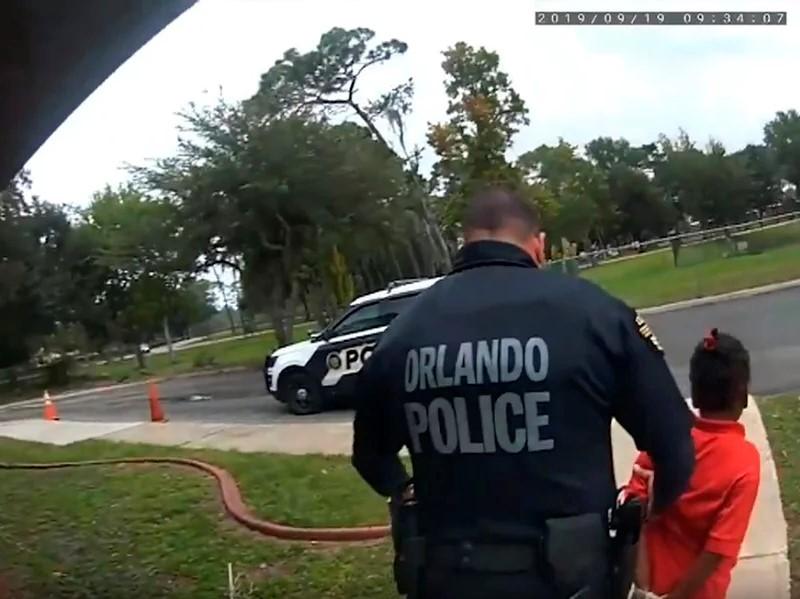
A video of a six-year-old being handcuffed in Florida in 2019 prompted the state to consider adopting a minimum age for a juvenile’s arrest. The school resource officer placed zip ties on the student after she was accused of kicking and punching staff members during a tantrum. The child’s grandmother commented that “whether someone accidentally gets hit or not, it’s a tantrum. There should not be any law on the books that allows a child to be arrested for being a child.” The grandmother also claimed that two years after the conflict, the child was still in therapy for PTSD and suffered from separation anxiety. Previously, Florida was one of 25 other states that did not have a written law setting a minimum age for a juvenile’s arrest. The taped arrest and a more significant national movement have promoted an effort to reform juvenile legal systems by increasing the minimum age and only creating a contact event if the accusation is a serious felony. Advocates for these reform efforts cite the dehumanizing nature of being handcuffed in front of school-aged peers and the stigmatization of being criminalized at such a young age. Unfortunately, the progress has been difficult as Alyson Clements, with the National Juvenile Justice Network, explains that the movement for these reforms is handled at the state level, resulting in a piecemeal approach.
|
|
Please share recent research you would like to see featured, including your own!
Send it to carceralstudies@ou.edu
|
|
ABSTRACT: Introduction - With the recent changes to the composition of the Supreme Court in the USA, speculation that Roe v. Wade may be overturned abounds. Research assessing people’s knowledge and sentiment toward Roe v. Wade is limited. As such, we assessed the relationship between knowledge and sentiment regarding Roe v. Wade and whether the relationship is moderated by political affiliation and abortion identity (e.g., “pro-life,” “pro-choice”). Method - In 2018, after Justice Brett Kavanaugh was nominated to the Supreme Court, we distributed an online survey to a quota-based sample of English- and Spanish-speaking adults in the USA. Results - Roe v. Wade knowledge was significantly related to sentiment; higher knowledge was generally associated with greater support for upholding Roe v. Wade. However, both political affiliation and abortion identity moderated this relationship. Specifically, higher baseline knowledge was associated with lower sentiment scores among those identifying as Republican and “pro-life.” Those who identified as neither or both “pro-life” and “pro-choice” and Independents responded similarly to those who identified as pro-choice and Democrats, respectively. Conclusion - Roe v. Wade knowledge is associated with sentiment; this relationship is moderated by political affiliation and abortion identity. People in subgroups without a clear stance on abortion (e.g., Independents; people who identify as neither or both “pro-life” and “pro-choice”) seem to hold sentiments similar to those more supportive of abortion (e.g., Democrats, “pro-choice”). Policy Implications - In addition to other data, policymakers should consult comprehensive assessments of constituents’ attitudes toward Roe v. Wade when making decisions about abortion and reproductive health issues.
|
|
ABSTRACT: Though Gresham Sykes identified several aspects of prisoner life in his classic text The Society of Captives, he failed to consider the role of race. In this chapter, we offer a critique of this oversight by exploring race from the time Sykes was writing to the present day. We show that race has been and continues to be an organizing principle within American society, including prison society and the free world to which ex-prisoners return. The consequences of discrimination and inequitable treatment have manifested in an intergenerational cycle of captivity, whereby Black, Latino, and Native Americans have been disproportionately subjected to punishment in the United States. Echoing Sykes’s own call for reform, we argue that, to move towards an America that has equal treatment under the law and within society, regardless of race, thus breaking this cycle, criminological research must investigate how various individual, social, structural, environmental, and other contextual factors intersect within social phenomena. More importantly, criminological research must encourage social action to improve outcomes.
|
|
ABSTRACT: Research Summary - We investigated the degree to which legislatively mandated firearm restrictions for domestic violence protective orders (DVPOs) have been implemented in North Carolina. We used a representative sample of n = 406 DVPO hearings (2016–17) and found that defendant access to firearms was seldom discussed (23.81%). Among granted orders (n = 303), 69.5% prohibited defendant firearm possession (n = 238) but only 38.61% ordered firearm surrender (n = 143). There were higher odds of restrictions when the defendant had threatened to kill the plaintiff (OR for prohibited possession: 2.25, CI: 1.02, 4.97; OR for firearm surrender: 1.93, CI: 1.09, 3.40); no other lethality indicators were significant. Judges verbally announced firearm restrictions only in one out of three cases (30.87% of DVPOs granted with prohibited possession; 33.02% of firearm surrender cases). Policy implications - Protocol to assess firearm access, implement firearm restrictions, and communicate these provisions to litigants must be more clearly and consistently applied in the courtroom.
|
|
ABSTRACT: In 2020, some scholars publicly demanded that the newly established Division of Convict Criminology (DCC) of the American Society of Criminology (ASC) change its name. Critics asserted that the use of ‘convict’ caused further stigmatization of those of us with direct criminal justice experience. Unbeknownst to those critics, prior to the official formation of the DCC, the informal group known as Convict Criminology engaged in a decades-long conversation about language and appropriate terminology. This paper responds to the critiques by exploring the power of language, summarizing various sides of the ongoing language debate, reviewing existing convict criminology research, and addressing structural violence within the academy. We conclude with a call to action that asks scholars to address the endemic structural violence in academia that perpetuates our oppression before attempting to police our language.
|
|
Updates, Events & Opportunities |
|
The People’s Garden at Mabel Bassett Correctional Center Seeks New Outside Sponsor
The People's Garden at MBCC is led and run by women who are incarcerated in Oklahoma, in support of food sovereignty at Mabel Bassett Correctional Center in McCloud, Oklahoma.
Outside Sponsor Responsibilities:
A badged DOC volunteer (or willingness to become a badged volunteer) to act as an advocate for the needs of The People's Garden at Mabel Bassett Correctional Center (MBCC). The position requires strong interpersonal skills, and the ability to communicate effectively across disparate groups (women who are involved in the program, an Inside Sponsor and other staff at MBCC, outside volunteers, potential donors, etc.). This includes creation, delivery, and regular follow-up on official DOC donation request forms, and coordination with a network of volunteers to support social media fundraising as well as seed, plant, and supply deliveries.
The women have already created a thriving garden thanks to their commitment to their own food sovereignty, and financial support from our community. They have high hopes of continuing these successes by implementing monthly meetings at MBCC with the inside and outside sponsors, and spreading the hope and wellness that they themselves are experiencing even further throughout Oklahoma's prison system.
|
|
|
University of Pittsburgh Hosts First Symposium for Reimagining Educational Work for Collective Freedom: The Labor Strike as a Portal
The first symposium is titled "The longue durée of freedom work: Bridging history and the current movement through the agricultural mass strike." The symposium will present three dialogues open to a global audience from May 19 through May 20. The details about each dialogue and registration can be found in the linked flyer below.
|
|
|
OU Libraries and Carceral Studies Consortium Assemble “Racial Capitalism” Library Guide
In a collaborative effort between OU Libraries and the Carceral Studies Consortium, a library guide on “Racial Capitalism” is now available for all students, staff, and faculty. Racial capitalism contends that racist oppression is central to how capitalism operates. Racial subjugation is not one specific manifestation of a larger capitalist system, but rather, capitalism itself is a racial system. The guide includes resources (written, audiovisual, and contacts) for information about the carceral state, crimmigration, and race and labor.
|
|
|
ABOUT
The Consortium Newsletter will offer a roundup of a few selected articles that reflect today’s news, organizing, and thinking related to the carceral state. We understand that freedom work is built on education and engagement. Education requires an understanding of contemporary issues informed by their historical context. We hope that these curated articles will help you analyze the issues that we face and understand the community that we strive to construct.
Join the conversation!
We encourage feedback, suggestions, and article suggestions. Please reach out to carceralstudies@ou.edu with any ideas, thoughts, or recommendations.
If anyone you know is interested in receiving this newsletter and other information from the Carceral Studies Consortium, please forward them this email and they may click this link to subscribe.
|
|
Land Acknowledgment
The University of Oklahoma is on the traditional lands of the Caddo Nation and the Wichita & Affiliated Tribes. This land was also once part of the Muscogee Creek and Seminole nations. It also served as a hunting ground, trade exchange point, and migration route for the Apache, Cheyenne, Comanche, Kiowa, and Osage nations. Today, 39 federally-recognized Tribal nations dwell in what is now the State of Oklahoma as a result of settler colonial policies designed to confine and forcefully assimilate Indigenous peoples.
|
|
The University of Oklahoma is an equal opportunity institution. ou.edu/eoo |
|
|
|
|
|
|