A note from the road, the clinic, and the heart of our community | |
Welcome to Developmental FX Learning Journeys' Insights newsletter, designed especially for clinicians. We are so happy you are here, in a space where like-minded colleagues can learn from one another’s insights and
collectively elevate our important work. | |
Reflections from Tracy...
Integration is a word that quietly holds everything together, operating at many interwoven layers. It is the word that we centered our readings and conversation on this month and one that I find myself reflecting on when supporting others to understand that therapeutic process as integration is both the means and ends of this work that means so much.
| | | The term first entered my vocabulary in a deep and meaningful way when I began to study sensory integration and the work of Dr. A. Jean Ayres. Ayres Sensory Integration® (ASI®) provides a powerful foundational lens for occupational therapy (OT), rooted in the principle that the brain's ability to organize sensation is essential for participation, regulation, and learning. When well understood, the integrative nature of OT and Sensory Integration (SI) situates our work as deeply neuroaffirming. | | At Developmental FX, we've expanded these notions of integrating practice into what we call Therapy that Fits® - a model of integrated pediatric OT practice. With Therapy that Fits® we move beyond simply supporting sensory-affective-motor functions, weaving together the child, their relationships, the environment, and meaningful occupations. | | |
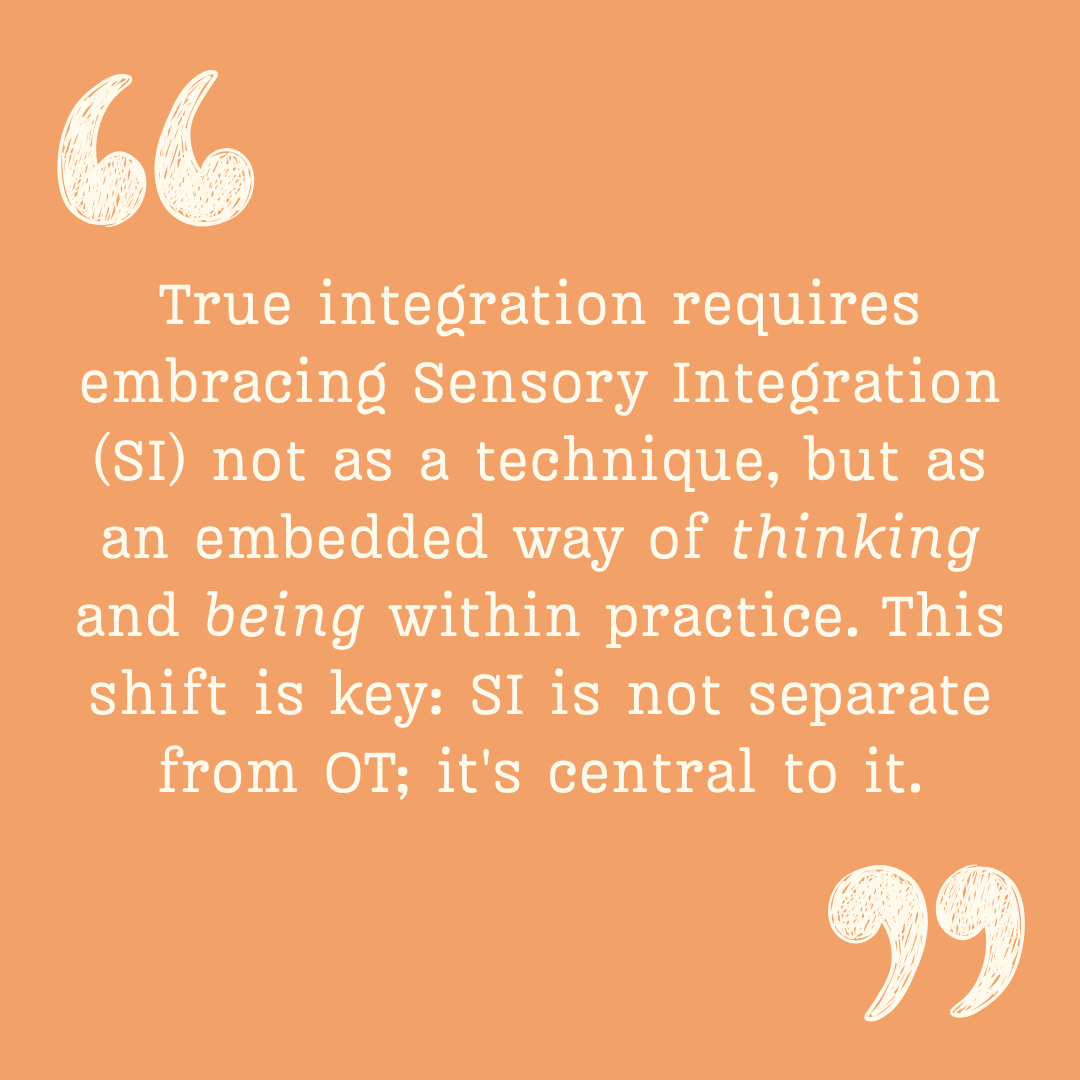
True integration requires embracing Sensory Integration (SI) not as a technique, but as an embedded way of thinking and being within practice. This shift is key: SI is not separate from OT; it's central to it. This approach allows us to incorporate other frameworks without diluting fidelity, strengthening and deepening our clinical reasoning. Coherence across perspectives, not eclecticism, defines this integration.
| | |
Drawing from Dan Siegel, integration is the linkage of differentiated parts into a functional whole across systems:
- Neural integration (linking brain networks for flexibility and regulation)
- Intrapersonal integration (making sense of sensations, emotions, and actions)
- Interpersonal integration (feeling seen, safe, and connected)
| | Coherence is the felt and observable outcome of this linking, reflecting flexible shifting between states, coordination across brain systems, and the capacity to adapt rather than react. | | This multi-perspective integration invites us to move beyond siloed approaches into a more coherent, relational, responsive, and affirming practice. We recently witnessed this come to life at our practicum program at Jabiru, where the participating children and their therapists were integrating in real time, leading to a growing sense of organization, confidence, and belonging. It was a powerful reminder that integration is not just something we talk about, but something we witness, support, and experience together. | At its core, integration means supporting children (and ourselves) to become more whole, more connected, and more able to engage fully in the life that is theirs. | | |
Warmly, and in reflection,
Tracy
| | This month in the Learning Journeys Community... | | |
In the LJC this month we’ve continued this conversation about integration! We’re discussing the language we use around SI, reflecting on a research article about how ASI® can be integrated with occupation-centered practice, and considering how our individual practice integrates across intervention approaches, theories, and more. Join the community to join the conversation!
For our live call this month we have a community forum with a mini-lecture from Tracy and discussion of community thoughts, questions, and epiphanies on the topic of integration. Join us live on April 30th at 2pm MT (find your time here), or catch the recording the following week in the community.
| | | |  |
Live LJ Community Events: Spring/Summer 2026
- Thursday, April 30: Community Forum: Occupation-centered sensory integrative processing
-
May 28: Case processing -STEPPSI
-
June 25: Community Forum
LJ Community Forums are
at 2:00pm MT
| | | |
DFX Learning Journeys Opportunities:
-
A SpIRiT cohort will be launching in Fall 2026 - this is an opportunity to pace your learning with a group of colleagues and have live meetings with Tracy and the Learning Journeys team to consolidate learning. We’ll keep you posted here when we announce dates!
-
If you have a group that would like to set up a private cohort for either the STEPPSSI or SpIRiT, reach out to us at learningjourneys@developmentalfx.org!
Other Ways to Join Us:
-
In late June, Tracy will be teaching “How Skill Emerges: Sensory Integrative Treatment for Praxis” in Wroclaw, Poland for Promyk Slonca.
-
In September you can catch Tracy at the 2026 PVI International Gathering - she will be presenting at the post-conference workshop day for clinicians about “Sensory Integrative Interventions: Portals to Possibility.”
-
This October, Tracy will be hosted by Mind 2 Mind Courses in Sydney, Australia - join Tracy for a two day course, “Sensory Integrative Processing Treatment Approaches for Praxis Capacities: From Sensory DIscrimination to Skillfullness.”
-
In November, CPD Retreats is hosting Tracy for a second time as she leads “A Spirited Retreat” - an immersive learning experience in Bali, Indonesia focused on the SpIRiT© model. As part of the retreat you get online access to the SpIRiT course, and then for a week we engage in hands-on, practical use of and reflection on the tool. There is no better way to learn how to apply this clinical reasoning tool in practice! The retreat is appropriate for learners of all levels that are looking to deepen their practice, but spots are limited. Learn more here.
| | | | |