Weekly Digest Number 25 - June 22, 2021 |
|
BMWED/SMART-MD Requests Mediation Following Latest National Bargaining Meeting with NCCC |
|
The BMWED and SMART-MD bargaining coalition has filed for mediation at the National Mediation Board (NMB) following the latest National Negotiation meeting with the National Carriers Conference Committee.
Despite a comprehensive proposal delivered June 4, the NCCC insisted it would continue to negotiate just one item at a time. This is concerning, problematic and inefficient. Both sides should be sharing comprehensive proposals intended for meaningful engagement and discussion. The Unions are, but the NCCC is not. Contained in our proposal is a six percent annual general wage increase, beginning retroactively in 2020 and continuing until 2024. Also included is a request for no changes to the current health and welfare benefits. In addition to many common requests, including improvements to various categories of paid time off, the BMWED is also asking the carriers to ensure that any new track technology introduced remains the work of BMWED-represented employees. To accomplish this, we ask that BMWED members be trained on the new technology and given exclusive right to perform the new technology once sufficiently trained. Negotiating one item at a time is untenable so the BMWED/SMART-MD coalition is requesting federal mediation. Dates have not been set for mediation, but the Union solicited that the scheduled bargaining dates with the NCCC in July become dates for mediation dates with the NMB.
|
|
RWU Resolution on Rail Improvement & Development
in North America
|
|
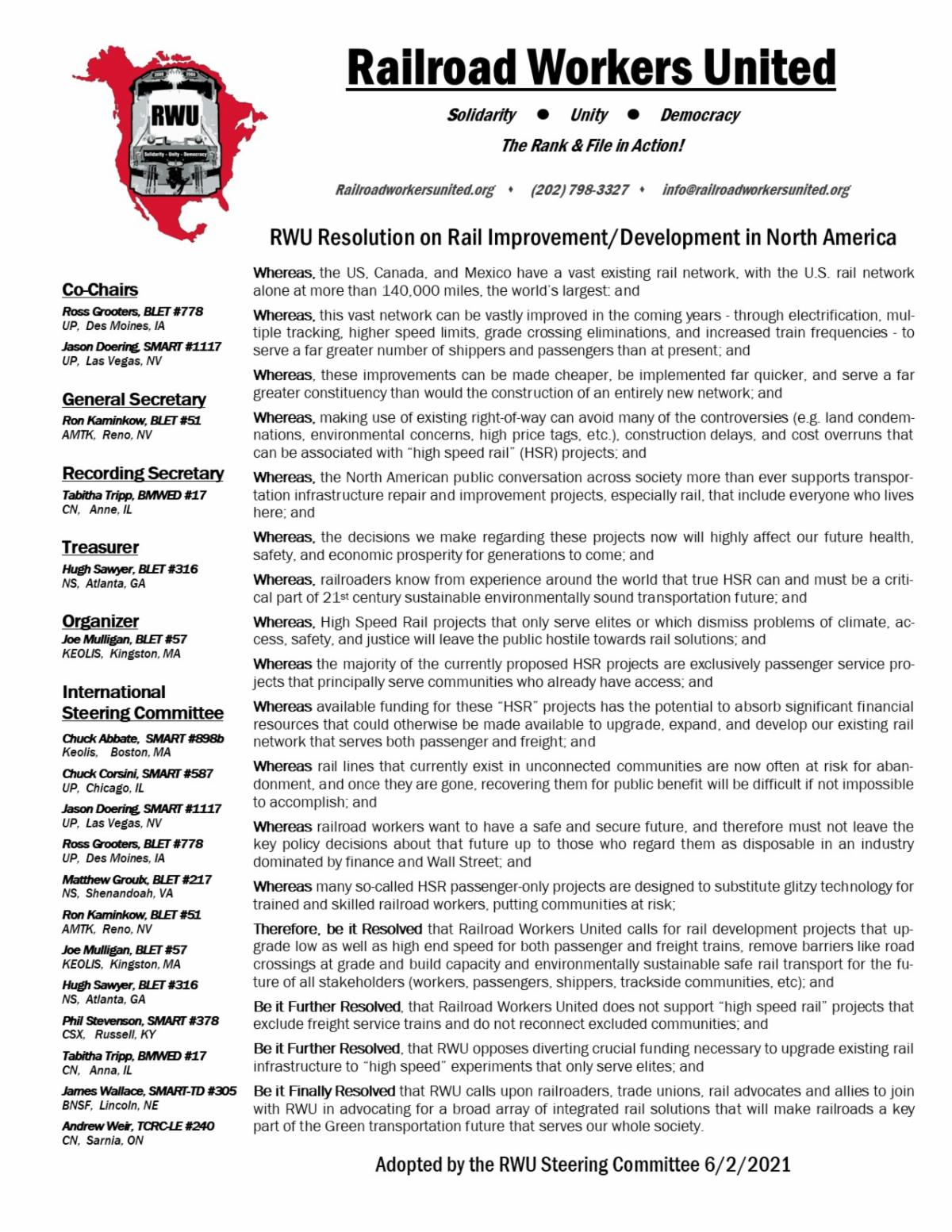
At the RWU Monthly Meeting on June 2nd, 2021, the Steering Committee adopted a new Resolution. In response to confusion over "high speed rail" and what is the best way to move forward with railroad improvement and development, RWU has staked out a position that we feel makes sense, one that serves railroad workers, the traveling public, shippers, trackside communities, and the nation as a whole. While we may support certain "high speed rail" projects, RWU emphasizes making better use of the existing rail network through improvements, upgrades, and infrastructural development. Please click on the link below to read this important Resolution.
|
|
CN, KCS Voting Trust Review Moves Ahead; CP Fires Another Salvo |
|
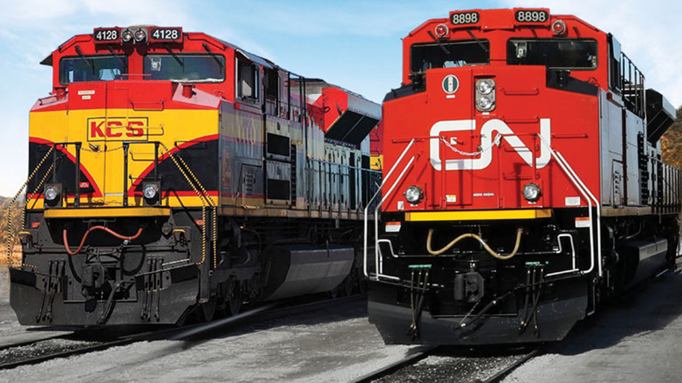
Per the Surface Transportation Board’s (STB) request, proposed merger partners CN and Kansas City Southern (KCS) have filed financial documents that will help STB decide whether or not to approve their voting trust agreement. Canadian Pacific, not surprisingly, responded with heavy artillery fire, with support from rail labor.
STB explained that “applicants contemplating the use of a voting trust in a major transaction must explain how the trust would insulate them from an unlawful control violation, and why their proposed use of the trust, in the context of their impending control application, would be consistent with the public interest.”
|
|
As Restrictions Ease, Passengers Return |
|
Amtrak and many transit agencies have been operating under limited schedules since March 2020, when the pandemic prompted government and business shutdowns. Although a number of trains kept running, ridership plummeted — in some cases to more than 90% below normal levels. Nationally, ridership on trains and buses in 2020 dropped 79% year over year at the start of the pandemic, according to the American Public Transportation Association.
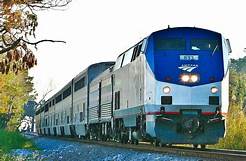
However, with the vaccine rollout in full swing and more Americans receiving shots, state and local governments are easing pandemic restrictions. On May 13 — when more than half of adults were fully vaccinated in 25 states, the District of Columbia and Guam — the CDC recommended that fully vaccinated individuals no longer need to wear masks indoors or outdoors except under certain circumstances. (Masks must still be worn on public transportation systems, including on trains and in stations.) Accordingly, passenger railroads announced plans to restore service to pre-pandemic schedules. For example, Amtrak and its partner state transportation departments in Illinois and Wisconsin restored all Hiawatha service round trips between Chicago and Milwaukee on May 23. The national intercity passenger railroad is also working with the Vermont Agency of Transportation to restore daily Vermonter and Ethan Allen Express service starting July 19.
|
|
BLET Prevails in Injunction Hearing on Unlawful Suspensions |
|
Following a June 11 hearing, a federal judge in El Paso, Texas has issued a Preliminary Injunction against Union Pacific Railroad (UP) to reverse the unlawful suspensions of a group of six members of the Brotherhood of Locomotive Engineers and Trainmen (BLET) — five of whom are elected officers of Division 192 in El Paso. The Injunction will remain in effect until further order of the Court.
This ruling comes on the heels of a June 2 Temporary Restraining Order (TRO), in which the judge ruled that all these union members had been wrongfully suspended by the UP in violation of the Railway Labor Act (RLA). UP had suspended them following a physical altercation at a private union meeting that was off-duty and completely off company premises. Rather than comply with the TRO, UP filed a Motion for Reconsideration and Dissolution, and demanded a hearing on the matter.
The Preliminary Injunction found that “[i]t is essential that the Court issue temporary and preliminary injunctive relief to prevent immediate and irreparable injury” to the BLET in order preserve “employees’ rights under the [Railway Labor Act] to engage in organizing and union activity ….” The Court’s Order also found that the Injunction was in the public interest, that “far more injury will be done to” the BLET in denying the Injunction than to UP from granting the Union’s request, that there “is no adequate remedy at law for the stifling of rights to be free of undue interference, influence or coercion” caused by UP’s conduct and that “there is a strong likelihood that [the BLET] will prevail in their arguments.”
|
|
Virginia is a Rising Leader in Passenger Rail. Here’s How it Happened. |
|
Ask Shannon Valentine how passenger rail rose to the top of Virginia’s transportation priority list and she will take you to the crawling traffic of Interstate 95. Gridlock has plagued the highway for decades, endangering the sanity of commuters while threatening the quality of life and economic growth of the region. The addition of high occupancy toll lanes in the past decade increased capacity, yet traffic jams persist.
Valentine, Virginia’s transportation secretary, said widening is no longer an option for the corridor, which she said averages more than 350,000 people daily. One lane in each direction for 50 miles would cost $12.5 billion, she said, citing a study that looked at possible improvements to a highway that connects the state capital to the nation’s capital.
|
|
Senate Commerce Committee’s Bipartisan $78B Surface Transportation Bill Advances |
|
The Senate Committee on Commerce, Science and Transportation has passed its five-year surface transportation bill authorizing $78 billion for rail, freight, safety and research programs; it is a bipartisan measure supported by the Association of American Railroads (AAR) and the American Short Line and Regional Railroad Association (ASLRRA).
|
|
BLET Reaches Tentative Agreement with Long Island Railroad |
|
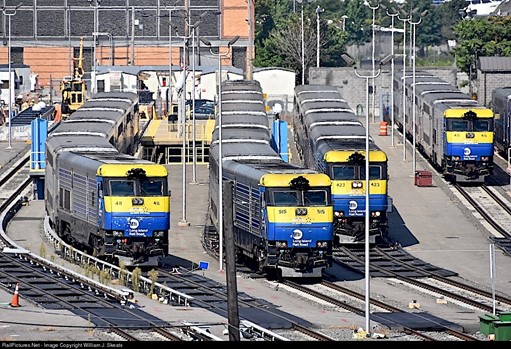
The Brotherhood of Locomotive Engineers and Trainmen (BLET) has reached a tentative agreement with MTA Long Island Rail Road (LIRR) governing rates of pay, benefits and work rules for nearly 500 locomotive engineers. Yesterday, the union mailed ballots, instructions and a synopsis of the pact to active members working for LIRR. Ratification ballots are due July 19.
The BLET's LIRR General Committee of Adjustment began the current round of negotiations by filing a Section 6 notice on Nov. 1, 2018. After negotiations stalled, the BLET filed a request with the National Mediation Board to assist in contract negotiations on March 2, 2021.
Founded in 1834, LIRR is the busiest commuter railroad in North America. It operates a more than 700-mile system with 11 branch lines between Montauk — on the eastern tip of Long Island — to Penn Station in Manhattan and Atlantic Terminal in Brooklyn.
|
|
Rail Groups Applaud Senate Panel's Vote on Transport Bill; Democrats Call for High-speed Rail Funding |
|
The proposed Surface Transportation Investment Act, which would authorize over $78 billion over five years to modernize surface transportation infrastructure and enhance safety. Specific to the rail sector, the bill calls for $7.5 billion in rail safety and improvement projects, including the establishment of a new grant program to eliminate grade crossings. The bill would also increase funding for the Consolidated Rail Infrastructure and Safety Improvement (CRISI) grant program, which provides essential support to short line and passenger railroads as well as state departments of transportation.
Additionally, the bill authorizes more than $25 billion over five years for intercity passenger rail, provides funding to address Northeast Corridor (NEC) maintenance backlogs and enhances the Railroad Rehabilitation and Improvement Financing Program (RRIF).
“By staying focused on vital funding needs and safety, the committee was able to build consensus on a package that makes a solid down payment on our future surface transportation needs,” said AAR President and Chief Executive Officer Ian Jefferies in a press release.
Meanwhile, a group of Democratic members of the House and Senate this week held a press conference to argue for more funding for high-speed rail in infrastructure legislation being debated in Congress.
|
|
Write Your Senators: REJECT Bigger, Heavier Trucks! |
|
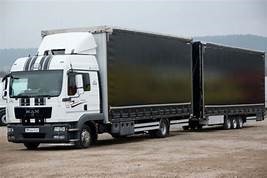
Thanks to your action and commitment, we have secured several victories against the Bigger Truck Lobby. Now, I'm writing to ask you if you'll join us as this battle moves to Round 2: full votes in the Senate and the House. Earlier this month, over 4,000 activists shared their opposition to bigger trucks with their Representatives. Will you keep up the pressure and make an even bigger impact by writing to your Senator today? You see, even as we celebrate committee victories, the Bigger Truck Lobby will continue their fight to include these dangerous amendments in the infrastructure bill. On the floor, they’ll attempt to win what they lost in committee – bigger, heavier, more dangerous trucks on our Interstate Highways…. millions more tons of CO2 pouring into our atmosphere. |
|
High-speed Rail Getting Last Minute Push in Congress |
|
(Editor's Note: If you have yet to read the RWU take on HSR and rail improvement and development, see the article above or click Here to read the Resolution.)
High-speed rail is getting a last-minute push from lawmakers and lobbyists as Congress debates how to revamp the nation’s infrastructure. The House Transportation and Infrastructure Committee last week advanced a $547 billion infrastructure bill that would provide $25 billion for high-speed rail projects. The Senate Commerce, Science and Transportation Committee followed on Friday by introducing an accompanying bill with funding for similar projects.
But unlike the Senate bill, the House legislation doesn’t allow private rail firms to receive federal funding. That omission has sparked a lobbying campaign by companies aiming to build some of the first high-speed railways in the country.
Companies, unions and lawmakers on both sides of the aisle are now rallying behind an amendment from Rep. Dina Titus (D-Nev.) that would allow private firms to receive federal grants when partnering with state or local governments on high-speed rail.
The measure could free up significant funding for Brightline, the only operational private passenger railroad in the country. The company is building a high-speed railway connecting Los Angeles and Las Vegas.
|
|
Class I Execs Respond to Shippers' Rail Service Concerns |
|
(Editor's Note: Since PSR has taken center stage on the nation's Class One railroads, shipper/passenger complaints have been the order of the day. But to hear the nation's rail CEO's tell it, everything is gonna be OK. They have been saying this now for years ... and it does nor get better. And how can it, when the Class Ones have trimmed the workforce to bare bones levels?)
BNSF Railway Co. President and Chief Executive Officer Katie Farmer, Canadian Pacific President and CEO Keith Creel, CSX President and CEO James Foote, and Union Pacific Railroad Chairman, President and CEO Lance Fritz have written to Oberman to describe their railroads’ pandemic recovery, equipment and facility availability and train crew, rail yard and maintenance staffing levels.
They also described how their companies are responding to complaints from shippers such as the American Chemistry Council (ACC), which wrote to the STB on June 8 to report “widespread and persistent rail-service challenges” that have harmed chemical manufacturers’ operations and supply chains.
ACC members have reported ongoing service problems with the Class Is, particularly with CSX, the group wrote.
In response, CSX’s Foote said the railroad’s active train and engineer (T&E) active staffing levels have been brought back to within 4% of pre-pandemic levels. Additionally, the Class I continues to hire and train employees. As of June 1, less than 1% of CSX T&E employees remained furloughed, Foote said.
|
|
|
|
|
|
|