Forage management for good times and bad
|
|
Ryan Buetow
Extension Cropping Systems Specialist
Dickinson Research Extension Center
North Dakota State University
1041 State Avenue
701 456-1106
|
|
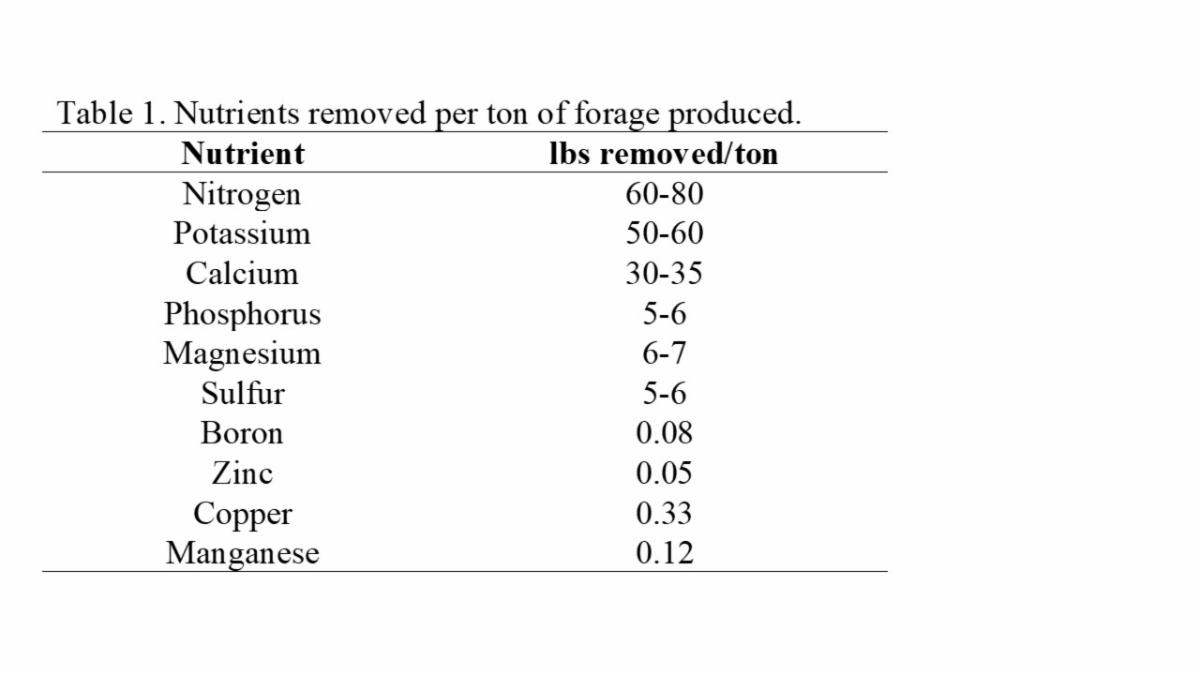
While the moisture this year has been great, we aren’t too far removed from dry times. When in a drought one can feel helpless in coming up with strategies to better manage their crop. Over the previous few years, the drought has limited forage production in the western part of the state. Some may have noticed that certain producers have better forage and alfalfa stands than others. While moisture is definitely an important factor here, so is overall management. While alfalfa has the potential to fix nitrogen, other nutrients are not being provided and with each cutting, nutrients are being removed (Table 1). Phosphorus, sulfur, and (if soil tests indicate) potassium fertilization are essential to reducing winter stand loss, receiving optimal returns from alfalfa, and are often limiting factors in production in ND.
Along with fertility issues, management such as cutting timing and field traffic can impact stand. As the stand continues past 5 years, N fixation and productivity decreases. Many “alfalfa” stands in our region are older than 20 years and don’t have much alfalfa left in them. For older stands it is recommended to switch to an annual forage crop or cash crop for at least one season and then reseed to alfalfa or a perennial mix. A benefit of switching to an annual is some short-term productivity before reseeding back to a perennial that can take a little longer to establish properly. This can be done after the first cutting of the old stand, or at the end of the season with a winter annual crop such as winter wheat.
|
|
A stand of alfalfa releases auto-toxic compounds into the soil, inhibiting alfalfa regrowth. How long these compounds remain is based on soil type, temperature, amount of rainfall and the time from tillage or spraying to reseeding. These compound residues affect only alfalfa. They will reduce future yield up to 60 percent if reseeded within one year of killing the stand and 15 to 20 percent if reseeded in one to two years on medium to heavy soils. Do not try to reseed back to alfalfa too quickly.
A great resource for helping determine if a hay field should be replanted is a University of Wisconsin Extension publication. The publication, “Alfalfa stand assessment: Is this stand good enough to keep?” at http://tinyurl.com/alfalfa3620. While Wisconsin often has a higher amount of rainfall than us, and different dietary needs this is still a great resource for checking the health of your alfalfa.
Along with stand integrity and fertility, there are soil factors that can greatly impact water uptake and N fixation, including soil salinity and acidity. If the pH is below 5.3 alfalfa roots will be stunted and nitrogen fixation will be impacted from reduced rhizobial activity. Liming may be in your future management decisions. Remember to sample zones at a 0-3” and 3-6” depth for pH if surface acidity is a concern in reduced and no-till systems. If salts are an issue impacting alfalfa stand there are some options for more salt tolerant perennial grasses such as AC Saltlander or a wheatgrass mix.
With some added attention to your hay fields now while there is moisture, a stronger stand will provide better quality and likely higher tonnage even in harder times.
NDSU Extension has a new resource for producers located at the Minot North Central Research Extension Center. James Rogers is the new Extension Specialist in Forage Crop Production. He can be reached at james.rogers.1@ndsu.edu for forage related questions.
|
|
The NDSU Extension does not endorse commercial products or companies even though reference may be made to tradenames, trademarks or service names. NDSU encourages you to use and share this content, but please do so under the conditions of our Creative Commons license. You may copy, distribute, transmit and adapt this work as long as you give full attribution, don’t use the work for commercial purposes and share your resulting work similarly. For more information, visit www.ag.ndsu.edu/agcomm/creative-commons.
County commissions, North Dakota State University and U.S. Department of Agriculture cooperating. NDSU does not discriminate in its programs and activities on the basis of age, color, gender expression/identity, genetic information, marital status, national origin, participation in lawful off-campus activity, physical or mental disability, pregnancy, public assistance status, race, religion, sex, sexual orientation, spousal relationship to current employee, or veteran status, as applicable. Direct inquiries to Vice Provost for Title IX/ADA Coordinator, Old Main 201, NDSU Main Campus, 701-231-7708, ndsu.eoaa@ndsu.edu. This publication will be made available in alternative formats for people with disabilities upon request, 701-231-7881.
|
|
|
|
|
|
|