Infant & Toddler

Connection of Virginia

September 2025


PART C UPDATES


Test your Knowledge with our Poll Feature

Pick your answer and scroll below to find the correct answer and explanation!

Which of the following apply when adding a one-time audiology assessment to an IFSP?

 ITCVA Monitoring Community of Practice (MCoP)


The next ITCVA monthly monitoring community of practice (MCoP) call will be held on September 3, 2025, at 3PM. Thank you to all who have been able to join us for our monthly monitoring calls and for the positive feedback shared.


To simplify scheduling, ITCVA MCoP calls are held on the first Wednesday of each month beginning at 3:00PM. These calls are open to anyone who may be interested in the topic(s) being discussed. Calls are recorded for those who are unable to attend. Please visit the Monitoring Community of Practice page of the ITCVA website for a list of upcoming topics, the Microsoft Teams meeting link and session resources.


September 2025

POSM: Lessons Learned and Moving Forward


October 2025

SFY25 Determination Reports (Copy 2 of 2)


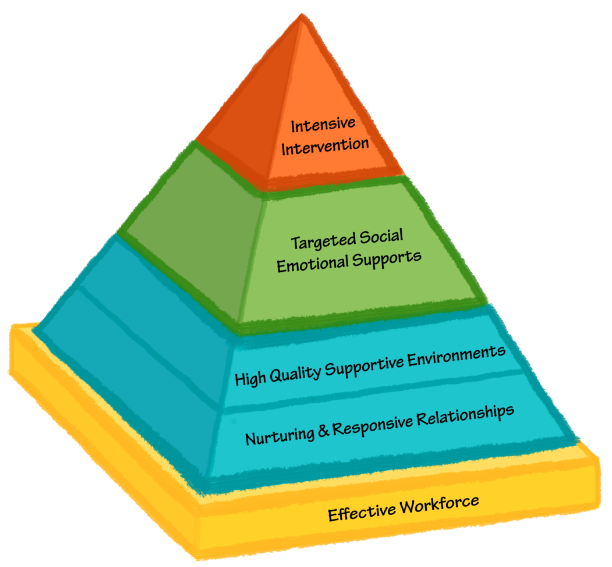
SUPPORTING POSITIVE SOCIAL-EMOTIONAL SKILLS


Pyramid Model Framework


Research Synthesis

Infant Mental Health and Early Care and

Education Providers


This synthesis has been developed to answer some of the most frequently asked questions that early childhood providers have about Infant Mental Health (IMH) - early social and emotional development - and the IMH system. It also provides information about where to turn for additional information for promoting IMH when children and families are experiencing challenges. The synthesis will address:

  • The definition of IMH
  • Why it is important that early childhood providers know about IMH
  • Approaches to promoting IMH
  • Prevention of IMH challenges
  • Focused intervention with children and families at risk
  • More intense/tertiary interventions

Study shows relationship between baby's developing social brain and mother's postpartum depression, anxiety


Using functional near-infrared spectroscopy (fNIRS) and functional MRI (fMRI), the Shriver Center's Baby Brain Study collected data from a community sample of more than 80 children and their mothers from delivery through the first 14 months of the child's life.


"We're interested in the baby's social brain, critical for long-term neurodevelopmental and socioemotional and mental health," said Sohye Kim, Ph.D., assistant professor of psychiatry & behavioral sciences and principal investigator on the study. "The baby's social brain develops in the context of early social input from their early environment, and oftentimes the mother is a central component of the baby's earliest environment."


Virginia Resources for Exploring Related Factors:

Virginias-Social-Emotional-Related-Factors-Screening-and-Assessment-Toolkit-2024-08.docx (live.com)

Virginia’s Social Emotional Related Factors Screening & Assessment Guidance Document


PROFESSIONAL DEVELOPMENT


A GEM YOU MIGHT HAVE FORGOTTEN?

WHAT YOU MIGHT HAVE MISSED?

WHAT'S COMING

UP NEXT?

You and your team may find this information sheet helpful when explaining developmental services to families.

Developmental Services in Early Intervention – Info Sheet (PDF)

Infant & Toddler Connection of Fairfax-Falls Church

This information sheet describes how developmental service providers can support caregivers and their children during early intervention visits.

The latest episode of Meaningful Moments is a conversation you will not want to miss! 


Episode 12: Meaningful Moments Meets the Odyssey


TThe October Talks on Tuesday webinar will be on the 21st.


Please mark this date change in your calendar and be on the lookout for the registration email. 

October’s Talks on Tuesday: Gestalt Language Processing - What’s the Buzz, Part II


Gestalt Language Processing - What’s the Buzz, Part I is archived here.

Act Early ECHO (Extension of Community Health Outcomes) Series – FREE!


Deana Buck, Virginia’s Act Early Ambassador, is collaborating with Ambassadors in Ohio and Wyoming to offer a FREE Act Early ECHO series this fall.


We will focus on using the CDC’s “Learn the Signs. Act Early” materials and education around health disparities, social emotional development, resources, autism spectrum disorder, and more. This series provides information and resources about current and emerging knowledge and evidence based promising practices about the five components of early identification: developmental promotion, family-engaged developmental monitoring, developmental screening, referral to needed resources and receipt of needed services. Please share this information with families and early childhood partners in your community!


To register, visit Early Childhood ECHO: Act Early Fall 2025 - Cincinnati Childrens Hospital Medical Center - Continuing Education (CE) - Early Childhood ECHO: Act Early Fall 2025 (cloud-cme.com)


Mondays 3:30 PM – 5:00PM | September 25th – November 17th | 8-week course. All sessions are recorded and can be accessed on the iECHO website. Dates: September 29th, October 6th, 13th, 20th, 27th, and November 3rd, 10th, and 17th.

Update on Ordering LTSAE Materials from the CDC


For many years, we have been able to order limited numbers of “Learn the Signs. Act Early” resources from the CDC. Over that past year, the CDC has been reviewing their priorities and have decided to discontinue the direct mailing of LTSAE resources to individuals.  I know that many of you have ordered materials from the CDC in the past. 


The CDC will supply limited quantities of the LTSAE materials directly to Act Early Ambassadors (that’s me!) in each state. I expect the shipment to arrive in September. I will also continue to work with state partners to identify funding for printing key materials, especially the children’s books. Some providers across Virginia are also working with local printers to print the resources locally.


I’d love to help you figure out a plan of action to secure needed print materials. Please email me directly at dmbuck@vcu.edu for assistance. Remember – all LTSAE materials can be accessed electronically at cdc.org/actearly and some providers/systems are expanding links to these resources in all social media platforms and websites. The materials can also be customized for local use. To learn more about customization, please visit https://www.cdc.gov/ncbddd/actearly/freematerials.html#customizematerials.


If you have any questions about the CDC’s “Learn the Signs. Act Early” resources,

please contact Deana Buck, Virginia’s Act Early Ambassador

dmbuck@vcu.edu

 (804) 405-9064


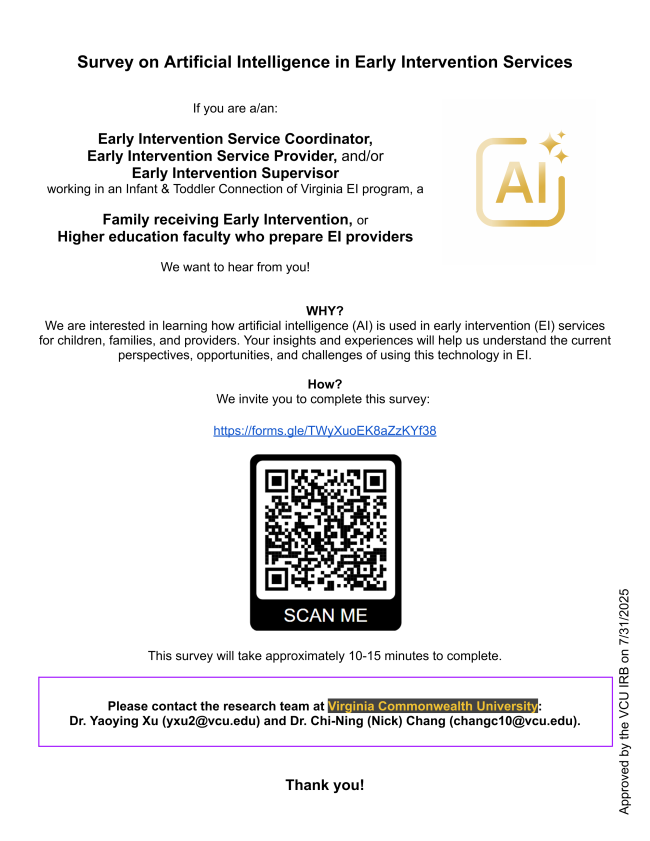
SURVEY OPPORTUNITY

ANSWER TO POLL QUESTION


The correct answer is “e”.


If the team determines it is necessary to meet the needs of the child and family, then one-time audiology assessment is an entitled Part C service and should be handled just like speech, PT, OT or DS. If the audiology appointment is scheduled outside of the 30-day timeline, there should be documentation of an earlier time offered to use family reason. Please reference the List of Part C entitled services in the Practice Manual on page 27 of chapter 7.


EMPLOYMENT OPPORTUNITIES


The Employment Opportunities page on the ITCVA website 

receives nearly 5,000 visits each year!


Practitioners: Early intervention needs you! Influence the future of infants and toddlers with developmental delays or disabilities and their families by putting your skills and expertise to work today! Please visit the Employment Opportunities page on the ITCVA website for links to current job openings.


LSMs and local contracted agencies: Let us help connect you to qualified applicants! Are you a Local System Manager (LSM) or the director of an agency that contracts with one or more local early intervention systems in Virginia? Are you looking to find qualified applicants to fill vacant positions? Please visit our Employment Opportunities page for instructions on how to submit a job posting.


ITCVA DIRECT ACCESS

 
INFANT & TODDLER CONNECTION OF VIRGINIA

Looking for the most up-to-date version of the Part C Practice Manual...upcoming meeting dates...or even a new career opportunity? You'll find plenty of helpful information on the Infant & Toddler Connection of Virginia's early intervention website! Be sure to visit and bookmark itcva.online.

MEDICAID ENROLLMENTS

If you have questions about enrollments for children with Medicaid please

contact Brenda Ayala at Brenda.Ayala@dbhds.virginia.gov


EARLY INTERVENTION CERTIFICATION


For questions about certification of practitioners, contact Anne Brager- 804-664-2462.

For questions related to completing the online application, contact VATRACITsupport@ssg-llc.com or from 8AM-5PM ET by calling 804-508-7229.

Infant & Toddler Connection of Virginia is part of the Department of Behavioral Health and Developmental Services


https://itcva.online/itcva-staff/

1220 Bank Street, 9th Floor, P.O. Box 1797, Richmond, Virginia 23219-1797

Main Office: (804) 786-3710 • Main Fax: (804) 371-7959

Do you have colleagues who aren’t getting the Monthly Part C Update? Ask them to check their spam folder. If they're still not receiving it, have them email anne.brager@dbhds.virginia.gov.

DMAS RESOURCES

DMAS Early Intervention Support


For specific Medicaid questions related to billing and supports for Early Intervention, please use these emails:


EarlyIntervention@dmas.virginia.gov

CCCPlusEarlyIntervention@dmas.virginia.gov

 
1220 Bank Street
Richmond, VA 23219
(804) 664-2462