ADAPTATION FINANCE BULLETIN | |
UNFCCC Adaptation Committee | |
Spotlight on decisions adopted at COP 28 | |
Photo credit: Kiara Worth/UNFCCC | |
|
The twenty-eighth session of the Conference of the Parties to the UNFCCC (COP 28) and the fifth session of the Conference of the Parties serving as the meeting of the Parties to the Paris Agreement (CMA 5) yielded a wide range of decisions relevant to adaptation finance, as follows below.
-
The first day of COP 28 saw the adoption of the decision operationalizing the new funding arrangements, including a fund, for responding to loss and damage. The decision includes the governing instrument of the fund as well as adopted recommendations relating to the new funding arrangements.
-
The first global stocktake concluded at COP 28. The resulting decision contains a dedicated section on finance, which, among other things, noted with concern that the adaptation finance gap is widening; recognized that adaptation finance will have to be significantly scaled up beyond the doubling urged in decision 1/CMA.3; decided to convene a high-level ministerial dialogue at CMA 6 on the urgent need to scale up adaptation finance; and urged developed country Parties to prepare a report on the doubling of the collective provision of climate finance for adaptation.
- The two-year Glasgow–Sharm el-Sheikh work programme on the global goal on adaptation concluded with the adoption of the UAE Framework for Global Climate Resilience. The framework includes a variety of thematic and dimensional targets, and launched a two-year UAE – Belém work programme on indicators for measuring progress achieved towards these targets. The decision recognizes that means of implementation, including finance, are crucial to the implementation of the Framework as well as the importance of the timeliness and predictability of adaptation finance and the need to accelerate efforts to enhance access to adaptation finance.
- The Guidance to the GCF from the CMA requests the Board to take into consideration the framework for the global goal on adaptation and explore ways to assist Parties in fully and effectively implementing the goal, in line with existing investment, results framework and funding windows and structures of the GCF. (See also the COP decision on the Report of the GCF to the COP and guidance to the GCF.)
- Similarly, the Guidance to the GEF from the CMA requests the GEF, in administering the Least Developed Countries Fund and the Special Climate Change Fund to take into account, in the context of its adaptation strategy, the global goal on adaptation framework, and to explore ways to support Parties in achieving the goal. (See also the COP decision on the Report of the GEF to the COP and guidance to the GEF.)
- The CMA also decided to take into consideration and build on the outcome of the first global stocktake and the framework for the global goal on adaptation in its deliberations on the new collective quantified goal on climate finance. Further, the decision confirmed that the deliberations on the scale and elements of the new collective quantified goal will take into consideration the exigent need to support implementation of current nationally determined contributions and national adaptation plans and adaptation communications.
- Among other things, the decisions taken on Matters relating to the Adaptation Fund encourage the Board to consider providing support for country-driven adaptation projects and programmes in developing country Parties that are particularly vulnerable to the adverse effects of climate change with a view to assisting them in enhancing implementation of their national adaptation plans, adaptation components of nationally determined contributions, and other voluntary adaptation planning processes. (See the CMA decision and the decision of the Conference of the Parties serving as the meeting of the Parties to the Kyoto Protocol.)
Other related decisions taken at the Conference include:
| |
Joint declaration from the multilateral climate funds on enhancing access and increasing impact | |
Photo credit: UNFCCC/ Kiara Worth | |
|
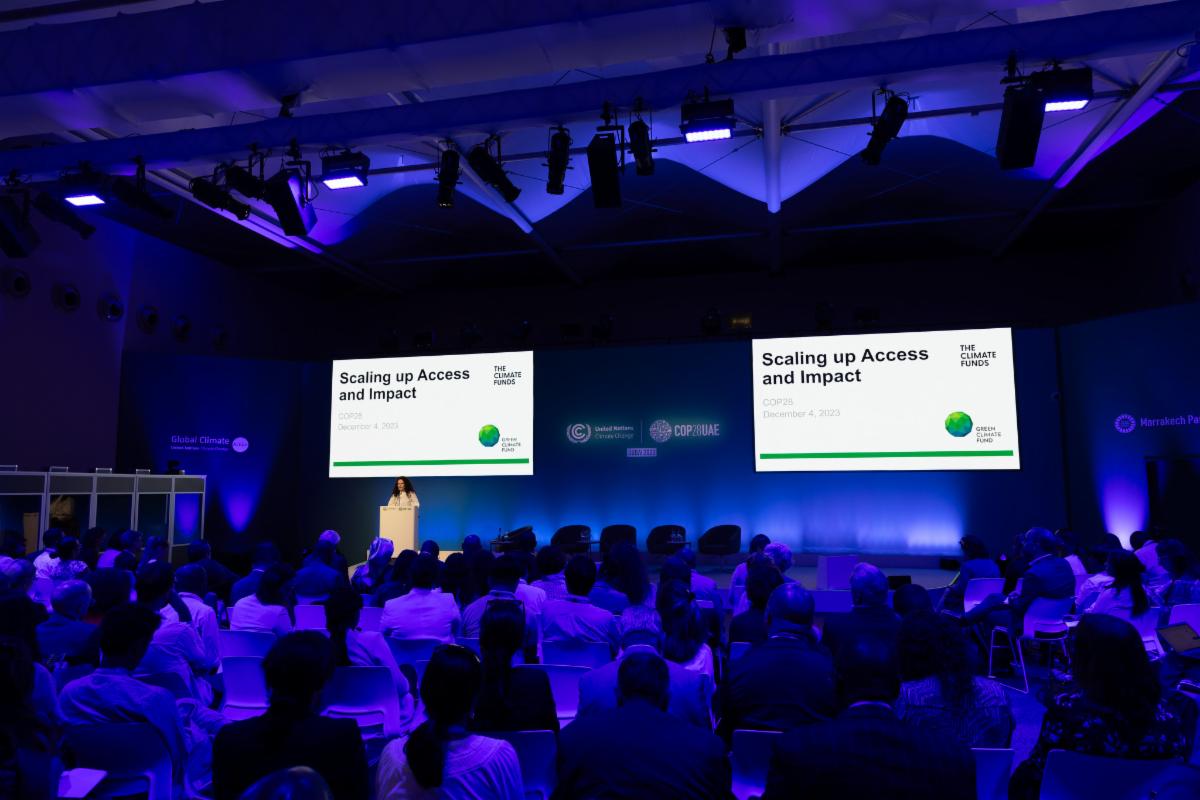
At COP 28, the heads of the Adaptation Fund, Climate Investment Funds, GEF and GCF released a joint declaration highlighting their commitment to develop an ambitious and concrete action plan to enhance access to climate finance and increase the collective impact of their action.
With respect to enhancing access to climate finance, the declaration highlights that the funds will endeavor to increase collaboration within their capacity-building support; develop greater synergies within their programming and between theories of change, and to scale up projects; ramp up collaborative work on monitoring, evaluation, and learning; and move towards harmonization of procedures and processes.
In relation to increasing their impact, the declaration notes that the funds will use their resources to mobilize greater financial flows from the private sector and other external sources of finance; collaborate with multilateral development banks and other financial institutions to leverage their respective strengths, expertise and financial tools; and increase support to help the most vulnerable adapt to the impacts of climate change.
| |
News from the Adaptation Fund | |
Photo credit: Kiara Worth/UNFCCC | |
Over USD 192 million in new pledges for Adaptation Fund made at COP 28 | |
Adaptation Fund makes two health-related announcements at COP 28 Health Day | |
|
At COP 28, contributors announced new pledges to the Adaptation Fund totaling USD 192.31 million. While sending positive signals, the amount falls short of the Fund's 2023 resource mobilization goal of USD 300 million for 2023. The Fund has a growing pipeline of projects that are not yet funded, which has reached USD 425 million.
Several of the pledges are part of multi-year commitments.
| |
|
During the COP 28 Health Day, the Adaptation Fund made two announcements that demonstrate its commitment to strengthening health adaptation and resilience.
First, the Fund announced its accreditation of the World Health Organization as an implementing partner. This is the first-health focused implementing entity among climate funds, and the 15th multilateral implementing entity accredited to the Adaptation Fund.
Second, the Fund endorsed the Guiding Principles for Financing Climate and Health Solutions, an initiative spearheaded by the COP 28 Presidency, the World Health Organization, and other partners.
| |
News from the Global Environment Facility | |
Photo credit: Kiara Worth/UNFCCC | |
Pledges totaling USD 174 million announced for Least Developed Countries Fund and Special Climate Change Fund | |
New initiative launched at COP 28 to leverage climate adaptation investment | |
|
During COP 28, eight donors announced pledges totaling USD 174.2 million for the Least Developed Countries Fund (LDCF) and the Special Climate Change Fund (SCCF), hosted by the Global Environment Facility (GEF). Of this, USD 141.74 million was pledged to the LDCF and USD 32.5 million was pledged to the SCCF.
Pledges broken down by country are listed in the joint statement released by the eight donor countries.
With the LDCF as a dedicated adaptation fund for the Least Developed Countries, and the SCCF playing a key role in addressing adaptation needs in small island developing States, the pledges signal a boost for adaptation financing in vulnerable developing countries.
| |
|
The United Nations Industrial Development Organization and the GEF launched an initiative to share lessons from recent investments in climate resilience and identify strategies that can boost successful adaptation measures involving the private sector.
The initiative will draw on the experiences of winners of the GEF Challenge Program for Adaptation Innovation, facilitating the capturing and sharing of experiences from the 19 initiatives that have been awarded seed funding under the program and other adaptation investments in developing countries.
Three communities of practice will be created under the initiative, focusing on three pillars: blended finance investment funds; micro, small, and medium-sized enterprise incubation and acceleration; and adaptation impacts and metrics.
| |
News from the Green Climate Fund | |
|
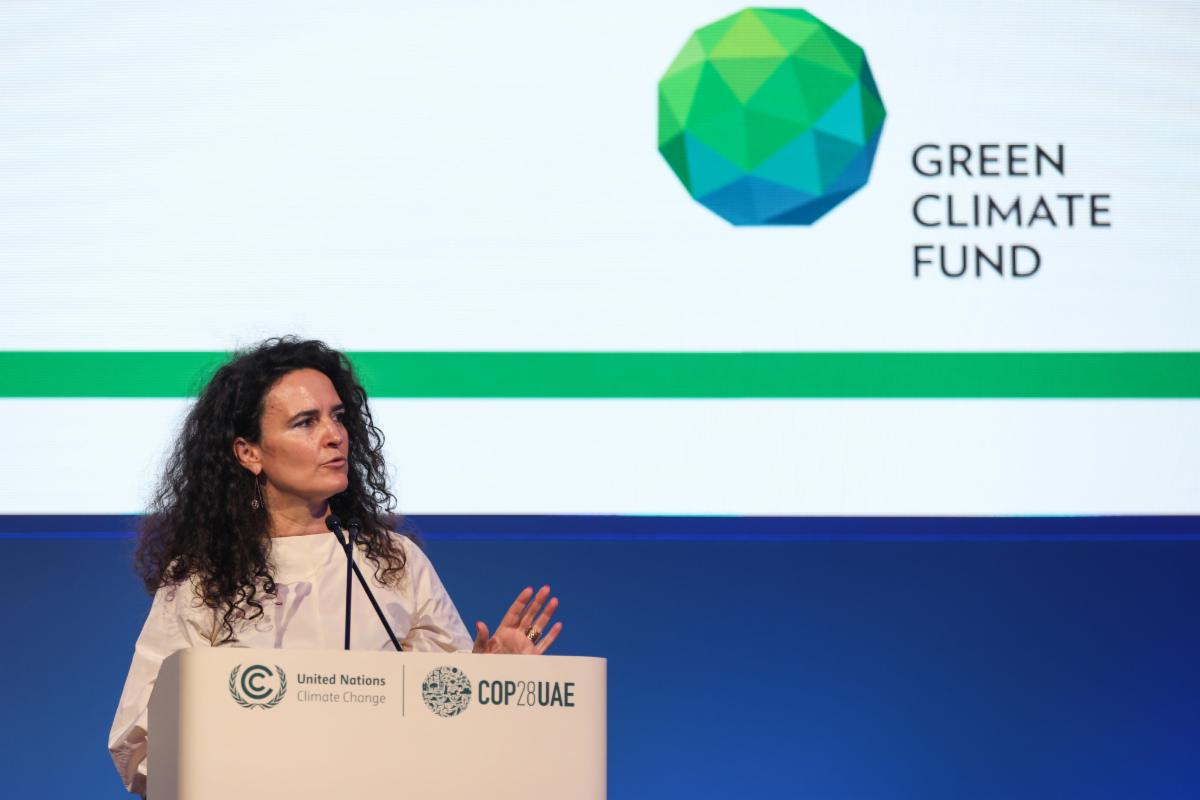
Mafalda Duarte, Executive Director of the GCF at COP 28.
Photo credit: Kiara Worth/UNFCCC
| The GCF at COP 28: new pledges and announcements | |
During COP 28, six new pledges to the Green Climate Fund (GCF) were announced from Australia, Estonia, Italy, Portugal, Switzerland, and the United States of America. Totaling USD 3.5 billion, the pledges bring the second replenishment of the GCF up to a record USD 12.8 billion from 31 countries.
Other notable developments and announcements that took place during the conference included:
- The GCF announced seven grants from its Project Preparation Facility to develop new projects, including on topics such as health, mangroves, and food systems.
- In support of early warning systems, the GCF signed a framework agreement together with other partners which will help close data gaps in weather and climate observations.
- In the area of health, the GCF announced a new initiative with UNDP and the WHO to increase climate health financing, and also helped launch the "Guiding Principles for Financing Climate and Health Solutions" together with partners including the COP 28 Presidency, the Global Fund, Rockefeller Foundation, WHO, and more.
- The GCF and the NDC Partnership launched a joint Climate Investment Planning and Mobilization Framework.
| |
News from the Standing Committee on Finance | 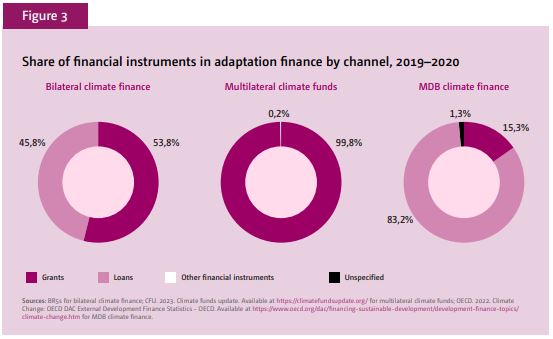 | |
New reports published by the Standing Committee on Finance (SCF) on the doubling of adaptation finance and types of climate finance definitions
In response to a request by the fourth session of the Conference of the Parties serving as the meeting of the Parties to the Paris Agreement (CMA 4), the SCF was asked to prepare a report on the doubling of adaptation finance for consideration at CMA 5. This request relates to the Glasgow Climate Pact, in which developed country Parties were urged to at least double their collective provision of climate finance for adaptation to developing country Parties from 2019 levels by 2025.
The report offers an overview of quantitative and qualitative information on progress towards this doubling of adaptation finance. Its key findings highlight: methodological issues related to tracking adaptation finance and outcomes, such as the lack of methods for disaggregating finance provided for activities with both mitigation and adaptation objectives; the overall provision of adaptation finance from developing countries, such as that the doubling would amount to between USD 14.2 billion and USD 40.6 billion by 2025 depending on the sources of information considered; an assessment of the provision of adaptation finance, such as that 59 per cent of finance delivered from 2019-2020 was through loans vs. 31 per cent through grants.
Additionally, the report summarizes key challenges and opportunities in relation to at least doubling adaptation finance from 2019 to 2025. One challenge, for example, is that the small scale and context-specific nature of adaptation lead to higher transaction costs as compared with mitigation projects. By contrast, an opportunity is that scaling up public sources of adaptation finance, particularly in the short term, can help unlock broader flows.
A second recent report, published in response to a request by COP 27, relates to clustering types of climate finance definitions in use. Based on an extensive literature review, the report approaches the clustering of types of definitions through four element clusters, namely the scope and context of a definition; climate-related aspects of a definition; finance-related aspects of a definition; and elements relevant to accounting methods.
| |
Other relevant developments at COP 28 | |
|
Other adaptation finance relevant developments from COP 28 include:
-
Thirteen countries signed the UAE Leaders' Declaration on a Global Climate Finance Framework. The declaration highlights, for example, that efforts are needed to bridge concessional finance gaps, particularly for adaptation, and that multilateral development banks need to work as a system, including in support of making a difference in public adaptation finance.
-
Multilateral development banks released a joint statement at COP 28. The statement notes that, to scale up adaptation finance, the banks will enhance support for disaster risk management and resilience-building through a wide range of efforts, including planning and policy, risk assessment, preparedness for disaster and recovery, post-disaster reconstruction, financing mechanisms, capacity-building and knowledge sharing.
-
The Second High-Level Ministerial Dialogue on Climate Finance regarding information to be provided by Parties in accordance with Article 9, paragraph 5, of the Paris Agreement took place on 8 December. It focused on improving the utility of biennial communications and enhancing the provision and mobilization of climate finance.
-
The Independent High-Level Expert Group on Climate Finance released its second report, mandated by the COP 27 and COP 28 Presidencies, which focuses on actions required to deliver a reformed, holistic framework for climate finance. Among its findings, the report includes a number of insights and opportunities related to improving both the quantity and quality of adaptation finance.
| | | | |