Skilled Construction Trades and Respected Contractors
Building Wisconsin Together ®
| |
Welcome to Construction Business Group's Industry Updates. This monthly e-newsletter will help us communicate the important initiatives that we have underway and relevant updates on issues that impact Wisconsin's construction industry. | |
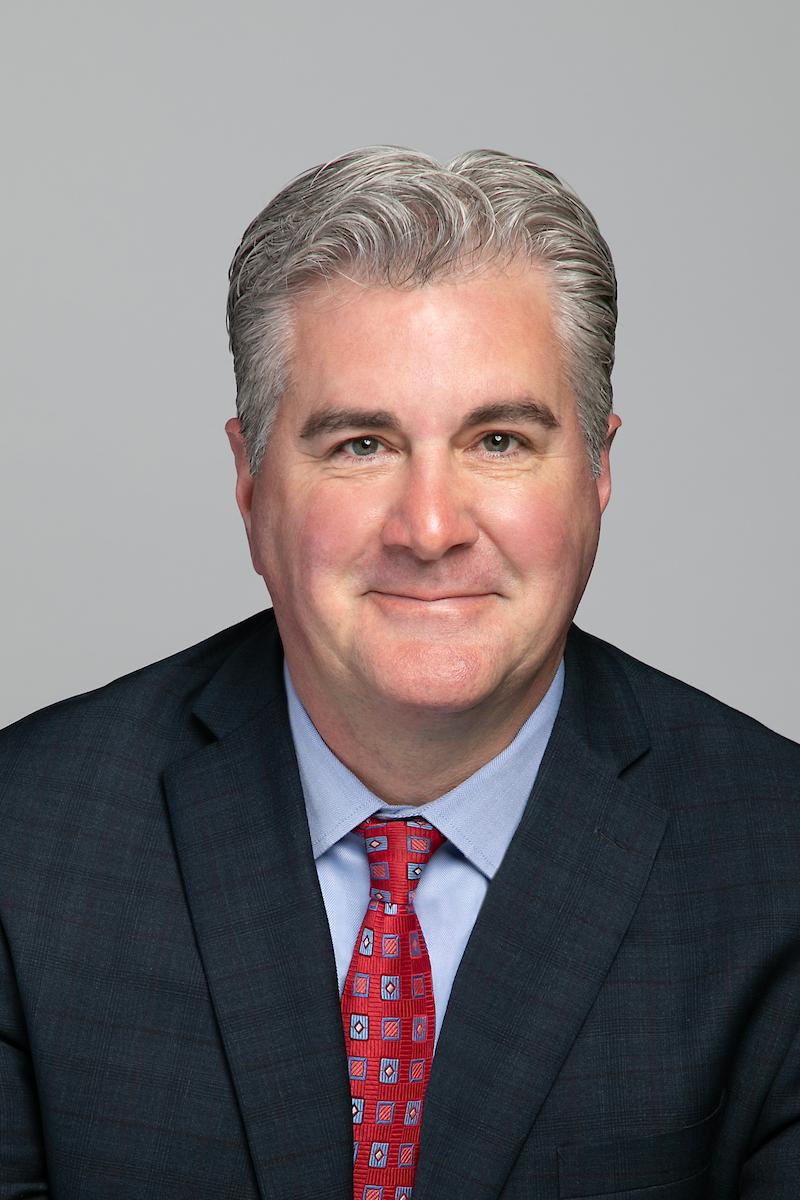
Message from Executive Director Robb Kahl | |
|
Take One-Call Obligations Seriously or Prepare for Steep Consequences
Contractors and trades workers alike are aware that before excavating, they must contact Diggers Hotline to have underground utilities located and marked. Wisconsin’s one-call law, Wis. Stat. § 182.0175, has been in place for many decades. In 2018, the one-call statute was amended to include an enforcement mechanism for damage to natural gas or other hazardous material transmission facilities resulting from failure to comply with the law. See 2017 Wis. Act 136. The Public Service Commission of Wisconsin (PSC) now has jurisdiction to hear complaints and assess forfeitures for violations of one-call. One recent PSC decision should provide an incentive for you to always contact Diggers Hotline before excavating.
| |
|
|
On January 9, 2025, the PSC issued a decision involving Forward Contractors, LLC (Forward).i Background facts are noteworthy because the PSC decision contains many references to Forward’s conduct, which clearly influenced the imposition of substantial forfeitures. Significant facts include: 1) Diggers Hotline was not contacted before excavating; 2) the excavation occurred in an area where the presence of natural gas lines servicing residential homes was obvious; 3) damage to the natural gas line was obvious by sound and smell; 4) the excavated area was covered and Forward left the area without notifying the utility or calling 911; 5) Forward refused to pay the cost to repair the natural gas line; 6) Forward refused to answer the initial complaint; 7) Forward did not answer PSC staff’s information requests; and 8) Forward declined an offer to attend educational courses to close out the complaint.
Thankfully, no personal injury or property damage occurred, except for damage to the utility’s natural gas line. Despite the lack of personal injury or property damage, the PSC concluded that the maximum forfeiture of $25,000 should be imposed for five separate violations of the one-call statute. Each of the five violations arose from the same utility strike but each separate law violation could, and did, have a separate forfeiture assessed. In addition to the five forfeitures of $25,000 each for a total forfeiture of $125,000, the PSC assessed a surcharge of $12,500 payable to Diggers Hotline to cover administrative costs. Finally, the PSC ordered that anyone performing excavation or planning work for Forward attend an educational course.
So, what are the lessons learned from this PSC one-call case? First, always make certain that Diggers Hotline is contacted in the timeframes required prior to excavating. Second, even if utility markings are present, staff onsite should pay attention to obvious signs of underground utilities that may not have been properly marked. Third, if a utility line is struck, contact the utility and 911 immediately. Fourth, respond to any Diggers Hotline complaint and do not ignore PSC staff requests for information. CBG follows many one-call cases before the PSC, and it is amazing how many excavators simply do not respond or participate. Ignoring Diggers Hotline investigators and PSC staff virtually guarantees imposition of monetary forfeitures. And finally, if Diggers Hotline offers a resolution for a violation, seriously consider taking the offer unless you are able to prove that no violation occurred.
i Investigation of the Complaint of WPL against Forward Contractors, LLC, Referred to the Commission Pursuant to Wis. Stat. § 182.0175(3)(br)2., Docket No. 9300-PLI-128, Final Decision (Jan. 9, 2025), avail. at https://apps.psc.wi.gov/ERF/ERFview/viewdoc.aspx?docid=528831.
| |
Building Wisconsin Together® | |
|
The Spring Externship event is scheduled for April 29-May 1, in alignment with Wisconsin’s celebration of National Apprenticeship Week. Contractors are invited to join us for this event to promote your company to students interested in learning more about the construction career pathway. We are seeking contractors to participate on the Contractor Panel for this event, held at the Coloma Training Center. Contact Laura Cataldo at laura.cataldo@bakertilly.com if you are interested in participating.
Help us promote the event to students, parents and educators that would benefit from a full-day exploration of what it means to be an Operating Engineer! Share the attached flyer or direct them to the online registration link: https://bit.ly/Externship2025
| |
Construction Worker at Viking Lakes Apartments Pleads Guilty to Raping Cleaner on Job Site | |
|
A construction worker pleaded guilty on Thursday to raping a co-worker in an apartment bathroom during construction of Viking Lakes, a sprawling multi-use Eagan development built by the Wilf family, owners of the Minnesota Vikings.
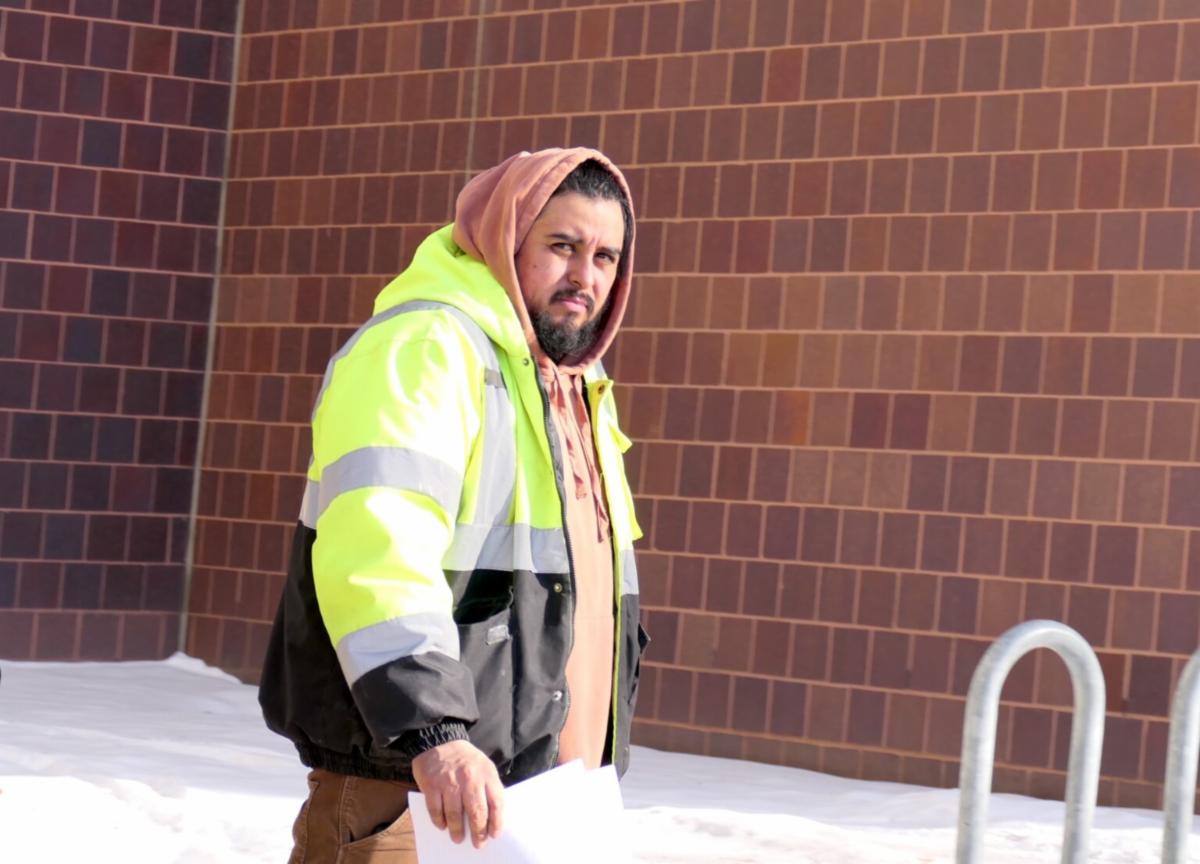
Juan Diego Medina Cisneros, a 31-year-old Mexican citizen, was charged in Dakota County two-and-a-half years ago but wasn’t apprehended until last June by border patrol agents at the Gateway International Bridge in Texas. The Dakota County Sheriff’s Office brought him back to Minnesota, where he was released the next day on $100,000 bail.
The assault came to light as the North Central States Regional Council of Carpenters union was helping workers report their allegations of wage theft on the Viking Lakes development by two subcontractors — Absolute Drywall and Advantage Construction.
Absolute Drywall employee Norma Izaguirre said she repeatedly rejected Medina Cisneros’ advances while working as a cleaner at Viking Lakes, which is built around the Vikings’ headquarters and training facility.
One day in May 2021, Medina Cisneros came up behind Izaguirre as she was cleaning a bathtub and raped her.
(The Reformer does not typically name survivors of sexual violence, but Izaguirre consented when she shared her story with the Reformer in 2022. She has spoken publicly about her attack in hopes of preventing other women in construction from being treated the way she was.)
Izaguirre told her supervisor about the abuse, but the company determined it was a consensual relationship and owner Dan Ortega fired Izaguirre soon after.
In response to a complaint Izaguirre filed with the Minnesota Department of Human Rights, Absolute Drywall said Izaguirre was fired for creating a hostile work environment by refusing to do cleanup work. Izaguirre said she did complain to her supervisor about having to clean bathtubs because they were often filled with urine and other excrement.
Izaguirre watched Thursday’s court proceeding over Zoom, wiping away tears as Medina Cisneros admitted to the assault in Spanish through an interpreter. Medina Cisneros’ attorney said he was “deeply remorseful.”
Izaguirre has filed a complaint with the Minnesota Department of Human Rights, which is investigating her allegations of sex discrimination, and could bring a lawsuit against the contractor.
Medina Cisneros will serve 36 months in prison followed by 10 years probationary release. His lawyer explained to him during Thursday’s hearing that he will likely be deported upon leaving prison.
It’s unclear if Medina Cisneros has legal authorization to be in the United States, and he could be swept up in Trump administration efforts to carry out widespread deportations. Izaguirre’s attorney said they hope he will serve prison time in the United States to ensure justice is served.
Dakota County District Court Judge Luis Morales seemed dissatisfied with the settlement agreement, which is five months shorter than the sentencing guideline. But he said he would accept the agreement because Izaguirre approved. He said he would make further comments when Medina Cisneros returns to court on July 8 to be formally sentenced and taken into custody.
The carpenters union, which has supported Izaguirre through the investigations and legal proceedings, commended her for her courage and perseverance.
“It took an immense amount of bravery for Norma to come forward,” said Richard Kolodziejski, the carpenters union’s director of government affairs, in a statement. “Norma was faced with hostility and retaliation from her employer after she came forward, yet she persisted.”
The state Department of Labor and Industry opened an investigation into Absolute Drywall for wage theft and is currently seeking $2.4 million in back wages for workers for Advantage Construction and its subcontractor Property Maintenance and Construction, including for work at the Viking Lakes development. It is the largest wage theft case ever brought by the agency.
| |
2025-27 Budget Update #1 Governor's Budget | |
|
Gov. Evers released his 2025-27 budget proposal. TDA staff are still combing through the details and analyzing the proposal.
Here is a summary of the governor's budget recommendations:
Revenue
The governor proposes more than $400 million over the biennium in new ongoing revenue:
· Transfer annually from the general fund to the transportation fund an amount that approximates the change in sales tax generated from the sale of automotive parts, accessories, tires, and automotive repair and maintenance services between FY2020 and the fiscal year of the transfer, estimated at $129.2 million.
· Increase the vehicle title fee by $120, generating about $282.6 million.
· Up the driver's license renewal fee by $8.50, providing $7.5 million.
Bonding
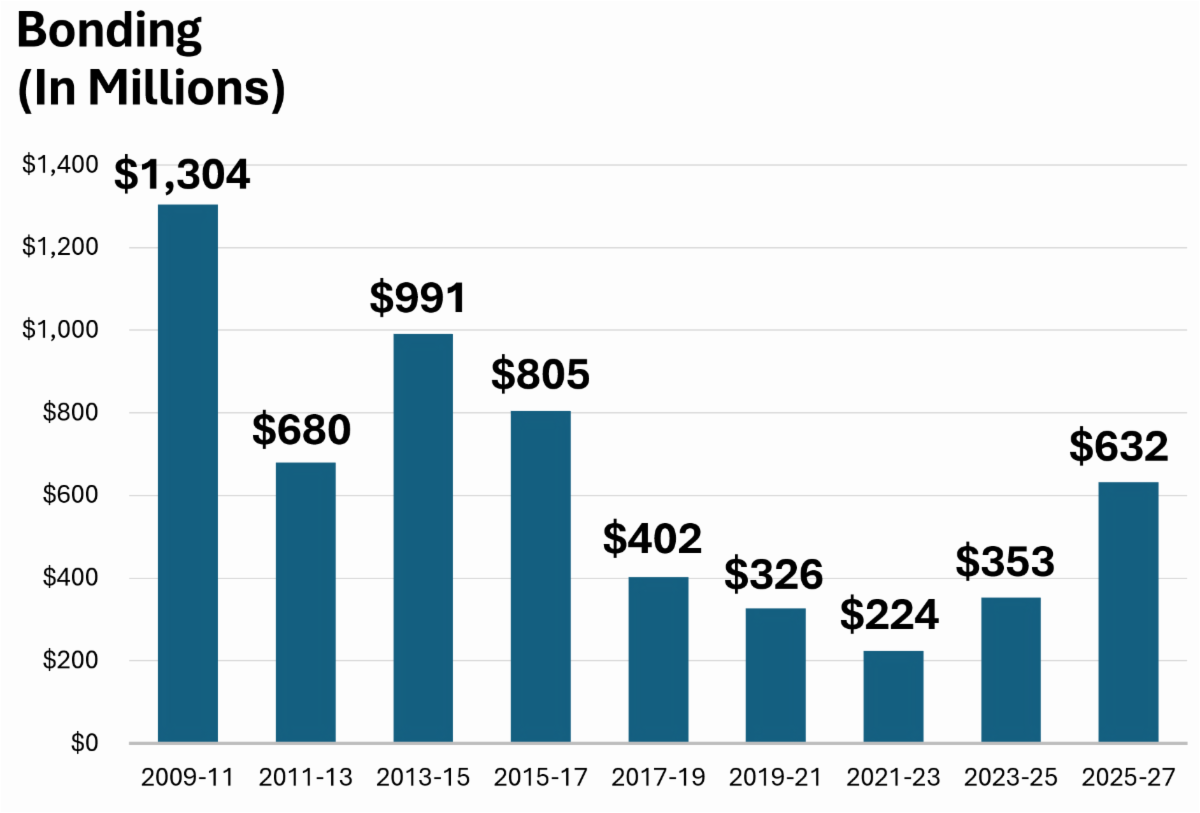
Bonding is up slightly in this budget proposal but about equal to the average over the last eight biennia. And still well below historical highs.
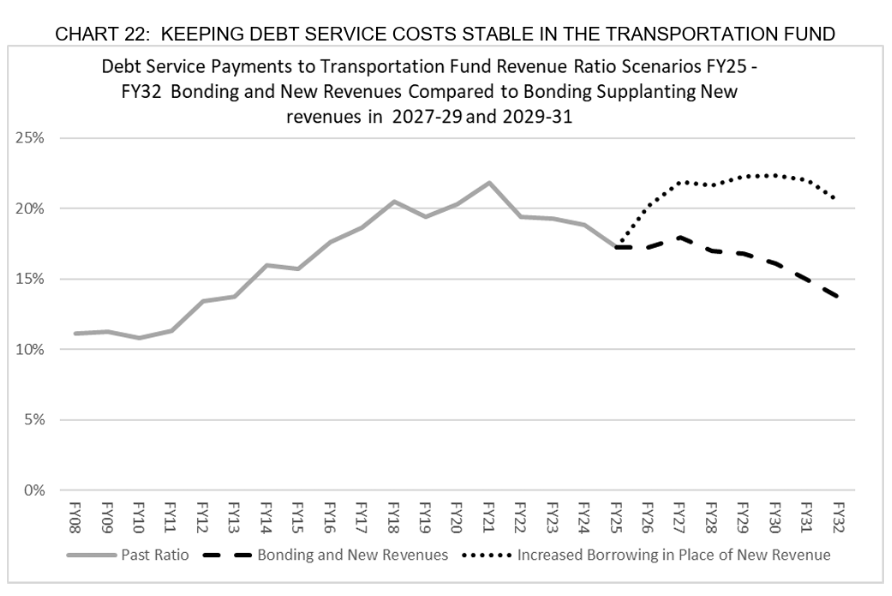
| According to the administration, despite higher bonding levels, the debt service as a percentage of transportation revenue continues to decline with the infusion of new revenue. | |
Program Details
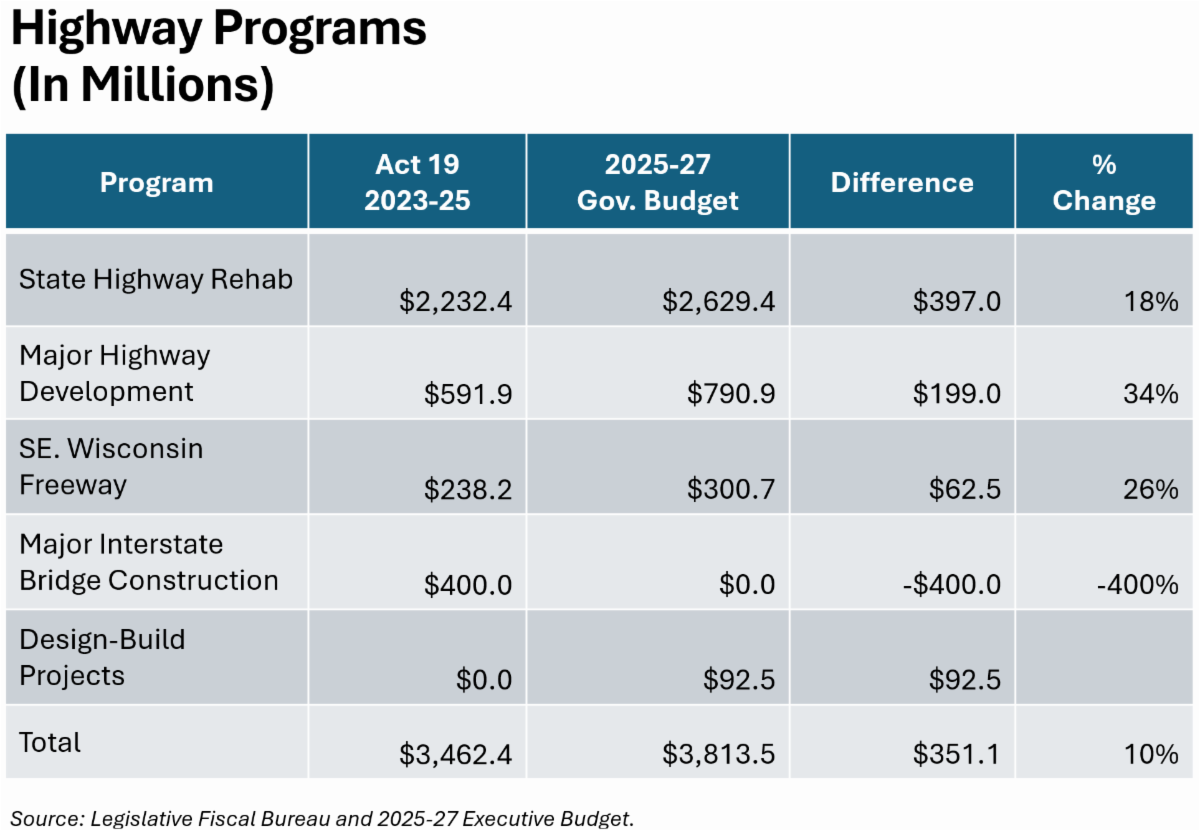
Highway Programs
- State Highway Rehabilitation Program increases by approximately $400 million over the prior biennium.
- Provide $19.5 million in State Highway Rehab in FY2026 to build additional sound barriers between 27th Street and 76th Street in Milwaukee along I-894.
- Enumerate the expansion, reconstruction, and modernization of the I-39/90/94 corridor from the Beltline in Madison through Wisconsin Dells.
- Major Highway Development Program funding increases by almost $200 million to fund the I-41 expansion project between Appleton and DePere, the USH-51 project in southern Dane County, and start work on the I-39-90-94 expansion.
-
Southeast Wisconsin Mega Project funding is up more than $60 million to keep the I-94 East-West project moving forward.
| |
Local Aids
- Fund the next round of the Local Road Improvement Program Supplement (LRIP-S) with $100 million GPR.
- Provide $6 million from LRIP-S for improvements to the I-39-90-94 and CTH-V interchange in Dane County.
- Use $500,000 from LRIP-S for residential road development in Vernon County.
- Increase the Local Road Improvement Program by 3% yearly, about $2.2 million over the biennium.
- Up General Transportation Aids by 3% annually, $43.1 million in the 2025-27 biennium.
- Provide $20 million SEG to fund increases for routine highway maintenance agreements.
- Provide $35 million SEG for Highway System Management and Operations to fund the purchase of salt, improve roadway markings, and implement a wrong-way driver mitigation program.
- Provide $50 million for the Agricultural Road Improvement Program (ARIP). First-year funding will be a one-time GPR, and second-year funding will come from a one-time transfer from the forestry account of the conservation fund.
- Create a new program with $60 million GPR over the biennium in funding for traffic calming grants to improve road safety and reduce reckless driving.
- Increase funding for county forest road aids by 3 percent in calendar years 2026 and 2027.
- Raise state support (GPR) of Mass Transit Aids by 4 percent in each calendar year, roughly $7.2 million over the biennium, and provide $20 million GPR to the newly created transit capital assistance program to help transit agencies replace aging vehicles.
- Provide $5 million in GPR funding to hold harmless transit agencies from the reclassification of tiers due to the most recent census.
- Increase funding for the Specialized Transportation Assistance Program by $5.3 million over the biennium and increase Paratransit Aids by 20% annually, $1.5 million over two years.
- Raise Employment Access and Mobility Program funding by $532,800 over the biennium.
Ports, Rail, and Aviation
- Provide $5 million over the biennium in transportation-support general obligation bonding for the Freight Rail Preservation Program.
- Provide more than $5 million SEG in FY2026 and more than $10 million SEG in FY2027 to support the operation of passenger rail service in Wisconsin and continue ongoing studies of passenger rail expansion routes across the state.
- Provide $33 million over the biennium, including $30 million in transportation fund-supported general obligation bonding, for dredging, seawall reconstruction, and other projects associated with the Harbor Assistance Program, including support for specific projects in Sheboygan and the Menominee Harbor.
- Provide $62,000 SEG annually for internships in the aviation industry for disadvantaged youths.
Policy Items
- Modify the Local Road Improvement Program and Agricultural Road Improvement Program to include the replacement of aging bridges and culverts documented from a study on local bridges and culverts funded in the 2023-25 biennium.
- Prioritize deteriorated roadway elements identified by the ongoing local bridge and culvert assessment in LRIP-S and ARIP, allocating up to 10 percent of each program's funding to prioritize these projects.
- Restore complete streets and eminent domain for paths.
- Reinstate a law that allows municipalities and counties to enter into agreements to create regional transit agencies anywhere in the state.
- Create new synergies by attaching the Office of the Commissioner of Railroads to the Wisconsin Department of Transportation and increasing staffing and funding to the Office to expand railroad crossing safety efforts.
Next, the Legislative Fiscal Bureau will analyze the governor’s budget proposal and issue a summary in about a month. In addition, the legislature will develop its plan for the 2025-27 budget.
Budget Documents:
Budget in Brief
2025-27 Executive Budget
| |
TDA Statement on the Governor's Budget | |
|
MADISON - Governor Tony Evers has put forward a two-year budget proposal recognizing Wisconsin’s current transportation funding streams are insufficient to meet well-documented system needs. Wisconsin’s transportation network is interconnected and essential to the state’s economy as reflected in the plan’s key investments across the system. Transportation Development Association Executive Director Debby Jackson issued the following comment in response:
"We applaud Governor Evers continuing to take steps to address challenges facing the state's transportation system, and we welcome the inclusion of the vital I-39/90/94 project in his budget proposal and other critical investments from local roads to public transit. Transportation investment has been an area where bipartisan agreement led to significant progress in recent budgets, and we are optimistic that will be the case again this year. We look forward to working with the administration and the legislature to build consensus around the investments necessary to keep Wisconsin moving forward.”
| |
New Executive Order Pauses Certain Funding Under IRA and IIJA | |
|
President Trump’s “Unleashing American Energy” order requires a 90-day review before funding disbursements resume
On his first day in office, President Trump signed an executive order titled Unleashing American Energy that directs federal agencies to pause disbursements of certain funds under the Inflation Reduction Act (IRA) of 2022 and the Infrastructure Investment and Jobs Act (IIJA) of 2021. According to Section 7 of the order, agencies must suspend Inflation Reduction Act grants, loans, and other financial mechanisms, including those supporting electric vehicle infrastructure, until they complete a 90-day review to ensure alignment with the administration’s energy policy.
| |
Misclassifying Workers as Independent Contractors is Costly for Workers and States | |
|
Summary: Workers misclassified as independent contractors lose out on critical protections, benefits, and labor rights including minimum wage, overtime pay, unemployment insurance, the right to form a union, and anti-discrimination protections in most states.
Executive summary
- Workers misclassified as independent contractors lose out on critical protections, benefits, and labor rights including minimum wage, overtime pay, unemployment insurance, the right to form a union, and anti-discrimination protections in most states. Additionally, these workers bear the full financial costs of Social Security and Medicare contributions.
- This analysis estimates the cost of independent contractor status for 11 commonly misclassified jobs. For example, a typical construction worker, as an independent contractor, would lose as much as $19,526 per year in income and job benefits compared with what they would have earned as an employee. A typical truck driver, as an independent contractor, would lose as much as $21,532 per year in income and job benefits compared with what they would have earned as an employee.
- Lost compensation due to misclassification also varies by state. Estimated annual per-worker costs in lost compensation are as high as $26,253 for truck drivers in New Jersey.
- Home health care aides, janitors, and landscapers are some of the occupations most affected by misclassification, as well as being relatively low-paying jobs. Misclassification further threatens the economic security of these workers leaving them vulnerable to exploitation and harmful labor practices.
| |
President Trump’s “Unleashing American Energy” order requires a 90-day review before funding disbursements resume | |
|
On his first day in office, President Trump signed an executive order titled Unleashing American Energy that directs federal agencies to pause disbursements of certain funds under the Inflation Reduction Act (IRA) of 2022 and the Infrastructure Investment and Jobs Act (IIJA) of 2021. According to Section 7 of the order, agencies must suspend Inflation Reduction Act grants, loans, and other financial mechanisms, including those supporting electric vehicle infrastructure, until they complete a 90-day review to ensure alignment with the administration’s energy policy.
While the executive order’s full implications are still developing, affected programs include, but are not limited to:
- National Electric Vehicle Infrastructure (NEVI) Formula Program
- Charging and Fueling Infrastructure Discretionary Grant Program
During the 90-day review period, each agency will assess the consistency of its processes with the new policy and submit recommendations to both the Director of the National Economic Council (NEC) and the Director of the Office of Management and Budget (OMB). Disbursements may resume only if deemed consistent with any adopted recommendations.
At this stage, it remains unclear whether the pause covers all prospective funding, such as direct pay provisions under the IRA, or if it applies solely to grants, loans and contracts administered at the federal level. Pausing funding already appropriated by Congress may prompt legal challenges, though the administration can impose interim review processes. Any resulting delays could affect organizations and projects depending on future allocations under these statutes.
| |
Construction Business Group | 608-240-4170 | www.cbgwi.com | | | | |