Protecting Buildings on Your Own Property

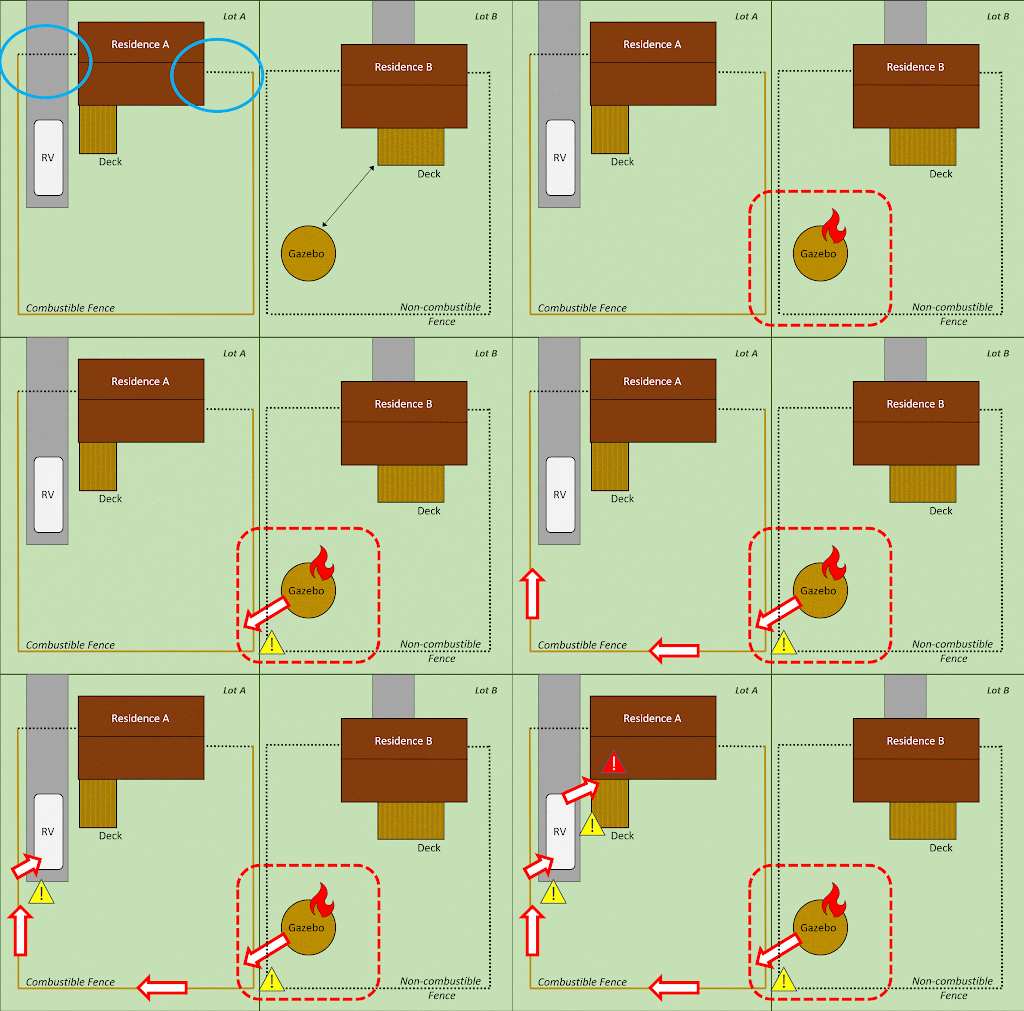
Animated GIF created by NIST.

One of the best ways to reduce the risk of ignition on your property is to remove combustibles and dead vegetation within the first 5 feet of your home, deck, and accessory structures. Taking care to protect structures on your property, either by building or retrofitting them to the standard of the Wildland Urban Interface (WUI) Building Code, now referred to as the CBC Title 24, Part 7, or by keeping them maintained and repaired, helps to reduce your loss and also helps to reduce your neighbors’ loss. If your home or accessory structures are close to your neighbor’s (less than 10 feet), it is even more important to discuss ways to reduce the risk of ignition for both properties and work towards a more resilient community for all.


Research by NIST’s (National Institute of Standards and Technology) Wildland-Urban Interface Fire Group, CAL FIRE and IBHS (Insurance Institute for Building and Home Safety) formed a Hazard Mitigation Methodology (HMM) to study how fire spreads and how to protect structures and properties from ember and flame exposures in wildfires. The HMM describes how fire spreads and what communities can do to create resilience structures in the WUI. 


Fire Spread Pathways, one section in the Methodology, is important to feature here, as it illustrates the dozens of pathways fire can spread through communities. This is important in assessing where your home and accessory structures, fences and vehicles are located and what you can do to reduce risk.


For example, you may have replaced your fence with a noncombustible one and located a wooden structure in your backyard to be over 10-feet away from your home, but if the wooden structure ignites and is near your neighbor’s wood fence, it could spread along the fence to your neighbor’s home and put their home at risk. Please see the article on Fire Pathways by the National Institute of Standards and Technology to learn more. 

Regional Priority Plan Status Update

Project solicitations to begin again in Spring

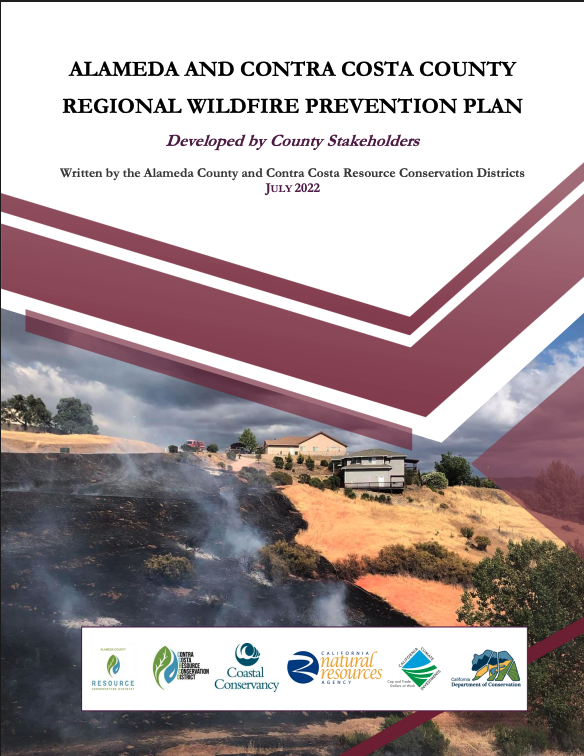
The DFSC continues its work on the Regional Priority Plan (RPP), which covers both Alameda and Contra Costa Counties and builds upon work completed in 2022 by the Resource Conservation District of Contra Costa County.

What is the Regional Priority Plan?

The RPP overlaps somewhat with existing Community Wildfire Protection Plans (CWPP) in that it addresses threats to people and property located in the wildland-urban interface. However, the RPP is more expansive in that it covers ecological assets in natural areas and prioritizes a list of projects for immediate implementation.  


The RPP is funded by the State Coastal Conservancy and aligns with new planning guidelines emerging throughout California. Although the framework only began in 2020, similar regional efforts are already underway. These are being led by various fire safe councils, resource conservation districts, and nonprofit conservation organizations, including the One Tam partnership.


Benefits

There are a few important benefits to completing an RPP: 

  1. Potential funding of a “portfolio” of projects, such as one grant that covers multiple projects. 
  2. Helps identify high priority projects for future grant applications and review by funders. 
  3. Helps our community set goals and encourages collaboration amongst stakeholders.

Status Update

The RPP will include mapping projects using a GIS platform. Board member Tom Gandesbery attended a workshop on October 16, 2025, hosted by the Coastal Conservancy and Department of Conservation. The event was a chance for other RPP grant recipients to come together and share information, challenges and lessons-learned as well as get an update on future funding. In December Tom obtained a GIS license to enable posting project data on our website. In addition to providing a grant to undertake the RPP, the Coastal Conservancy has offered the assistance of its on-call GIS consultants. Mapping proposed projects, critical infrastructure and wildfire risk is key to creating a useful plan.  


DFSC will continue outreach to stakeholders that was started in 2024. A sixth round of project solicitations will come this spring as well as updating our existing project list.  


Please reach out to DFSC board member Tom Gandesbery with any questions at tom@diablofiresafe.org 

Alameda County Board of Supervisors Approve Community Wildfire Protection Plan 2025 Update

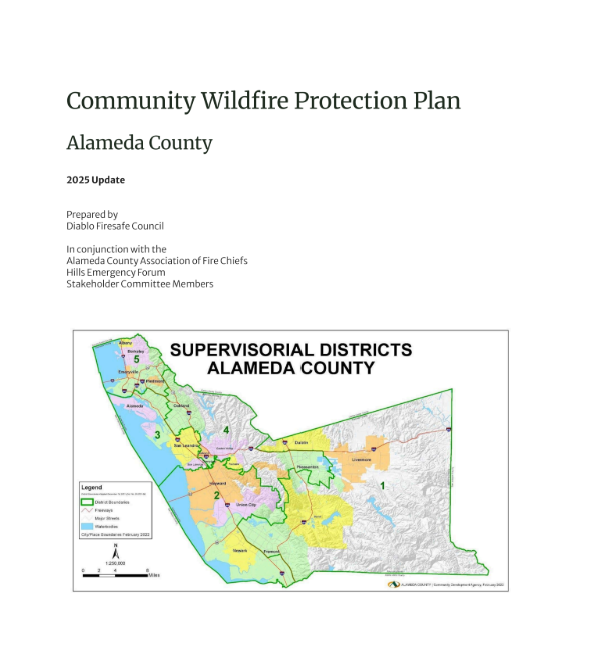
Alameda County Board of Supervisors approved by resolution in December 2025 the Alameda County Community Wildfire Protection Plan 2025 Update.


The Alameda County CWPP is the result of an area-wide planning effort. The first CWPP in 2012, began with a compilation of existing documents, analysis of fire behavior potential (based on fuels, topography and historical weather conditions) and collaboration with homeowners, representatives of special interest groups, and agency officials. 


In 2014 - 2015, the current CWPP was revised through a similar area-wide planning effort that reviewed the plan, updated relevant sections and refined priority actions. This new update occurred in 2024 - 2025 through a similar process that built upon and expanded the stakeholder group invited to give feedback on and update the last plan update. This CWPP update also integrated recommendations and suggested actions in the 2021 Alameda County Local Hazard Mitigation Plan and also referenced the 2025 CAL FIRE maps which were made public in February 2025. Every effort has been made to coordinate this plan update with all relevant plans and data that have been created since 2015.

DFSC 2024-2025 Annual Report Released

Check out our highlights of our work in 2024-2025 including


  • 28 Cost-Share Projects of matching funds of up to $5,000 
  • 14 Free Home Hardening educational presentations 
  • 2025 update to the Alameda County Community Wildfire Protection Plan (CWPP)
  • 4 Stakeholder meetings for the Alameda and Contra Costa County Regional Priority Plan update.
  • Launching our Fiscal Sponsorship program
  • and more…


Our Mission

Our Programs

Donate


PO Box 18616, Oakland, 94619 | joelle@diablofiresafe.org

 
LinkedIn Share This Email
 

Our Socials

Facebook  LinkedIn