September E-News

JOIN US IN NANAIMO!

October 23-25, 2026

Coast Bastion Hotel, Nanaimo, BC


Are you interested in serving on the BCHPA Executive?


Nominations are now open for the following positions: 


• President (2 year term)

• Second Vice-president (2 year term)

• Treasurer (no term limit)

• Canadian Honey Council Representative (2 year term)

• Director at Large (2 year term)


Role Descriptions - HERE


Contact the Nomination Chair - Barry Denluck

Barry@BarrysBees.ca


Research Updates

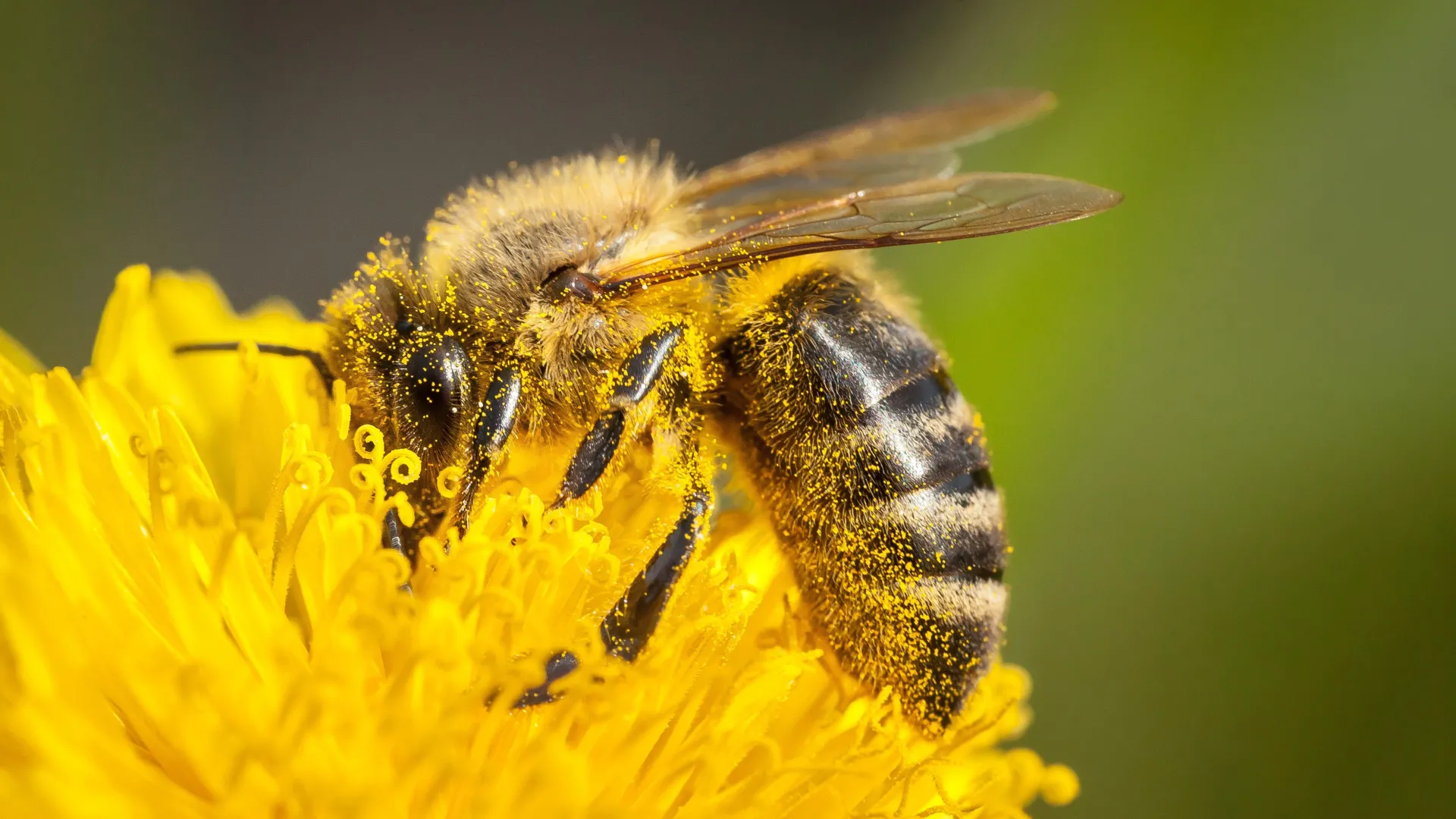
Pollen has a surprising problem - and honeybees have found a way around it

Honeybees can apparently detect when their food has the wrong balance of essential nutrients and adjust how much they eat to avoid potentially harmful excesses. They also transform pollen into remarkably well-balanced "baby food" for their larvae, revealing a sophisticated nutritional strategy hidden inside the hive.

Aston University study reveals how mānuka honey fights antibiotic resistance

New research at Aston University has shown that a variety of compounds is responsible for the antimicrobial action of mānuka honey, not just the sugar content and methylglyoxal (MGO) alone, as previously thought.

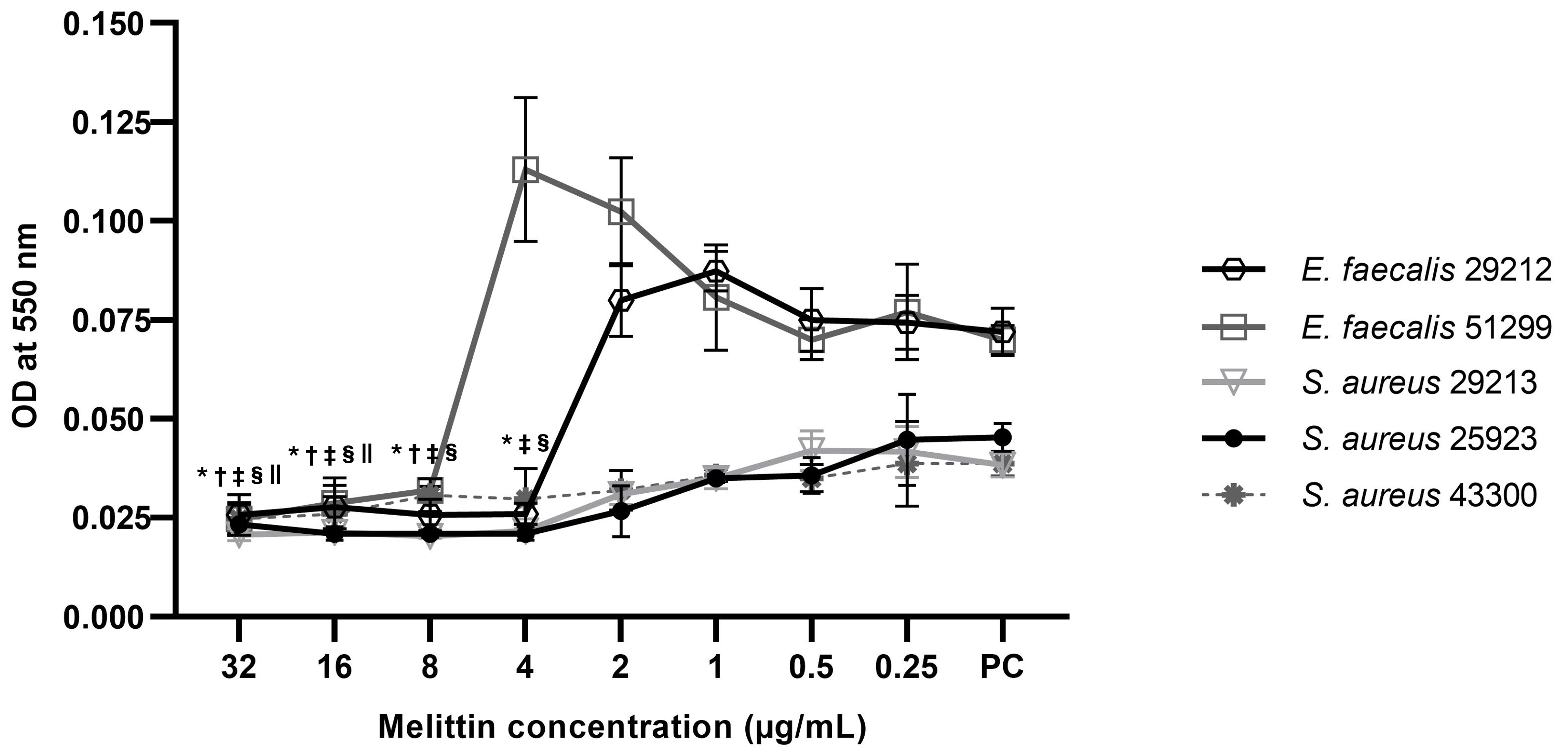
Melittin inhibits bacterial growth and reduces biofilm formation across multiple species

Introduction: Biofilms are surface-attached microbial communities encased in an extracellular matrix, creating gradients and metabolic heterogeneity that foster slow-growing, antibiotic-tolerant subpopulations. Predominant in natural and clinical

Bees in the News

Some Sask. industries hit hard by newest tariffs | CBC News

The latest round of U.S. tariffs will "essentially stop all honey heading into the U.S. from Canada," according to the president of the Saskatchewan Beekeepers Development Commission. Meanwhile, a distillery says the tariffs are opening consumers' eyes.

CHC Press Release: Statement on U.S. Tariffs & Canadian Honey Industry - manitobabee.org

See CHC press release by clicking below.

From the TTP

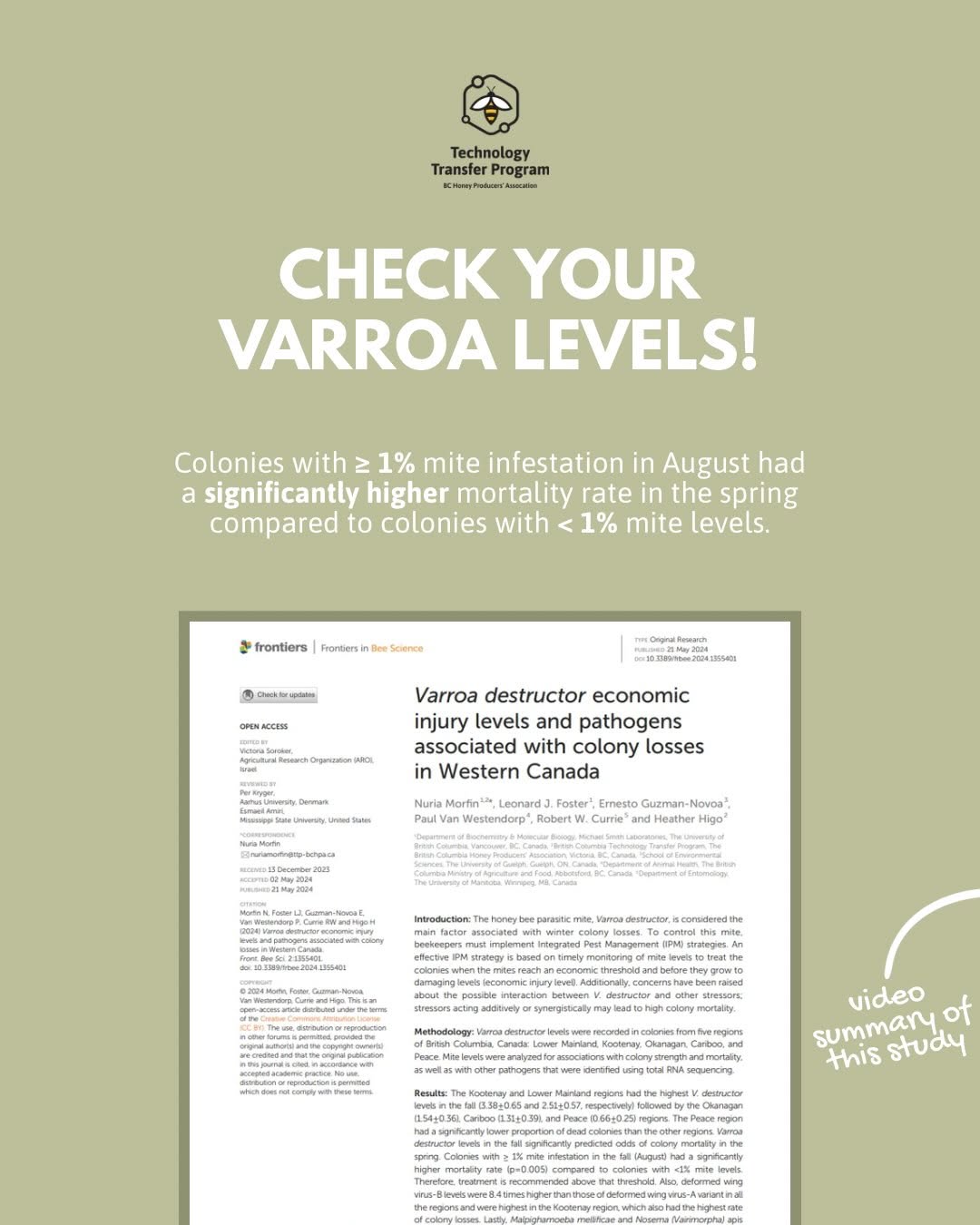
At this point in the year, the queen is now laying eggs that will become winter bees, so knowing the level of varroa mites in your colonies is crucial! A study that the BC-TTP led showed that colonies with ≥ 1% mite infestation in August had a significantly higher mortality rate in the spring compared to colonies with < 1% mite levels.

To read the full article or watch a video summary of the study, click the link in our bio or visit ttp-bchpa.ca/varroadestructoreil.

Reference:

Morfin, N., Foster, L. J., Guzman-Novoa, E., Van Westendorp, P., Currie, R. W., & Higo, H. (2024). Varroa destructor economic injury levels and pathogens associated with colony losses in Western Canada. Frontiers in Bee Science, 20(2). https://doi.org/10.3389/frbee.2024.1355401


Facebook  Instagram

Just for Fun