April 2021
In this issue:
- The Warped Magnetic Field of Centaurus A
- June 22-25: Magnetic Fields and the Structure of the Filamentary ISM
- SOFIA Archival Research Program Proposals Selected
- Featured Archival Data Set: Magnetic Fields in Nearby Galaxies
- Report on German Deployment
- How HAWC+ Keeps Its Cool
- JATIS Special Section on Origins Space Telescope
- Join Science Talks Remotely
|
|
The Warped Magnetic Field of Centaurus A
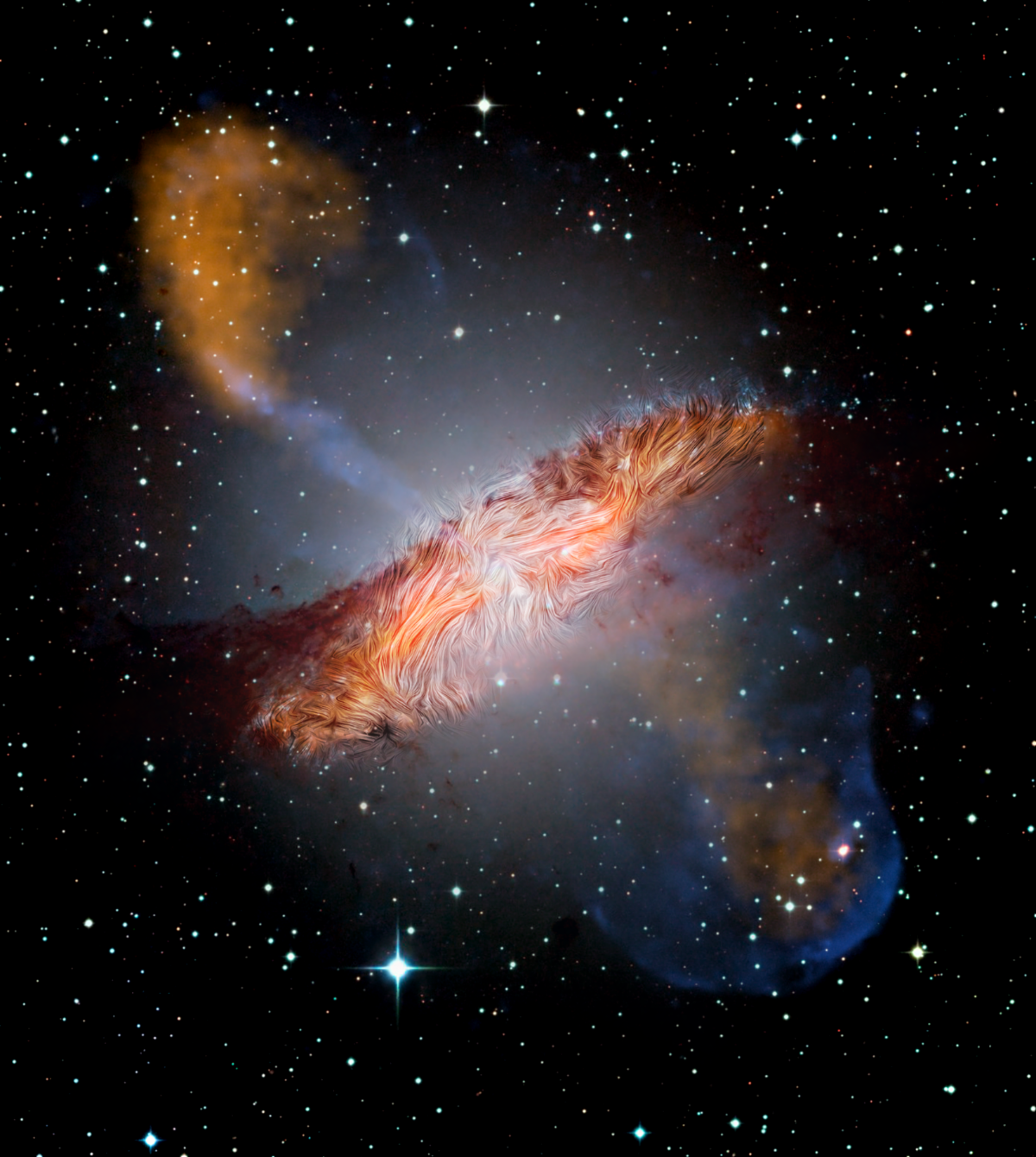
Centaurus A, the remnant of a merger between an elliptical and a spiral galaxy, is one of the best laboratories to study the effects of mergers on magnetic fields. As an analog of mergers in the early universe, Centaurus A can provide information on the evolution of galactic-scale magnetic fields, and in particular on the question of why high-redshift galaxies display unexpectedly strong magnetic fields.
The team led by Enrique Lopez Rodriguez (KIPAC/Stanford) and Ann Sui Mao (MPIfR) recently used SOFIA to observe the warped molecular disk of Centaurus A at 89 microns with HAWC+, with an angular resolution of 7.8” (~125 pc). These observations, part of the 'SOFIA heralds a new era of measuring the magnetic fields of galaxies' legacy program, show that the magnetic field orientation is tightly aligned with the disk. While a large-scale regular field would be expected, results show a significant dispersion of the magnetic field orientations.Thus, a mechanism, such as small-scale turbulence, must be producing the angular dispersion in the magnetic field orientations across the warped disk. Read more.
|
|
Composite image of Centaurus A. Magnetic fields from SOFIA are shown as streamlines over an image of the galaxy taken at visible and submillimeter wavelengths by the European Southern Observatory and Atacama Pathfinder Experiment, X-ray wavelengths from the Chandra X-Ray observatory and infrared from the Spitzer Space Telescope. (Optical: European Southern Observatory (ESO) Wide Field Imager; Submillimeter: Max Planck Institute for Radio Astronomy/ESO/Atacama Pathfinder Experiment (APEX)/A.Weiss et al.; X-ray and Infrared: NASA/Chandra/R. Kraft; JPL-Caltech/J. Keene; SOFIA)
|
|
Magnetic Fields and the Structure of the Filamentary Interstellar Medium
June 22-25, 2021
How do magnetic fields affect the evolution of the dense interstellar medium (ISM), and in particular star formation? Recent observations on many scales, both in photometry and polarization, indicate that the dense ISM is filamentary in nature, from sub-structures in giant molecular clouds to the mysterious snake-like infrared dark clouds stretching for tens to hundreds of parsecs along the Galactic plane. To what extent is this filamentary structure driven by magnetic forces and where in the transition from kilo-parsecs scales to molecular cloud scales does it arise?
This 4-day virtual workshop on June 22-25, 2021 (Mornings Pacific Time), part of the SOFIA Science series ( S3) and organized in partnership with the James Clerk Maxwell Telescope (EAO), will provide a forum to exchange insights and views on recent polarimetric observations, numerical simulations and advances in theoretical understanding, in an attempt to identify observable markers of the impact of magnetic fields. We are also dedicating a day to the question of turning polarimetric observations into magnetic field measurements.
We solicit contributions for short talks ( abstract submission deadline: June 4, 2021), and we welcome attendance from scientists at any career level, especially early career scientists. Registration is free but necessary to attend. |
|
SOFIA Archival Research Program Proposals Selected
The SOFIA Science Center is pleased to announce the selection of awarded SOFIA Archival Research Program (SARP) proposals. SARP funds archival research projects primarily using SOFIA data. The purpose of the program is to encourage the use of public SOFIA archival observations for impactful science. Eleven projects were awarded funding for a total of $1.8M, spanning a variety of scientific topics and sources (young stars, molecular clouds, H 2 regions, nearby dwarf galaxies). See the full list of the accepted proposals.
|
|
Legacy Program: Magnetic Fields in Nearby Galaxies
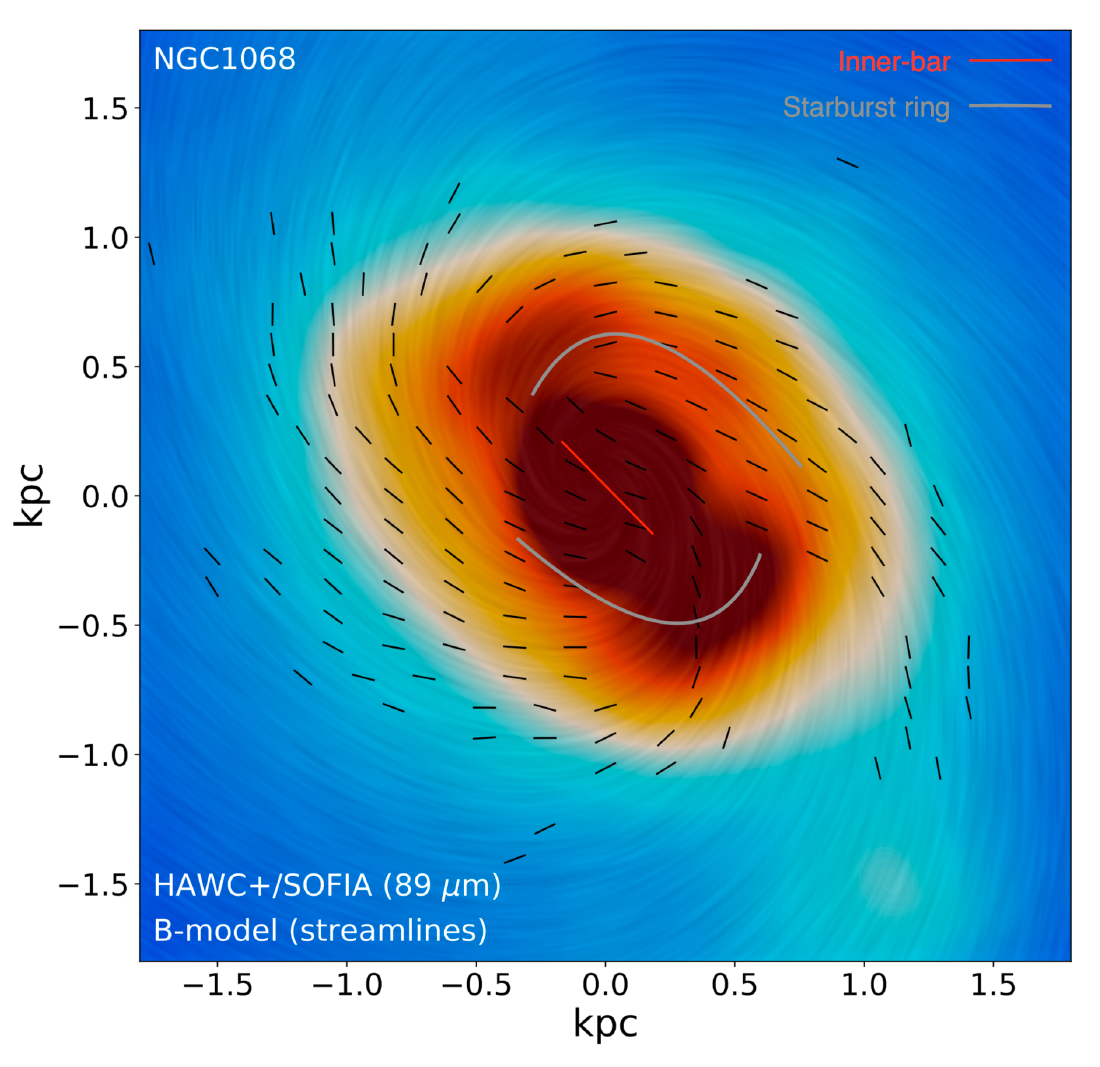
What is the role of magnetic fields in sculpting the ISM at kiloparsec scales? This question is the driver behind the Legacy Program ' SOFIA heralds a new era of measuring the magnetic fields of galaxies', led by Enrique Lopez Rodriguez (KIPAC/Stanford) and Ann Sui Mao (MPIfR). This survey consists of 50-220 microns polarimetric observations of a flux-limited sample of 17 nearby galaxies including starbursts, mergers, active galaxies, and spiral galaxies.
Far-IR emission probes the emission from magnetically aligned dust grains in high density cold regions, where star formation tends to occur. All targeted galaxies have rich archival data that will be used to quantify the effect of the multi-phase ISM and star formation regions in the B-field as traced by dust and synchrotron emission.
The HAWC+ data for targets M82, NGC 1097, NGC 2146, NGC 6946, Centaurus A, and Circinus are already public, and datasets are available from the IRSA archive, under program IDs 08_0012, 07_0032, and 07_0034. The legacy team will provide tools to analyze the data as the project develops; for now they have provided a script to generate polarization maps from the archival data. |
|
Total flux (color scale) with measured polarization vectors (black lines), rotated by 90◦ to show the inferred magnetic field. Approximated locations of the inner-bar and starburst rings are shown. Streamlines show the magnetic field model that best describes the observed kpc-scale spiral magnetic field.
|
|
German Deployment
SOFIA conducted its first ever series of science observations from Germany in February and March, 2021. After completing scheduled maintenance and telescope upgrades in Hamburg, Germany, SOFIA completed observations with the GREAT instrument from the Cologne Bonn Airport. The programs observed included the FEEDBACK and HyGal Legacy programs.
|
|
How HAWC+ Keeps Its Cool
HAWC+ is the only instrument on SOFIA with superconducting transition-edge sensor (TES) bolometric detectors, and must be operated in a cryogenic environment at sub-Kelvin temperatures to reach its nominal sensitivity. HAWC+ is stored at all times at liquid nitrogen temperature (77 K), and before the start of a series must be passively pre-cooled with liquid helium down to 4.2 K. A few hours before a flight, sub-Kelvin refrigeration must be achieved through a complete cooling cycle, which takes about 6 hours, using both a 4He sorption cooler and an Adiabatic Demagnetization Refrigerator (ADR). The ADR consists of a ferric ammonium alum salt pill suspended in a superconducting magnet producing a field of up to 2T. Once at observing altitude, the system can be cooled down to 170 mK for up to 10 hours.
Note that HAWC+ will be soon fully upgraded with four new detectors arrays, increasing both the instantaneous field of view and sensitivity, allowing one to map magnetic fields up to four times faster. This HAWC+ upgrade is expected to be completed by 2023, and is the first step in the proposed SOFIA Instrument Roadmap. |
|
JATIS Special Section on Origins Space Telescope
Nineteen papers on the Origins Space Telescope and related technology were published in an Origins Special Section of the Journal of Astronomical Telescopes, Instruments and Systems ( JATIS). Guest Editors George Helou (IPAC) and Antonios Seas (NASA Goddard) coordinated the Special Section, which presents the scientific vision and the baseline mission concept for this actively cooled mid- and far-IR space-based observatory project. All papers can be accessed here.
|
|
Join Science Talks Remotely: Colloquia, Tele-Talks & Workshops
Upcoming Colloquia
- May 5: Laura Perez (Universidad de Chile)
- May 19: Eric Switzer (NASA Goddard)
Tele-Talks are scientific presentations given via phone, with slides distributed ahead of time. The talks are held approximately twice a month on Wednesdays at 9:00 a.m. Pacific, noon Eastern. For information on how to participate, check the SOFIA Tele-Talk webpage.
Upcoming Tele-Talks
- May 5: Jordan Guerra (Villanova University); Magnetic Field Map of OMC-1
- May 12: Bhaswati Mookerjea (Tata Institute for Fundamental Research); The Rho Oph PDR
|
|
|
|
|
|
|