Email          LinkedIn          Web


Greg Allen

Director
Toxic-Free Healthcare

(formerly the IPM in Health Care Facilities Project)

A Healthier Approach to Pest Management with Toxic-Free Healthcare

(Formerly the IPM in Healthcare Facilities Project)

We’re excited to welcome Greg Allen, Ph.D., as the new Project Director for Toxic-Free Healthcare. Sean Lynch will continue as an advisor to the Project as well as to other MD Pesticide Education Network Projects and campaigns.


Greg’s impressive background as an environmental scientist, leadership educator, and organizational consultant with nearly 40 years of experience advancing environmental protection, organizational performance, and collaborative problem-solving will be a great benefit to the Toxic-Free Healthcare Project now entering its 20th year. Greg also brings extensive expertise in integrated management systems, environmental stewardship, stakeholder collaboration, evidence-based decision-making, and initiatives that advance science-based pesticide policy, integrated pest management, healthier ecosystems, and collaborative solutions that protect public health and the environment.


Greg joins us at an exciting time as we continue building on the momentum of our recent rebrand and expanding our work with healthcare decision-makers and facilities professionals.


Please join us in welcoming Greg to MPEN.


What Does “25(b)” Mean for Healthcare Facilities?


Healthcare facilities are increasingly looking for ways to replace unnecessary pesticide exposure while maintaining effective pest management. In product discussions, one term that often comes up is “25(b),” the minimum risk pesticide exemption under Section 25(b) of the Federal Insecticide, Fungicide, and Rodenticide Act, or FIFRA.


Under this exemption, certain pesticide products that meet specific federal requirements do not need to be registered with the U.S. Environmental Protection Agency. To qualify, products must use only eligible active and inert ingredients, list all ingredients on the label, meet specific labeling requirements, and satisfy other conditions established by EPA.


For facilities implementing Prioritized Integrated Pest Management, 25(b) products are considered among the available and useful tools when a least-toxic pesticide is needed. The overall program should be guided by prevention, monitoring, maintenance, sanitation, exclusion, and other nonchemical strategies. 


A healthier facility begins with the conditions that prevent pest problems. When treatment is necessary, understanding a product's regulatory status and ingredients helps facilities make more informed decisions.


Reach out to our team for pro bono assistance in identifying appropriate 25(b) options that are approved for use in your Maryland facility. 


Check your disinfectants for risk level

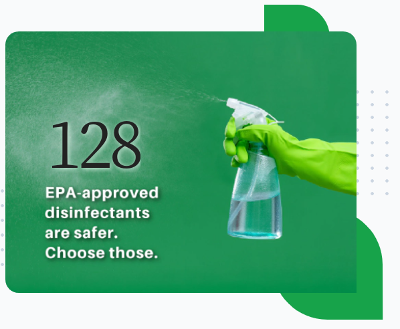
Some regularly used disinfectants in facilities are actually registered pesticides that can deplete a patient’s immune system and harm respiratory function. Use the SaferDisinfectants.org website to see if what your facility uses is an “increased risk” or “safer” product.


Go to the SaferDisinfectants.org website's The List page and search your products by name, using your browser search keys, "Command + F" on Macs and "Control + F" on PCs. Type in the name to see if it has an increased risk or is a safer choice. View the Safer Choice list and sort by use site and need for better product choices.


Find effective safer products to replace the increased-risk ones


Expert Note from the Field

From our EVS and Facility Operations Advisor with 35+ years of senior operations experience, including 16 years at Sheppard Pratt

Summer brings increased pest activity and more opportunities for pests to enter, feed, and reproduce around healthcare facilities. I have provided a few steps below to help your team address conditions that contribute to pest problems before treatment becomes necessary.


1. Keep food and waste managed.

Make sure discarded food, trash, and waste are promptly removed and that outdoor containers are positioned and maintained to reduce pest access.


2. Check doors and entry points.

Inspect door sweeps, screens, seals, and other barriers, especially at loading docks, kitchens, and frequently used entrances. Repair other gaps that allow pests to enter.


3. Monitor before treating.

Use routine inspections and pest monitoring to identify where activity is occurring and what may be causing it. A pest sighting should prompt investigation into the underlying conditions.


4. Maintain the grounds around your facility.

Keep vegetation from touching buildings, direct water away from foundations, and manage landscaping in ways that reduce shelter and access for pests.


Summer is a good time to review the conditions around your facility that may be contributing to pest activity. A prioritized IPM approach can help your team address problems earlier, reduce unnecessary pesticide use, and support a healthier care environment. Learn more here.


undefined

Joe Griffen


Project Consultant


Toxic-Free Healthcare


For information and help, contact us!


Greg@mdpestnet.org


Our services are always free.


www.ToxicFreeHealthcare.org